Fifty-five percent. That is the pass score SAP displays for the SAP PS certification, five points under the 60 percent most SAP associate exams ask for, and it is easy to read as a soft landing. It is not one. C_TS412, formally SAP Certified – SAP S/4HANA Project Systems, is a single System-Based Assessment activity lasting three hours, and the points come from tasks you complete inside a working system: building a work breakdown structure, planning and budgeting it, posting against it and settling it at period end. A task you only half finish earns little, so the lower bar buys margin, not shortcuts.
This article covers what the credential proves, how a System-Based Assessment scores you, the three topics SAP weights and the seven study areas underneath them, how a WBS element carries cost from plan to settlement, the difference between investment and logistics projects, which exam code is current, what the certification costs and how long it lasts, and a preparation order that follows SAP’s own learning journey.
What Does the SAP PS Certification Prove?
The SAP PS certification, exam code C_TS412, proves that you hold the core skills of the SAP S/4HANA Project System consultant profile and can apply them in a mentored role during the planning and implementation phases of a project. In practice that means structuring, planning, budgeting, executing and settling investment and logistics projects in SAP S/4HANA, on either Cloud, private edition or on-premise.
SAP states that the certification is relevant for SAP S/4HANA Cloud, private edition and SAP S/4HANA on-premise, so it does not cover the public cloud edition. The roles and skills SAP attaches to it are Consultant, Project Implementation, Project Scoping, and Project Planning and Execution. The learning journey behind it lists Consultant and Project Manager as its roles and recommends first experience of managing investment and logistics projects and of SAP S/4HANA before you start.
The facts SAP displays are short, and every one of them matters for planning. The C_TS412 certification page shows a pass score, a format, a duration, a language and three weighted exam topics. It shows no question count, because a single system task has none, and no fee in any currency.
| Exam detail | C_TS412 |
|---|---|
| Credential | SAP Certified – SAP S/4HANA Project Systems |
| Level | Associate |
| Product | SAP S/4HANA Project System, part of Enterprise Portfolio and Project Management |
| Format | System-Based Assessment, 1 activity |
| Passing score | 55 percent |
| Duration | 3 hours, as displayed by SAP; ERPPrep publishes no duration |
| Language | English |
| Deployments in scope | SAP S/4HANA Cloud, private edition and SAP S/4HANA on-premise |
| Learning journey | Implementing SAP S/4HANA EPPM Project System (PS), five courses |
| Keeping the badge | Complete the assessment once a year, per SAP’s badge criteria |
How Does a System-Based Assessment Score C_TS412?
A System-Based Assessment scores C_TS412 by placing you inside a configured SAP S/4HANA system and checking whether the configuration and transaction tasks you were given were completed correctly. There is no bank of items to recognise. SAP finished moving its certifications to performance-based formats in early 2026, and C_TS412 is the system-based kind: one activity, three hours, 55 percent to pass.
SAP runs two performance-based formats. A System-Based Assessment, or SyBA, is hands-on: you create, change and post things in a live-style system and the result is checked. A Scenario-Based Assessment, or SBA, gives you a business situation and scores the reasoning you show while working through it. C_TS412 belongs to the first group, which is why SAP’s page sends candidates to an introduction to system-based assessments and points to a practice system inside the learning journey.
The practical consequence is that reading speed and recall count for less than navigation speed and accuracy. A task that asks you to create a network activity for work bought from a vendor is not answered by knowing that an external activity exists. You have to pick the right activity category, make sure a purchase requisition is generated, and leave the internal work centers untouched. ERPPrep’s FAQ makes the same point about the cut score: partial familiarity rarely earns partial credit in a task-based format, so a lower threshold still demands complete steps.
Which Topics Does SAP Weight, and Where Do the Seven Study Areas Fit?
SAP displays three weighted exam topics for C_TS412: PS Configuration and Master Data at 31 to 40 percent, Project Planning at 31 to 40 percent, and Project Execution at 21 to 30 percent. ERPPrep’s study guide breaks the same scope into seven blueprint areas without weightings. Read the three as SAP’s scoring groups and the seven as the study list that fills them.
| SAP exam topic | Weight displayed by SAP |
|---|---|
| PS Configuration and Master Data | 31 to 40 percent |
| Project Planning | 31 to 40 percent |
| Project Execution | 21 to 30 percent |
The seven areas below are ERPPrep’s blueprint, quoted by name, with the SAP topic each one most naturally falls under. That mapping is a reading aid, not something SAP publishes, so use it to plan your time rather than to predict the exact task you will get.
| Blueprint area | What it asks you to handle | Closest SAP topic |
|---|---|---|
| Project Structures & Work Breakdown Structures (WBS) | Outlining and building WBS elements, networks and activities, documents, milestones and mass changes for investment and logistics projects | PS Configuration and Master Data |
| Project Planning: Dates, Costs, Resources & Materials | Scheduling dates, planning costs at every level, assigning resources and capacities, planning materials and forecasting revenue | Project Planning |
| Budgeting & Investment Project Management | Setting and controlling budgets and integrating Investment Management with the Project System | Project Planning |
| Project Execution & Logistics Processing | Posting to WBS elements and networks, confirmations through the Cross-Application Time Sheet (CATS), procurement, in-house production, external activities, claims and progress | Project Execution |
| Revenue, Billing & Project Financials Control | Revenue planning, sales pricing and sales order integration, milestone billing with down payments, resource-related billing including cross-company code cases | Project Execution |
| Period-End Closing, Results Analysis & Settlement | Settlement rules, overhead, results analysis, cost forecasts, progress analysis and settling projects to their receivers | Project Execution |
| Basic Configuration & Cross-LOB Integration | Customizing WBS and network settings, user fields, standard structures, simulation and project versions, workflows, and integration with Financials, Controlling, Procurement, Manufacturing and Sales | PS Configuration and Master Data |
Two things stand out once the tables sit side by side. Configuration and master data can carry as much weight as planning, so the customizing courses are not optional extras. And execution, though weighted lowest, holds the areas candidates find hardest: ERPPrep’s FAQ names network scheduling logic, settlement rules and results analysis, the difference between cost planning and budgeting, and resource-related billing as the topics that most often go wrong. ERPPrep builds its C_TS412 scenario simulations around those connected chains: 12 scenario simulations and 120 skill drills, grouped into eight drill domains that split the seven areas a little more finely.
How Does a WBS Element Carry Cost From Plan to Settlement?
A WBS element carries cost through five stages in SAP S/4HANA Project System: it is created as part of a project structure, its costs are planned, a budget is set against it, actual costs are posted to it during execution, and at period end results analysis and settlement move those costs to their final receivers. C_TS412 tasks sit at every stage, and an early mistake shows up late.
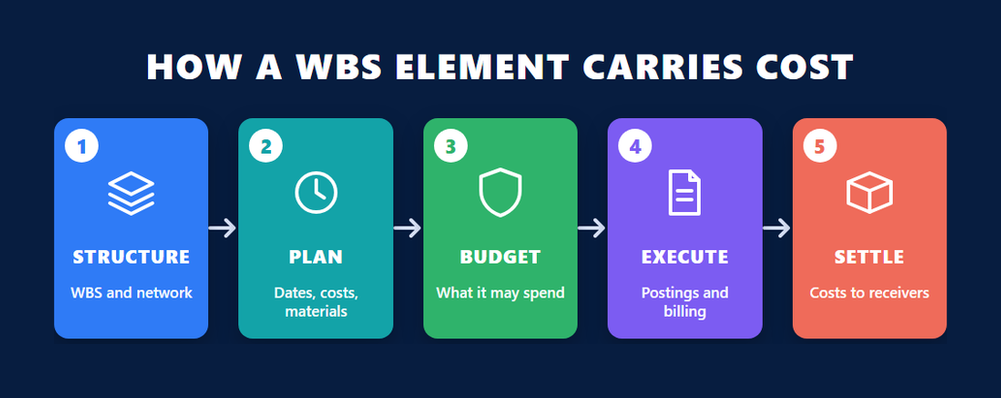
Structure: the WBS and the network
The work breakdown structure is the hierarchy of what the project must deliver and where cost is collected; the network holds the activities, their durations and the relationships that drive dates. SAP’s design follows the general idea of a WBS that the international standard ISO 21511 on WBS describes for any project organisation, but the system adds what a standard does not: account assignment, planning elements, billing elements and settlement rules on each element. Which flags you set at this point decides what can be planned, billed and settled later.
Planning: dates, costs, resources and materials
Planning quantifies the project before it starts. Dates come from network scheduling, where relationships and constraints between activities shape the calculated schedule. Costs can be planned at WBS level or derived from network activities, resources are assigned against capacity, and materials are planned so procurement can be triggered from the project. Revenue planning sits here too for customer projects.
Budgeting: the line planning does not draw
Cost planning says what the project is expected to cost; a budget says what it is allowed to spend, and availability control checks postings against it. ERPPrep’s study guide asks candidates to separate the two in their study for exactly this reason, because they use different functions and control a project differently. For investment projects the budget connects to Investment Management, which is where capital spending is approved and monitored.
Execution: postings, confirmations and billing
During execution, documents post to WBS elements and network activities: purchase orders, goods issues, confirmations recorded through CATS, and costs from production. Customer projects then bill, either by milestone with down payments or through resource-related billing based on what was actually consumed, including cross-company code cases that SAP’s learning journey treats separately.
Results analysis and settlement: where errors surface
At period end, results analysis evaluates work in process and the revenue that matches the progress made, and settlement moves the project’s costs to receivers such as a cost center, an asset under construction or profitability analysis. Revenue that follows progress on a contract is governed in financial reporting by IFRS 15 revenue standard, which is why the results analysis settings on a customer project are an accounting decision as well as a system one. A settlement rule missing or wrong on one WBS element is the classic late failure: everything posted correctly, and the period still will not close.
Investment Project or Logistics Project: Which One Is the Task About?
C_TS412 covers two kinds of project, and SAP’s learning journey teaches them in separate courses. An investment project builds something the company keeps, such as a plant or an IT platform, and its costs end up capitalised. A logistics project delivers something to a customer, so materials, sales orders, billing and revenue drive it. A task tells you which you are working on through its receivers and its billing.
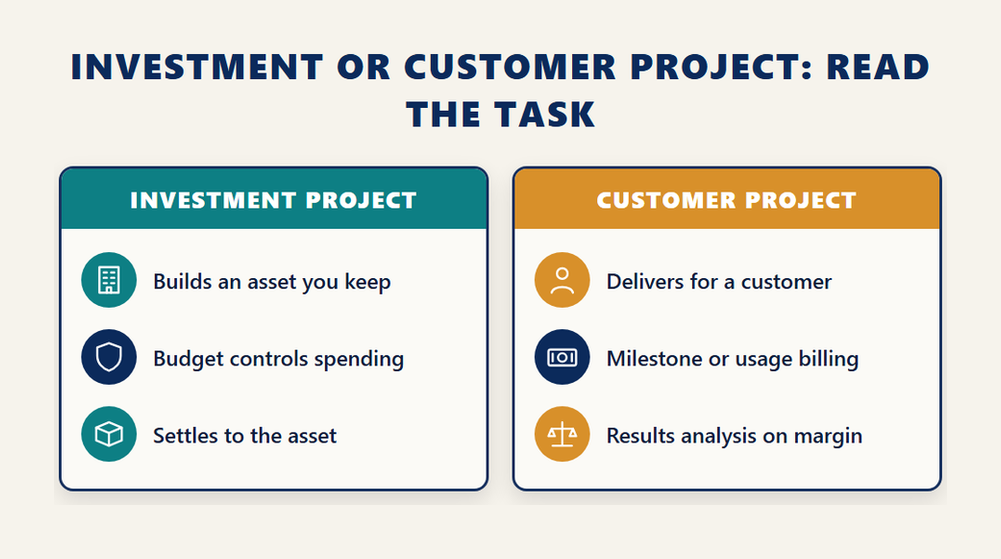
| Question | Investment project | Logistics (customer) project |
|---|---|---|
| What it delivers | An asset the company keeps | Goods or services for a customer |
| Where costs end up | Asset under construction, then the final asset | Results analysis and profitability analysis |
| Main control | Budget and Investment Management | Revenue, billing and margin |
| Typical billing | None to a customer | Milestone billing with down payments, or resource-related billing |
| SAP course | S49010 Exploring Investment Projects in SAP S/4HANA | S49020 Exploring logistics projects in SAP S/4HANA |
The distinction is not academic in a timed task. A settlement rule pointing at an asset under construction is right for an investment project and wrong for a customer project, and a billing element is irrelevant to the first and essential to the second. When a task describes a project, find the receiver and the billing method before you touch a structure, and most of the later decisions follow from them.
C_TS412, C_TS412_2021 or C_TS412_1909: Which Exam Code Applies Now?
The exam code that applies now is C_TS412 with no release suffix, which is how SAP’s certification page and ERPPrep both display it. C_TS412_2021 and C_TS412_1909 are earlier releases of the same Project Systems credential, and material written for them describes a timed paper with a question count, which the current System-Based Assessment does not use.
The search demand still sits on the old codes. On this blog the query for C_TS412_2021 questions and its variants draws more impressions than the plain exam code, and every one of those readers is expecting a list of items to memorise. The product they cover has not changed in kind, so the configuration knowledge transfers; the way you are assessed has. This blog covered the C_TS412_2021 release when it was still a paper, and its figures belong to that release, not to the exam you would book today.
Two further cautions apply. Credit for old knowledge only holds where the S/4HANA product still works the same way, so verify anything older than the current learning journey against it. And labels on third-party listings drift: confirm the credential name on SAP’s page, SAP Certified – SAP S/4HANA Project Systems, before you trust any study material that carries the C_TS412 code.
What Does the SAP PS Certification Cost, and How Long Does It Stay Valid?
SAP displays no fee in any currency on the C_TS412 certification page. Exam attempts come from a Learning Hub subscription that includes certification attempts, and each attempt counts as one from your subscription. Validity is not shown as a number of years either: SAP’s badge criteria say the badge is kept valid by completing the assessment once a year.
That makes the real cost of the SAP PS certification the subscription you already hold or buy, plus the preparation time, rather than a one-off exam fee. Before booking, SAP asks candidates to check three things on the exam page: that the system meets the technical readiness checklist, that the subscription includes certification attempts and shows how many remain, and that an SAP Universal ID with a secondary email is set up.
On validity, the SAP badge criteria state that the badge requires passing C_TS412 and stays valid when the assessment is completed once a year. Any fee or expiry period quoted elsewhere is that site’s own claim, not a figure SAP displays for this certification.
How Should You Prepare for C_TS412?
Prepare for C_TS412 by working through SAP’s five Project System courses in the order a project runs, practising each task in a system until it is routine, and finishing with full projects timed to three hours. ERPPrep’s FAQ puts the learning journey at roughly 74 hours across five courses and suggests two to three months alongside a job, longer without Project System experience.
- Start with S49010 Exploring Investment Projects in SAP S/4HANA to see one project end to end, from structure and cost planning through budgeting to period-end settlement.
- Move to S49020 Exploring logistics projects in SAP S/4HANA and follow a customer project through material and revenue planning, billing, results analysis and closing.
- Take S49100 Carrying out the Basic Configuration of SAP S/4HANA Project System and configure WBS, network, activity and milestone settings yourself, then use them in an operative project.
- Work through S49200 Project Logistics Control in SAP S/4HANA, practising scheduling, capacity leveling, external activities and material procurement from the network.
- Finish with S49300 Project Financials Control in SAP S/4HANA and rehearse budgets, actual postings, billing methods, results analysis and settlement until a period closes cleanly every time.
All five courses sit in SAP’s Project System learning journey, which is also where SAP places the practice system for this exam. Settlement and results analysis lean heavily on Controlling, so if cost elements and receivers still feel unfamiliar, the way overhead and costs flow in the management accounting exam is worth reading alongside the last course. Spend the final weeks on whole projects rather than single screens, and after each run note which early setting produced any figure you did not expect.
Frequently Asked Questions
What is the passing score for the SAP PS certification?
The passing score for C_TS412 is 55 percent, displayed by SAP and published by ERPPrep. It applies to the single System-Based Assessment activity as a whole, and it is five points lower than the 60 percent many SAP associate exams use.
How long is the C_TS412 exam?
SAP displays a duration of 3 hours on the certification page. ERPPrep does not publish a duration, so the SAP figure is the one to plan around.
How many questions are on the C_TS412 exam?
None in the traditional sense. C_TS412 is one System-Based Assessment activity in which you complete configuration and transaction tasks in a working system, and SAP publishes no question count for it.
Is C_TS412_2021 still the current SAP Project Systems exam?
No. SAP’s certification page and ERPPrep both show the code as C_TS412 with no release suffix. C_TS412_2021 and C_TS412_1909 are earlier releases of the same credential, written for a format the current exam no longer uses.
Which topics carry the most weight in C_TS412?
SAP displays PS Configuration and Master Data at 31 to 40 percent, Project Planning at 31 to 40 percent and Project Execution at 21 to 30 percent. ERPPrep’s study guide divides the same scope into seven unweighted blueprint areas.
How much does the SAP PS certification cost?
SAP displays no fee in currency for C_TS412. Attempts are taken from a Learning Hub subscription that includes certification attempts, and each attempt counts as one from that subscription.
Does the SAP PS certification cover SAP S/4HANA Cloud, public edition?
No. SAP states that the certification is relevant for SAP S/4HANA Cloud, private edition and SAP S/4HANA on-premise.
How long does the SAP PS certification stay valid?
SAP displays no validity period in years. Its badge criteria state that the badge is kept valid by completing the assessment once a year to stay certified.
Do I need hands-on system access to pass C_TS412?
It is strongly recommended. The System-Based Assessment checks whether tasks were completed correctly in a system, and SAP places a practice system inside the learning journey so candidates can rehearse before the exam.
Conclusion
The SAP PS certification is one system task, three hours, a 55 percent pass score and three weighted topics, and what it checks is whether a project you build in SAP S/4HANA can be planned, budgeted, posted and settled without breaking. Configuration and master data weigh as much as planning, and the hardest areas sit in execution and period end. Work the five SAP courses in project order, configure as well as post, keep investment and logistics projects distinct, ignore the item counts attached to C_TS412_2021, and rehearse full projects until a period closes cleanly. Then book C_TS412 through your Learning Hub subscription and plan to repeat the assessment yearly to keep the badge.


