Most of the pages that still rank for this exam carry a four digit suffix on the code, and every one of them describes a test that no longer runs. SAP’s own certification page lists it simply as C_S4TM, the SAP Certified – SAP S/4HANA Cloud Private Edition, Transportation Management credential from SAP, delivered as one Scenario-Based Assessment activity with a 60 percent pass score and a 2 hour duration that only SAP displays. The older pages describe an item-based test that no longer exists for this credential. What you sit now is a single transportation scenario in which a lane you define early decides whether the optimizer can build a route, whether a freight order can be tendered, and what the carrier invoice will finally match against.
This guide to the SAP transportation management certification follows that chain from network to settlement. It gives the exam facts from the money-site study guide, verified against SAP’s page, names the seven blueprint areas exactly as published, shows where the harder decisions sit, and lays out the four course learning path in the order the courses build on each other. If you plan freight, tender loads or settle carrier charges for a living, this is the credential that proves you can do the same inside SAP S/4HANA.
Table of Contents
- What does the SAP transportation management certification test?
- Which seven blueprint areas does C_S4TM cover?
- How does one lane travel from the network to the carrier invoice?
- Where do candidates lose marks in the C_S4TM scenario?
- Which S/4HANA edition and which code does the exam carry?
- How should you prepare for the C_S4TM Scenario-Based Assessment?
- Frequently Asked Questions
- Conclusion
What does the SAP transportation management certification test?
C_S4TM tests whether you can apply the core Transportation Management processes of SAP S/4HANA at associate level, as a consultant working under experienced guidance. It is one Scenario-Based Assessment activity with a 60 percent pass score, and SAP displays a 2 hour duration for it. The scope runs from transportation master data and networks through planning, freight execution and charge settlement, on SAP S/4HANA Cloud Private Edition and on-premise alike.
| Field | Value |
|---|---|
| Exam code | C_S4TM |
| Credential | SAP Certified – SAP S/4HANA Cloud Private Edition, Transportation Management |
| Level | Associate, an entry-level qualification for a mentored project role |
| Format | Scenario-Based Assessment (SBA), 1 activity |
| Duration | 2 hours, as displayed by SAP; the money-site pages publish none |
| Passing score | 60 percent |
| Languages | Vary by response format: roleplay with AI guidance in English, Spanish, Italian, French, Japanese and more; recorded video in English only |
| Product | SAP S/4HANA Cloud Private Edition, with content that also applies to SAP S/4HANA on-premise |
| Blueprint areas | 7, with no published weightings |
| Exam fee | Not published on the exam card; access comes through an SAP Learning Hub subscription that includes certification attempts |
One activity, not a list of items
A Scenario-Based Assessment gives you a realistic transportation situation and asks you to make the decisions it calls for, in order. There is no bank of standalone items to work through. That is why the 60 percent cut score behaves differently here than on an item-based exam: you cannot bank easy marks early and guess the rest. Each decision rests on the ones before it, so a wrong network or master data choice costs you again when planning and settlement fail to behave.
SAP publishes the duration, the cut score and the assessment type on the C_S4TM certification page, together with the roles and skills it maps the credential to: consultant, transportation management, transportation planning, freight handling and system configuration. Those four skill labels are a fair summary of what the single activity will ask you to demonstrate.
Two ways to respond, and the languages differ
SAP states that available languages vary by format. If you respond through roleplay with AI guidance, the exam is available in English, Spanish, Italian, French, Japanese and a longer list beyond those. If you record a video response, English is the only option. The money-site study guide lists languages as not published, which was true of the plain language field, so the format banner on SAP’s page is the detail to plan around. Decide which response format suits you before you book, because the language choice follows from it.
Which seven blueprint areas does C_S4TM cover?
C_S4TM covers seven blueprint areas: Transportation Management Foundations and Master Data; Transportation Networks; Transportation Requirements and Freight Units; Transportation Planning; Subcontracting, Load Planning and Execution; Freight Charges and Settlement; and Strategic Freight Procurement and Cross-Functional Configuration. No weightings are published for any of them, so plan by objective rather than by percentage.
| Blueprint area | What it asks you to handle |
|---|---|
| Transportation Management Foundations & Master Data | Reaching TM features through Fiori apps, then maintaining the organizational structures, materials and business partners that downstream documents default from |
| Transportation Networks | Locations, transportation zones and lanes, default routes and schedules, plus the capacities, conditions and incompatibilities that shape how freight can move |
| Transportation Requirements & Freight Units | Transportation relevance for orders and deliveries, freight unit creation, packaging and handling units, and the change controller |
| Transportation Planning | Planning documents, selection and planning profiles, the transportation cockpit, interactive planning, and automatic planning with the VSR optimizer and hub scenarios |
| Subcontracting, Load Planning & Execution | Carrier selection, tendering and load optimization, then freight orders, deliveries, Extended Warehouse Management integration, output management, track-and-trace and discrepancies |
| Freight Charges & Settlement | Scales, rate tables, calculation sheets and freight agreements, charge calculation on freight documents, settlement documents, mapping to Materials Management, carrier invoice verification and cost distribution |
| Strategic Freight Procurement & Cross-Functional Configuration | Agreement RFQs, quotations and award, the embedded logistics service provider process, and the RISE with SAP methodology context around an implementation |
The seven areas are listed in process order, and that order is the study plan. The first two give the system a world to move freight in. The third turns orders and deliveries into freight units the planner can see. The fourth and fifth decide how those units become freight orders and who carries them. The sixth prices the result, and the seventh sits above the whole flow with procurement and methodology.
The C_S4TM study guide on ERPPrep publishes these area names, the four course path and the format facts on one page, and it is the source the table above was taken from. Read it alongside SAP’s certification page rather than instead of it, because the two publish different things: the money site carries the blueprint, SAP carries the duration and the language banner.
One wrinkle worth knowing before you count areas. The study guide and the sample page list seven blueprint areas, while the product page on the same site describes its skill drills as spanning eight skill domains. The seven published names are the blueprint. Treat the eighth as a practice grouping, not an extra exam topic.
How does one lane travel from the network to the carrier invoice?
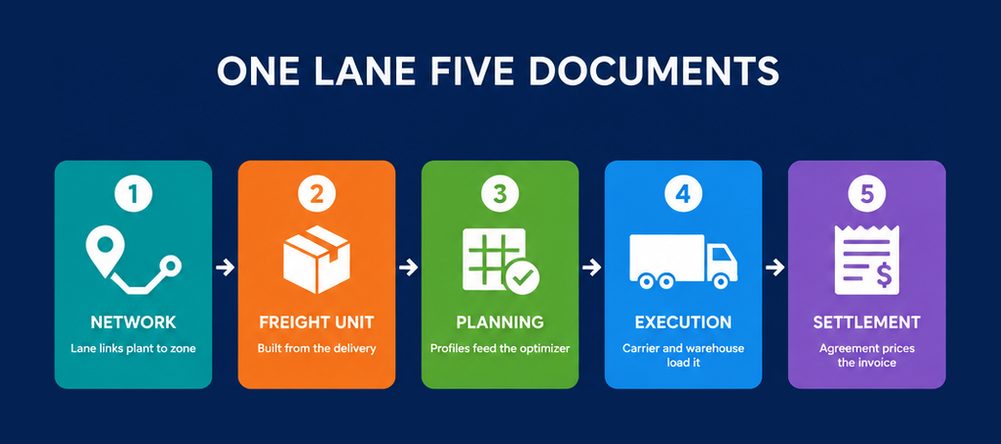
In SAP S/4HANA Transportation Management, a transportation lane in the network decides whether planning can connect a source and a destination at all. If the lane exists, freight units can be planned onto a freight order, the order can be tendered to a carrier, charges can be calculated from the agreement on that lane, and a settlement document can pass to Materials Management for invoice verification.
The chain in order
- Network: a location sits inside a transportation zone, and a lane links the dispatching plant to that zone. Capacities, conditions and incompatibilities on the lane restrict what can move across it.
- Freight units: transportation relevance on the order or delivery lets the system create freight units, and the freight unit building rule decides how deliveries group into them.
- Planning: selection and planning profiles tell the transportation cockpit which freight units to consider and what the VSR optimizer is allowed to do with them; the output is a freight order or booking.
- Execution: carrier selection and tendering assign the order, Extended Warehouse Management picks and loads it, output management sends the documents, and track-and-trace records events and discrepancies.
- Settlement: the freight agreement, calculation sheet and rate table price the freight order, a settlement document transfers the charge to Materials Management, and the carrier’s invoice is verified against it before cost is distributed to the originating delivery items.
The sample scenarios on the money site are built around exactly this dependency. In one, a new customer site is correctly modelled as a location inside its zone, stock is available, the deliveries are correct, and automatic planning still produces no freight order. The gap is the missing lane from the plant to the new zone, not a freight unit rule, a carrier record or a calculation sheet. Candidates who can rule out the three plausible wrong answers are the ones who have traced the chain in a system.
“By connecting freight procurement, planning, execution, and settlement on a single platform, SAP helps organizations respond more effectively to disruptions, align transportation decisions with broader supply chain objectives, and support compliance with regional and industry-specific requirements.”
That sentence from SAP’s own announcement of its placement in the 2026 Gartner Magic Quadrant for transportation management systems, where SAP reports a twelfth consecutive year as a Leader, is also a one line map of the exam. Procurement, planning, execution and settlement are four of the seven blueprint areas, and the scenario expects you to keep them connected.
Where do candidates lose marks in the C_S4TM scenario?
Candidates preparing for C_S4TM most often struggle with three chains: automatic planning through the VSR optimizer, carrier selection with subcontracting, and freight charge calculation with settlement. Each is hard for the same reason. A profile, a condition or a rate table set several steps earlier quietly changes which freight document or charge the system produces later, so a misread upstream shows up as a wrong answer downstream.
Automatic planning returns nothing, or the wrong thing
The optimizer only sees what the selection profile hands it and only does what the planning profile allows. A time window on the selection side, an incompatibility on the lane, or a missing default route each produce the same symptom in the cockpit: freight units that stay unplanned. Interactive planning will often let you force the assignment by hand. The scenario is checking whether you know why the automatic run refused, because in a live project that is the difference between a fix and a workaround.
Subcontracting decides more than the carrier
Carrier selection, tendering and load optimization are presented as one area because they are one decision with three outputs. The carrier that wins the tender is the business partner whose freight agreement prices the order, so an award made for capacity reasons changes the charge calculation in area six. Strategic freight procurement in area seven feeds the same agreements from the other end, through RFQs, quotations and awards. Study the two areas together, as the money-site study guide recommends, and the connection between an award and a later charge stops being a surprise.
Charges fail quietly
Freight charges depend on four master data objects stacked in order: scales define the dimensions, rate tables hold the values, calculation sheets assemble the lines, and freight agreements attach the sheet to a carrier and a validity. A missing scale level or an agreement that does not cover the lane does not throw an obvious error; it produces a charge that is zero or wrong. From there the settlement document carries the wrong amount into Materials Management, invoice verification mismatches, and cost distribution to the delivery items inherits the error. Work this block as its own study unit and follow one charge from freight order to invoice before exam day.
Which S/4HANA edition and which code does the exam carry?
C_S4TM is written for SAP S/4HANA Cloud Private Edition, and SAP states the content is also relevant to SAP S/4HANA on-premise. The code on SAP’s certification page is C_S4TM with no suffix, and the credential title names the Private Edition explicitly. Older guides that reference a suffixed code describe an earlier delivery of the same subject, not the current single activity assessment.
The edition question matters less than it looks for the transportation content itself, because the networks, planning and settlement objects behave the same way in both deployments. Where it matters is the seventh blueprint area. Cross-functional configuration includes the RISE with SAP methodology context, which is the implementation framework for Private Edition adoptions, and the SL_RISE419 course sits in the learning path for that reason. A transportation specialist who has never looked at a methodology dashboard or a clean core principle has an area to cover that has nothing to do with freight.
Embedded transportation management is the other reason the edition wording is precise. Transportation Management runs inside SAP S/4HANA rather than as a separate system, which is why the exam can ask about delivery integration, Extended Warehouse Management and Materials Management as parts of one flow. The transportation management system category that analysts and reference works describe is broader than SAP’s product, and reading that definition first helps you see which TMS functions the blueprint covers and which it leaves to warehousing or procurement.
That embedded design is also why execution is where transportation stops being a planning exercise. A freight order that Extended Warehouse Management cannot stage, load or confirm is a plan without a shipment, and the fifth blueprint area asks for that integration explicitly. If you already hold or are preparing for the warehouse credential, the SAP EWM certification guide on this site covers the same handoff from the warehouse side, which is the half most transportation consultants see least of.
One prerequisite is easy to miss. The learning journey page lists Getting Started with Support from SAP, the support accreditation, as a prerequisite to the journey. It is a short orientation rather than an exam, but it is listed, so complete it before you assume the four courses are the whole path.
How should you prepare for the C_S4TM Scenario-Based Assessment?
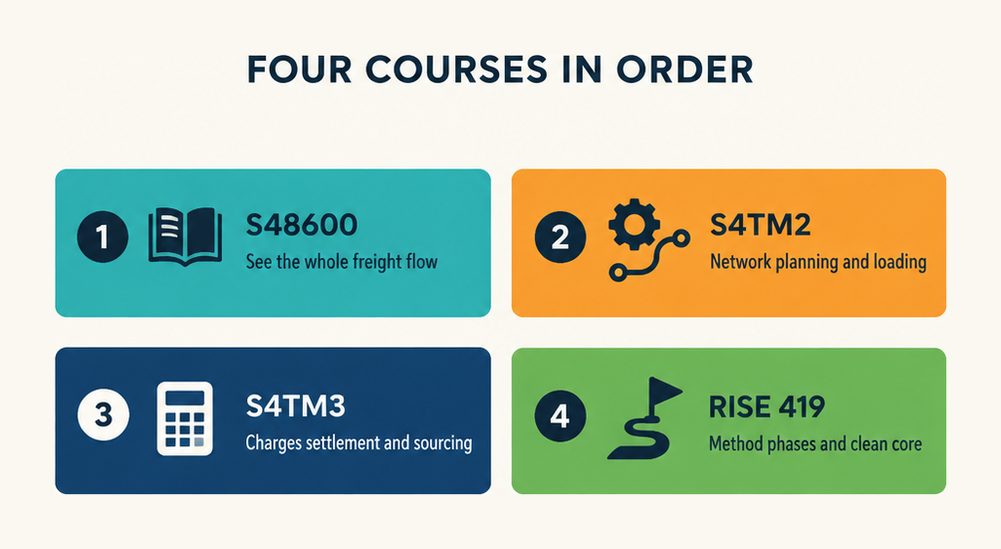
Prepare for C_S4TM by taking the four courses of SAP’s Implementing Transportation Management in SAP S/4HANA Cloud learning journey in order, S48600, S4TM2, S4TM3 and SL_RISE419, then rehearsing full transportation scenarios from network to settlement in a system or a scenario simulation. The money site suggests two to three months alongside a job, with the journey itself estimated at roughly 35 hours of course time.
The four courses in the order they build
- Take S48600, Exploring Business Processes in SAP S/4HANA, Transportation Management, first to see the whole flow from master data and networks through planning, execution and charges before configuring any of it.
- Move to S4TM2, Applying Planning and Execution in SAP S/4HANA Transportation Management, which configures the network, freight units and packaging, then interactive and automatic planning, subcontracting, load planning and execution including warehouse integration.
- Follow with S4TM3, Exploring Charges and Settlement in SAP S/4HANA Transportation Management, for charge master data, freight settlement into Materials Management, carrier invoice verification, cost distribution and strategic freight procurement.
- Finish with SL_RISE419, Introducing RISE with SAP Methodology for SAP Partners and Customers, which supplies the methodology phases, toolchain and clean core context that the seventh blueprint area expects.
- Rehearse complete scenarios under a timer until the handoffs between network, planning, warehouse and settlement feel routine, and review why each step produced its result rather than only whether it was right.
The journey is hosted on SAP Learning, and the SAP TM learning journey page also lists the products it covers and the support accreditation prerequisite. SAP’s certification page adds three steps before exam day: run the technical readiness checklist for your hardware and connection, confirm your SAP Learning Hub subscription includes certification attempts and that your SAP Universal ID has a secondary email, and try the AI-powered scenario-based assessment tool so the response format is familiar.
What to rehearse, and what to skip
Rehearse the three chains from the previous section most. Build a lane, remove it, and watch planning fail. Tender a freight order to two carriers with different agreements and compare the charge. Price a freight order with a scale level missing and see what settlement carries forward. Those three exercises cover the areas the money site flags as hardest, and each one teaches cause and effect that reading cannot.
Skip anything built around memorising screens or field names. The single activity scores decisions and their consequences, so a list of transaction codes earns nothing on its own. If this is your second look at the subject, the earlier C_S4TM preparation guide on this site describes the previous delivery of the credential, which is useful for the topic list and misleading for the format; read it for the former only.
Frequently Asked Questions
What is the passing score for the C_S4TM exam?
The passing score for C_S4TM is 60 percent. Both the money-site study guide and SAP’s certification page publish the same figure. Because the exam is a single Scenario-Based Assessment activity, the score reflects decisions made across one connected transportation scenario rather than a count of correct items.
How long is the SAP transportation management certification exam?
SAP displays a duration of 2 hours on the C_S4TM certification page. The money-site study guide, FAQ and product pages publish no duration at all, so the 2 hour figure comes from SAP alone. Plan your scenario rehearsals around that window rather than around an item count, because there is none.
How many questions are on the C_S4TM exam?
C_S4TM has no published question count because it is not an item-based exam. SAP delivers it as one Scenario-Based Assessment activity in which you work through a realistic transportation situation and make the process decisions it requires. Preparation should be measured in scenarios rehearsed, not items answered.
Which languages is the C_S4TM exam available in?
SAP states that languages vary by response format. Roleplay with AI guidance is offered in English, Spanish, Italian, French and Japanese, with 25 more listed. Recording a video response is available in English only. The money-site page lists languages as not published, so use SAP’s format banner when you book.
Is C_S4TM an entry-level certification?
Yes. SAP describes C_S4TM as an entry-level qualification that lets consultants implement Transportation Management skills in projects under the guidance of an experienced consultant. The money-site study guide aims it at logistics and supply chain consultants, and at business users moving into a transportation role, who want an associate credential.
Does C_S4TM cover SAP S/4HANA on-premise as well as Private Edition?
Yes. The credential is named for SAP S/4HANA Cloud Private Edition, and SAP states that it is relevant to SAP S/4HANA on-premise too. The transportation networks, planning and settlement objects behave the same in both deployments; the RISE with SAP methodology content in the seventh blueprint area is the Private Edition specific part.
Which courses prepare for the C_S4TM exam?
Four courses in SAP’s Implementing Transportation Management in SAP S/4HANA Cloud learning journey: S48600 for the end to end business processes, S4TM2 for planning and execution configuration, S4TM3 for charges, settlement and strategic freight procurement, and SL_RISE419 for the RISE with SAP methodology context. The money site recommends taking them in that order.
Which C_S4TM topics are the hardest?
The money-site FAQ names automatic planning with the optimizer, carrier selection and subcontracting, and freight charge calculation and settlement as the areas candidates struggle with most. All three are chains in which a setting made earlier changes the freight document or charge produced later, so they reward practice in a system over reading.
Does the C_S4TM certification publish domain weightings?
No. The study guide lists seven blueprint areas with no percentage attached to any of them, and SAP’s certification page publishes none either. Plan coverage by objective across all seven areas, giving extra time to planning, subcontracting and settlement, rather than trying to weight your study by a share that does not exist.
How much does the C_S4TM exam cost?
Neither the money-site pages nor SAP’s certification card publishes a separate fee for C_S4TM. SAP’s page states that exam attempts come through an SAP Learning Hub subscription that includes certification attempts, with subscription attempts and exam attempts shown separately on the exam page. Check your subscription before booking.
Conclusion
The SAP transportation management certification is one scenario, 2 hours by SAP’s display, and a 60 percent pass score, across seven blueprint areas that run in process order from master data to settlement. The decisive skill is tracing a dependency: a lane that is missing, a selection profile that is too narrow, an agreement that does not cover the carrier, each surfaces several steps later as a freight order that will not plan or a charge that will not match.
Take the four courses in order, add the support accreditation the journey lists, choose your response format with its language list in mind, and rehearse whole chains rather than screens. When you can explain why planning returned nothing and fix it in one move, you are ready. Start with the blueprint on the money-site study guide, confirm the duration and languages with SAP, and rehearse the three chains that cost the most marks.


