A chief sustainability officer sits across the table with three problems at once: a decarbonization target the board keeps asking about, a circular economy goal that nobody owns, and a reporting deadline that depends on data scattered across finance and supply chain. The seller who walks in with a product demo loses that meeting. The seller who starts with those three problems and ends with a customer who solved them wins it.
That conversation is what C_BCSSS measures. Its full title is SAP Certified – Positioning SAP Sustainability Solutions as part of SAP Business Suite, and it is the SAP sustainability certification written for presales and sales people rather than consultants. SAP runs it as one Scenario-Based Assessment activity of 2 hours with a 60 percent pass score. This article follows the value case the exam rewards, from the persona to the proof point, and closes with a study plan built on SAP’s learning journey.
Is C_BCSSS an ESG Expert Exam or a Presales Credential?
C_BCSSS is a presales credential. It does not test whether you can calculate a carbon footprint or file an ESG report. It tests whether you can discover a customer’s sustainability challenge, explain the SAP Sustainability portfolio in business terms and position it credibly inside SAP Business Suite. SAP names Presales and Sales as the roles it serves.
The difference matters for how you study. A sustainability analyst knows the reporting standards in depth; a C_BCSSS candidate knows enough about them to recognise the pressure they put on a company, then connects that pressure to the right SAP offering and to a value the customer will pay for.
SAP’s own description is short: the certification is designed for you to discover and position SAP Sustainability solutions. The skills SAP lists beside it are Competitive Positioning, Circular Economy and Carbon Footprint Reduction, which tells you the exam expects business fluency in those topics, not technical setup.
Who else the learning journey names
The learning journey behind the exam lists Sales, Presales, Marketing and CEE as its audiences, with SAP Sustainability Control Tower as the product. If you build customer-facing messages on sustainability, the material fits your job even if you never book the exam.
How Does SAP Run the C_BCSSS Assessment?
SAP runs C_BCSSS as a single Scenario-Based Assessment activity lasting 2 hours, with a 60 percent pass score. Instead of a long list of separate items, you read one realistic customer situation and reason toward a credible, value-led recommendation. The level is associate, and the language you can use depends on how you take the scenario.
| Exam detail | C_BCSSS |
|---|---|
| Full title | SAP Certified – Positioning SAP Sustainability Solutions as part of SAP Business Suite |
| Level | Associate |
| Format | Scenario-Based Assessment, 1 activity |
| Duration | 2 hours |
| Pass score | 60% |
| Languages | Roleplay with AI guidance: English, Spanish, Italian, French, Japanese and 25 more; recorded video: English only |
| Roles named by SAP | Presales, Sales |
| Product at the centre | SAP Sustainability Control Tower |
The format, level and pass score match on SAP’s C_BCSSS certification page and the C_BCSSS study guide. The duration and the format-dependent language list come from SAP’s page, which shows both clearly.
SAP shows no exam fee and no question count on the certification page, so this article states neither. Attempts come from a Learning Hub subscription that includes certification exam attempts, and you need an SAP Universal ID with a secondary email set up before exam day. SAP also offers an introduction to scenario-based assessments and an AI-powered tool to try the format.
Which Six Blueprint Areas Shape C_BCSSS?
C_BCSSS covers six blueprint areas that move from the people and the portfolio, through business value and end-to-end processes, to competitive positioning, cross-portfolio extensions and industry proof. No weightings are published for the six areas, so plan your study around how one area feeds the next rather than around percentages.
| Blueprint area | What it asks you to do |
|---|---|
| Introducing SAP Sustainability Solutions and Key Personas | Recognise what sustainability leaders want and struggle with, and describe the portfolio and where SAP Sustainability Control Tower fits |
| Business Value within the SAP Business Suite | Explain how sustainability capabilities create value when they are embedded in the Suite rather than bolted on |
| Sustainability across End-to-End Business Processes | Show where sustainability appears in connected finance and supply chain flows |
| Competitive Positioning and Value Differentiation | Differentiate value drivers and benefits with clear, outcome-focused narratives |
| Extending Value with SAP Business AI, Clean Core and RISE/GROW | Combine sustainability with SAP Business AI, a clean-core strategy and a RISE with SAP or GROW with SAP journey |
| Industry-Specific Value and Customer Proof Points | Make the case concrete for one industry with real customer stories |
Read the six areas as one storyline. The rest of this article follows that storyline in order, because a scenario rewards an argument that holds together from the first question you ask the customer to the last example you give.
Who Is the Sustainability Leader You Are Positioning To?
The sustainability leader in a C_BCSSS scenario is the person accountable for targets, data and disclosure, often working with finance and operations leaders who control the processes that produce the emissions. Your first task is to find out which pressure drives them: decarbonization, circular economy goals or regulatory reporting. The recommendation you make later depends on that answer.
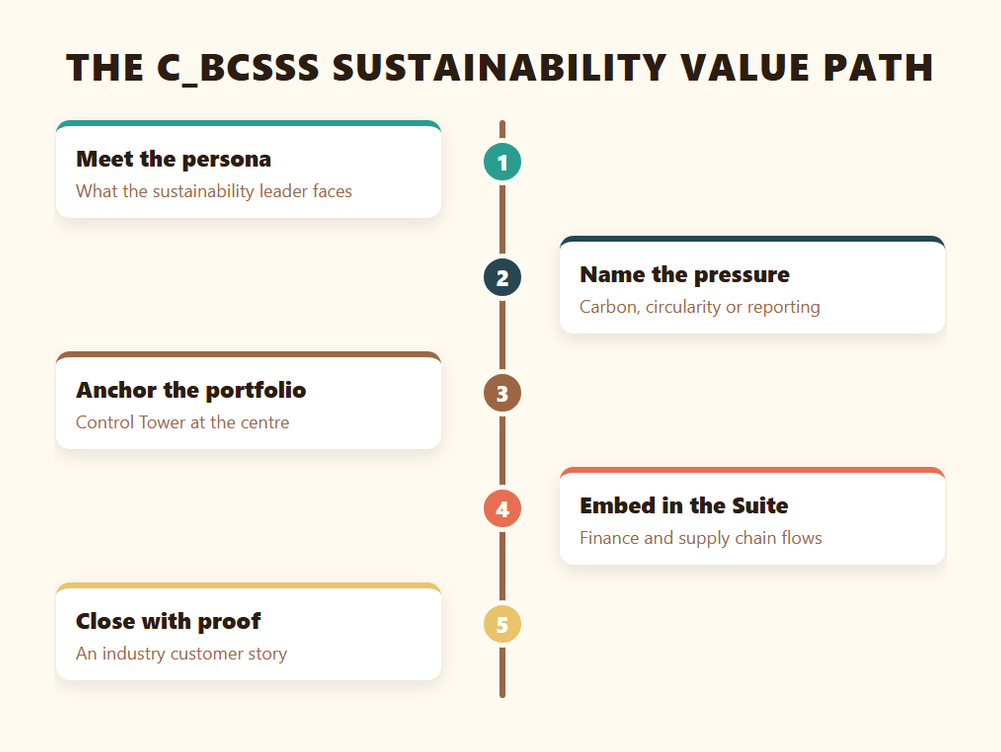
The three pressures pull in different directions. A decarbonization target leads to questions about where emissions arise in operations and suppliers. A circular economy goal leads to questions about materials, products and waste. A reporting demand leads to questions about trusted, auditable data and the frameworks the company must follow.
Reporting is often the most concrete of the three. The IFRS S2 climate disclosure standard, effective for annual reporting periods beginning on or after 1 January 2024, requires a company to disclose climate-related risks and opportunities that could reasonably be expected to affect its prospects. A leader facing that kind of requirement needs data that finance trusts, which is a business problem you can position against.
Questions that reveal the persona
- Which target is the board watching most closely this year?
- Where does the sustainability data come from today, and who checks it?
- Which processes in finance or supply chain produce the numbers you report?
- What would change for the business if that data arrived faster and could be audited?
Why Does SAP Sustainability Control Tower Anchor the Story?
SAP Sustainability Control Tower anchors the C_BCSSS story because it is the place where sustainability and ESG data come together. SAP describes it as centralizing sustainability and ESG data and performance, using embedded AI to support auditable compliance and to embed sustainability into core business operations. ERPPrep names it as the exam’s product.
On the SAP Sustainability Control Tower page, SAP lists what customers do with it: capture ESG metrics from SAP and third-party systems, generate ESG reports with metrics and content from SAP and partners, comply with reporting standards such as ESRS and the EU Taxonomy, and drive progress by embedding sustainability into core processes.
In a scenario, that list becomes a bridge. The leader’s reporting pressure maps to report generation and compliance; the data problem maps to capture from many systems; the target pressure maps to steering progress. Anchoring on the Control Tower first lets you add the rest of the portfolio as the customer’s needs grow, instead of opening with every product at once.
What not to do with the anchor
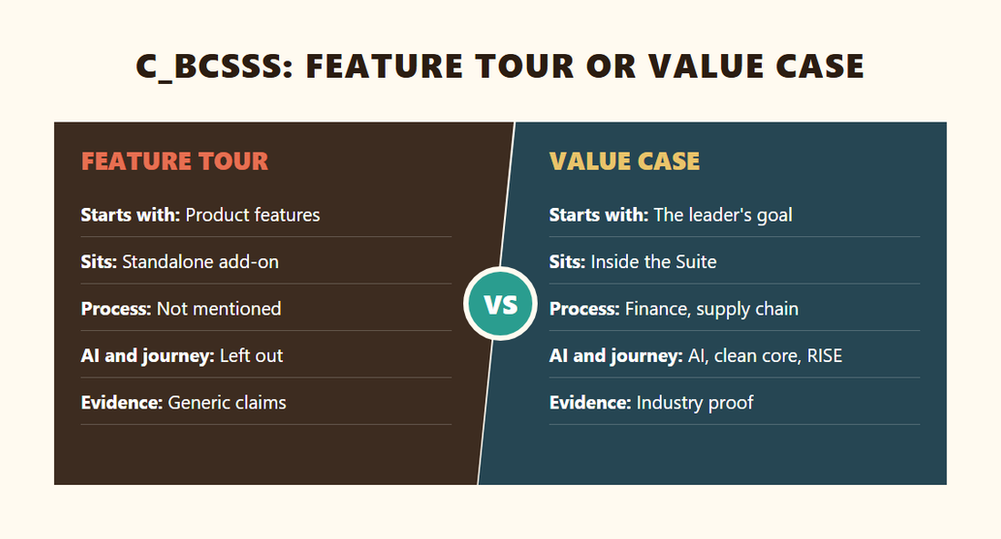
Do not turn the anchor into a feature tour. The exam rewards the link between a customer’s stated challenge and the outcome the solution supports. A list of capabilities with no customer reason behind it is the most common way a positioning answer loses credibility.
How Do You Show Sustainability Inside Finance and Supply Chain?
You show it by placing sustainability inside the process flows the customer already runs. The C_BCSSS blueprint asks you to frame where sustainability capabilities appear across end-to-end processes and how they support decisions in finance and supply chain management. The point is that sustainability value comes from the Suite, not from a separate add-on beside it.
In finance, the conversation is about treating sustainability data with the same discipline as financial data: metrics that can be audited, analysed beside cost and margin, and reported with confidence. SAP’s product page describes analysing ESG metrics alongside financial and operational data to steer performance across business units and locations.
In supply chain, the conversation is about where emissions and material flows actually arise: in sourcing, production and logistics. A decision in one of those flows changes the footprint the leader has to report. Positioning that link is stronger than describing a dashboard.
- Name the business process the customer cares about.
- Show where sustainability data is created inside that process.
- Explain the decision that improves when the data is available in the flow.
- Connect that decision to the leader’s target or reporting duty.
Where Do SAP Business AI, Clean Core and RISE or GROW Strengthen the Case?
They strengthen the case when you position them together with sustainability rather than as separate topics. The C_BCSSS blueprint asks you to show how sustainability value grows with SAP Business AI, how it aligns with a clean-core strategy, and how it fits a RISE with SAP or GROW with SAP transformation journey. SAP’s learning journey frames this as its AI-First, Suite-First strategy.
SAP Business AI fits the parts of the story where people spend time on manual work today, such as collecting data and drafting reports. SAP’s product page mentions AI-assisted drafting of ESG reports, which gives you a concrete example rather than a general promise.
Clean core fits the conversation about keeping the ERP standard and extending it in a governed way, so that sustainability capabilities stay supportable as the system evolves. RISE with SAP and GROW with SAP give the customer a path: a way to adopt the capabilities as part of a wider move rather than as a one-off project.
A combined story, not three extra slides
The ERPPrep study guide notes that scenarios often reward positioning these capabilities as one reinforcing value story. In practice, that means one sentence that ties them together for this customer, for example how a governed core, AI help with reporting and a clear transformation path together shorten the time to trusted sustainability data.
The same positioning family covers other parts of the Suite with the same skills, and our SAP Business Suite positioning page brings those credentials together if you plan to add a second one later.
How Do Industry Proof Points Close the Argument?
Industry proof points close the argument because they show that a value claim has already worked for a similar company. The C_BCSSS blueprint asks you to analyse sustainability value for specific industries and to reinforce positioning with real customer stories, and ERPPrep’s study guide names CP Foods, Mercedes-Benz and Martur Fompak as examples.
Pick the story that matches the customer’s industry and pressure. A food producer worried about its farm-to-table footprint hears CP Foods differently from an automotive supplier hearing about a carmaker. SAP’s Control Tower page describes CP Foods, an agro-industrial and food conglomerate, making sustainability a key ingredient in every farm-to-table step with SAP Sustainability solutions.
Circularity often decides which story fits. If the customer’s goal is about keeping materials and products in use longer, the circular economy model is the frame they are already using, and a proof point about materials or product life will land better than one about reporting.
How to use a proof point in a scenario
- State the customer’s challenge in one sentence.
- Name the comparable customer and its similar challenge.
- Say what changed for that customer, without inventing numbers.
- Bring it back to the next step you recommend for this customer.
How Should You Prepare for C_BCSSS?
Prepare for C_BCSSS by following SAP’s learning journey, Positioning SAP Sustainability Solutions, and then rehearsing complete positioning conversations from persona to proof point. SAP lists Discovering SAP as the prerequisite for the journey. The journey promises that you will be able to link SAP solutions to key challenges and show their impact through real use cases.
The Positioning SAP Sustainability Solutions journey draws on three courses: SL_SUS100 Discovering SAP Sustainability Solutions, SL_SUS200 Positioning SAP Sustainability Solutions, and SL_SUS290 Selling SAP Sustainability Solutions. The first builds the persona and portfolio picture, the second builds the positioning argument, and the third turns positioning into a sales motion.
A study order that follows the value case
- Learn the sustainability leader personas and their goals before any product detail.
- Learn the portfolio with SAP Sustainability Control Tower at the centre.
- Practise placing sustainability in finance and supply chain process flows.
- Rehearse SAP Business AI, clean core and RISE or GROW as one combined story.
- Finish by matching customer stories to industries and pressures.
Say your answers out loud. Explaining why a solution matters to one persona is the reasoning the scenario rewards, and speaking it exposes gaps that silent reading hides. For a second view of the same exam, our earlier C_BCSSS preparation notes page covers its background and resources.
Frequently Asked Questions
Is C_BCSSS a technical sustainability exam?
No. It is a positioning credential for presales and sales roles. It tests discovery and value articulation, not configuration or report preparation.
How long is the C_BCSSS exam?
SAP shows a duration of 2 hours for the single scenario activity.
What score do you need to pass C_BCSSS?
The pass score is 60 percent, as shown on SAP’s certification page and the ERPPrep study guide.
How many questions are on C_BCSSS?
SAP does not publish a question count. The exam is one Scenario-Based Assessment activity in which you reason through a customer situation.
In which languages can you take C_BCSSS?
It depends on the format. Roleplay with AI guidance is offered in English, Spanish, Italian, French, Japanese and 25 more languages. A recorded video is English only.
Which SAP product is at the centre of C_BCSSS?
SAP Sustainability Control Tower, which centralizes sustainability and ESG data and performance.
How many blueprint areas does C_BCSSS have?
Six, from sustainability solutions and key personas to industry value and customer proof points. No weightings are published for them.
What is the prerequisite for the C_BCSSS learning journey?
SAP lists Discovering SAP as the prerequisite for the Positioning SAP Sustainability Solutions learning journey.
Which customer stories does the exam preparation mention?
The ERPPrep study guide names CP Foods, Mercedes-Benz and Martur Fompak as examples of customer proof points.
Conclusion
C_BCSSS is the SAP sustainability certification for people who sell and position, not for people who configure or report. SAP runs it as one Scenario-Based Assessment activity of 2 hours with a 60 percent pass score, across six blueprint areas that read as one value case: the sustainability leader and the pressure they face, SAP Sustainability Control Tower as the anchor, value inside finance and supply chain, the combined lift from SAP Business AI, clean core and RISE or GROW, and an industry customer story that proves it.
Study in that order, follow SAP’s learning journey, and practise saying the whole argument out loud until every recommendation traces back to the customer’s own challenge.


