Is C_ARSCC an SAP Ariba exam or an SAP Business Network exam? SAP’s own certification page answers both ways: it describes the credential as proof of the core skills of an SAP Ariba and SAP Business Network Supply Chain implementation consultant. The two names point at one job, which is getting a buyer’s ERP system and its suppliers to exchange the same documents without anyone retyping them.
That job is what the SAP supply chain collaboration certification tests. Its full title is SAP Certified – Implementation Consultant – SAP Business Network Supply Chain, and SAP delivers it as one Scenario-Based Assessment activity with a 2 hour duration and a 60 percent pass score. This article covers how the exam runs, the six blueprint areas ERPPrep maps out, how purchase order collaboration works across the network, the collaboration variants candidates mix up, where configuration and the Cloud Integration Gateway fit, how C_ARSCC compares with the other Ariba credentials, and how to prepare.
What Does the C_ARSCC Exam Ask You to Do?
C_ARSCC asks you to work through one realistic supply chain collaboration scenario and make the setup and process decisions an implementation consultant would make. SAP delivers it as a single Scenario-Based Assessment activity, displays a 2 hour duration, and sets the pass score at 60 percent. Judgment is scored, not recall of isolated facts.
A Scenario-Based Assessment is one of the two performance-based formats SAP now uses for certification. You are given a business situation, such as a buyer whose suppliers keep shipping against outdated delivery schedules, and you reason through the correct collaboration setup and the order of the steps. There is no bank of separate items to work through, so preparation has to feel like the job rather than a reading exercise.
| Field | ERPPrep study guide | SAP certification page |
|---|---|---|
| Exam code | C_ARSCC | C_ARSCC |
| Level | Associate | Not displayed |
| Format | Scenario-Based Assessment, 1 activity | 1 activity, Scenario Based Assessment |
| Pass score | 60% | 60% |
| Duration | Not published | 2 hours |
| Languages | Not published by SAP | Vary by format |
| Product | SAP Business Network Supply Chain Collaboration | Learning journey: Configuring SAP Business Network Supply Chain Collaboration |
Two fields differ between the sources. ERPPrep publishes no duration, while the official SAP certification page displays 2 hours, so 2 hours is the figure to plan around. On languages, SAP shows that availability depends on the response format: the roleplay with AI guidance option is offered in English, Spanish, Italian, French, Japanese and more, while the recorded video option is English only. Neither source publishes a fee or an item count, and none is given here.
ERPPrep builds its C_ARSCC scenario simulations around that format, with full multi-phase scenarios and skill drills grouped into twelve skill domains. Those domains are a finer practice grouping of the same six blueprint areas described below, not a different syllabus.
What SAP asks you to check before exam day
SAP lists three readiness steps on the certification page. Run the technical readiness checklist for hardware, software and connectivity. Confirm a Learning Hub subscription that includes certification exam attempts, along with an SAP Universal ID that has a secondary email set up. Then watch SAP’s introduction to scenario-based assessments and try its AI-powered scenario-based assessment tool, so the format is familiar before an attempt counts.
Which Six Blueprint Areas Does C_ARSCC Cover?
ERPPrep’s C_ARSCC study guide maps six blueprint areas: Supply Chain Collaboration foundations and architecture; purchase order collaboration; returns, scheduling agreement and consignment collaboration; subcontracting, multi-tier and stock transport order collaboration; planning, quality and inventory collaboration; and configuration and administration. Neither ERPPrep nor SAP publishes weightings for these areas, so none are given here.
| Blueprint area | What it asks of you | Learning journey courses |
|---|---|---|
| Supply Chain Collaboration Foundations and Architecture | Why complex supply chains need collaboration, the solution package and its architecture | ARC130 |
| Purchase Order Collaboration | PO, order confirmation, advance ship notice, goods receipt and invoice across buyer system and network; complex PO scenarios; Supply Chain Monitor | ARC131 |
| Returns, Scheduling Agreement and Consignment Collaboration | Returns orders, return ship notices and credit memos; scheduling agreements with and without releases; consignment orders, transfer postings and settlement invoices | ARC132, ARC133, ARC134 |
| Subcontracting, Multi-Tier and Stock Transport Order Collaboration | Subcontracting and multi-tier processes on their own and combined; stock transport orders across CM-to-OEM, OEM-to-CM and CM-to-CM | ARC135, ARC136 |
| Planning, Quality and Inventory Collaboration | Planning with IBP or ERP as the source, manufacturing visibility, quality notification, inspection and review, supplier-managed inventory | ARC141, ARC142, ARC143 |
| Configuration and Administration | Buyer account and Cloud Integration Gateway, transaction rules, message output controls, event linkages, business add-ins and reports per module | ARC240, ARC241, ARC242, ARC243 |
Fourteen courses sit behind those six areas. Five carry the SAP Business Network name and nine carry the SAP Ariba Supply Chain Collaboration name, which is why candidates meet both labels for the same product while they study.
How to read an unweighted blueprint
Without weightings, the learning journey itself is the best guide to emphasis. Purchase order collaboration is the base process every other module reuses, and the configuration courses touch every module, so those two areas deserve more time than their single row suggests. A scenario on consignment or subcontracting still assumes you can trace a purchase order from creation to invoice.
How Do Buyer and Supplier Documents Meet on the Network?
In SAP Business Network Supply Chain Collaboration, the buyer’s ERP system sends a purchase order to the network, the supplier answers with an order confirmation and an advance ship notice, the buyer posts the goods receipt, and the supplier’s invoice closes the cycle. C_ARSCC tests whether you can follow that document chain and spot where it breaks.
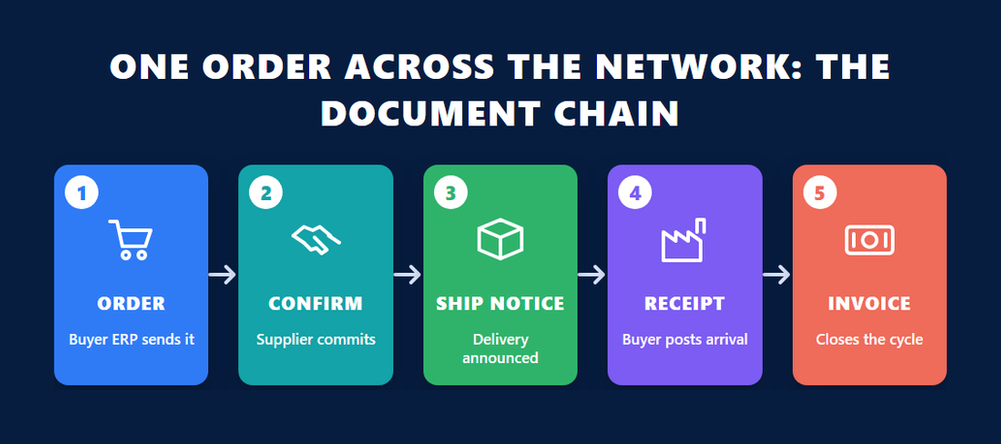
SAP positions the product as a single networked platform for working with trading partners on direct materials. Its Supply Chain Collaboration product page frames the goal as assuring supply through better planning, inventory visibility and automation. Direct materials are what goes into the product, which is why a late confirmation or a wrong ship notice quickly turns into a production problem rather than a paperwork one.
The documents behind the process
The same handful of business documents carries most supply chain traffic in any industry. GS1, the global standards body behind barcodes and supply chain identifiers, notes in its GS1 EDI standards overview that the three most used messages are the order, the invoice and the despatch advice, which is another name for the advance ship notice. Those are exactly the documents purchase order collaboration moves between buyer and supplier.
What the Supply Chain Monitor is for
The Supply Chain Monitor appears in several course descriptions on the learning journey, from purchase orders to scheduling agreements and supplier-managed inventory. It is where exceptions surface: an order line the supplier has not confirmed, a ship notice that does not match the order, a delivery schedule that has moved. Expect a scenario to describe a symptom and ask you to reason back to the cause.
“As multi-enterprise collaboration continues to evolve, we see tremendous opportunity to help organizations unlock new levels of agility, visibility, and efficiency.”
Which Collaboration Variants Do Candidates Confuse Most?
ERPPrep’s study guide singles out scheduling agreements, subcontracting with multi-tier, and stock transport orders across the CM-to-OEM, OEM-to-CM and CM-to-CM scenarios as the flows candidates most often confuse. It adds two choices that decide many planning and inventory tasks: IBP or ERP as the planning source, and planned shipments or replenishment orders for supplier-managed inventory.
Scheduling agreements, with and without releases
A scheduling agreement replaces repeated purchase orders with a standing agreement and a delivery schedule. The learning journey covers it both with and without releases, and the difference changes what the supplier actually receives and when. A scenario that says the supplier keeps working from an old schedule is usually a question about releases.
Subcontracting, multi-tier and stock transport orders
Subcontracting sends components to a supplier who builds and returns an assembly. Multi-tier extends that across more than one supplier level, and the two can run combined. Stock transport orders move material between plants, and in this product they connect contract manufacturers and original equipment manufacturers in three directions. Learn each flow on its own before combining them, because a combined scenario hides which document belongs to which tier.
Supplier-managed inventory
Supplier-managed inventory hands replenishment decisions to the supplier, who sees the buyer’s stock and demand and decides what to ship. The general practice is described in vendor-managed inventory literature, where the supplier becomes the decision maker on order size. In C_ARSCC the variant matters: planned shipments run through scheduling agreement releases and advance ship notices, while the other path uses replenishment orders.
| Choice | Option one | Option two |
|---|---|---|
| Planning source | SAP IBP | ERP |
| Supplier-managed inventory path | Planned shipments with scheduling agreement releases and ship notices | Replenishment orders |
| Scheduling agreement | With releases | Without releases |
| Stock transport direction | CM-to-OEM or OEM-to-CM | CM-to-CM |
Where Do Configuration and the Cloud Integration Gateway Fit?
Configuration is the sixth blueprint area and runs through every module. C_ARSCC expects you to set up the buyer account and the Cloud Integration Gateway in the ERP system, then configure transaction rules, message output controls, event linkages, business add-ins and reports so buyer and supplier systems exchange each document type correctly.
Four courses carry this area. The core course, ARC240, covers common configuration and the module setup for purchase order, returns, scheduling agreement, consignment, subcontracting and multi-tier collaboration. SAP’s core configuration course page lists it at 4 hours 24 minutes across 6 units at intermediate level. ARC241, ARC242 and ARC243 then add the planning, quality and inventory configuration.
Why configuration and process belong together
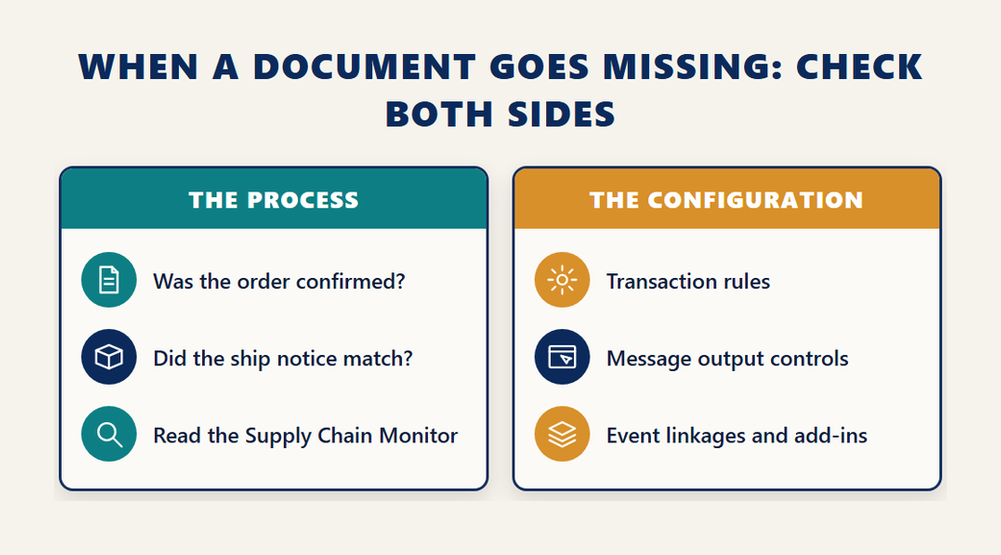
ERPPrep’s study guide advises pairing every module’s process with its configuration, and the reason is practical. A transaction rule or a message output control decides whether a document reaches the supplier at all. When a scenario describes a missing confirmation, the fix is as likely to be in configuration as in the process, so study the two side by side.
- Transaction rules control what each party may do with a document on the network.
- Message output controls decide which documents leave the ERP system and when.
- Event linkages and business add-ins connect quality and planning events to the right processing.
- Module reports, such as the planning collaboration report and the supplier-managed inventory report, show whether the setup works.
How Does C_ARSCC Compare With the Other SAP Ariba Certifications?
C_ARSCC is the SAP Ariba family credential for direct-material collaboration with suppliers. The other Ariba credentials on ERPPrep cover sourcing, procurement, contracts, supplier management and the managed gateway for integration. All are associate Scenario-Based Assessments, so the choice depends on which part of the source-to-pay process your project actually runs.
| Exam code | Focus | Pick it when |
|---|---|---|
| C_ARSCC | SAP Business Network Supply Chain Collaboration | You connect a manufacturer’s ERP with direct-material suppliers |
| C_ARSOR | SAP Ariba Sourcing | You run sourcing events and supplier selection |
| C_ARP2P | SAP Ariba Procurement | You implement the procurement process |
| C_ARCON | SAP Ariba Contracts | You implement contract management |
| C_ARSUM | SAP Ariba Supplier Management | You implement supplier management |
| C_ARCIG | Managed gateway for spend management | You connect Ariba solutions with back-end systems |
The sourcing exam is the upstream neighbour of C_ARSCC: a supplier chosen in a sourcing event becomes a trading partner on the network. ERPQnA’s guide to the SAP Ariba sourcing scenario explains what C_ARSOR asks, which is useful if your role spans both ends of the supplier relationship.
Indirect spend versus direct materials
Sourcing, procurement and contracts deal with the commercial side of buying. C_ARSCC is different because it sits next to production planning and inventory, with schedules, subcontracting and quality inspections in scope. Candidates from an SAP MM or supply chain background often find it closer to their daily work than the other Ariba exams.
How Should You Prepare for a Two Hour Scenario?
Prepare for C_ARSCC by learning the collaboration modules as one connected system on the same buyer and supplier network, then pairing each process with its configuration. Work through SAP’s learning journey in order, give the easily confused variants dedicated time, and rehearse full scenarios against a two hour clock until you can trace a requirement from buyer to supplier.
SAP’s Supply Chain Collaboration learning journey is designed for consultants, technical leads and anyone involved in a deployment. ERPPrep’s study guide turns it into a five-step order:
- Learn the Supply Chain Collaboration modules as one connected system, starting with the ARC130 architecture picture.
- Study each collaboration process alongside its configuration, so every module’s how comes with its why.
- Give the scheduling agreement, subcontracting with multi-tier and stock transport scenarios dedicated attention.
- Practise planning, quality and supplier-managed inventory collaboration end to end, keeping each variant distinct.
- Rehearse how the Supply Chain Monitor and the Cloud Integration Gateway tie documents together, then work full scenarios under a timer.
Practising against the clock
Two hours is enough for one scenario only if the routine steps are already automatic. Time at least two complete runs, note which flows slow you down, and confirm each outcome before moving on. In a collaboration scenario, a decision about the planning source or the inventory path early on shapes every later answer.
Older ERPQnA material for this exam
ERPQnA has covered this credential before under an earlier release code. The C_ARSCC study materials page collects resources from that release; use it for background on the modules, and rely on SAP’s current certification page for the format and pass score.
Who Should Take the SAP Supply Chain Collaboration Certification?
The SAP supply chain collaboration certification is built for Ariba and SAP Business Network consultants, and for business users moving into a Supply Chain Collaboration implementation role. SAP lists the role as Consultant, with Strategic Procurement, Supply Chain Integration and Supplier Identification and Selection as the skills, at the depth of a mentored member of a project team.
SAP recommends the credential as a qualification for taking part in design and implementation projects, which makes it a sound first credential for an SAP MM or procurement consultant joining a supplier collaboration rollout. It also suits an Ariba procurement specialist who is being pulled onto direct-material projects and needs to show they understand schedules, consignment and supplier-managed stock.
What it does not cover
C_ARSCC stays on the collaboration side. Sourcing events, contract authoring and indirect buying each have their own Ariba credential, and deeper planning work in SAP IBP has its own exam as well. Pair C_ARSCC with one of those if your role spans more than supplier collaboration.
Frequently Asked Questions
What is C_ARSCC?
C_ARSCC is the exam code for SAP Certified – Implementation Consultant – SAP Business Network Supply Chain. It certifies that you can implement and administer SAP Business Network Supply Chain Collaboration as a member of a project team.
How is the C_ARSCC exam delivered?
As one Scenario-Based Assessment activity. You work through a realistic supply chain situation and reason through the correct collaboration setup and steps, and SAP’s certification page displays a 2 hour duration.
What is the pass score for C_ARSCC?
The pass score is 60 percent. SAP’s certification page and ERPPrep’s study guide show the same figure.
Does C_ARSCC have a fixed set of items to answer?
No. It is a single scenario activity rather than a list of separate items, so preparation should focus on reasoning through complete collaboration scenarios rather than memorising answers.
Which languages is C_ARSCC offered in?
SAP shows that it depends on the response format. The roleplay with AI guidance option is available in English, Spanish, Italian, French, Japanese and more, while the recorded video option is English only.
Is C_ARSCC an SAP Ariba or an SAP Business Network certification?
Both labels describe the same product. SAP’s page refers to an SAP Ariba and SAP Business Network Supply Chain implementation consultant, and the learning journey mixes courses carrying both names.
Which modules does C_ARSCC cover?
Purchase order, returns, scheduling agreement, consignment, subcontracting and multi-tier, stock transport order, planning, quality and supplier-managed inventory collaboration, plus the configuration and administration behind them.
How many courses are on the C_ARSCC learning journey?
ERPPrep’s study guide lists fourteen courses, from ARC130 on core features and architecture to ARC243 on inventory configuration and administration.
Does ERPPrep or SAP publish weightings for C_ARSCC?
No. Neither source publishes weightings for the blueprint areas, so plan your time by the learning journey and give purchase order collaboration and configuration extra attention.
Conclusion
C_ARSCC tests the SAP supply chain collaboration work a consultant does when a buyer and its direct-material suppliers move onto one network: one Scenario-Based Assessment activity, a 2 hour duration and a 60 percent pass score. ERPPrep’s six blueprint areas cover the whole range, from purchase order collaboration through returns, consignment, subcontracting, planning, quality and supplier-managed inventory, with configuration running underneath every module. Learn purchase order collaboration first, pair each process with its configuration, keep the easily confused variants apart, and choose C_ARSCC over the other Ariba exams when your project connects production supply rather than indirect buying. Then rehearse full scenarios against the clock before you book.


