Is there an SAP certification for SmartRecruiters yet? Yes. The SAP SmartRecruiters certification is C_THR104, SAP Certified – SmartRecruiters for SAP SuccessFactors, and SAP’s certification card shows it as one Scenario-Based Assessment activity with a 60 percent pass score and a 2 hour duration. It is an entry-level consultant credential, and it expects you to know two things at once: how SmartRecruiters is configured, and how the SAP SuccessFactors platform underneath it handles permissions, objects and rules.
This guide covers what C_THR104 certifies, how the scenario is delivered and scored, the seven blueprint areas on the money-site study guide, the configuration choices that travel furthest through a hiring flow (access, job fields, screening questions, hiring processes and offers), where the Winston assistants, CRM and compliance fit, how the exam differs from the SAP SuccessFactors Recruiting exams, and how to prepare.
Table of Contents
- What is the SAP SmartRecruiters certification?
- How is C_THR104 delivered and scored?
- Which seven blueprint areas does C_THR104 cover?
- Why does a recruiting exam begin with the SAP SuccessFactors platform?
- System roles, access groups and hiring teams: who can do what?
- How do job templates, fields and approvals shape every job?
- What decides what a candidate sees when applying?
- How do hiring processes, offers and messages fit together?
- Where do the Winston assistants, CRM and compliance fit?
- SmartRecruiters or SAP SuccessFactors Recruiting: which exam is yours?
- How should you prepare for the C_THR104 scenario?
- Frequently Asked Questions
- Conclusion
What is the SAP SmartRecruiters certification?
The SAP SmartRecruiters certification is C_THR104, SAP Certified – SmartRecruiters for SAP SuccessFactors. It is an Associate level credential for consultants who configure and administer SmartRecruiters alongside SAP SuccessFactors. SAP describes it as an entry-level qualification showing fundamental knowledge that the holder can apply in projects under the guidance of an experienced consultant.
SmartRecruiters is a talent acquisition platform that joined SAP’s human capital management portfolio through an acquisition SAP announced in 2025. The certification followed, and it is aimed at the people who set the product up for customers: recruiting and HR consultants, and SAP SuccessFactors professionals moving into a talent acquisition role. The money-site study guide describes the scope as the whole recruiting lifecycle, from navigating the system and setting up the company, users and roles, through jobs, advertising, candidate and interview experience, hiring and offers, to communications, assistants, candidate relationship management and compliance.
“SmartRecruiters’ mission has always been to make hiring easy. Joining forces with SAP presents a tremendous opportunity for enterprises worldwide to benefit from our industry-leading approach to talent acquisition.”
What SAP’s card shows
The role tag on SAP’s page is Consultant, and the skills listed are Talent Recruitment, Candidate Relationship Management, Full-Cycle Recruitment Management, Recruitment Strategy and Recruitment Tools. To sit the exam you need a Learning Hub subscription that includes certification attempts and an SAP Universal ID with a secondary email address.
How is C_THR104 delivered and scored?
C_THR104 is one Scenario-Based Assessment activity with a 60 percent pass score. You are given a realistic recruiting situation and reason your way to the configuration decisions it calls for. SAP’s card displays a 2 hour duration and says the available languages vary by assessment format.
| Field | Value |
|---|---|
| Exam code | C_THR104 |
| Credential | SAP Certified – SmartRecruiters for SAP SuccessFactors |
| Level | Associate |
| Format | Scenario-Based Assessment (SBA), 1 activity |
| Passing score | 60 percent |
| Duration | 2 hours, as displayed by SAP; the money-site pages publish no duration |
| Languages | Vary by format, as displayed by SAP: roleplay with AI guidance in English, Spanish, Italian, French, Japanese and more; recorded video in English only |
| Product | SmartRecruiters for SAP SuccessFactors |
| Blueprint areas | 7, with no published weightings |
Two ways to answer a scenario
SAP’s page lists two formats for a scenario-based assessment. In a roleplay with AI guidance you talk the situation through, and SAP shows a long list of languages for it. In the recorded video format you present your answer on camera, and SAP shows English only. Either way you are explaining and justifying decisions, so preparation that stops at recognising screen names will not carry you. SAP also points candidates to its AI-powered scenario tool for a trial run before exam day.
Check the version before you book
SAP’s certification page carries a note that the next version of this exam was expected around the middle of September 2026. The code stays C_THR104, and SmartRecruiters itself changes frequently, so open the page shortly before booking and confirm that the learning journey you studied matches the version on offer.
Which seven blueprint areas does C_THR104 cover?
The money-site study guide lists seven blueprint areas for C_THR104 and publishes no weightings. One covers the SAP SuccessFactors platform, and six follow SmartRecruiters from first sign-in to compliance: navigation, company administration, job configuration and sourcing, candidate and interview experience, hiring and offers, and the Winston assistants with CRM and global compliance.
| Blueprint area | What it asks of you |
|---|---|
| SAP SuccessFactors Platform Foundations | Provisioning and the Admin Center, role-based permissions and proxy access, administrator tasks, the user experience and People Profile, Metadata Framework objects with business rules |
| SmartRecruiters System Navigation & Recruiting Overview | The dashboard, hiring team collaboration, jobs, talent pools, candidate communications, creating and posting jobs, application handling end to end |
| Company Administration, Users & Roles | Company profile and security settings, multi-factor authentication, default notifications, apps and WebSSO, system roles, access groups, delegated administrators, hiring team roles |
| Job Configuration, Advertising & Sourcing | Job templates, fields and dependencies, locations, salary transparency, job approvals, agencies, employee referrals, career site brands and pages, job widgets and alerts |
| Candidate Experience & Interview Configuration | Application fields, screening questions including branching and rejection questions, applicant data transfer, custom forms, interview types, templates, scheduling, scorecards, calendar integration |
| Hiring, Offers & Communications | Hiring processes and workflows, rejection processes, offer templates, clauses, DocuSign integration, offer approvals, email, automated notifications and SMS |
| Winston Assistants, CRM & Global Compliance | Winston Chatbot, Match and Companion, communities, prospects, email campaigns, lead-capture forms, reporting, GDPR and consent templates |
According to the money-site FAQ, candidates struggle most with job configuration dependencies, screening logic in the candidate experience, and the hiring and offer workflows, because a setting made at one step changes what happens several steps later. ERPPrep’s free SmartRecruiters skill drills are written around situations of that kind, such as how to give store managers the right level of access or how to make job creation consistent across a company.
Why does a recruiting exam begin with the SAP SuccessFactors platform?
C_THR104 certifies SmartRecruiters for SAP SuccessFactors, so the first blueprint area is the platform the recruiting product works alongside. The learning journey opens with the SAP SuccessFactors platform academy, and the study guide treats role-based permissions, the Metadata Framework and business rules as assumed knowledge when the scenario begins.
What the platform area includes
Provisioning is the back-end area where a company instance is set up, and the Admin Center is where administrators work day to day. Role-based permissions decide what a group of users may see and do for a target group of employees. Proxy access lets one user act as another for support or testing. The People Profile presents employee data, and the Metadata Framework lets you define custom objects and attach business rules that set or check values when data changes.
Why it matters for a recruiting scenario
A new hire does not stop at the offer. Their data moves on into the HR system, where permissions decide who can see it and objects and rules decide how it is stored. A consultant who understands only the recruiting side cannot explain why a hiring manager sees one thing in SmartRecruiters and another in SAP SuccessFactors, and a scenario can ask exactly that kind of question.
System roles, access groups and hiring teams: who can do what?
Access in SmartRecruiters is decided in layers. A system role sets what a user may do across the product, an access group narrows which jobs and candidates that user can reach, and a hiring team role sets what the user does on one particular job. The study guide puts all three, plus delegated administrators, in the company administration area.
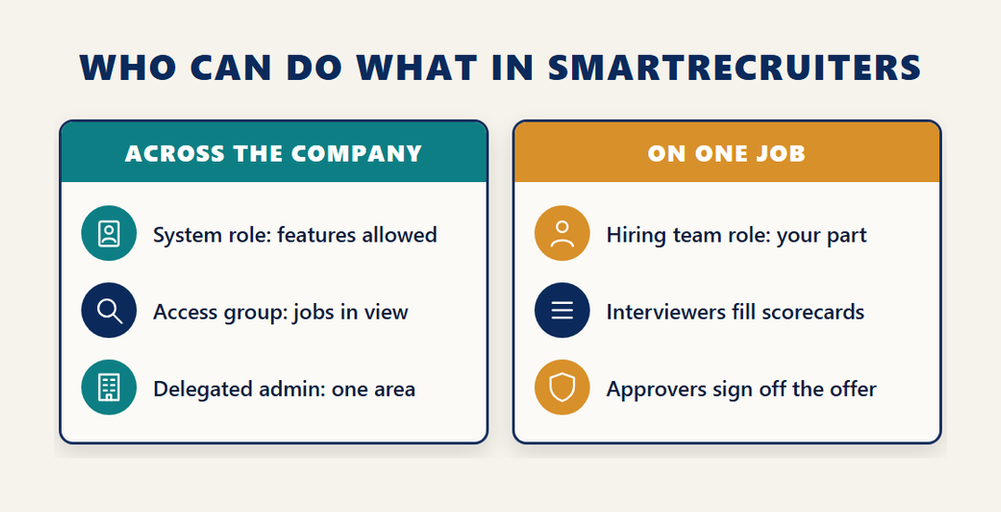
| Layer | What it controls | Typical question in a scenario |
|---|---|---|
| System role (default or custom) | The features a user may use anywhere in the product | Should this user be able to create jobs or change settings at all? |
| Access group | Which part of the company’s jobs and candidates the user can see | Should a regional manager see jobs outside the region? |
| Hiring team role | The user’s part on a single job | Who interviews, who approves, who only reviews? |
| Delegated administrator | Administration handed down for a defined part of the company | Who maintains users for one brand or country? |
Security settings sit in the same area
Company administration also covers the company profile, multi-factor authentication, default notifications and sign-on through WebSSO. When a scenario asks how to require a second sign-in factor for everyone, the answer is a company-level security setting, not a request to each user. When single sign-on is in place, authentication is handled by the identity provider, and the configuration question moves there.
Right-sizing access
The usual mistake is to solve a visibility problem with a bigger role. A store manager who needs to see candidates for one store does not need a more powerful system role. They need the right access group and a place on the hiring team. Keeping the three layers apart in your head makes most access scenarios straightforward.
How do job templates, fields and approvals shape every job?
Job configuration sets the rules every later step inherits. Templates make job creation consistent, job fields and their dependencies classify each job, and approvals decide who signs off before posting. The study guide groups these with advertising and sourcing, because what is configured on the job decides where and how it can be advertised.
Fields and dependencies
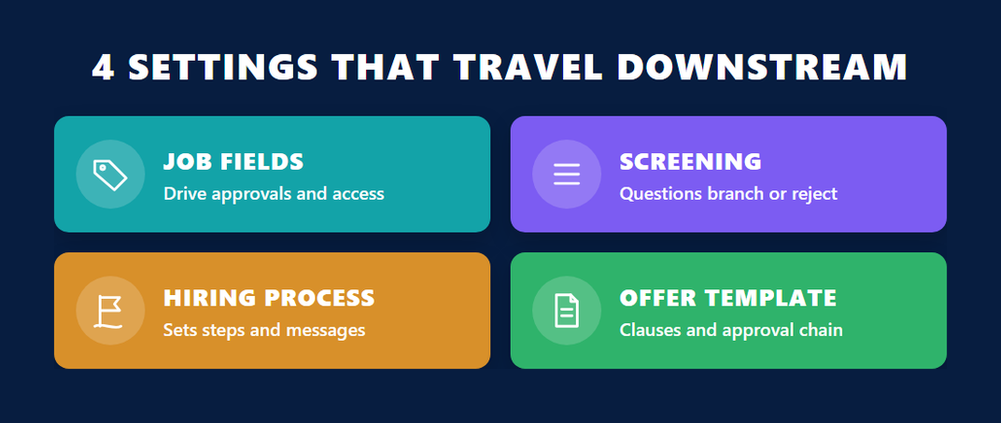
Job fields describe a job in the company’s own terms, for example brand, department or cost centre. A dependency ties one field to another so that choosing a brand limits the departments on offer. Those fields are not decoration. Approval chains, access groups and reporting can all be driven by them, which is why the money-site FAQ lists job field dependencies among the hardest topics. A careless field design shows up later as an approval sent to the wrong person or a job the right recruiter cannot see.
Templates, locations and salary transparency
A job template carries a prepared description and settings so that recruiters do not start from a blank page. Locations and salary transparency settings matter because pay disclosure rules differ by place, and bulk field updates let an administrator correct many jobs at once after a reorganisation.
Advertising and sourcing
Once a job is approved it can be published to career site pages under one or more brands, shared through job widgets and alerts, opened to employee referrals and released to recruitment agencies through an agency portal. Centralising agency relationships in the system, instead of leaving them in recruiters’ inboxes, is a typical scenario recommendation because it makes agency terms and candidate ownership visible.
What decides what a candidate sees when applying?
The application a candidate sees is assembled from configured parts: application fields, screening questions and custom forms. Screening questions can be standard, custom or specific to a job, can branch depending on an earlier answer, and can be set to reject. Interview configuration then decides how a shortlisted candidate is scheduled and assessed.
Screening logic
A branching question shows a follow-up only when a certain answer is given, so two candidates for the same job may see different forms. A rejection question removes a candidate who gives a disqualifying answer, for instance on the legal right to work. Combine these with job-specific questions and the path through an application depends on both the job’s fields and the candidate’s answers. Scenarios in this area usually describe a symptom, such as qualified people being rejected, and ask which piece of logic is responsible.
Interviews and scorecards
Interview types and templates define the stages, scheduling and self-scheduling decide how a slot is booked, calendar integration keeps interviewers’ diaries in step, and scorecards give every interviewer the same criteria to rate. A scorecard matters for fairness as much as for convenience: it records why a decision was made.
Applicant data transfer
The study guide lists applicant data transfer in this area. It is the reminder that fields collected at application time are the fields available later, both to the hiring team and to the HR system that receives the new hire. If a value is needed after hiring, it has to be collected or created somewhere in the flow.
How do hiring processes, offers and messages fit together?
A hiring process defines the steps a candidate moves through and what happens at each one. Offers add templates, clauses, approvals and electronic signature, and the communications layer sends email, automated notifications and SMS as candidates move. The three are examined together because a change in one alters the other two.
Hiring and rejection processes
Different kinds of job can follow different hiring processes: a high-volume store role does not need the same steps as an executive search. A rejection process works the same way in reverse, defining the reasons a candidate can be turned down and the message they receive. Reasons chosen here feed reporting, so vague reasons produce vague reports.
Offer templates, clauses and approvals
An offer template is the document, clauses are the reusable blocks of wording inserted by job or location, and an approval chain decides who must agree before the offer is sent. With the DocuSign integration the candidate signs electronically. The classic scenario is an offer that went out with the wrong wording or without the right approval, and the fix is nearly always in how the template, the clause conditions and the approval rule were tied to job fields.
Communications
Email templates, automated notifications, automated replies, sending domains and SMS templates decide what a candidate hears and when. Messages triggered by a step in the hiring process are only as good as the process design, so check both when a scenario says candidates are receiving the wrong message.
Where do the Winston assistants, CRM and compliance fit?
The last blueprint area collects three topics that sit around the core hiring flow: the Winston assistants, which are SmartRecruiters’ AI features; candidate relationship management, which keeps prospects warm between openings; and global compliance, which governs consent and data handling for all of it.
Winston Chatbot, Match and Companion
The study guide names three Winston assistants: Chatbot, Match and Companion. In broad terms they converse with candidates, help compare candidates with jobs, and assist the people doing the hiring. For the exam, know what each is for and where its settings are, and avoid claiming more for them than the configuration supports.
CRM: communities, prospects and campaigns
Candidate relationship management is how a company reuses people it has already met. Prospects are gathered through lead-capture forms, grouped into communities, contacted through email campaigns and tracked in reports. When a scenario describes recurring openings and a team that keeps starting from nothing, a community of vetted prospects is the capability it is pointing at.
Global compliance
Recruiting systems hold personal data about people who never become employees, so consent and retention are configuration work, not paperwork. The study guide names GDPR and consent templates. The official GDPR text is the reference for what consent and data subject rights mean in the European Union. Compliance in hiring is wider than privacy, though. The International Labour Organization’s fair recruitment principles are a useful independent view of what a responsible recruitment process looks like across borders.
SmartRecruiters or SAP SuccessFactors Recruiting: which exam is yours?
Take C_THR104 if the project you work on implements SmartRecruiters. Take the SAP SuccessFactors Recruiting exams, C_THR83 and C_THR84, if the customer runs the recruiting module built into the SAP SuccessFactors suite. Both sets of exams belong to SAP’s human capital management portfolio, but they certify different products with different configuration.
| Question | C_THR104 | C_THR83 and C_THR84 |
|---|---|---|
| Product | SmartRecruiters for SAP SuccessFactors | SAP SuccessFactors Recruiting |
| Where configuration happens | In SmartRecruiters, with platform knowledge of SAP SuccessFactors | Inside the SAP SuccessFactors suite |
| Level described by SAP | Entry-level, working under guidance | Check each exam’s own page |
| Best fit | New SmartRecruiters projects and recruiting consultants joining them | Customers and consultants on the suite’s own recruiting module |
If you are still deciding where to specialise within SAP’s HR products, ERPQnA’s look at the SuccessFactors Recruiting certification covers the suite-side option. Ask which product a prospective employer or project has actually bought before you choose.
How should you prepare for the C_THR104 scenario?
Prepare for C_THR104 by learning the recruiting lifecycle as one connected flow and practising the reasoning out loud. The money-site FAQ puts the learning journey at about 16 hours across two courses and suggests roughly one to two months of preparation alongside a job, with extra time for hands-on repetition.
- Learn the SmartRecruiters recruiting lifecycle as one connected flow, from job setup through candidate experience, interviews, hiring and offers, so you can trace how an early configuration choice shapes later steps.
- Study the SAP SuccessFactors platform foundations alongside SmartRecruiters, since role-based permissions, the Metadata Framework and business rules are assumed knowledge going into the exam.
- Drill job configuration and screening logic together, because job fields, dependencies and screening questions interact and are often examined as one combined scenario.
- Practise the hiring and offer workflows hands-on, covering hiring processes, rejection steps, offer templates, clauses and approvals, and how they chain.
- Work through candidate relationship management and global compliance scenarios end to end, since communities, campaigns and consent settings carry detail that is easy to miss when reading alone.
The two courses
SAP’s SmartRecruiters learning journey maps to the exam. The money-site study guide lists two courses: THR80, the SAP SuccessFactors Platform Introduction Academy, and THR104, the SmartRecruiters for SAP SuccessFactors Academy. The FAQ recommends taking them in that order, so the platform layer is in place before the recruiting configuration is added.
Before you book
Open SAP’s C_THR104 certification page to confirm the current version, the format you will be assessed in and your available attempts. For the platform side, ERPQnA’s guide to Employee Central exam guide explains role-based permissions and business rules in the context of another SAP SuccessFactors exam.
Frequently Asked Questions
What is the exam code for the SAP SmartRecruiters certification?
The exam code is C_THR104, for SAP Certified – SmartRecruiters for SAP SuccessFactors. Search results sometimes show suffixed codes such as C_THR104_2605, but SAP’s certification page lists plain C_THR104.
What is the passing score for C_THR104?
The passing score is 60 percent, on a single Scenario-Based Assessment activity.
How long is the C_THR104 exam?
SAP’s certification page displays a duration of 2 hours. The money-site pages do not publish a duration, so SAP’s page is the source for that figure.
Which languages is C_THR104 offered in?
SAP’s page says available languages vary by format. It lists English, Spanish, Italian, French, Japanese and more for the roleplay with AI guidance, and English only for the recorded video format.
Is C_THR104 an entry-level certification?
Yes. SAP describes it as an entry-level qualification for consultants who will apply their knowledge in projects under the guidance of an experienced consultant.
Do I need SAP SuccessFactors knowledge for C_THR104?
Yes. One of the seven blueprint areas is SAP SuccessFactors Platform Foundations, and the learning journey begins with the platform introduction academy, THR80.
Which C_THR104 topics are hardest?
The money-site FAQ names job configuration dependencies, screening logic in the candidate experience, and the hiring and offer workflows, because one setting changes behaviour several steps later.
What are the Winston assistants?
They are the SmartRecruiters AI features named in the blueprint: Winston Chatbot, Winston Match and Winston Companion. They appear in the same blueprint area as candidate relationship management and global compliance.
Is C_THR104 the same as the SAP SuccessFactors Recruiting exams?
No. C_THR104 covers SmartRecruiters for SAP SuccessFactors, while C_THR83 and C_THR84 cover SAP SuccessFactors Recruiting, the recruiting module inside the suite.
Conclusion
The SAP SmartRecruiters certification is a young, entry-level credential with a clear shape: C_THR104 is one Scenario-Based Assessment activity, 2 hours by SAP’s display, passed at 60 percent, across seven blueprint areas that start on the SAP SuccessFactors platform and follow SmartRecruiters from company setup to compliance. The decisions that matter most are the ones that travel: how access is layered, how job fields are designed, how screening questions branch, and how hiring processes, offers and messages are tied together. Take THR80 before THR104, practise explaining your reasoning as well as doing the configuration, confirm the current exam version on SAP’s page, and book once you can follow a single job from template to signed offer and say why each setting is there.


