Pages about the SAP Signavio process management consultant exam usually stop at the pass mark and the topic list. What they leave out is the detail that shapes your whole attempt: SAP lists two response formats for this assessment, roleplay with AI guidance and a recorded video, and the languages available to you depend on which format you use.
The rest of the picture is just as different from older SAP exams. C_SIGPM is a single Scenario-Based Assessment activity with a 2 hour duration and a 55 percent pass score, and SAP publishes no question count because there is no list of items to count. You are given a business situation and you have to reason your way through it as a consultant would.
Table of Contents
- What does the SAP Signavio process management consultant exam involve?
- Which response formats does SAP list for C_SIGPM?
- What do the seven blueprint areas cover?
- Why do BPMN and DMN decide so much of the scenario?
- How do governance and administration appear in a scenario?
- Where the consultant credential sits in the Signavio family
- How should you prepare for a single scenario?
- Frequently Asked Questions
- Conclusion
What does the SAP Signavio process management consultant exam involve?
The SAP Signavio process management consultant exam, code C_SIGPM, is one Scenario-Based Assessment activity lasting 2 hours, with a pass score of 55 percent. It sits at associate level and SAP recommends it as an entry level qualification. There is no published question count and no published weighting for any of its seven blueprint areas. SAP Cloud ALM uses the same single activity format, and our C_STC exam breakdown explains how C_STC scores it at 60 percent.
| Field | Value |
|---|---|
| Credential | SAP Certified – Process Management Consultant – SAP Signavio |
| Exam code | C_SIGPM |
| Level | Associate |
| Format | Scenario-Based Assessment (SBA), 1 activity |
| Duration | 2 hours |
| Pass score | 55 percent |
| Question count | None published, the exam is one activity |
| Languages | Vary by response format |
| Blueprint areas | 7, with no published weightings |
| Recommended course | SIG001, Managing Business Processes with SAP Signavio Solutions |
SAP completed its move to performance-based certification in early 2026, and this exam is a product of that change. A Scenario-Based Assessment presents a realistic business situation and asks you to reason through the right decisions and the right sequence of steps. Recognising a correct statement is not enough. You have to produce the reasoning yourself. The system-side counterpart is covered in our guide to the LeanIX consultant exam, where the scenario is an application landscape instead of a process engagement.
The format, the 2 hour duration and the 55 percent pass score are all displayed on the official SAP certification page, which is the place to confirm them before you book. The same page describes the role as crucial in establishing a continuous, process-centric approach within an organization.
What a 55 percent pass score really means
A 55 percent bar looks generous next to the pass marks of older exams. It is not a reason to relax. In a single scenario, an early misreading of the business situation carries into every decision that follows, so marks are lost in chains and not one at a time. The margin exists because applied reasoning is harder to score perfectly than recall.
Which response formats does SAP list for C_SIGPM?
SAP lists two response formats for the C_SIGPM assessment: roleplay with AI guidance and record a video. Language availability differs between them. Roleplay with AI guidance is offered in English, Spanish, Italian, French, Japanese and 25 more languages, while the recorded video format is offered in English only.
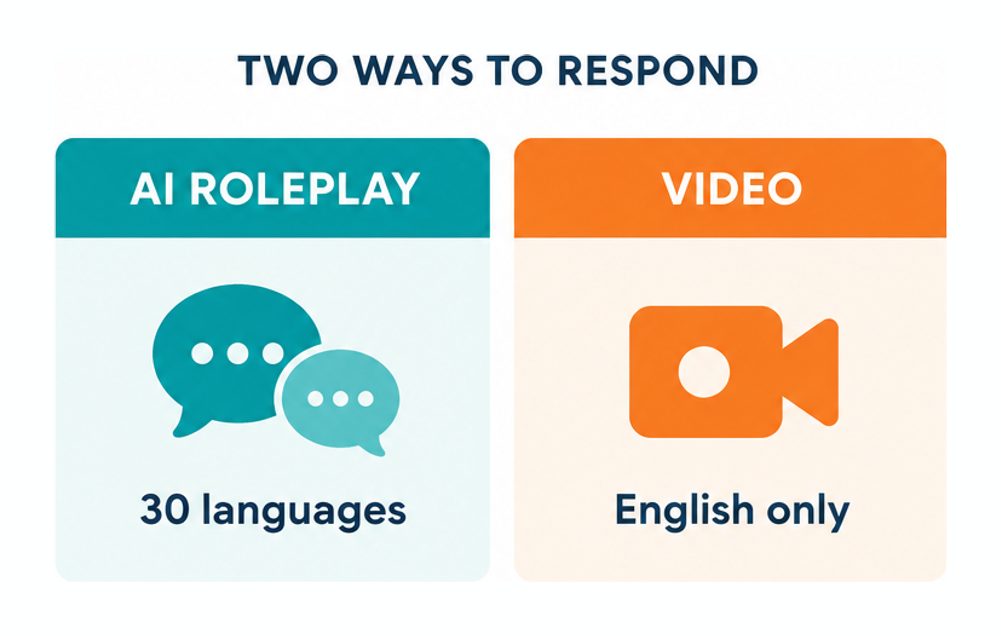
This is the detail most exam pages skip, and it matters more than it first appears. A Scenario-Based Assessment is read closely and answered in your own words, so working in your strongest language is a real advantage. If English is not your first language, the language list alone may decide which format suits you.
Roleplay with AI guidance
In the AI-guided option, the assessment runs as a simulated interview. An AI persona plays a client or project stakeholder and questions you about the scenario you were given. The skill being measured is whether you can hold a position on a process design and defend it when someone pushes back.
Record a video
The recorded video format is listed as English only. SAP’s page does not describe its mechanics in detail, so treat the official page and its introduction to scenario-based assessments as the authority on how the recording works.
Try the format before exam day
SAP’s certification page points candidates to an introduction to scenario-based assessments and to an AI-powered assessment tool you can explore before the exam. Use both. Meeting the format for the first time during a scored attempt wastes minutes you need for reasoning.
What do the seven blueprint areas cover?
The C_SIGPM blueprint has seven areas: process foundations and the BPM lifecycle, Process Manager and the Collaboration Hub, BPMN 2.0 modeling, governance and workflow, workspace administration, decision modeling with DMN, and customer journeys with connectors and embedded AI. None carries a published weighting, so you plan by area and not by percentage.
| Blueprint area | What you need to be able to do |
|---|---|
| Business Process Foundations & BPM Lifecycle | Explain what a process is, where variation and inefficiency come from, and how BPM works as a lifecycle |
| SAP Signavio Process Manager & Collaboration Hub | Use the Explorer, Editor, QuickModel and Dictionary, build navigation maps and value chains, run simulations, handle variants |
| Process Modeling & Design (BPMN 2.0) | Assign responsibilities, control flow with gateways, use events and sub-processes, model external parties, IT systems and data objects |
| Process Governance & Workflow Management | Build workflows in SAP Signavio Process Governance and manage approval flows that connect it with Process Manager |
| Administering SAP Signavio Solutions | Configure notation and attributes, manage licenses, groups and access rights, maintain the dictionary, apply security settings |
| Decision Modeling with DMN | Build decision tables, apply hit policies, split decisions into sub-decisions, verify completeness and consistency |
| Customer Journeys, Connectors & Embedded AI | Model journeys with the Journey Modeler, configure the Business Process Model Connector, use the embedded AI capabilities |
Read the list as one connected flow. A process is understood, modeled, published for collaboration, governed through approvals, and administered in a workspace. Decisions and customer journeys attach to that same model. A scenario can enter at any point and ask you to follow the consequences.
The quickest way to feel how the areas connect is to work through Signavio scenario simulations built for this format. ERPPrep offers 24 scenario simulations and 120 skill drills for C_SIGPM, ordered from foundation to advanced, so you can start with a single hand-off problem and build up to a full process chain.
Why there are no weightings to plan around
Neither the money-site blueprint nor SAP’s certification page shows a percentage for any area. Older pages for earlier releases of this exam quote percentage bands, and those bands do not apply to the current assessment. Give every area real time, then add extra time where your hands-on experience is thinnest.
Why do BPMN and DMN decide so much of the scenario?
BPMN 2.0 and DMN are the two notations the C_SIGPM blueprint names directly, and they are where a scenario is usually won or lost. A wrong gateway or a wrong hit policy changes how the modeled process behaves, so the error carries into governance, reporting and every later decision in the same scenario.
BPMN 2.0: the construct has to match the behaviour
Both notations are open standards maintained by the Object Management Group, not by SAP. The BPMN 2.0.2 specification defines what each symbol means, and SAP Signavio Process Manager follows those semantics. That is why tool familiarity alone does not carry you. You need to know what the diagram says.
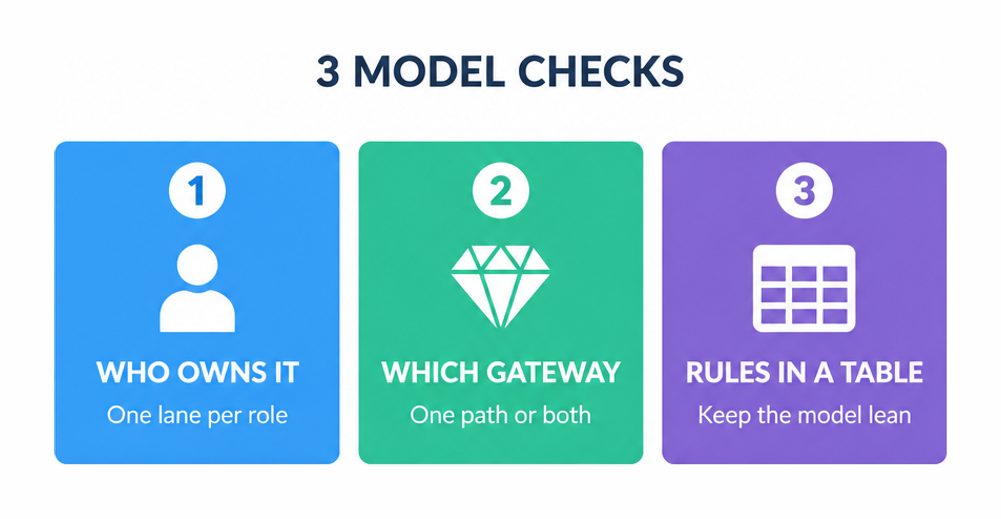
Take an inspection step where each delivery is either accepted or returned, never both. A parallel gateway sends work down both branches at once. An exclusive gateway sends it down exactly one, based on the inspection result. The two diagrams look similar and describe completely different processes. Scenarios are built around choices like this one.
The constructs worth drilling until they are automatic:
- Pools and lanes, to show who is responsible for each task
- Exclusive, parallel and event-based gateways, to control flow
- Start, intermediate and end events, to act and react
- Sub-processes, to structure a long model
- Message flows, to show interaction with external parties
- IT systems and data objects, linked to shared Dictionary entries
DMN: decisions belong in a table, not in the diagram
Decision Model and Notation is the companion standard for business rules. The blueprint expects you to build decision tables with clear inputs, choose a hit policy, split a large decision into sub-decisions, and follow naming conventions. It also expects you to use the SAP Signavio verification feature to check a table for completeness and consistency.
The practical test is simple. If a process model is filling up with gateways that only encode business rules, the rules belong in a decision table and the model should call it. Recognising that moment is a consultant skill, and a scenario is a natural place to test it.
How do governance and administration appear in a scenario?
Governance and administration appear in C_SIGPM as consequences of modeling choices. A workflow in SAP Signavio Process Governance depends on how the process was modeled and who was made responsible, while workspace administration decides who can model, who can review and who can only read. Both areas reward understanding of how the pieces connect.
Governance follows the model
The blueprint asks you to explain what workflows and workflow management are, build workflows, and manage the approval flows that connect Process Manager with Process Governance. In a scenario, that often means deciding how a changed model gets reviewed and released. If responsibilities were unclear in the model, the approval flow will be unclear too.
Administration is about matching rights to real work
Workspace administration covers notation and attribute configuration, user licenses, groups, access rights, the dictionary, the Collaboration Hub, standard workspace reports and security settings. A typical situation: a workspace where everyone holds a modeling license but only a handful of people ever change a diagram. The consultant answer matches each license type to what people actually do.
Customer journeys, the connector and embedded AI
The last blueprint area takes an outside-in view. You define customer journeys with the Journey Modeler and the Customer Journey Map, configure the Business Process Model Connector with its systems, synchronization settings and synchronization runs, and use the embedded AI capabilities. When a scenario says the goal is a better customer experience, internal process diagrams alone will not answer it.
How should you prepare for a single scenario?
Prepare for C_SIGPM by rehearsing whole process chains, not isolated topics. Complete the SIG001 learning journey, model real processes in BPMN 2.0, build decision tables, connect a model to a governance workflow, and explain your choices out loud. The assessment scores reasoning you can defend, so your preparation has to produce reasoning.
ERPPrep’s guidance is to allow roughly four to eight weeks when studying alongside a job, and it puts the core content of the learning journey at about twelve hours. People who already model processes can move faster. People new to SAP Signavio should plan for the longer end.
- Complete the learning journey in order, starting with process foundations and BPM basics so later topics have context.
- Model three real processes in BPMN 2.0, and for each gateway write one sentence explaining why that type is correct.
- Build a decision table for one of those processes, choose a hit policy, and run the verification feature on it.
- Connect one model to an approval workflow in Process Governance, so you see how a model is reviewed and released.
- Rehearse full scenarios against a 2 hour clock, and explain each decision aloud as if a client had asked why.
The fifth step matters most. Speaking your reasoning is a different skill from knowing the answer, and both response formats depend on it. The SAP Signavio learning journey gives you the content, and rehearsal gives you the fluency.
Administrative checks before you book
SAP’s certification page lists three things to settle first. Follow the Technical Readiness Checklist for hardware, software and connectivity. Confirm that your Learning Hub subscription includes certification exam attempts, and check how many attempts remain. Make sure your SAP Universal ID is set up with a secondary email.
For a wider view of the product family before you commit, the site’s Signavio certification overview lists the related credentials. It predates the scenario-based format, so use it for orientation and take the exam facts from SAP’s current page.
Frequently Asked Questions
How long is the C_SIGPM exam?
SAP lists a duration of 2 hours for one Scenario-Based Assessment activity.
What is the pass score for C_SIGPM?
The pass score is 55 percent, shown on both SAP’s certification page and the ERPPrep exam page.
How many questions are on the SAP Signavio consultant exam?
SAP publishes no question count. The exam is a single scenario activity in which you reason through a business situation, not a list of separate items.
Which languages is C_SIGPM available in?
It depends on the response format. Roleplay with AI guidance is listed in English, Spanish, Italian, French, Japanese and 25 more languages. Record a video is listed in English only.
How much does the SAP Signavio certification cost?
SAP’s certification page displays no standalone exam price. It states that you need a Learning Hub subscription that includes SAP Certification exam attempts, so check the current subscription terms with SAP.
Is there a prerequisite for C_SIGPM?
SAP’s certification page lists no prerequisite certification and recommends the exam as an entry level qualification. Familiarity with BPMN modeling makes preparation much smoother.
Are the C_SIGPM blueprint areas weighted?
No weightings are published for any of the seven blueprint areas, so prepare across all of them.
Is C_SIGPM_2403 the same exam as C_SIGPM?
C_SIGPM_2403 is the code of an earlier release. SAP’s current certification page lists the code as C_SIGPM, delivered as a Scenario-Based Assessment, so facts written for the earlier release do not apply.
Does the SAP Signavio consultant certification expire?
The overview on SAP’s certification page displays no validity period for this credential. Confirm the current policy with SAP before relying on any figure you read elsewhere.
How long should I prepare for C_SIGPM?
ERPPrep suggests roughly four to eight weeks alongside a job. Candidates with modeling experience can shorten that, and newcomers to SAP Signavio should plan for the longer end.
Conclusion
The SAP Signavio process management consultant exam is one scenario, 2 hours and a 55 percent pass score. It has no question count and no weightings across its seven blueprint areas, and its language options depend on whether you respond through roleplay with AI guidance or a recorded video.
That shape tells you how to prepare. Learn BPMN 2.0 and DMN well enough to explain every construct you place. Follow a model through collaboration, governance and administration until the connections are obvious. Then rehearse complete scenarios aloud and against the clock.
Check the response formats and languages on SAP’s page first, settle your subscription and system setup, and book when you can defend a process design to someone who keeps asking why.


