Five percentage points are the only published difference between the two associate SAP Signavio exams. C_SIGPM asks for a 55 percent pass score and C_SIGDA asks for 50 percent. Everything else SAP prints about them is identical: one Scenario-Based Assessment activity, 2 hours, the same response formats and an entry level position on the certification ladder. The numbers will not make the choice for you.
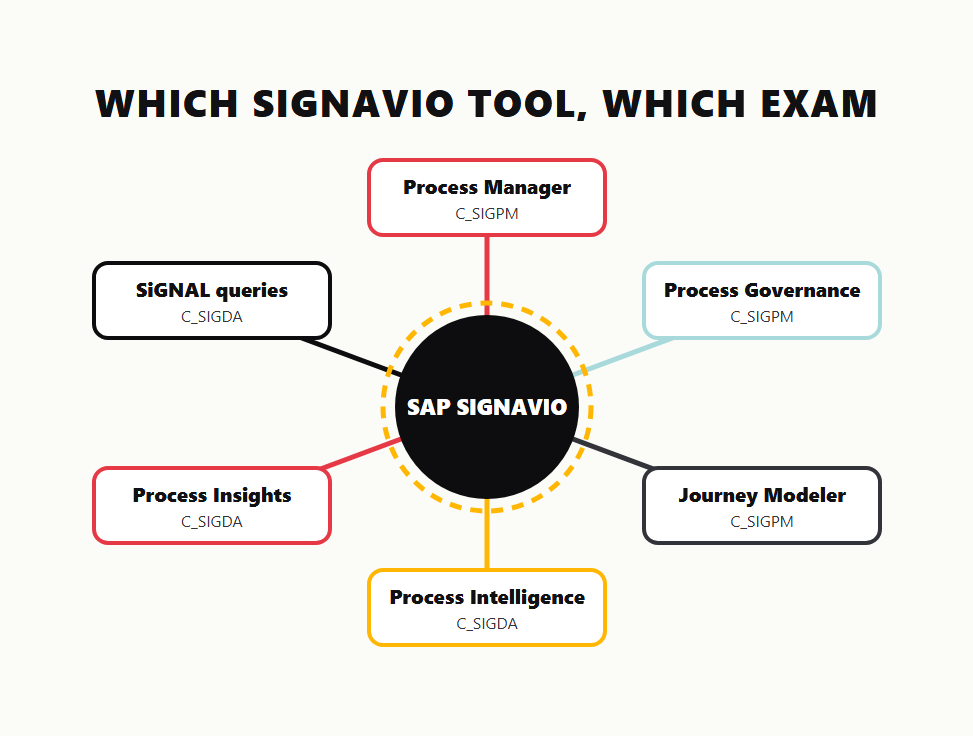
What separates them is where the work starts. C_SIGPM is the process management consultant credential, and it starts with a blank canvas: you design, govern and administer processes in SAP Signavio Process Manager with BPMN 2.0 and DMN. C_SIGDA is the process data analyst credential, and it starts with event data: you investigate how processes really run in SAP Signavio Process Intelligence, write SiGNAL queries and turn findings into recommendations.
This SAP Signavio certification comparison puts the two exams side by side, area by area, then gives a decision table and a preparation order for each, using only what SAP and the ERPPrep study guides publish.
How Do C_SIGPM and C_SIGDA Compare on Paper?
On paper the two exams are near twins. SAP lists both C_SIGPM and C_SIGDA as one Scenario-Based Assessment activity lasting 2 hours, both as entry level qualifications, and both with the same language options. The only published figure that differs is the pass score: 55 percent for the consultant exam and 50 percent for the analyst exam.
| Exam detail | C_SIGPM | C_SIGDA |
|---|---|---|
| Full title | SAP Certified – Process Management Consultant – SAP Signavio | SAP Certified – Process Data Analyst – SAP Signavio |
| Level | Associate, entry level | Associate, entry level |
| Format | Scenario-Based Assessment, 1 activity | Scenario-Based Assessment, 1 activity |
| Duration | 2 hours | 2 hours |
| Pass score | 55% | 50% |
| Languages | Roleplay with AI guidance: English, Spanish, Italian, French, Japanese and 25 more; recorded video: English only | Roleplay with AI guidance: English, Spanish, Italian, French, Japanese and 25 more; recorded video: English only |
| Role named by SAP | Consultant | Data Analyst |
| SAP learning journey | Managing Business Processes with SAP Signavio Solutions | Analyzing Business Processes with SAP Signavio Solutions |
| Courses named by ERPPrep | SIG001 | SIG002 and SIG005 |
| Question count and fee | Not published by SAP | Not published by SAP |
The duration and the language list come from SAP’s own pages for the process management consultant exam and the process data analyst exam. Both pages show the same 2 hour slot and the same rule for languages: they depend on whether you answer through roleplay with AI guidance or by recording a video.
Three things are missing from both pages, and this article does not fill them in. There is no question count, because a single scenario activity has no list of items to count. There is no exam fee, because attempts come from a Learning Hub subscription that includes certification attempts. And there are no domain weightings for the seven blueprint areas of either exam.
Which Job Does Each SAP Signavio Certification Describe?
C_SIGPM describes a process management consultant who designs and manages business processes with customer experience at the heart of the design. C_SIGDA describes a process data analyst who investigates processes from their data and recommends improvements. SAP tags the first with the Consultant role and the second with the Data Analyst role, which is the clearest signal of the split.
The consultant in C_SIGPM
SAP says the consultant exam validates fundamental knowledge for managing and designing business processes, and calls the role crucial for building a continuous, process-centric way of working inside an organization. The skills listed beside it are Business Process Monitoring, Process Transformation and Business Process Transformation. In practice this is the person who owns the model: the BPMN diagram, the decision table, the approval workflow and the workspace that holds them.
The analyst in C_SIGDA
The analyst exam confirms fundamental knowledge to conduct thorough investigations and make recommendations for improvement, as part of a process management practice founded on process data. SAP lists Data Analysis, Business Process Transformation, Process Transformation and Database Architecture as its skills. Database Architecture is the telling entry: this role touches how event data is connected and shaped before anyone reads a chart.
If the analyst path is the one that matches your week, the C_SIGDA study guide on ERPPrep lists its seven blueprint areas and the two SAP courses behind them, which makes a useful checklist against your own experience.
What Does C_SIGPM Test Beyond BPMN Diagrams?
C_SIGPM covers seven blueprint areas, and only one of them is pure BPMN modeling. The others reach into the Process Collaboration Hub, process governance and workflows, workspace administration, decision modeling with DMN, customer journeys with the Business Process Model Connector, and the embedded AI in SAP Signavio. ERPPrep publishes no weightings, so treat the areas as equally important.
- Business process foundations and the BPM lifecycle: what a process is, where variation and inefficiency come from, and how business process management is defined and structured.
- SAP Signavio Process Manager and the Collaboration Hub: the Explorer, the Editor, QuickModel, the Dictionary, value chains, simulation, reports and variant management.
- Process modeling and design in BPMN 2.0: responsibilities, gateways, events, sub-processes, external parties, IT systems and data objects.
- Process governance and workflow management: building workflows and approval flows that connect Process Manager with SAP Signavio Process Governance.
- Administering SAP Signavio solutions: notation and attributes, user licenses, groups and access rights, the dictionary, workspace reports and security settings.
- Decision modeling with DMN: decision tables, inputs, hit policies, sub-decisions, the Decision Manager and the verification feature.
- Customer journeys, connectors and embedded AI: the Journey Modeler, the Customer Journey Map, the Business Process Model Connector and AI support.
The notation itself is an open standard. The BPMN 2.0.2 specification from the Object Management Group defines the gateways, events and sub-processes the exam expects you to place correctly, so reading its element overview is time well spent.
Decision modeling follows a second standard from the same body. The OMG DMN specification explains decision tables and hit policies, the two DMN topics a scenario is most likely to turn on.
What Does C_SIGDA Test Beyond Dashboards?
C_SIGDA also covers seven blueprint areas, and reading charts is only a slice of them. The exam asks how event data is extracted and transformed, how SiGNAL queries define metrics, how process mining reconstructs real process flows, how SAP Signavio Process Insights guides analysis, and how the Plug and Gain approach supports SAP ERP transformation. ERPPrep publishes no weightings here either.
- Business process foundations and business process management: the same conceptual base as the consultant exam, used here to judge what a finding means.
- SAP Signavio Process Collaboration Hub: sharing a common process view so that findings can be discussed and acted on.
- Process mining fundamentals: rebuilding how processes actually run from event data, so deviations, delays and rework become visible.
- SAP Signavio Process Intelligence for analysts: starting investigations, using widgets, and analyzing performance, times, distributions and conformance.
- Data management, ETL and SiGNAL queries: connectivity, transformation, process data pipelines and queries that define metrics.
- SAP Signavio Process Insights and guided analysis: connecting a managed system and surfacing improvement opportunities without deep query writing.
- The Plug and Gain approach and embedded AI: use cases, provisioning, process house scores and best practice content, with AI support.
Process mining is the idea everything else in this blueprint builds on. If the term is new to you, the process mining overview on Wikipedia explains event logs, discovery and conformance checking in plain terms before you meet them inside Process Intelligence.
Where Do the Two Blueprints Overlap?
The two blueprints share three of their seven areas: business process foundations and the BPM lifecycle, the SAP Signavio Process Collaboration Hub, and the embedded AI capabilities of SAP Signavio. They also share the delivery model, one 2 hour scenario. Part of the study for either exam therefore counts toward the other, which matters if you plan to sit both.
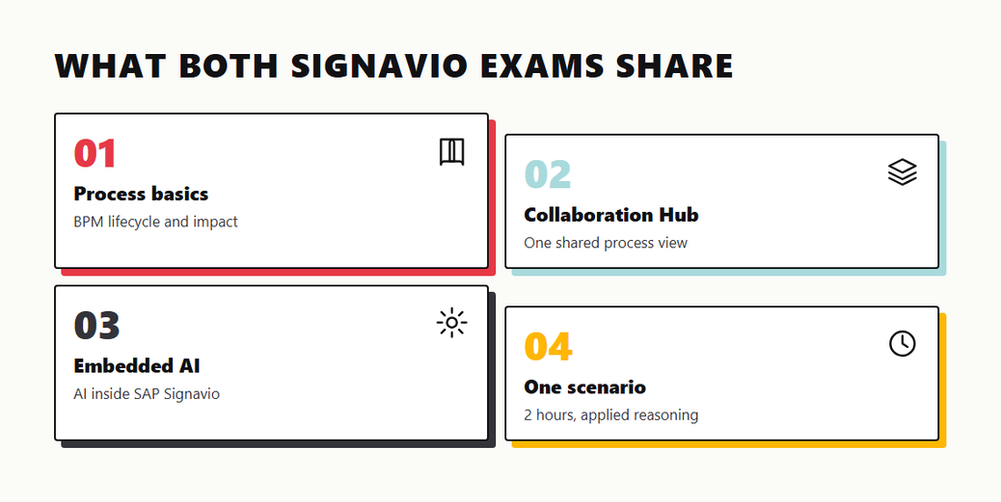
The overlap is conceptual rather than technical. Both exams expect you to explain why a process matters to the business before you change or measure it, and both expect you to publish and discuss results in the Collaboration Hub rather than keep them in a private model or report.
The split begins as soon as the tools come out. The consultant works in Process Manager, Process Governance and the Journey Modeler. The analyst works in Process Intelligence, Process Insights and the data pipeline behind them. Notation also divides cleanly: BPMN and DMN on one side, SiGNAL on the other.
Which SAP Signavio Certification Should You Take First?
Take C_SIGPM first if your work begins with designing, documenting or governing processes, and take C_SIGDA first if it begins with data that shows how processes really run. Neither page lists a prerequisite, and both are entry level, so the right first exam is the one that matches tasks you already do every week, not a fixed order set by SAP.
| Your situation | Start with | Why |
|---|---|---|
| You draw BPMN models for a transformation project | C_SIGPM | Modeling, governance and administration are four of its seven areas |
| You run approval workflows for process changes | C_SIGPM | Process Governance and approval flows are a named area |
| You map customer journeys | C_SIGPM | Journey Modeler and Customer Journey Map sit in its blueprint only |
| You analyze event logs or process KPIs | C_SIGDA | Process mining and Process Intelligence carry its blueprint |
| You build data pipelines or write queries | C_SIGDA | ETL and SiGNAL queries are a named area |
| You support an SAP ERP transformation with benchmarks | C_SIGDA | Process Insights and the Plug and Gain approach appear only here |
If your role mixes both, start with the exam whose missing areas are smaller for you. A modeler who has never touched an extraction pipeline will find the C_SIGDA data areas the steeper climb, while an analyst who has never built a DMN decision table will find the reverse.
How Does the Scenario Format Shape Preparation for Both?
Both exams are a single Scenario-Based Assessment, so preparation is about reasoning through one realistic business situation, not about recalling isolated facts. SAP offers two response formats: roleplay with AI guidance, available in English, Spanish, Italian, French, Japanese and 25 more languages, or a recorded video, available in English only. Choose your format before you study.
The format choice changes how you practise. For roleplay you rehearse explaining a modeling or analysis decision in conversation and answering follow-up questions. For a recorded video you rehearse a structured spoken answer that stands on its own, because no one interrupts to steer you.
SAP’s pages also point to an introduction to scenario-based assessments and an AI-powered tool where you can try the format before exam day. Before booking, check that your Learning Hub subscription includes certification attempts and that your SAP Universal ID has a secondary email, since both pages list these as conditions.
The consultant exam’s response formats get a closer look in our earlier walkthrough of the C_SIGPM scenario, which covers how the format shapes each of its blueprint areas.
How Should You Prepare for Each Exam?
Prepare for C_SIGPM by modeling, and for C_SIGDA by investigating. SAP attaches one learning journey to each exam: Managing Business Processes with SAP Signavio Solutions for the consultant and Analyzing Business Processes with SAP Signavio Solutions for the analyst. ERPPrep maps them to the course SIG001 for C_SIGPM and to SIG002 plus SIG005 for C_SIGDA.
A preparation order for C_SIGPM
- Work through the process foundations and the BPM lifecycle until you can explain a process problem in business terms.
- Model realistic processes in BPMN 2.0, with gateways, events, sub-processes and external parties.
- Build DMN decision tables, apply hit policies and check them with the verification feature.
- Connect a model to a governance workflow and an approval flow, then review workspace administration and access rights.
- Finish with customer journeys, the Business Process Model Connector and the embedded AI features.
A preparation order for C_SIGDA
- Learn the process foundations and what process mining reconstructs from event data.
- Run investigations in Process Intelligence with widgets for performance, times, distributions and conformance.
- Study ETL and data pipelines, then write SiGNAL queries that define metrics.
- Practise guided analysis in Process Insights and the Plug and Gain approach with process house scores.
- Close every practice run by turning a finding into a recommendation you can defend.
In both orders the last step is the one the scenario rewards most: a defensible decision. Knowing where a feature lives is necessary, but the assessment asks what you would do with it in a described situation.
Is It Worth Earning Both Signavio Credentials?
Earning both makes sense when your role covers the full improvement loop: designing a process, measuring how it really runs, and redesigning it from the evidence. The two exams describe the two halves of that loop. Holding both shows you can work on either side of a Signavio project, though for most people one credential matches the current job better.
The shared areas lower the cost of the second exam. Once you have passed one, the process foundations, the Collaboration Hub and the embedded AI are already familiar, so the effort goes into the four areas that differ.
The wider Signavio family on ERPPrep also includes C_SIGBT and C_SIGVT. For the toolchain side of transformation projects, see our article on the C_SIGVT toolchain credential, which covers a different exam and a different set of skills.
Frequently Asked Questions
What is the difference between C_SIGPM and C_SIGDA?
C_SIGPM certifies a process management consultant who designs, governs and administers processes in SAP Signavio Process Manager with BPMN 2.0 and DMN. C_SIGDA certifies a process data analyst who investigates processes from event data in SAP Signavio Process Intelligence and Process Insights, using ETL and SiGNAL queries.
What pass score do C_SIGPM and C_SIGDA require?
SAP shows a 55 percent pass score for C_SIGPM and a 50 percent pass score for C_SIGDA. It is the only published figure that differs between the two exams.
How long is each SAP Signavio exam?
SAP lists a duration of 2 hours for both C_SIGPM and C_SIGDA, each delivered as one Scenario-Based Assessment activity.
How many questions are on C_SIGPM and C_SIGDA?
SAP publishes no question count for either exam. Each is a single scenario activity, so there is no list of items to count.
How much does an SAP Signavio certification cost?
Neither SAP certification page shows an exam fee. Attempts come from a Learning Hub subscription that includes certification attempts, so the cost depends on the subscription you hold.
Which languages can I use for the SAP Signavio exams?
For both exams, SAP says languages vary by format: roleplay with AI guidance is available in English, Spanish, Italian, French, Japanese and 25 more languages, and a recorded video is available in English only.
Do I need C_SIGPM before C_SIGDA?
No. Neither SAP page lists a prerequisite, and SAP recommends both as entry level qualifications, so you can start with whichever matches your work.
Which SAP Signavio exam suits a business analyst?
A business analyst who works from process data, KPIs or event logs fits C_SIGDA. A business analyst who documents and redesigns processes in diagrams fits C_SIGPM.
Which SAP courses prepare for each exam?
SAP links C_SIGPM to the learning journey Managing Business Processes with SAP Signavio Solutions and C_SIGDA to Analyzing Business Processes with SAP Signavio Solutions. ERPPrep names SIG001 for C_SIGPM and SIG002 and SIG005 for C_SIGDA.
Conclusion
C_SIGPM and C_SIGDA look almost identical on paper: one scenario, 2 hours, entry level, the same languages, and pass scores of 55 and 50 percent. The real choice is about where your work starts. If you design, govern and administer processes with BPMN and DMN, C_SIGPM matches your week. If you investigate processes from event data with Process Intelligence and SiGNAL, C_SIGDA does. Use the decision table to pick the first exam, follow its preparation order, and rehearse in the response format you plan to use. The three shared areas will then carry into the second credential if your role grows into the full improvement loop.


