Most people expect a service certification to test how well they handle customer cases. The SAP Service Cloud certification does something else. It asks whether you can build the place those cases land: the tenant, the roles, the service organization, the products and installed bases, the case types with their status schemas, the service-level agreements, the routing rules and the email and phone channels. Exam C_C4H56 checks that build inside one hands-on System-Based Assessment that SAP times at three hours and passes at 67 percent.
This article explains what the credential certifies, how the single activity works, how SAP weights its three exam topics against the seven setup areas, why a setting made early decides what happens later, a preparation order built on SAP’s learning journey, which code to book, and who gains most from holding it.
What Does the SAP Service Cloud Certification Actually Certify?
The SAP Service Cloud certification, C_C4H56, certifies that you can set up, implement and use SAP Service Cloud Version 2 as a member of a project team working in a mentored role. SAP frames it around the core skills of the consultant profile, so it checks configuration ability rather than familiarity with the product’s screens or its marketing vocabulary.
The full credential name SAP displays is SAP Certified – Implementation Consultant – SAP Service Cloud Version 2. ERPPrep lists it at the Associate level, and SAP attaches a single role to it, Consultant. The skills SAP lists alongside the exam are System Configuration, Customer Relationship Management, Service Management, Customer Inquiries, Customer Service and Master Data Management.
Read that list carefully and the shape of the exam appears. Two of the six skills are about the customer conversation, but four are about the system behind it. The credential is for the person who makes a service desk work, not the agent who works in it. That is the distinction this article keeps returning to, because it decides how you should study.
What the product is
SAP Service Cloud Version 2 is SAP’s customer service application for handling cases, service objects and contact across channels such as email and phone. It sits in the wider class of customer relationship management software, which independent CRM background describes as the practices and tools a company uses to manage interactions with customers. SAP’s own Service Cloud product overview covers the commercial side; the exam covers the configuration side.
How Does the C_C4H56 System-Based Assessment Work?
C_C4H56 is a System-Based Assessment made of one activity. Instead of reading questions and choosing answers, you work inside a configured SAP Service Cloud Version 2 system and carry out real setup and operational tasks. SAP displays a duration of 3 hours and a pass score of 67 percent, and the exam is available in English.
SAP finished moving its certification portfolio to performance-based formats in early 2026. There are two of them. A System-Based Assessment, or SyBA, puts you in a live-style system and scores whether each task was completed correctly. A Scenario-Based Assessment, or SBA, gives you a business situation and asks you to reason through the right decisions. C_C4H56 is the first kind: the grader looks at what you configured, not at what you can recognise.
| Exam fact | What SAP displays |
|---|---|
| Credential | SAP Certified – Implementation Consultant – SAP Service Cloud Version 2 |
| Code | C_C4H56 |
| Format | System-Based Assessment, 1 activity |
| Duration | 3 hr |
| Pass score | 67% |
| Language | English |
| Role | Consultant |
Three hours for a single activity is a long stretch of continuous work. Speed matters less than steadiness: a candidate who knows where each setting lives and moves through the sequence without hesitating keeps time in hand for the steps that depend on reading the task closely. Rehearsing whole flows rather than isolated screens is the way to build that, and ERPPrep’s C_C4H56 scenario simulations are built around multi-phase setups in that spirit, alongside skill drills for each area.
What you need before booking
SAP’s certification page lists three things to sort out first. Run the Technical Readiness Checklist to confirm your hardware, software and connection meet the requirements. Hold a Learning Hub subscription that includes SAP certification exam attempts. Set up a valid SAP Universal ID that includes a secondary email address. The exam page shows subscription attempts and exam attempts separately, and each exam attempt counts as one attempt from the subscription.
How Are the Three Exam Topics Weighted?
SAP weights C_C4H56 across three exam topics: Essential Configuration for SAP Service Cloud v2 at 31 to 40 percent, Master Data Creation in SAP Service Cloud v2 at 31 to 40 percent, and Transaction Data creation in SAP Service Cloud v2 at 21 to 30 percent. Configuration and master data together carry most of the weight, so the build matters more than the cases.
| SAP exam topic | Weight | Setup areas it draws on |
|---|---|---|
| Essential Configuration for SAP Service Cloud v2 | 31-40% | Starting the implementation and base configuration; user management and interface tailoring; service elements; communication channels |
| Master Data Creation in SAP Service Cloud v2 | 31-40% | Service organization, customer accounts and products; service objects such as registered products, warranties and installed bases |
| Transaction Data creation in SAP Service Cloud v2 | 21-30% | Case management: case types, the case designer, party and status schemas |
The third column is a reading aid, not an SAP mapping. SAP publishes the three topics and their weightings; ERPPrep’s study guide breaks the same ground into seven setup areas without weights. Placing the seven inside the three makes clear which tasks feed which share of the score.
The seven setup areas
- Starting the implementation and base configuration: scoping the rollout, confirming system requirements, activating contracts and tenants, switching on base configuration.
- User management and interface tailoring: roles with access restrictions, employee records, generic settings, extensibility, code-list restriction rules and page layouts.
- Master data setup: a root service organization and the organization beneath it, customer accounts, products and restricted access to service objects.
- Creating service objects: number ranges, custom party roles, registered products, warranties, installed bases, functional locations and product installation points.
- Setting up case management: case types, the case designer, the party schema, a customised status schema and extracting business information from cases.
- Configuring service elements: service categories, service-level agreements and case routing.
- Configuring communication channels: the email channel with its templates, and the phone channel.
What Does the Setup Chain Look Like From Tenant to Routed Case?
The C_C4H56 setup chain runs from enabling the tenant, through users and access, master data and service objects, to case types, service-level agreements and routing. Each stage assumes the one before it is correct, which is why SAP’s learning journey teaches the steps in this order and why the exam rewards candidates who think in sequence.
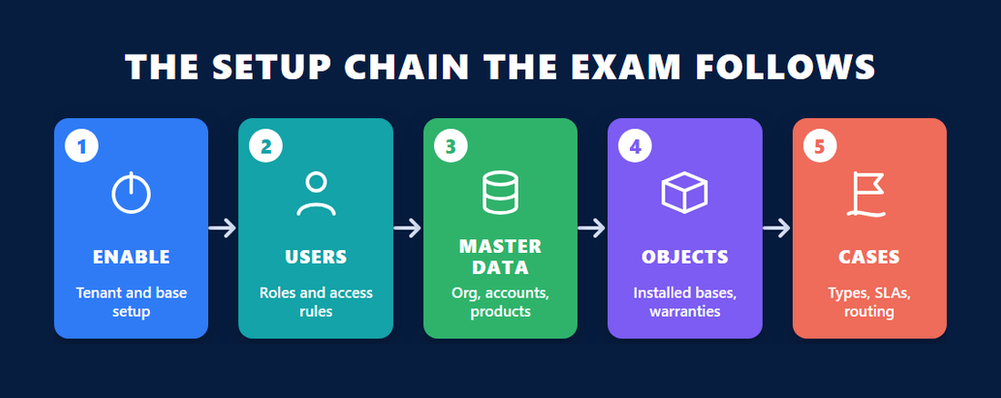
Start at the top. Base configuration and the activated tenant are what every later screen depends on. Users come next, because a role without the right access restriction either sees too much or cannot reach the record it needs. Master data follows: the service organization tree, customer accounts and products are the records that service objects and cases point at.
Service objects are where Service Cloud starts to look like a service business rather than a contact list. A registered product ties an item to a customer, a warranty sets what is covered, and an installed base groups the assets at a site, with functional locations and product installation points describing where they sit. When a case is later raised against equipment, these objects are what it refers to.
Only then do cases appear. Case types, the case designer, the party schema and the status schema decide what a case looks like and how it moves. Service categories classify it, service-level agreements set the response and resolution expectations, and routing sends it to the right team or queue. The email and phone channels close the loop by turning customer contact into cases that arrive in that structure. Email in particular rides on the long-standing internet mail standard, described in the SMTP specification RFC 5321, which is useful background when a channel test fails for reasons outside the application.
Why Does an Early Setting Change What Happens Later?
In SAP Service Cloud Version 2 an early setting changes what happens later because later objects inherit it. An access restriction on a role decides who can see which cases, a status schema on a case type decides which steps a case can take, and the service organization tree feeds where routing can send work. The C_C4H56 activity is built on chains like these.
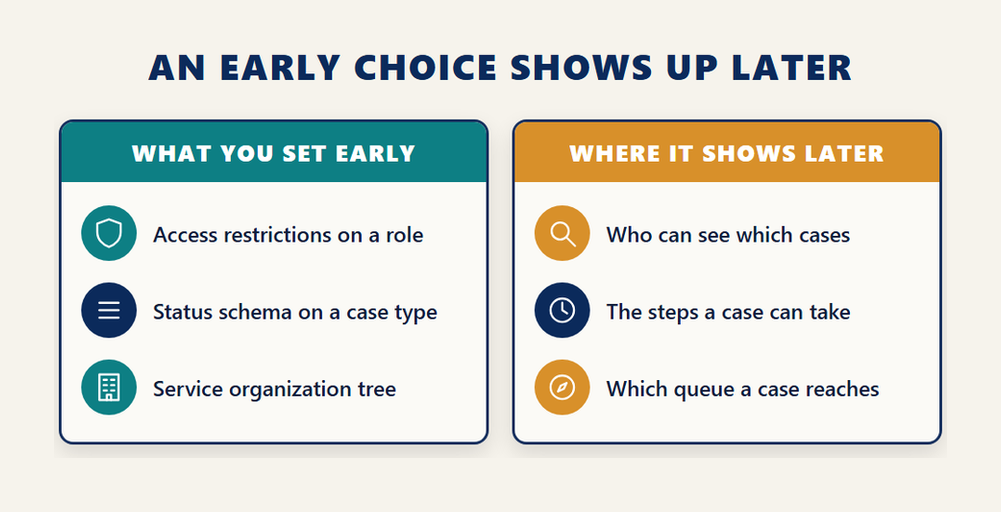
ERPPrep’s study guide makes the same point about case management: a status schema or party role set up early quietly shapes how work flows later. Its exam FAQ names the hardest areas for candidates as case management configuration, service-object modelling, and the access-restriction and routing logic that decides who sees what.
This has a direct consequence for how you read a task. If a step near the end of the activity does not behave as expected, the cause is often several steps back. A case that will not reach a team may be a routing rule, but it may also be an organization unit that was never created or a role that cannot see the record. Candidates who check upstream before changing the downstream setting lose less time and break less.
Three habits that help in the activity
- Read the whole task before touching the system, and note which earlier objects each step relies on.
- After each setting, confirm the result where it shows up, not only on the screen where you made it.
- When something fails late, walk back up the chain one stage at a time before editing anything.
How Should You Prepare for C_C4H56?
Prepare for C_C4H56 by following SAP’s Implementing SAP Service Cloud Version 2 learning journey in order, then rehearsing the setup chain hands-on until it is routine. The journey has two core courses, C4H561 Essentials and C4H562 Configuring Service Operations, and SAP places a practice system inside it for System-Based exams.
The Service Cloud learning journey lists Administrator, Business User and Consultant as its roles and expects basic knowledge of SAP Service Cloud Version 2 and service business processes before you start. ERPPrep puts the two courses at about 284 minutes of content, which is a small fraction of the preparation time once hands-on repetition is added. A sensible order looks like this:
- Work through the C4H561 Essentials course first, covering system enablement, user management, interface tailoring and master data setup.
- Continue with C4H562 Configuring Service Operations, covering service objects, case management, service elements and communication channels.
- Rebuild the master data foundation yourself in the practice system: a root service organization, the organization beneath it, customer accounts and products.
- Give case management its own block of study, building case types, the party schema and a customised status schema, then checking how a case moves.
- Configure service categories, service-level agreements and routing together, then raise test cases and confirm each lands where you expect.
- Finish by running the whole chain end to end under a three-hour limit, from base configuration to a routed case arriving by email.
The order follows the dependency chain on purpose. Each step uses objects built in the one before, so the practice itself teaches the cause-and-effect reading that the activity rewards. Candidates new to SAP can still take this route; ERPPrep notes that the credential targets an entry-level, mentored role, so it assumes foundational learning rather than years of project work, but newcomers should budget extra weeks for the hands-on steps.
Older study material is easy to find and worth reading with care. Earlier exam codes for this credential were delivered differently, so descriptions of question counts or older pass marks do not describe the current activity. ERPQnA’s own earlier Service Cloud V2 preparation page is useful for product background, but take every exam fact from SAP’s current certification page.
C_C4H56, C_C4H56_2601 or C_C4H56_2411: Which Code Do You Book?
The code SAP displays on its certification page today is C_C4H56. Searches also use versioned codes such as C_C4H56_2601 and C_C4H56_2411, and older pages carry C_C4H56I_34. They all refer to the same credential line, but only the current SAP page describes the exam you will actually sit.
Search data shows the lag clearly. Queries for the older C_C4H56_2411 code still outnumber those for anything newer, which means many readers arrive expecting the exam those older codes described. If a page you are reading gives a question count, a pass mark other than 67 percent, or no mention of a System-Based Assessment, it is describing an earlier version.
The safe rule is to book from the SAP C_C4H56 certification page, check the displayed pass score, duration and format there on the day you book, and treat any other source as background. SAP’s page is also where a future retirement or successor would be announced first.
Who Is the Credential For, and Where Does It Lead?
C_C4H56 suits implementation consultants, administrators and business users moving into an SAP Service Cloud Version 2 project who want an associate credential showing they can configure the solution. It fits people early in their Service Cloud path and service professionals formalising platform skills, and it signals readiness for a mentored project role.
For a consultant, the value is credibility on a rollout team: proof that you can be handed the master data or the case setup and produce a working result. For an in-house administrator, it confirms that the person maintaining the service desk understands why it behaves as it does. For a business user, it is a structured way into the configuration side of a tool they already use.
The credential sits within SAP’s customer experience family. ERPPrep lists related exams including C_C4H47 for SAP Sales Cloud Version 2, C_C4H41, C_C4H62 and C_C4H63, so a consultant working across sales and service processes has a natural next step. Earlier ERPQnA coverage of the C_C4H56_2411 code details shows how the credential looked before the move to the current format, which is useful if your employer’s records still use the older code.
Frequently Asked Questions
What is the pass score for the SAP Service Cloud certification?
SAP displays a pass score of 67 percent for C_C4H56. ERPPrep’s study guide gives the same figure. Pages quoting a different pass mark are describing an earlier version of the exam.
How long is the C_C4H56 exam?
SAP displays a duration of 3 hours for the single System-Based activity. Plan your rehearsal around a full three-hour run of the setup chain.
Is C_C4H56 a System-Based Assessment?
Yes. SAP lists the assessment type as System Based, with one activity. You configure and operate SAP Service Cloud Version 2 in a working system, and the result depends on whether the tasks are completed correctly.
Which code is current: C_C4H56, C_C4H56_2601 or C_C4H56_2411?
SAP’s certification page displays C_C4H56. The versioned codes refer to the same credential line, and the older ones describe earlier versions. Book from SAP’s current page.
How are the C_C4H56 exam topics weighted?
SAP weights Essential Configuration at 31 to 40 percent, Master Data Creation at 31 to 40 percent and Transaction Data creation at 21 to 30 percent.
What languages is the SAP Service Cloud Version 2 exam available in?
SAP’s page shows the exam as available in English, and ERPPrep lists English as well.
Which courses prepare you for C_C4H56?
SAP’s Implementing SAP Service Cloud Version 2 learning journey, made up of C4H561 Essentials and C4H562 Configuring Service Operations. SAP also places a practice system inside the journey.
What do you need before booking the exam?
A Learning Hub subscription that includes certification exam attempts, a valid SAP Universal ID with a secondary email, and a passed Technical Readiness Checklist for your hardware, software and connection.
Can you prepare without previous SAP experience?
Yes, because the credential targets an entry-level, mentored project role. Follow the learning journey in order and allow extra weeks for hands-on work in the practice system.
Conclusion
The SAP Service Cloud certification is about the build, not the cases. C_C4H56 asks you to enable a tenant, set up users and access, create the service organization and master data, model service objects, and configure case types, service-level agreements, routing and channels, all in one System-Based activity that SAP times at three hours and passes at 67 percent. Configuration and master data carry most of the weight, and the hardest tasks are the ones where an early setting shows up much later. Work through SAP’s learning journey in order, rehearse the whole chain in the practice system until it is routine, check every exam fact on SAP’s current page before you book, and walk into the activity ready to trace any problem back up the chain.


