Type SAP SD certification into a search box and the answer you need back is a code: C_TS462. SAP no longer certifies a module called Sales and Distribution; the credential that took its place is SAP Certified – Implementation Consultant for SAP S/4HANA Cloud Private Edition, Sales, an Associate level exam from SAP that covers the same order-to-cash work the SD consultant always did, configured and run inside SAP S/4HANA. Three things about it catch out people who prepared for the older release-stamped versions. The pass mark is 82 percent, well above the 60 percent that many SAP associate exams use. The exam is a single System-Based Assessment activity, so you complete configuration and transaction tasks in a working system rather than selecting answers. And SAP displays a 3 hour duration on its certification page, a figure the money-site pages do not carry at all.
This article answers the questions candidates actually type: which code to book now that the suffixed versions have gone, how the 82 percent threshold is scored, what happens inside the 3 hour activity, which seven blueprint areas make up the syllabus, how the twelve-course learning journey is sequenced, and whether the procurement sibling, C_TS452, would suit your role better than the sales exam.
Table of Contents
- What is the SAP SD certification called now?
- How is C_TS462 scored, and why is 82 percent the bar?
- What happens inside the 3 hour System-Based Assessment?
- Which seven blueprint areas does C_TS462 cover?
- How does the order-to-cash chain run through the exam?
- Which twelve courses make up the learning journey?
- SAP MM or SAP SD: which certification fits your role?
- Who should take C_TS462, and who should wait?
- Frequently Asked Questions
- Conclusion
What is the SAP SD certification called now?
The SAP SD certification is now C_TS462, SAP Certified – Implementation Consultant for SAP S/4HANA Cloud Private Edition, Sales. SD stands for Sales and Distribution, the module name in SAP ERP; in SAP S/4HANA the same functions sit under the Sales line of business, which is why the credential title says Sales rather than SD. The current code carries no release suffix.
That last point matters because the suffixed codes still draw searches. Candidates type C_TS462_1909, C_TS462_2021, C_TS462_2022, C_TS462_2023 and C_TS462_2601 into search engines every month, and each of those named a specific release of the exam. SAP’s certification page today lists the credential as C_TS462, release 1, with no retirement date shown. If you are comparing study material or a job advert that names one of the older codes, the exam you book is the un-suffixed one.
What the Associate level means here
SAP pitches C_TS462 at an entry-level consultant working at mentored project depth. The money-site study guide describes the audience as sales and distribution consultants, and business users moving into an SAP S/4HANA sales role, who want proof they can configure and run order-to-cash, delivery, billing and pricing as a member of an implementation team rather than its lead. The content applies to SAP S/4HANA Cloud Private Edition and to on-premise deployments, so the badge transfers across both kinds of project.
Why the title no longer says Associate
ERPPrep and SAP’s own page both use the exact wording SAP Certified – Implementation Consultant for SAP S/4HANA Cloud Private Edition, Sales. Older erpqna guides for this exam used the earlier form, SAP Certified Associate, and some job boards still do. The level is unchanged; only the naming convention moved, with the level shown as a separate field on the certification card. The credential also sits in SAP’s Stay Certified programme, and SAP’s page is the place to check the assessment cadence that keeps the badge current.
How is C_TS462 scored, and why is 82 percent the bar?
C_TS462 is passed at 82 percent, a threshold both ERPPrep and SAP publish, and one that sits well above the 60 percent used by many SAP associate certifications. Because the exam is a System-Based Assessment, the score reflects how many assigned tasks were completed correctly inside the system. There is no list of separate items to collect marks from.
| Field | Value |
|---|---|
| Exam code | C_TS462 |
| Credential | SAP Certified – Implementation Consultant for SAP S/4HANA Cloud Private Edition, Sales |
| Level | Associate |
| Format | System-Based Assessment (SyBA), 1 activity |
| Duration | 3 hours, as displayed by SAP; the money-site pages publish no duration |
| Passing score | 82 percent |
| Languages | English |
| Product | SAP S/4HANA Cloud Private Edition, with content that also applies to on-premise |
| Blueprint areas | 7, with no published weightings |
| Renewal | Part of SAP’s Stay Certified programme |
What 82 percent means in a task-based exam
ERPPrep’s FAQ explains the high cut score plainly: SAP sets each exam’s threshold to the competency it wants certified for that role, and for sales it expects reliable capability across the whole order-to-cash scope rather than familiarity with a few topics. In a task-based activity, partial familiarity rarely earns partial credit. A copying-control rule set wrong early shapes how a later document is created, so one upstream slip can cost marks at several downstream steps.
The practical response is to prepare for execution rather than recognition. Candidates who already configure sales documents, pricing and billing in a live system generally find the threshold manageable; those who have only read about those settings tend to struggle once the system demands real actions.
What SAP displays and what ERPPrep publishes
The two sources agree on everything they both carry: Associate level, the single System-Based activity, the 82 percent pass score, English delivery and the Private Edition product. SAP’s C_TS462 certification page adds the 3 hour duration and the Stay Certified entry, neither of which appears on the money-site pages. Neither source publishes an exam fee for C_TS462, so none is stated here.
What happens inside the 3 hour System-Based Assessment?
A System-Based Assessment places you in a configured SAP S/4HANA system and asks you to carry out sales configuration and transaction tasks: create documents, adjust settings, complete process steps. C_TS462 is one such activity, and SAP displays a 3 hour duration for it. Each task is scored on whether it was completed correctly, so fluency with the screens matters as much as knowing the theory.
SAP moved its certification programme to performance-based formats and completed that shift in early 2026. The head of that programme described the intent when SAP Certification marked its thirtieth year.
“For 30 years, SAP Certification has helped people demonstrate the skills they need to grow their careers and help organizations get more value from SAP technology. What has kept it relevant is our willingness to evolve. As AI changes how people work, certification must change with it, moving beyond what someone knows to validating what they can actually do.”
That framing explains the 82 percent threshold as much as the format. If the activity records what you did rather than what you recognised, the bar can sit higher without becoming arbitrary. SAP’s thirty year certification review also carries the recollection of a long-certified consultant who has watched the format move from on-site and webcam-proctored exams to today’s scenario-based and system-based assessments.
What the tasks look like
The money-site sample scenarios show the reasoning the exam rewards. A new distribution channel accepts orders but proposes no delivering plant, because the plant was never assigned to the new sales area. A new customer account group does not propose a ship-to party, because its partner determination procedure lacks that function. A new product prices at zero, because no condition record exists for the price condition type. A billing document will not release to accounting, because revenue account determination finds no general ledger account. In every case the fix is a configuration object, not a manual workaround, and that is the habit the activity scores.
Working through ERPPrep’s full scenario simulations builds exactly that habit: each scenario describes a business situation and asks you to pick the configuration change that fixes it for every future order, not just the one on screen. The free sample needs no account, and the full set runs to 24 scenario simulations and 240 skill drills across the blueprint areas.
Managing 3 hours as one activity
Because there is one activity rather than a sequence of short items, hesitation on routine steps adds up. ERPPrep’s FAQ recommends rehearsing the standard sequences, creating a sales order, posting a goods issue, generating a billing document, until they run without thought, so the exam time goes on the decisions that vary by scenario. Knowing the common navigation paths and configuration entry points in the Fiori launchpad in advance is the other half of the same advice.
Which seven blueprint areas does C_TS462 cover?
C_TS462 covers seven blueprint areas: Sales Processes & Order-to-Cash Execution; Enterprise Structure & Sales Master Data; Sales Document & Item Category Configuration; Copying Control, Partner, Output & Text Determination; Availability Check & Delivery Processing; Billing & Pricing Configuration; and Implementation Approach: RISE and S/4HANA Cloud Private Edition. No weightings are published for any of them, so plan by process chain rather than by percentage.
| Blueprint area | What it asks you to handle |
|---|---|
| Sales Processes & Order-to-Cash Execution | Running the end-to-end cycle in SAP S/4HANA Sales: order entry, shipping and goods issue, billing and its handoff into Finance, navigating the Fiori launchpad and recognising the organisational units that frame selling |
| Enterprise Structure & Sales Master Data | Setting up the selling enterprise structure and maintaining business partner and customer records, the material master, the condition records that drive pricing, and customer-vendor integration so documents default correctly |
| Sales Document & Item Category Configuration | Configuring sales document types, item categories and their assignment, schedule line categories, bills of material, and special functions such as blocks and rejection reasons |
| Copying Control, Partner, Output & Text Determination | Configuring copying control across the document flow, the partner function concept and determination procedures, and output, text and incompletion handling |
| Availability Check & Delivery Processing | Running the available-to-promise check and backorder processing, then configuring delivery documents, goods issue posting, delivery and transportation scheduling, and embedded EWM integration |
| Billing & Pricing Configuration | Configuring billing documents, special billing types, account determination and the link into Financial Accounting, plus condition technique pricing, special condition types, tax determination and condition contract management |
| Implementation Approach: RISE and S/4HANA Cloud Private Edition | Framing the work inside a Cloud Private Edition implementation: RISE with SAP methodology, clean core, fit-to-standard workshops, landscapes, users and authorisations, extensibility, integration, data migration and testing |
Six functional areas and one about the project
The first six areas are the sales functions themselves, and they follow the order in which a sales document is built: structure and master data first, document behaviour second, shipping third, money last. The seventh is different in kind. It asks you to understand the project you would be working on, which for a Private Edition customer means RISE with SAP, the methodology SAP uses to move customers into its cloud editions, together with clean-core fundamentals and fit-to-standard workshops.
Candidates coming from an on-premise SD background usually know the first six areas well and the seventh hardly at all. The two implementation courses in the learning journey exist for that reason, and skipping them because the sales content feels familiar is a common way to leave marks behind.
How does the order-to-cash chain run through the exam?
Order-to-cash in SAP S/4HANA Sales runs sales order, outbound delivery, goods issue, billing document, and C_TS462 follows that chain. The enterprise structure and master data decide what an order can do, document and item category configuration decide how it behaves, availability checking and delivery scheduling decide when it ships, and billing with account determination decides how revenue reaches Financial Accounting.
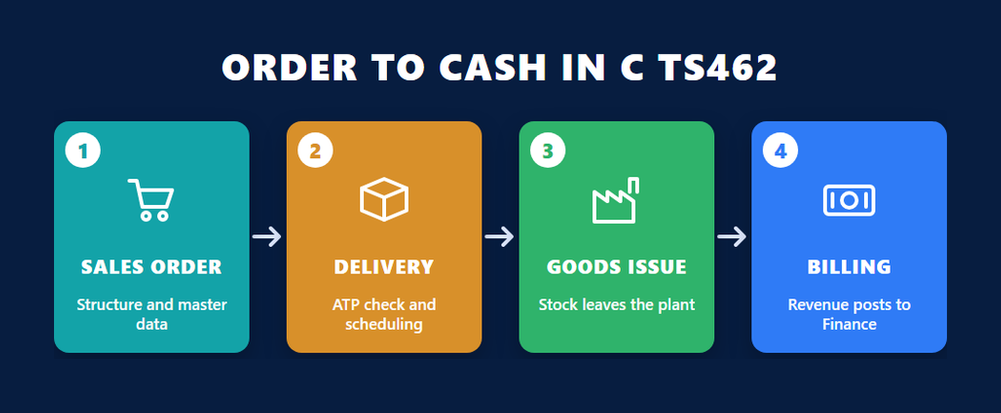
Order-to-cash is not an SAP term. It is the generic name for the business process that starts when a customer places an order and ends when payment is received, as the order to cash overview on Wikipedia sets out, and every ERP vendor implements some version of it. What C_TS462 tests is SAP’s specific implementation: which objects carry the process, where each setting lives, and how a value entered at one step is copied, determined or checked at the next.
Where an upstream setting surfaces downstream
Three mechanisms carry most of the cause and effect. Copying control governs how a delivery is created from an order and a billing document from a delivery, so a rule set wrong at order level shows up as a problem two documents later. Item category determination uses the material’s item category group, so a material master entry decides whether a line is relevant for delivery, for billing, or for neither. The condition technique decides which pricing condition records are found, so a missing record shows up as a zero net value on the order and, if uncaught, on the invoice.
ERPPrep’s FAQ names exactly these three, copying control and document flow, pricing and the condition technique, and availability check and delivery scheduling behaviour, as the areas candidates find hardest. The difficulty is not the individual screen. It is building the mental model of what each setting changes several steps away.
The Finance handoff
The chain ends when the billing document releases to accounting, and that step has its own configuration. Revenue account determination must find a general ledger account for the combination of customer, material and billing type involved; if it does not, the invoice is created but no accounting document follows and the revenue never reaches the ledger. Billing & Pricing Configuration therefore asks you to understand the link from Sales into Financial Accounting, not only the sales side of the invoice. Account determination, data flow and special billing types are high-value topics because the correct outcome depends on how the upstream order and delivery were configured.
Which twelve courses make up the learning journey?
The learning journey Implementing Sales in SAP S/4HANA Cloud Private Edition contains twelve courses, S46000 through S4C03, and ERPPrep’s FAQ puts the journey at roughly 80-plus hours, suggesting two to three months of preparation alongside a job. Ten courses cover the sales functions themselves; the last two, SL_RISE419 and S4C03, supply the implementation context behind the seventh blueprint area.
| Course | Title | Covers |
|---|---|---|
| S46000 | Exploring SAP S/4HANA Sales Essentials | Launchpad navigation, organisational units, a full order-to-cash cycle, master data, presales documents, embedded sales analytics |
| S46001 | Performing the Availability Check | Running and reviewing an ATP check on a sales order, backorder processing and how its results are read |
| S46050 | Fundamental customizing in SAP S/4HANA Sales | Enterprise structure, business partner and customer master data, document types, item and schedule line categories, copying control, partner determination |
| S46051 | Defining Outline Agreements in SAP S/4HANA Sales | Scheduling agreements, quantity contracts and value contracts |
| S46052 | Configuring Incompletion Procedures in SAP S/4HANA Sales | The incompletion log and how to configure an incompletion procedure |
| S46055 | Customizing Output Control in SAP S/4HANA Sales | Output control concepts, core components, output parameters for sales orders |
| S46056 | Setting up Text Control in SAP S/4HANA Sales | Text control for manual entry and automatic transfer, where texts originate |
| S46100 | Configuring Delivery Processing in SAP S/4HANA Sales | Delivery document structure, organisational units, controls, goods issue posting, scheduling, embedded EWM integration |
| S46150 | Configuring Billing in SAP S/4HANA Sales | Billing integration, special billing types, data flow, billing plans, down and installment payments, account determination |
| S46200 | Configuring Pricing in SAP S/4HANA Sales | The condition technique, pricing control, condition records, special and statistical condition types, tax determination, condition contracts |
| SL_RISE419 | Introducing RISE with SAP Methodology for SAP Partners and Customers | RISE phases, standardised framework, tools, clean-core fundamentals, the methodology dashboard |
| S4C03 | Implementing SAP S/4HANA Cloud Private Edition | Conversion and new-implementation scenarios, landscapes, Cloud ALM project setup, authorisations, fit-to-standard, extensibility, migration, testing |
SAP hosts all twelve on its Implementing Sales learning journey, which is the authoritative place for current course content. The course list is identical on the money-site study guide, so either page can be used to track progress.
A preparation order that follows the process
The course codes are not the study order. ERPPrep’s FAQ sets out a sequence that mirrors how the processes connect in a real project, so each course reinforces the one before it.
- Start with S46000, Exploring SAP S/4HANA Sales Essentials, to see the whole order-to-cash cycle once before configuring any part of it.
- Work through S46050, Fundamental customizing in SAP S/4HANA Sales, so the enterprise structure, master data, document types, item and schedule line categories and copying control are in place before the process courses depend on them.
- Take S46001 for the availability check and S46100 for delivery processing together, because ATP results, backorder processing and delivery scheduling interact.
- Move to S46150 for billing and S46200 for pricing, treating pricing as its own study block and following billing through account determination into Financial Accounting.
- Add S46051, S46052, S46055 and S46056, the outline agreement, incompletion, output and text courses, once the main chain runs cleanly.
- Finish with SL_RISE419 and S4C03 for the RISE with SAP methodology and the Cloud Private Edition implementation context, then rehearse complete scenarios and skill drills under a clock in the final weeks.
Hands-on system access is the one resource the FAQ calls strongly recommended rather than optional, because only a system builds the speed the single activity demands. Where direct access is limited, scenario-based simulation that mirrors the task sequences is the next best rehearsal. The site’s earlier sales preparation guide for this credential still covers the enterprise structure and master data topics in more detail than this article does.
SAP MM or SAP SD: which certification fits your role?
SAP MM and SAP SD are the legacy module names for what SAP S/4HANA now certifies as Sourcing and Procurement, exam C_TS452, and Sales, exam C_TS462. Choose by the process you want to own: C_TS452 covers the buying side, C_TS462 covers selling from order through delivery to billing. ERPPrep lists C_TS452 as the closest related credential to C_TS462.
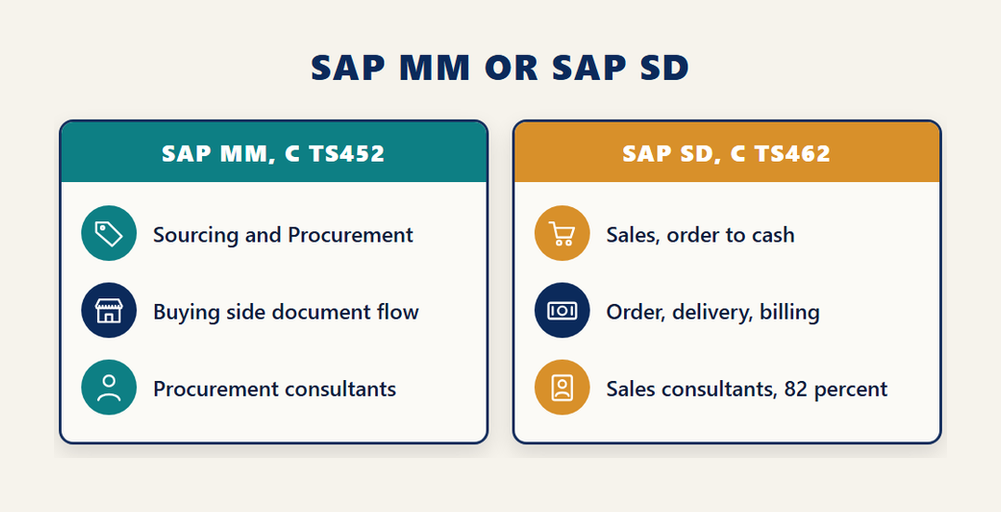
The decision is rarely about which exam is easier. It is about which document flow your projects run through you. If your day involves purchase requisitions, purchase orders, goods receipts and invoice verification, the procurement credential matches the work. If it involves sales orders, outbound deliveries, goods issue and customer invoices, C_TS462 does. Consultants who sit between the two, on intercompany or third-party order processing, usually start with the side their employer bills for and add the other later.
Private Edition, on-premise, or Public Edition
One more fork sits inside the sales choice itself. C_TS462 is written for SAP S/4HANA Cloud Private Edition, and ERPPrep’s FAQ confirms that its content also applies to on-premise deployments, because the same sales processes are examined against the S/4HANA environment rather than a legacy or public-cloud edition. A project on SAP S/4HANA Cloud Public Edition certifies sales through a different exam, C_S4CS. Check which edition your target projects run before booking either one.
For a Private Edition or on-premise sales role, C_TS462 is the right exam, and the seventh blueprint area already covers the RISE methodology that a Private Edition project is delivered under.
Who should take C_TS462, and who should wait?
C_TS462 suits sales and distribution consultants early in their SAP consulting path, business users moving into an SAP S/4HANA sales role, and experienced sales professionals formalising platform skills they already use. The money-site FAQ assumes entry-level project participation under mentoring, so prior hands-on exposure to the order-to-cash cycle makes preparation noticeably smoother but is not a formal prerequisite.
Candidates with no SAP background
You can prepare without prior SAP experience, but the FAQ is direct about the cost: more time and more deliberate hands-on practice. The credential targets a mentored role, so it assumes foundational learning rather than years of expertise, and the full learning journey in the order above is designed for exactly that reader. Budget the fuller end of the two to three month range, and prioritise repeated scenario rehearsal over reading, because the format tests doing.
When a broader credential fits better
Some candidates do not yet know which line of business they will specialise in. For them, a single-module exam like C_TS462 can be premature. The end-to-end business processes credential, C_IEE2E, runs the lead-to-cash flow as one of five cross-functional processes in a System-Based Assessment at a lower pass score, and it is a reasonable first badge for someone who wants breadth before depth. Candidates who already know they will configure sales should go straight to C_TS462; the 82 percent bar rewards focus.
Who should wait
Two groups benefit from a pause. Anyone without access to a system should secure one first, through an employer, a training provider or a sandbox, because reading alone leaves candidates unable to execute tasks fluently. And anyone whose project is on SAP S/4HANA Cloud Public Edition should confirm that the Private Edition sales exam is the one their employer recognises before committing two to three months to it.
Frequently Asked Questions
What is the exam code for the SAP SD certification?
The current exam code is C_TS462, for SAP Certified – Implementation Consultant for SAP S/4HANA Cloud Private Edition, Sales. SD is the legacy Sales and Distribution module name from SAP ERP; in SAP S/4HANA the same functions are certified under Sales. Older codes such as C_TS462_2022 and C_TS462_2023 named specific releases and are no longer the code to book.
What is the passing score for C_TS462?
The passing score is 82 percent, published by both ERPPrep and SAP. That is notably higher than the 60 percent used by many SAP associate certifications. Because the exam is scored on tasks completed correctly inside a system, partial familiarity with a topic rarely earns partial credit, so prepare for reliable execution across the whole sales scope.
How long is the C_TS462 exam?
SAP displays a duration of 3 hours on the C_TS462 certification page. The money-site study guide, FAQ and product pages publish no duration at all, so SAP’s page is the only source for it. The 3 hours cover one System-Based Assessment activity rather than a sequence of separate items, which changes how you should manage the time.
What format does the C_TS462 exam use?
C_TS462 is a System-Based Assessment, or SyBA, delivered as one activity. You carry out configuration and transaction tasks inside a working SAP S/4HANA system, such as creating documents, adjusting settings and completing process steps, and the activity is scored on whether each task was completed correctly. There is no fixed count of items to answer.
Does C_TS462 cover on-premise SAP S/4HANA as well as Cloud Private Edition?
Yes. The certification focuses on SAP S/4HANA Cloud Private Edition, and ERPPrep’s FAQ confirms the content also applies to on-premise deployments, because the same sales processes are examined against the S/4HANA environment. Only SAP S/4HANA Cloud Public Edition sales projects are certified through a different exam, C_S4CS.
How long should I prepare for C_TS462?
ERPPrep’s FAQ suggests two to three months when studying alongside a job. The twelve-course learning journey runs roughly 80-plus hours, and the performance-based format adds time for hands-on repetition beyond reading. Candidates with prior sales configuration experience can compress that; newcomers to SAP sales should budget the fuller end of the range.
Are domain weightings published for C_TS462?
No. Neither the money-site study guide nor SAP’s certification page publishes a percentage for any of the seven blueprint areas. Plan preparation by process chain instead: structure and master data, document configuration, availability and delivery, billing and pricing, and the RISE implementation approach, giving extra time to copying control, pricing and availability checking.
What happened to C_TS462_2023 and the other suffixed codes?
Codes such as C_TS462_1909, C_TS462_2021, C_TS462_2022, C_TS462_2023 and C_TS462_2601 were release-stamped versions of the same sales credential. SAP’s certification page now lists the exam as C_TS462, release 1, with no retirement date shown. Book the un-suffixed code, and treat material written for a suffixed version as background rather than as the current blueprint.
Does the C_TS462 certification expire?
SAP lists the credential in its Stay Certified programme, and the certification page shows a Stay Certified entry for SAP S/4HANA Cloud Private Edition, Sales. That means the badge is kept current through a periodic assessment rather than by retaking the full exam. SAP’s page is the authoritative source for the cadence and the assessment content.
Does preparing for C_TS462 help with SAP SD interview preparation?
Largely yes, because the blueprint areas map onto the configuration topics interviewers ask about: copying control, item category determination, partner functions, the condition technique and revenue account determination. Preparing for a System-Based Assessment also means you can explain what a setting changes downstream, which is the kind of answer a hiring consultant listens for.
Conclusion
The SAP SD certification has a new name, a new code and a new shape. C_TS462 is one System-Based Assessment activity, 3 hours by SAP’s display, passed at 82 percent, covering seven blueprint areas that trace a sales order from enterprise structure through delivery and goods issue to a billing document that posts to Finance. The pass mark looks severe until you see what it measures: whether a task in a live system was completed correctly, not whether an answer was recognised.
Work the twelve courses in process order, secure system time early, and spend the final weeks on complete scenarios under a clock, so that routine navigation is automatic and your attention goes on the configuration decision each scenario turns on. The free scenario simulation linked above is a sensible place to find out which of those decisions you can already make without hesitation.


