Search for the SAP Sales Cloud certification and the results hand you four different exam codes for what is, in fact, one credential. SAP’s older training catalogue still lists C_C4H47I_34. Prep sites and course titles carry C_C4H47_2503. Search data shows people typing C_C4H47_2601. And the page where you actually book the exam today says simply C_C4H47, release 1. Most of the pages that rank for this topic also describe a paper that no longer exists.
This article settles the code first, because nothing else makes sense until it is settled. It then explains what SAP Certified – Implementation Consultant – SAP Sales Cloud Version 2 validates, what its single hands-on activity and 75 percent cut score ask of you, how SAP’s three weighted topics line up with the seven blueprint areas and ten skill domains ERPPrep trains, and how to prepare for an exam that scores what you configure rather than what you recall.
Which C_C4H47 Code Is the Current One?
The current code is C_C4H47 with no suffix, at release 1, and it is the code both SAP’s certification page and ERPPrep use for SAP Certified – Implementation Consultant – SAP Sales Cloud Version 2. C_C4H47I_34, C_C4H47_2503 and C_C4H47_2601 are earlier labels for the same credential, and material written under those codes describes an exam format SAP has since replaced.
The history explains the clutter. SAP used to stamp each exam with a release suffix, so a candidate in 2025 sat C_C4H47_2503 and a page written that year carries that code. When SAP moved its consultant certifications to performance-based delivery in 2026 it also dropped the suffix on this credential, and the unversioned C_C4H47 now stays current through SAP’s Stay Certified programme rather than through a new code each release.
Why the old codes still rank
Search demand lags a code change by months. Over the last 90 days the phrase “c c4h47 2503 questions” drew more impressions on ERPPrep than any current-code term, and “sap c_c4h47_2601” drew more than a hundred, even though no live SAP page uses that label. Readers arriving on an old code need to know two things: it is the same credential, and the format and cut score they read about under that code are no longer accurate. The official C_C4H47 page is the only place where the current values are guaranteed to be current.
What Does the SAP Sales Cloud Certification Validate?
It validates that you hold the fundamentals and administration knowledge of SAP Sales Cloud Version 2 expected of the consultant profile, and that you can take part in an implementation project as a mentored member of the team. It is an associate credential: proof you can configure and operate the solution under guidance, not proof you could lead the programme.
Two audiences sit behind that wording. The first is implementation consultants and administrators who already set up leads, opportunities, quotes and orders and want a recognised credential for it. The second is business users and sales operations staff moving into a configuration role, who know the sales process from the inside and now need to stand it up in the system. SAP’s learning journey names a single prerequisite, basic knowledge of CRM sales processes, and lists administrators, consultants, business users, presales and customer success managers among the roles it serves.
Fundamentals and administration together
The credential deliberately spans both halves. The fundamentals half covers what the solution delivers, how the sales process runs end to end, and how a representative and a sales manager each spend their day in it. The administration half covers the configuration that makes those days possible: lead and opportunity setup, quote and order processing, visit management, pricing, forecasting, the machine learning and generative AI features, Microsoft Teams integration, relationship intelligence and the mobile app. A candidate who knows only the screens, or only the settings, is half prepared.
What Does a System-Based Assessment Mean for C_C4H47?
It means the exam is one hands-on activity inside a configured SAP Sales Cloud Version 2 system, scored on whether the tasks were completed correctly, with a pass score of 75 percent and a two hour duration. There is no bank of recall items to work through. You read a set of guided tasks, you carry them out, and the system records what you built.
SAP calls this format a System-Based Assessment, abbreviated SyBA, and distinguishes it from the Scenario-Based Assessment used for credentials that test judgement rather than configuration. For Sales Cloud Version 2 the system-based form is the right fit, because the skills in scope are concrete: set a lead source, define a sales phase, create a quote from an opportunity, configure the mobile app’s security. Either you did it or you did not.
What the 75 percent cut changes
Three quarters is a high bar, and it sits well above the cut scores several sibling SAP associate credentials carry. In a performance-based activity a partially correct configuration rarely earns partial credit, so the cut rewards candidates who can execute every part of the sales chain reliably rather than those who know most of it well. Rehearsing in the same shape as the exam, through C_C4H47 scenario simulations and timed skill drills across the ten domains, is the closest approximation available outside an SAP practice system, and it shows up the gaps that reading about the configuration cannot.
The two hour duration matters more than it would in a recall paper. Hesitation on routine navigation, such as finding the entry point for pricing or the setting that enables a Teams channel, adds up across a connected activity. The candidates who finish comfortably are the ones for whom those paths are automatic before the day.
How Do SAP’s Three Weighted Topics Map to the Blueprint?
SAP publishes three weighted exam topics for C_C4H47, and master data carries 58 percent of them. ERPPrep breaks the same scope into seven blueprint areas and ten trainable skill domains. The two views are not in conflict: SAP’s topics describe the kind of data you touch, while the blueprint areas describe the business capabilities you configure. Preparing well means holding both maps at once.
| SAP exam topic | Weighting | What it covers in practice |
|---|---|---|
| Master data for sales cloud | 58% | Accounts, contacts, products, pricing and the organisational data every lead, quote and order depends on |
| Config data for sales cloud | 21-30% | Sales phases, playbooks, guided selling, lead scoring, Teams and mobile settings, automation and forecasting setup |
| Transaction data for sales cloud | 11-20% | Creating and progressing leads, opportunities, quotes, sales orders and visits inside the configured system |
The master data weighting is the single most important number on the page. More than half of a configuration activity in Sales Cloud Version 2 turns on whether the accounts, products and price data behind a transaction are right, because a quote built on a missing price list or an order on an incomplete account fails downstream in ways the task description will not point out.
The seven blueprint areas
| Blueprint area | Skill domains it feeds |
|---|---|
| Sales Cloud Version 2 Fundamentals & Navigation | Orientation that every domain depends on |
| Sales Representative & Sales Manager Workflows | Opportunity Management and Guided Selling; Visit Management |
| Lead, Opportunity, Quote & Sales Order Management | Lead Management; Quote Management; Sales Order Management |
| Machine Learning & Generative AI Capabilities | Machine Learning, Lead Scoring, and Generative AI |
| Microsoft Teams Integration & Relationship Intelligence | Microsoft Teams Integration and Relationship Intelligence |
| Mobile Application | Mobile App Configuration |
| Administration & System Configuration | Administration and System Configuration; Pricing and Sales Workflows |
ERPPrep publishes no weighting for the blueprint areas, and neither it nor SAP publishes a question count, because a single activity has none. Treat SAP’s three percentages as the only weightings that exist, and use the blueprint areas to decide what to practise.
Lead to Order: The Chain the Activity Follows
The core of C_C4H47 is one connected chain: a lead is captured and qualified, converts to an opportunity, the opportunity produces a quote, and the quote becomes a sales order, with visits planned alongside for field teams. The exam tests the chain as a chain, so a setting made at the lead stage shapes what appears on the order several steps later.
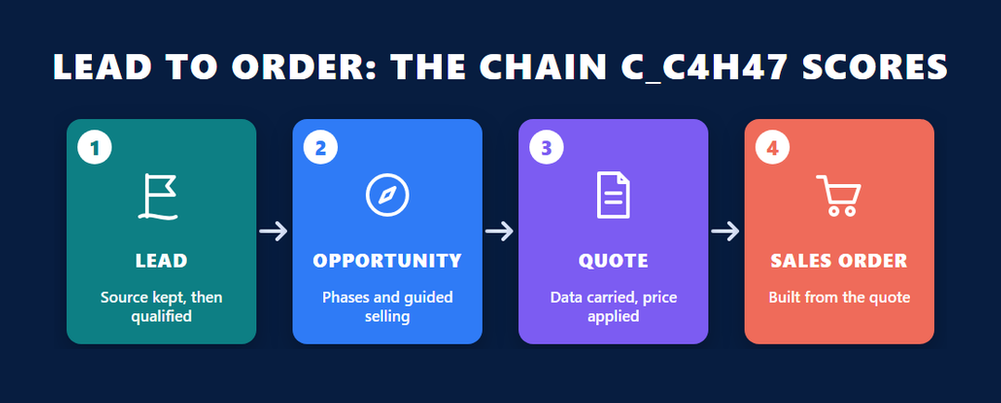
Lead management starts the chain. The exam expects you to know how a prospect enters the system in a way that preserves its origin, so that marketing can trace a trade fair contact back to the trade fair rather than to a generic house account. Lead source, qualification and conversion rules are configured here, and so is the scoring that the intelligent layer later applies.
Opportunity, guided selling and the quote
Once a lead qualifies, the opportunity carries the deal through its sales phases. Guided selling and playbooks present a representative with the recommended steps for each phase, and a sales manager reads pipeline and trends analytics across the team’s opportunities to steer it. Configuring those phases and playbooks is the consultant’s work; using them is the representative’s, and the exam asks about both.
The quote is where master data proves itself. Starting a quote from the opportunity carries the account, contacts and interested products forward without re-keying, which is the behaviour the exam looks for, and the pricing behind it comes from the price data configured under administration. A sales order then follows from the accepted quote. Visit management runs beside the chain for teams that sell face to face: planning the visit, logging it, and linking its outcome back to the opportunity.
SAP positions the whole solution as an agentic AI-enhanced CRM for sales automation, guided selling and forecasting, which is the vocabulary of its Sales Cloud product overview. For the exam, that translates into one practical habit: whenever you configure a step, check what it changed two steps later.
Where Does the Intelligent Layer Sit in the Exam?
The intelligent layer is a blueprint area in its own right and a skill domain of its own: machine learning for lead scoring, generative AI assistance and the customer experience AI tooling, and the configuration that switches each on. It is the area ERPPrep’s own guidance names as the one where candidates most often lose time, because the setup is less familiar than the sales objects it serves.
Lead scoring is the clearest example. The model ranks leads so that a representative works the most promising first, and the exam wants you to know both how the score is used in the daily workflow and how the feature is enabled and tuned. Generative AI assistance follows the same two-sided pattern: what it does for a seller, and what an administrator has to configure for it to appear.
“AI alone is no longer a differentiator: What matters is where intelligence operates inside of a business.”
That framing comes from SAP’s Q1 2026 Customer Experience release notes, which describe the direction the product is taking: intelligence inside the quote and the service case rather than beside them. The same release added an email to quote capability through the Microsoft Outlook add-in for SAP Sales Cloud, where SKUs are read from opportunity and email data and a quote is generated in a few clicks. Detail is in the Q1 2026 release summary.
Microsoft Teams, relationship intelligence and the mobile app
Collaboration is tested as configuration, not as familiarity with Teams itself. The exam expects you to enable the Microsoft Teams integration, manage the communication channels sellers use, and apply relationship intelligence so that engagement across those channels feeds the account picture. Microsoft’s own Teams platform overview is useful background on what the integration is attaching to, but the marks are for the Sales Cloud side of the connection.
The mobile application is the last piece of this layer, and it has the same two faces as everything else in the blueprint. A field seller works leads, visits and opportunities from the app; an administrator configures its features, its integrations and its security so that mobile access is productive and controlled. The security configuration is the part candidates tend to skip and the part a System-Based activity can test precisely.
What Does Administration and System Configuration Cover?
Administration and System Configuration is the blueprint area that turns a working demo into a system shaped for a business: identifying the administrator’s core responsibilities and tools, applying advanced configuration and automation, and setting up pricing strategies, pipeline and sales forecasting, call lists and planning, and sales activities. On ERPPrep it feeds two skill domains, administration itself and Pricing and Sales Workflows.
Pricing deserves its own study block because it is both config data and master data at once. A pricing strategy is configured; the price lists and conditions it draws on are maintained; and a quote only prices correctly when the two agree. Given that master data carries 58 percent of SAP’s weighting, this is the one administrative topic where under-preparation is most expensive.
Forecasting, call lists and automation
Pipeline and sales forecasting give the sales manager the numbers behind the pipeline view, and configuring them means deciding what counts, over which periods, for which teams. Call lists and planning organise outbound work for inside sales, which is where the digital selling workspace that SAP describes on its product page comes into play. Automation ties rules to events, such as a task created when an opportunity enters a phase, and the exam can ask you to set one up and then observe what it did.
What Are the C_C4H47 Exam Facts?
C_C4H47 is an associate-level SAP credential delivered as one System-Based Assessment activity in English, with a 75 percent pass score and a two hour duration, preparing through the Implementing SAP Sales Cloud Version 2 learning journey and kept current through SAP’s Stay Certified programme. SAP’s page displays no fee, no question count and no validity period, so none is stated here.
| Exam detail | Value |
|---|---|
| Credential | SAP Certified – Implementation Consultant – SAP Sales Cloud Version 2 |
| Exam code | C_C4H47 (release 1; earlier labels C_C4H47I_34 and C_C4H47_2503) |
| Level | Associate |
| Format | System-Based Assessment (SyBA), 1 activity |
| Pass score | 75% |
| Duration | 2 hours (displayed on SAP’s certification page; ERPPrep publishes no duration) |
| Languages | English |
| Exam topics | Master data 58%, config data 21-30%, transaction data 11-20% |
| Learning journey | Implementing SAP Sales Cloud Version 2 (courses C4H47B and C4H47I) |
| Prerequisite | Basic knowledge of CRM sales processes |
If you are comparing this table against a page that says 80 items, 180 minutes or a 68 percent pass mark, that page is describing the suffixed exam of an earlier year. The values above are what SAP displays for the credential as it is booked today.
How Should You Prepare for the C_C4H47 Activity?
Prepare for execution rather than recognition: work through the two learning journey courses in order, then rehearse each configuration task hands-on until the sequence is automatic, giving extra time to master data, the intelligent layer and the collaboration and mobile setup. ERPPrep’s guidance puts the journey at roughly ten hours of course time and suggests one to two months of preparation alongside a job.
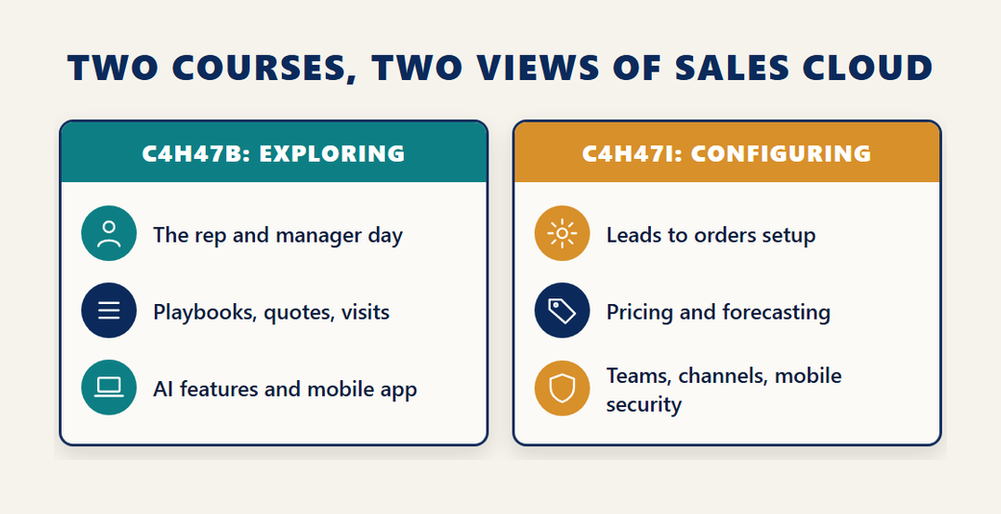
The two courses look at the same solution through different eyes. C4H47B, Exploring SAP Sales Cloud Version 2, walks the sales representative’s and sales manager’s day: tasks, guided selling and playbooks, quotes and orders, visits, the intelligent features, Teams collaboration and the mobile app. C4H47I, Configuring SAP Sales Cloud Version 2, is the consultant’s deep dive into setting all of that up, from leads through orders and visits to pricing, forecasting, the machine learning and generative AI features, communication channels and mobile security. Both are collected in the SAP learning journey.
A study order built for a single activity
- Learn the sales flow as one connected chain from lead to order and visit, so you can trace how a setting or piece of master data configured early shapes what appears in later documents and screens.
- Rehearse both the sales representative and the sales manager daily workflows, because guided selling, playbooks and pipeline analytics are examined as everyday tasks rather than as abstract configuration.
- Treat the machine learning and generative AI capabilities as their own study block, practising how lead scoring and AI assistance are used and how each is configured.
- Practise the collaboration and mobile setup hands-on, enabling the Microsoft Teams integration, managing communication channels, applying relationship intelligence and configuring the mobile app’s features, integrations and security.
- Work through pricing, forecasting, call lists and sales activity configuration end to end, reviewing why each step produced its result.
- Finish with timed, full-length rehearsal of connected scenarios rather than topic review, so the pace of a two hour activity is familiar before the day.
Candidates who passed under the old suffixed codes often kept notes organised by topic area; the earlier Sales Cloud preparation guide on this site is an example of that generation of material. Reuse the topic coverage from any such source, but take the format, cut score and timing from the current SAP page, because those are the values that changed.
What Does the Credential Do for a CX Career?
It places you on the SAP Customer Experience consulting track at the point where most careers in it begin: the configuring consultant on a Sales Cloud implementation. From there the natural moves are sideways to the service side of the same platform, or upward toward solution architecture across the CX portfolio, and the associate credential is the usual first proof point on both paths.
The salary picture is a consulting one rather than a product one. PayScale puts the average base salary of an SAP Consultant in the United States at $99,860, with a reported range from about $65,000 to $157,000 across 491 profiles updated in April 2026, per its SAP Consultant salary data. Sales Cloud specialists sit inside that band; what moves an individual within it is implementation experience, and the credential is what gets a newcomer onto the project where that experience is earned.
The sibling credential on the service side
SAP Sales Cloud Version 2 and SAP Service Cloud Version 2 share a platform, a data model and much of their administration, so consultants frequently hold both associate credentials. If your projects run cases and service orders as well as leads and quotes, the Service Cloud Version 2 exam is the obvious second step, and a good deal of the master data and Teams integration knowledge carries straight across.
Frequently Asked Questions
Is C_C4H47 the same exam as C_C4H47_2503?
It is the same credential, SAP Certified – Implementation Consultant – SAP Sales Cloud Version 2, but not the same exam format. C_C4H47_2503 was the suffixed 2025 release. The current unversioned C_C4H47 is a single System-Based Assessment activity with a 75 percent pass score, and material written under the old code describes a format SAP has replaced.
What is the passing score for the SAP Sales Cloud certification?
The pass score for C_C4H47 is 75 percent, published by both SAP and ERPPrep. Because the exam is one hands-on activity, the score reflects how much of the configured work was completed correctly, so reliable execution across the whole sales chain matters more than depth in one favourite area.
How long is the C_C4H47 exam?
SAP’s certification page displays a duration of 2 hours for C_C4H47. ERPPrep does not publish a duration for this exam. Spend that time executing rather than recalling: rehearse navigation paths and configuration entry points until they are automatic, so the clock goes on the decisions that vary by scenario.
How many questions does C_C4H47 have?
None in the conventional sense. C_C4H47 is delivered as a single System-Based Assessment activity in which you carry out configuration and transaction tasks inside a working SAP Sales Cloud Version 2 system. Neither SAP nor ERPPrep publishes a question count, because the format does not have one.
What are the exam topics and their weightings?
SAP displays three weighted topics: master data for sales cloud at 58 percent, config data for sales cloud at 21 to 30 percent, and transaction data for sales cloud at 11 to 20 percent. ERPPrep organises the same scope into seven blueprint areas and ten skill domains without weightings.
Which SAP courses prepare for C_C4H47?
The Implementing SAP Sales Cloud Version 2 learning journey, made up of C4H47B Exploring SAP Sales Cloud Version 2 for the business user view and C4H47I Configuring SAP Sales Cloud Version 2 for the consultant and administrator configuration. The journey’s stated prerequisite is basic knowledge of CRM sales processes.
Is SAP Sales Cloud the same thing as Salesforce Sales Cloud?
No. Both vendors use the name Sales Cloud, and in open search the bare phrase usually means the Salesforce product. C_C4H47 certifies SAP Sales Cloud Version 2, SAP’s own customer experience solution for the sales line of business. Always include SAP in your searches, or the results will point you at the wrong vendor’s exam.
Do I need hands-on system access to prepare?
Strongly recommended. The exam scores tasks completed in a system, so reading alone cannot build the speed and accuracy a single two hour activity demands. SAP provides a practice system within the learning journey, and scenario simulations that mirror the task sequences are the next best rehearsal where direct access is limited.
Does the SAP Sales Cloud certification expire?
SAP keeps the credential current through its Stay Certified programme, and lists a Stay Certified learning journey for Sales Cloud Version 2 alongside the certification. SAP’s page displays no fixed validity period for C_C4H47, so check the Stay Certified requirements on the official page when you book rather than relying on a figure quoted elsewhere.
Conclusion
Four codes, one credential. Whatever label brought you here, the SAP Sales Cloud certification you can book today is C_C4H47 at release 1: a single System-Based Assessment activity, a 75 percent pass score, two hours, English, and three weighted topics in which master data carries 58 percent. The old 80-item paper and its 68 percent mark belong to a suffixed exam that no longer exists.
Prepare accordingly. Learn the lead to order chain as a chain, study both the representative’s and the manager’s day, give the machine learning, Teams and mobile configuration the separate block it needs, and rehearse connected scenarios against the clock. Start with the two learning journey courses, confirm the current values on SAP’s certification page, and practise until the configuration moves are automatic before you book.


