Somewhere in the middle of a conversion weekend, the update tool stops on a phase and waits for someone to decide what happens next. The business is offline, the custom code report is open in another window, and the clock is running. The SAP S/4HANA conversion certification, exam code E_S4CON, is built around that moment. It checks whether you can carry an existing SAP system onto SAP S/4HANA and run a release upgrade, and whether you can explain each decision you make along the way, inside one scenario that SAP times at two hours and passes at 60 percent.
This article covers what the credential proves and who it suits, how the Scenario-Based Assessment works, the six blueprint areas ERPPrep sets out and the five skills SAP attaches to the exam, how the conversion half differs from the upgrade half, why the SAP Business Suite 7 maintenance dates make the skill timely, a preparation order built on SAP’s learning journey, which exam code applies now, and where the credential leads.
What Does the SAP S/4HANA Conversion Certification Prove?
The SAP S/4HANA conversion certification, E_S4CON, proves that you can perform a technical SAP S/4HANA system conversion and an SAP system upgrade. SAP describes it as confirming both an overall understanding and the in-depth technical skills needed to complete an upgrade and a conversion, and says that people who pass can apply those skills in real SAP projects.
The full credential name is SAP Certified – SAP S/4HANA Conversion and SAP System Upgrade. ERPPrep places it at the Specialist level, which signals that it is not an entry credential. The role SAP attaches to it is Consultant, and the skills it lists are Software Maintenance, Data Migration, System Monitoring, Cloud Migration and Code Analysis. The learning journey behind it frames the same work from the administrator’s chair: perform an SAP S/4HANA conversion as an administrator, and perform an SAP system upgrade as an administrator.
That framing matters for who should sit it. This is a technical credential, not a functional one. It does not ask how to configure a sales process or a ledger. It asks whether you can move the platform underneath those processes without breaking them. Basis administrators, technical consultants and people moving from classic system administration into an S/4HANA transition role are the natural audience.
The facts SAP displays on the E_S4CON certification page are short. It shows a pass score, an assessment type, a duration, the languages by format and the roles and skills. It shows no question count, because a single scenario has none, and no fee.
| Exam detail | E_S4CON |
|---|---|
| Credential | SAP Certified – SAP S/4HANA Conversion and SAP System Upgrade |
| Level | Specialist |
| Product | SAP S/4HANA, technical conversion and system upgrade |
| Format | Scenario-Based Assessment, 1 activity |
| Passing score | 60 percent |
| Duration | 2 hours, as displayed by SAP |
| Languages | Roleplay with AI guidance: English, Spanish, Italian, French, Japanese plus 25 more; recorded video: English only |
| Learning journey | Converting and Upgrading SAP S/4HANA Systems |
| Keeping the badge | Complete the assessment once a year, per SAP’s badge criteria |
How Does the E_S4CON Scenario-Based Assessment Work?
The E_S4CON Scenario-Based Assessment gives you one realistic technical situation and asks you to reason through the right decisions and the right order of steps for it. There is no list of separate items to work through. SAP completed its move to performance-based certification in early 2026, so the exam measures whether you can apply conversion and upgrade knowledge in context, not whether you recognise a term.
SAP displays three numbers for the activity: a 60 percent pass score, one activity, and a duration of two hours. Those two hours go on one connected case. A readiness finding you misread early on shapes how you handle the data migration later, and a custom code decision taken in a hurry comes back during validation. The format rewards people who can hold the whole sequence in their head.
Two ways to answer, two language lists
SAP states that the available languages vary by format. If you take the roleplay with AI guidance, the list covers English, Spanish, Italian, French and Japanese, plus 25 more. If you record a video instead, the assessment is in English only. Choose the format before you plan your rehearsal, because explaining a conversion decision aloud on camera is a different skill from answering a guided conversation.
What you need before booking
SAP lists three things to check before exam day: your system set-up against its Technical Readiness Checklist, a Learning Hub subscription that includes certification exam attempts, and a valid SAP Universal ID with a secondary email. The exam page shows subscription attempts and exam attempts separately, and each exam attempt counts as one attempt from the subscription. SAP also offers an introduction to scenario-based assessments and an AI-powered tool to try the format beforehand.
Rehearsal is where most of the work happens. ERPPrep builds E_S4CON scenario simulations and skill drills around the same five skills SAP names, ordered from foundation to advanced, so you can rehearse full conversion and upgrade cases before the real activity.
Which Six Areas Does the E_S4CON Blueprint Cover?
The E_S4CON blueprint covers six areas: the system conversion process, system upgrade and software maintenance, data migration and the S/4HANA data model, custom code analysis and adaptation, system monitoring and post-change validation, and cloud migration and deployment considerations. No weightings are published for any of them, so plan your study by area rather than by percentage.
| Blueprint area | What it asks you to handle | SAP skill it maps to |
|---|---|---|
| SAP S/4HANA System Conversion Process | Pre-checks and readiness analysis, the maintenance planner, the Software Update Manager phases, and the sequence that moves the database and application stack onto SAP S/4HANA | Software Maintenance |
| SAP System Upgrade and Software Maintenance | Preparing the landscape, applying support packages and stack updates, and keeping downtime controlled during a release upgrade | Software Maintenance |
| Data Migration and the S/4HANA Data Model | Adapting to the simplified S/4HANA tables and structures, running the migration steps, and confirming that business data lands correctly | Data Migration |
| Custom Code Analysis and Adaptation | Checking existing developments against S/4HANA requirements and remediating code that no longer fits the changed data model | Code Analysis |
| System Monitoring and Post-Change Validation | Tracking each phase for errors and confirming technical health before users return | System Monitoring |
| Cloud Migration and Deployment Considerations | Weighing cloud-oriented options for the target landscape and how infrastructure choices shape the conversion approach | Cloud Migration |
The two lists line up cleanly once you see that software maintenance spans both the conversion and the upgrade. That is the area to give the most time, because it carries two of the six blueprint areas and every other skill depends on it. A conversion you cannot sequence is a conversion where data migration, code adaptation and validation never get a fair start.
ERPPrep names custom code adaptation, the order of the update tool phases and data migration validation as the areas candidates find hardest. All three share one trait: the consequence of a choice shows up several phases after the choice was made.
Conversion or Upgrade: How Do the Two Halves of the Exam Differ?
A conversion changes the product: an existing SAP ERP system becomes an SAP S/4HANA system, with its data reshaped for the simplified data model and its custom code checked against it. An upgrade keeps the product and moves it to a newer release. E_S4CON tests both, and a scenario may describe either one, so you need to recognise which job you are being handed.
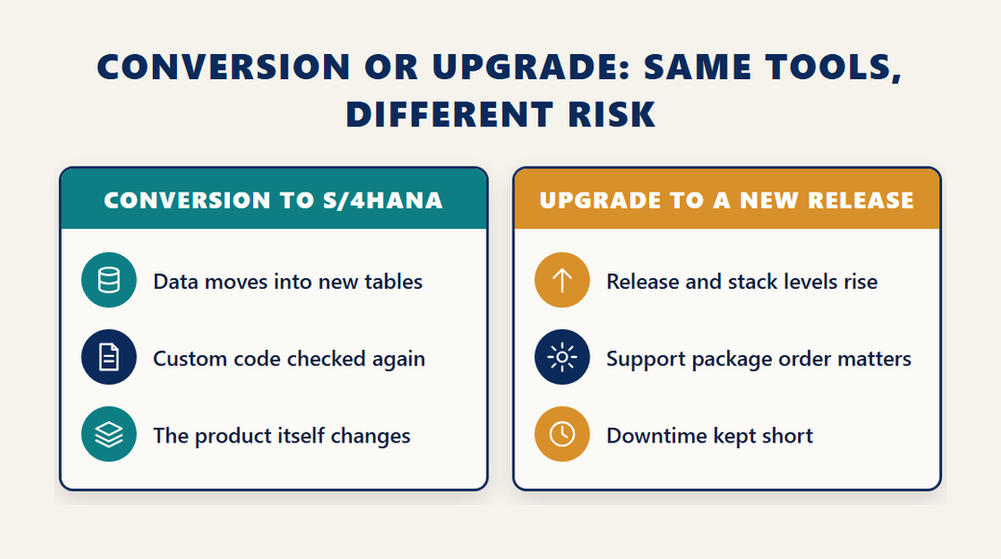
The tools overlap, which is why the two are easy to blur. Both rely on the maintenance and update tooling, both need downtime planning, and both end with technical validation. The difference sits in what changes underneath. A conversion moves business data into new structures and can break custom programs that read the old ones. An upgrade mostly changes software levels, so the risk sits in support package sequencing, modification adjustment and keeping the outage short.
Questions to ask when a scenario opens
- Is the source system an SAP ERP system that has to become SAP S/4HANA, or an S/4HANA system that has to reach a newer release?
- What did the readiness analysis report, and which findings must be cleared before the update tool can run?
- Which custom developments read tables that the S/4HANA data model has simplified?
- How much downtime has the business accepted, and which phase consumes most of it?
- What will you check afterwards to prove the system is healthy before users log on?
Answering those five questions out loud is a good rehearsal in itself. The assessment does not reward a correct tool name on its own. It rewards a correct tool name attached to the right reason at the right moment.
Why Does the 2027 Maintenance Date Make This Skill Timely?
The 2027 date makes conversion skill timely because SAP has committed to mainstream maintenance for the core applications of SAP Business Suite 7 only until the end of 2027, followed by optional extended maintenance until the end of 2030. SAP S/4HANA, by contrast, carries a maintenance commitment until the end of 2040. Every customer still on the older suite has a conversion decision to make.
SAP set out those dates in its 2040 maintenance announcement, which also said that extended maintenance would carry a premium of two percentage points on the existing maintenance basis. The user groups quoted alongside it pushed customers not to wait.
“The decision about a company’s ‘ERP of the future’ should not just center on a technical upgrade to SAP S/4HANA. It should be about how best to prepare a company’s business for the future.”
That is a useful reminder of where an E_S4CON holder sits. The business case belongs to others. The technical conversion is the part that has to work, on time and without data loss, so that the business case is not undone on the weekend it goes live.
Cloud targets change the conversation
The sixth blueprint area covers cloud-oriented deployment, and it reflects how many conversions now land on hyperscaler infrastructure rather than an on-premise data centre. The target platform shapes sizing, network design and the downtime approach. Microsoft’s guide to SAP on Azure VMs is one example of the planning material a technical consultant meets once the target is in the cloud. You do not need to master any one provider for E_S4CON, but you should be able to explain how an infrastructure choice changes the way you would run the conversion.
How Should You Prepare for E_S4CON?
Prepare for E_S4CON by confirming the administration prerequisites first, then following SAP’s Converting and Upgrading SAP S/4HANA Systems learning journey, and then rehearsing complete conversion and upgrade cases until the sequence is automatic. Reading builds understanding, but the scenario format only rewards what you can do and explain under time pressure.
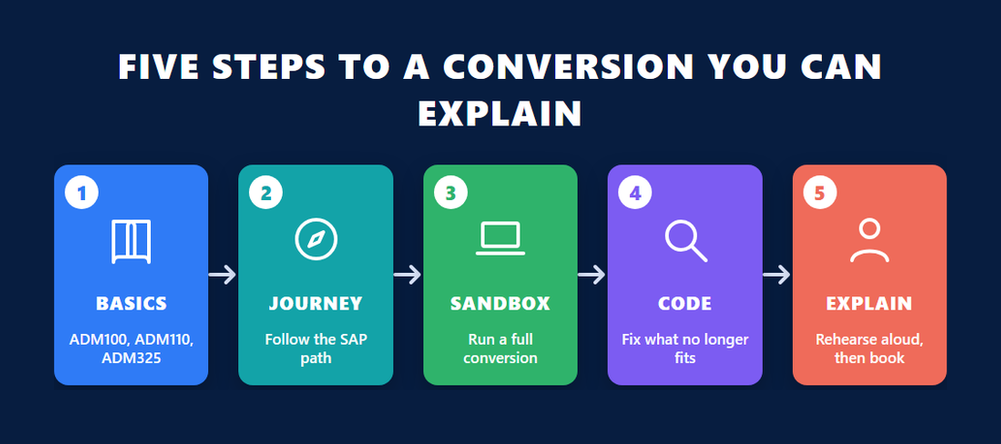
The conversion learning journey lists three prerequisites: ADM100 System Administration I of SAP S/4HANA and SAP Business Suite, ADM110 SAP System Installation and Patching, and ADM325 Software Logistics of SAP S/4HANA and SAP Business Suite. ERPPrep points to ADM328, SAP S/4HANA Conversion and SAP System Upgrade, as the course behind the journey. A workable order looks like this:
- Confirm that you are comfortable with the ADM100, ADM110 and ADM325 material, because system administration, patching and software logistics are the ground the conversion journey builds on.
- Work through the Converting and Upgrading SAP S/4HANA Systems learning journey in order, so that readiness analysis, the maintenance planner and the update tool phases arrive in the sequence a real project follows.
- Rehearse a full conversion in a sandbox system, from pre-checks through data migration to validation, and note where each phase can stop and what it needs from you.
- Drill custom code analysis against the simplified data model and practise remediating the developments that no longer fit, since this is one of the hardest areas.
- Run the upgrade path separately, then rehearse whole scenarios aloud in the format you will choose, explaining each decision as you would to a project lead.
Hands-on access matters more for this exam than for most. If you cannot get a sandbox, scenario rehearsal that follows the same technical sequence is the next best option. Keep a short log of every decision you make during a rehearsal and the reason for it. That log is the closest thing to the answer the assessment is looking for.
Mistakes that cost the most
- Studying the phases as a list instead of as a chain of cause and effect
- Treating the upgrade path as an afterthought to the conversion
- Skipping post-change validation because the update tool reported success
- Practising only in silence when the chosen format asks you to explain
E_S4CON, E_S4CON_2505 or E_S4HCON2023: Which Code Applies Now?
E_S4CON is the code SAP’s certification page now displays for this credential, and it is the one to book against. Older codes such as E_S4HCON2022 and E_S4HCON2023, and release-suffixed labels such as E_S4CON_2505, belong to earlier versions of the same certification and still appear in search results and older study material.
The older codes matter only as a warning. Material written for them may describe a question-based format with a fixed item count, a different pass mark and a different duration. None of that applies to the current Scenario-Based Assessment, so check the date and the format of anything you study from. Our earlier E_S4HCON2023 resource is useful for the history of the topic list, but take every exam fact from SAP’s current page.
The same caution applies to anything that promises the real exam content. A scenario that changes with each sitting has no fixed answer to memorise, and SAP’s assessment policies exclude leaked material in any case. The only preparation that transfers is the ability to run and explain the work.
Who Benefits From the Credential, and Where Does It Lead?
The credential benefits technical people whose job is the platform rather than the process: Basis administrators, technical consultants and system specialists who plan conversions, run upgrades and keep landscapes current. It gives an employer or a client evidence that you can deliver a technical S/4HANA transition end to end, not just describe it.
For a Basis administrator, conversion and upgrade work is a natural step up from routine operations. PayScale’s SAP Basis Administrator salary data puts the average base salary in the United States at about 106,930 dollars a year in 2026. That figure describes the role, not the certificate, and it varies with location and experience.
The credential also fits a wider S/4HANA path. Functional consultants on the same project hold their own associate credentials, while the E_S4CON holder owns the technical move that every one of them depends on. If you have an older certificate from this line, our original conversion certification page shows how long the topic has been part of SAP’s programme, though its exam facts are out of date.
Keep the badge current once you have it. SAP’s badge criteria state that the certification should be kept valid by completing the assessment once a year.
Frequently Asked Questions
How long is the E_S4CON exam?
SAP displays a duration of two hours for the E_S4CON Scenario-Based Assessment. The time goes on one connected activity rather than separate items.
What is the passing score for E_S4CON?
The pass score is 60 percent, as shown on both SAP’s certification page and the ERPPrep study guide.
How many questions are on the E_S4CON exam?
None in the old sense. E_S4CON is a Scenario-Based Assessment with one activity, so SAP publishes no question count.
Which languages is E_S4CON available in?
It depends on the format. The roleplay with AI guidance is offered in English, Spanish, Italian, French, Japanese and 25 more languages, while the recorded video format is English only.
Is E_S4CON_2505 the same exam as E_S4CON?
It is an earlier release label for the same certification. SAP’s certification page now shows the credential under E_S4CON, so book against that code and study from current material.
Are there prerequisites for the SAP S/4HANA conversion certification?
The learning journey lists ADM100, ADM110 and ADM325 as prerequisites. These cover system administration, installation and patching, and software logistics.
What do I need before booking the exam?
SAP asks for a Learning Hub subscription that includes certification exam attempts, a valid SAP Universal ID with a secondary email, and a system that passes its Technical Readiness Checklist.
How do I keep the E_S4CON certification valid?
SAP’s badge criteria state that the certification should be kept valid by completing the assessment once a year.
Is E_S4CON a Basis certification?
It is a technical credential that suits Basis administrators and technical consultants. SAP attaches the Consultant role to it, and the learning journey frames the work from the administrator’s point of view.
Conclusion
E_S4CON asks one thing in two forms: can you move an SAP system safely, either onto SAP S/4HANA or onto a newer release, and can you explain every step while you do it? SAP gives you one scenario, two hours and a 60 percent bar. The six blueprint areas tell you where to look, and software maintenance sits under both halves of the job. With Business Suite 7 mainstream maintenance ending in 2027, the skill is in demand now. Confirm the administration prerequisites, follow the learning journey, rehearse full conversions and upgrades in a sandbox, and practise explaining your decisions in the format you will choose. Then book against the current code on SAP’s own page.


