Two documents describe this exam, and they do not agree on its shape. SAP’s certification page for C_S4CPR, the SAP Certified – Implementation Consultant – SAP S/4HANA Cloud Public Edition, Sourcing and Procurement credential, displays five weighted exam topics, every one of them a procurement process. ERPPrep’s study guide for the same exam lists seven blueprint areas, and three of them are about implementation: provisioning systems, configuring with SAP Central Business Configuration, migrating data and automating tests. Neither document is wrong.
The scored topics are what you do inside the system during the three hour activity; the implementation areas are what you must have set up for those tasks to work at all. Read only the first and you will skip the setup that makes a purchase order possible. Read only the second and you will spread your time evenly across areas that carry very different weight. This guide puts the two side by side, explains how the single System-Based Assessment runs, settles the public-versus-private-edition question, and sets out a preparation order for the SAP public cloud sourcing and procurement certification.
What Does the SAP Public Cloud Sourcing and Procurement Certification Actually Score?
The SAP public cloud sourcing and procurement certification, exam code C_S4CPR, is scored on five exam topics that SAP displays on its certification page: Consumable Purchasing at up to 10 percent, Procurement of Direct Materials, Maintaining Master Data and Supplier Consignment at 21 to 30 percent each, and Service Purchasing and Recording at 11 to 20 percent. The pass score is 70 percent.
The surprise in that list is the third band. Supplier consignment, where a supplier keeps stock on your premises and you only pay when you withdraw it, carries the same weight as direct material purchasing and as master data. Most candidates spend their study time on purchase orders and goods receipts, because that is the daily work, and treat consignment as a special case. On this exam it is a core case.
The other surprise is the first band. Consumable purchasing, the self-service requisition for a laptop or a box of toner that posts straight to a cost centre, is where most people first learn procurement in SAP. It carries at most a tenth of the marks. Know it, but do not let it absorb a quarter of your preparation.
| Exam topic displayed by SAP | Weight | What it covers in practice |
|---|---|---|
| Consumable Purchasing | Up to 10% | Self-service requisitioning and purchase orders for items that post to a cost object rather than to stock |
| Procurement of Direct Materials | 21-30% | Stock materials bought for production or resale, including MRP-driven demand, inbound delivery, down payments, dunning reminders, batches and serial numbers, and automated invoice settlement |
| Maintaining Master Data | 21-30% | Business partner and product master, purchasing info records, purchasing organizations and groups, posting periods and material valuation |
| Supplier Consignment | 21-30% | Supplier-owned stock held at your site, withdrawals that trigger liability, and the settlement of consignment liabilities |
| Service Purchasing and Recording | 11-20% | Buying temporary labour, maintenance or professional work with model product specifications, and recording what was delivered |
Those weights come from the SAP certification page, which also displays the 70 percent pass score, a single System Based activity, a 3 hour duration and English as the delivery language. ERPPrep publishes the same pass score, format and language and lists the exam at associate level; it does not publish a duration, so the three hours is SAP’s figure alone.
Why Does the Learning Journey Cover More Than the Exam Topics?
The learning journey behind C_S4CPR covers more than the five scored topics because it teaches the implementation work that has to happen before any procurement task can run in SAP S/4HANA Cloud Public Edition. ERPPrep’s study guide sets out seven blueprint areas, and the first three are implementation: system landscape, configuration, extensibility, integration, data migration and test automation.
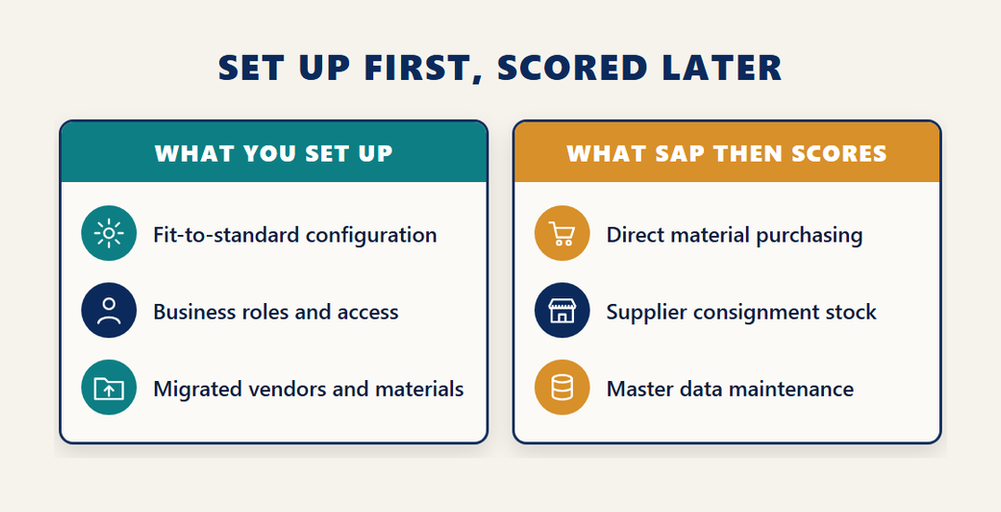
The seven areas on the ERPPrep study guide are, in its own words: Core Implementation of SAP S/4HANA Cloud Public Edition; Fiori Launchpad, Extensibility & Integration; Data Migration & Test Automation; Sourcing & Procurement Foundations; Requisitioning, Consumable & Direct-Material Purchasing; Intelligent Procurement, Sourcing & Contract Management; and Specialized Procurement & Data Access. They map onto nine SAP courses, from S4C01 on implementing the public edition through to S4C140 on accessing procurement data.
Setup first, scored later
The two lists fit together once you see the dependency. A direct material purchase order in the activity can only be created if the purchasing organization exists, the business role on your user allows it, the supplier and material were migrated or created, and the fit-to-standard configuration in SAP Central Business Configuration activated the right process. None of those setup steps is a scored topic by name. Every scored topic depends on them.
That is why the official learning journey describes two outcomes rather than one. The first is to explain and execute the core implementation tasks: building the project team, defining landscapes, setting up systems and authorizations, gathering data for fit-to-standard workshops, configuring with SAP Central Business Configuration, working in the Fiori launchpad, applying extensibility, setting up integration, migrating data and testing with automation. The second is to execute the procurement processes themselves. SAP lists one prerequisite for the journey, the Getting Started with Support from SAP support accreditation, and one target role, consultant.
What this means for your study time
- Learn the implementation areas to the point where you can perform them without hesitation, because a mistake there blocks a scored task downstream.
- Spend the longer, repeated rehearsal on the four heavier topics: direct materials, master data, consignment and service purchasing.
- Treat the practice system that SAP attaches to the learning journey as part of the course, not an optional extra.
How Does the C_S4CPR System-Based Assessment Work?
C_S4CPR is delivered as one System-Based Assessment: a single hands-on activity carried out in a configured SAP S/4HANA Cloud Public Edition system, with a 3 hour limit and a 70 percent pass score. You complete configuration and transaction tasks and are scored on whether each task was done correctly, not on recognising a correct statement from a list.
The practical mechanics are described on SAP’s system-based assessment FAQ. You launch the activity from the certification page or the learning journey, review the time limit and your remaining attempts, and start the countdown. Some systems are available at once; others need a reserved slot, which you can cancel up to 24 hours beforehand without using an attempt. The assessment dashboard holds two things you will keep open throughout: a setup guide with the technical instructions, and the certification tasks themselves. The system opens in a separate browser tab.
“No, you may take breaks as needed during a practical exam, but the timer will continue to run, and breaks will not pause the clock.”
Everything has to be finished in one session. When you confirm completion, the attempt goes under review, which SAP says usually takes about 15 minutes, and the result appears under My Certifications. A score report is available for system-based certifications. SAP names two reasons an attempt fails: the activity limit expired, or the passing score was not reached. Both point the same way for preparation. Fluency matters as much as knowledge, because a task you can do but do slowly still costs you the clock.
Before you can book at all, SAP displays three requirements: a Learning Hub subscription that includes certification attempts, an SAP Universal ID with a secondary email, and a run through the Technical Readiness Checklist for hardware, software and connectivity. Since the scoring is on completed tasks, the most useful preparation is to rehearse C_S4CPR scenarios that string a business requirement into the configuration and document steps that satisfy it, then check the outcome, exactly as the activity will.
Which Procurement Flows Should You Be Able to Run End to End?
For C_S4CPR you should be able to run four procurement flows end to end in SAP S/4HANA Cloud Public Edition: consumable purchasing from a self-service requisition, direct material purchasing from MRP demand through goods receipt and invoice, supplier consignment from stock withdrawal to liability settlement, and service purchasing with model product specifications and service entry. Each one starts from master data and a source of supply.
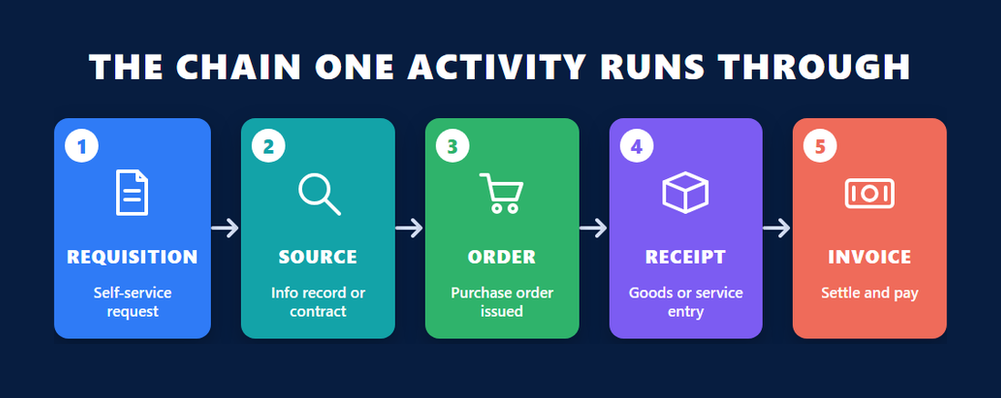
The flows share a backbone. A requirement is raised, a source of supply is found in an info record or a contract, a purchase order is issued, goods or a service are received, and an invoice is settled. What changes between the four is where the stock goes, who owns it, and what the receipt step records. The activity tests whether you can tell the difference and configure or post accordingly.
Where each flow departs from the backbone
| Flow | Starts from | What the receipt records | What to watch |
|---|---|---|---|
| Consumable purchasing | Self-service requisition with an account assignment | Consumption against a cost object, no stock | The account assignment decides the posting; get it wrong and the cost lands in the wrong place |
| Direct materials | MRP-driven requirement or manual requisition | Stock receipt, possibly with batch or serial number | Inbound deliveries, down payments and dunning reminders sit around the order; invoice settlement can be automated |
| Supplier consignment | Consignment info record and a consignment order | Supplier-owned stock at your site | Liability arises on withdrawal, not on receipt; settlement is a separate step |
| Service purchasing | Requisition with a model product specification | Service entry for what was actually delivered | Recording is what releases payment; the order alone proves nothing |
Two further blocks sit around these flows in ERPPrep’s area list and in the S4C120 and S4C130 courses: intelligent procurement, meaning flexible workflows, situation handling and embedded business AI, and sourcing, meaning requests for price, purchase contracts with version history and scheduling agreements. They are not displayed as scored topics by SAP, but a flexible workflow on a purchase order release will change what you see when you try to post a receipt in the activity, so you need to recognise it when it appears.
Public Edition or Private Edition: C_S4CPR or C_TS452?
C_S4CPR certifies sourcing and procurement on SAP S/4HANA Cloud Public Edition, the standardised multi-tenant edition configured through fit-to-standard and SAP Central Business Configuration. C_TS452 certifies the same line of business on the private edition, where the customer owns a dedicated system and configuration is done the classic way. Pick by the deployment your projects use, not by which exam looks easier.
The split matters because the two editions are implemented differently even when the procurement process looks the same on screen. In the public edition you select and activate scope through fit-to-standard workshops, extend with key-user and developer tools inside guardrails, and take quarterly releases as SAP ships them. In the private edition the system is yours to configure in detail, upgrades are planned by the customer, and the certification reflects that depth. SAP’s SAP S/4HANA overview describes the editions as one product line with different deployment and operating models, which is exactly why the two exams exist.
| Question | C_S4CPR (public edition) | C_TS452 (private edition) |
|---|---|---|
| Deployment the exam assumes | SAP S/4HANA Cloud Public Edition, SaaS, fit-to-standard | SAP S/4HANA Cloud Private Edition, dedicated system, classic configuration |
| Configuration tool in scope | SAP Central Business Configuration | Implementation Guide customizing |
| Who typically sits it | Consultants on public-cloud and midmarket projects, business users moving into a project role | Consultants on conversions, upgrades and larger private-cloud programmes |
| Format | System-Based Assessment, one activity | System-Based Assessment, one activity |
If you work in both worlds, the procurement knowledge transfers almost entirely and the implementation knowledge does not. The private edition sibling article walks through the C_TS452 activity in the same way this one does for the public edition, so the two can be read as a pair before you choose.
How Should You Prepare for C_S4CPR?
Prepare for C_S4CPR in the order the dependencies run: implementation setup first, master data second, then the four scored procurement flows, then the surrounding workflow and sourcing features, and finally timed rehearsal of whole scenarios. ERPPrep’s FAQ suggests roughly two to three months alongside a job, with more for candidates new to SAP procurement.
- Complete S4C01, Implementing SAP S/4HANA Cloud Public Edition, and practise provisioning, business roles and a fit-to-standard configuration in the practice system until you can do them without notes.
- Work through S4C101 and build the master data yourself: purchasing organizations and groups, business partners, product master records, purchasing info records and material valuation.
- Run the four scored flows repeatedly, giving direct materials, consignment and service purchasing the most time and consumable purchasing the least, in line with the weights SAP displays.
- Add the intelligent procurement and sourcing block from S4C120 and S4C130, so that a flexible workflow or a contract as source of supply does not surprise you inside a scored task.
- Rehearse data migration with the SAP S/4HANA Migration Cockpit across its template, remote database and direct ERP paths, and track and extend a migration object.
- Finish with timed, end-to-end scenario rehearsal against the clock, confirming each outcome before moving on, because the real activity scores completed tasks and does not pause.
Hands-on access is the one thing not to skip. SAP attaches a practice system to the learning journey, and the ERPPrep FAQ is blunt that reading alone leaves candidates unable to execute under system conditions. If you want the older material from before the format change for background, the site’s public edition preparation guide collects it, though its question counts describe the earlier paper rather than the current activity.
C_S4CPR, C_S4CPR_2508 or C_S4CPR_2602: Which Code Do You Book?
You book C_S4CPR. SAP’s certification page displays that code alone, and the credential is earned through the current System-Based Assessment attached to it. Codes with a four-digit suffix such as C_S4CPR_2502, C_S4CPR_2508 and C_S4CPR_2602 name earlier versioned papers and still circulate as search terms, but they are not a separate thing to buy or sit.
SAP published those suffixed codes as separate versioned exams in earlier years; the current certification page displays none of them. Under the subscription model you do not choose a version; you take the assessment SAP currently serves for C_S4CPR, which tracks the current public-edition release. The practical consequence is that any study material labelled with a suffix should be checked against the five topics and the single-activity format before you trust it, because older papers were built differently.
Search demand still clusters on the suffixed codes. That is why so many ranking pages quote figures from the earlier question-based paper. If a page tells you the exam has a fixed number of questions, it is describing a version that no longer applies.
Who Is This Credential For, and Where Does It Lead?
C_S4CPR is for sourcing and procurement consultants, and for purchasing or supply-chain professionals moving into an implementation role, who will join an SAP S/4HANA Cloud Public Edition project team in a mentored capacity. SAP lists the role as consultant and the skills as purchasing, procurement management, procurement, data migration and system configuration.
The mentored framing is honest. The credential does not claim you can lead the procurement workstream of a public-cloud programme on your own. It claims you can be given a requirement, translate it into configuration and documents, and confirm the result, with someone more senior reviewing the design decisions. That is the right level for a first SAP procurement certification and for an experienced buyer who understands the business side already.
“Procurement is defined as the buying of goods and services that enable an organisation to operate its supply chains, in a profitable and ethical manner.”
That professional definition is worth holding next to the exam topics. The CIPS procurement definition covers market analysis, sourcing, negotiation, contracting and supplier relationships; C_S4CPR covers the system execution of the purchasing and receiving part of that cycle, plus the contracts and requests for price that feed it. A candidate who already understands the profession has the context the exam assumes, and only needs to learn where each decision lives in the public edition.
Afterwards, the natural moves are sideways and up. Sideways is the private edition credential, C_TS452, for consultants whose next project is a dedicated system. Up is the broader public-edition implementation credential, C_S4CPB, for consultants who want to own the cross-functional implementation rather than one line of business.
Frequently Asked Questions
How many topics does the SAP public cloud sourcing and procurement certification cover?
SAP displays five exam topics for C_S4CPR: Consumable Purchasing (up to 10 percent), Procurement of Direct Materials, Maintaining Master Data and Supplier Consignment (21 to 30 percent each), and Service Purchasing and Recording (11 to 20 percent). ERPPrep’s study guide groups the learning journey into seven areas around them.
What is the C_S4CPR passing score?
The passing score is 70 percent, displayed on SAP’s certification page and published by ERPPrep. ERPPrep notes that this sits above the 60 percent floor several SAP associate certifications use, which is one reason to over-prepare the heavier topics.
How long is the C_S4CPR exam?
SAP displays a 3 hour duration for the single System-Based Assessment activity. The timer does not pause for breaks and the activity must be completed in one session. ERPPrep does not publish a duration for this exam.
Is C_S4CPR still a question-based exam?
No. C_S4CPR is a System-Based Assessment: one hands-on activity in a configured SAP S/4HANA Cloud Public Edition system, scored on completed tasks. Pages quoting a fixed question count and a 73 percent cut describe an earlier versioned paper, not the current certification.
Which code is current: C_S4CPR, C_S4CPR_2508 or C_S4CPR_2602?
SAP’s certification page displays C_S4CPR only, and that is what you book through a Learning Hub subscription. Suffixed codes name earlier versioned papers and survive mainly as search terms. Check any suffixed study material against the five displayed topics before relying on it.
What do I need before I can sit C_S4CPR?
SAP displays three requirements: a Learning Hub subscription that includes certification exam attempts, an SAP Universal ID with a secondary email, and a check of the Technical Readiness Checklist. The learning journey lists the Getting Started with Support from SAP accreditation as its prerequisite.
Is the C_S4CPR exam available in languages other than English?
SAP displays C_S4CPR as available in English, and ERPPrep lists English as the language. Because the activity involves reading task instructions and acting on them in the system, comfort with English procurement terms such as requisition, goods receipt and source of supply matters more than it would in a written paper.
Should I take C_S4CPR or C_TS452?
Take C_S4CPR if your projects run on SAP S/4HANA Cloud Public Edition with fit-to-standard configuration in SAP Central Business Configuration. Take C_TS452 if they run on the private edition with classic customizing. The procurement knowledge transfers between them; the implementation knowledge largely does not.
Where is the official C_S4CPR study material?
SAP’s learning journey, Implementing SAP S/4HANA Cloud Public Edition, Sourcing and Procurement, holds the nine courses from S4C01 to S4C140 and the attached practice system. ERPPrep’s study guide lists the same courses against its seven blueprint areas and adds a preparation order.
Conclusion
The most useful thing to take from this guide is the dependency. SAP scores five procurement topics in C_S4CPR, and three of them weigh the same: direct materials, master data and supplier consignment. The implementation areas in the learning journey are never scored by name, yet every scored task fails without them, so they come first in preparation and the heavy topics get the repeated rehearsal. Three hours, one activity, 70 percent, no pause on the clock: fluency decides the result as much as knowledge does. Choose the public edition exam if that is where your projects run, book C_S4CPR rather than a suffixed code, and spend most of your time performing the flows rather than reading about them. When you can take a requirement from master data to a settled invoice without looking anything up, you are ready.


