Nothing on this exam asks you to configure anything. That single fact separates it from almost every other SAP credential, and it explains why a strong functional consultant can walk in well prepared and still find the ground unfamiliar.
The SAP project management certification, exam code C_S4PM, is an Associate-level Scenario-Based Assessment built around one activity, scored at a 60 percent cut, and its seven blueprint areas are about steering a delivery rather than building one.
Table of Contents
- What is the SAP project management certification?
- Public Edition or Private Edition: C_S4PM is not C_S4PM2
- How is C_S4PM delivered and scored?
- What does a single-activity assessment actually mean?
- What do the seven blueprint areas cover?
- SAP Activate is the backbone and Cloud ALM is the tooling
- Why does change management get its own blueprint area?
- Who is the credential written for?
- How should you prepare for C_S4PM?
- Frequently Asked Questions
- Conclusion
What is the SAP project management certification?
The SAP project management certification for cloud ERP delivery is C_S4PM, formally SAP Certified – Managing SAP S/4HANA Cloud Public Edition Projects. It is an Associate-level credential covering the SAP Activate methodology, implementation setup, fit-to-standard governance, extensibility and migration, testing through SAP Cloud ALM, and organisational change management. Delivery leads who run those projects in sprints can also look at the SAP agile certification, which tests how SAP Activate works when the project is agile.
SAP names the target role plainly on its own certification card: Project Manager. The skills it lists alongside that role are project implementation, project management, organisational change management, lifecycle management, the SAP Cloud Suite portfolio, system configuration and agile project management. Seven of those eight are about how work is organised rather than about what is built. The methodology behind those transformations has its own credential, and the RISE methodology certification carries an experience rule this one does not.
That is the credential’s whole proposition. It certifies that you can take an S/4HANA Cloud Public Edition implementation from planning through go-live and adoption, coordinating the people who do the configuring rather than doing it yourself. If your implementation work also covers the tooling that carries it, the Cloud ALM implementation exam tests tenant setup, monitoring and the move off Solution Manager.
Public Edition or Private Edition: C_S4PM is not C_S4PM2
Two SAP credentials sit one character apart and they are not the same exam. C_S4PM covers Managing SAP S/4HANA Cloud Public Edition Projects. C_S4PM2 covers Managing SAP S/4HANA Cloud Private Edition Projects. Both are live, both are Associate level, and both are Scenario-Based Assessments.
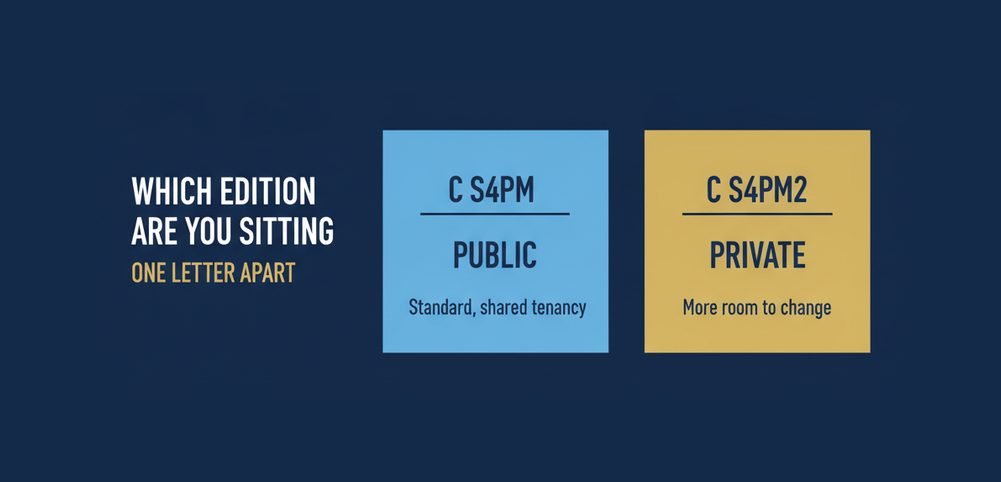
The confusion is real rather than theoretical. Search data on the money site shows more demand for the Private Edition code than for the Public Edition one, which means a significant number of people looking for one of these exams are typing the other. Before booking, check which edition your projects actually run on.
The distinction matters because the editions differ in how much can be changed. Public Edition is a standardised, multi-tenant deployment where fit-to-standard genuinely constrains the answer. Private Edition allows more latitude, and the project decisions that follow from that are different decisions.
Practising in the exam’s own format is the fastest way to confirm you are aimed at the right one, and ERPPrep’s C_S4PM scenario simulations are built specifically for the Public Edition blueprint rather than for the Private Edition one.
How is C_S4PM delivered and scored?
C_S4PM is a Scenario-Based Assessment consisting of one activity, allowed two hours, with a 60 percent cut score at Associate level against SAP S/4HANA Cloud Public Edition. SAP publishes the duration and the cut score on its own certification card; the money site’s study guide carries the format, level, cut score and product but no duration.
| Field | Value |
|---|---|
| Credential name | SAP Certified – Managing SAP S/4HANA Cloud Public Edition Projects |
| Exam code | C_S4PM |
| Level | Associate |
| Format | Scenario-Based Assessment, 1 activity |
| Duration | 2 hours |
| Cut score | 60 percent |
| Product | SAP S/4HANA Cloud Public Edition |
| Languages | Not published by SAP |
| Blueprint areas | 7 |
| Retirement date | None published |
Two fields on that table deserve a note about how they were sourced. The duration comes from SAP’s own certification card, which shows it twice, because the money site omits it. The languages field genuinely is not published: SAP’s card shows a heading saying availability varies by format above an empty list, so the honest answer is that there is no published language list rather than that the exam is English only.
There is no question count, and that is not an omission. A single-activity assessment has one connected task rather than a set of separately scored items, so the 60 percent is measured across the quality of decisions within that activity.
What does a single-activity assessment actually mean?
A single-activity Scenario-Based Assessment presents one extended, connected project situation and asks you to work through it, making the decisions a project manager would face in sequence. Each decision sits in the context the previous ones created, so the assessment measures coherent judgement rather than a set of independent recollections.
The practical consequence is that you cannot bank easy marks early and coast. On a paper made of separate items, a weak area costs you those items and nothing more. Here, misplacing a decision in the lifecycle can shape everything that follows it, because the scenario carries your choices forward.
It also changes what preparation looks like. Memorising the names of the SAP Activate phases is close to worthless; knowing which phase a described situation is in, and therefore what the right next step is, is the whole skill. SAP has moved its certification programme to performance-based assessment precisely to test that distinction.
SAP supports the format with its own readiness material, including a technical checklist, a Learning Hub subscription that carries the attempts, a valid SAP Universal ID with a secondary email, and an AI-assisted tool for rehearsing scenario reasoning before the real sitting.
What do the seven blueprint areas cover?
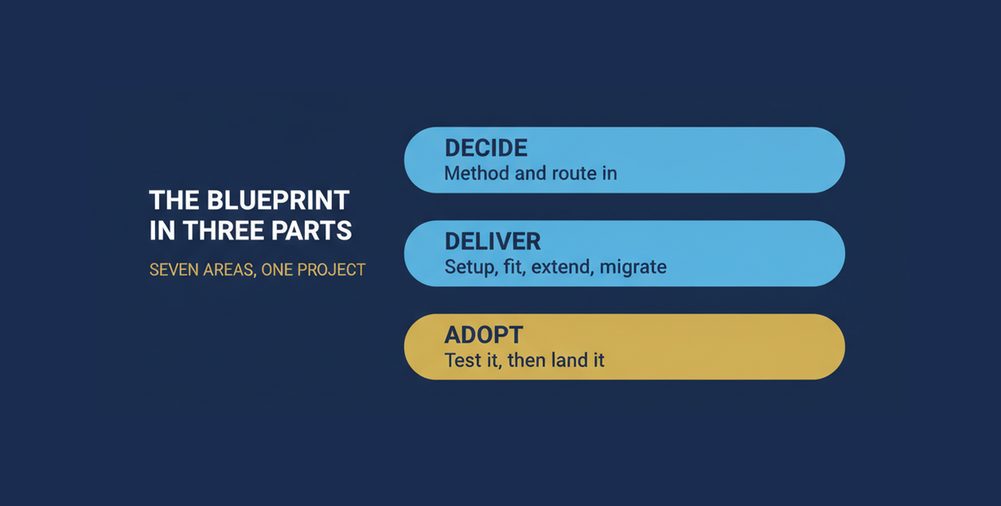
The blueprint publishes seven named areas with no percentage weightings attached to any of them. They run in lifecycle order, which is itself a useful signal: the exam is organised the way a project is organised rather than the way a syllabus usually is.
| Blueprint area | What it covers |
|---|---|
| SAP Activate Methodology Foundation | The framework across its phases and three pillars, the deliverables of each stage, and the guided content behind every step |
| Clean Core, Integrated Toolchain and Transition Paths | The clean-core principle, the toolchain for process-driven transformation, and the routes in: RISE with SAP, greenfield, system conversion and selective data transition |
| Implementation Setup, Landscapes and Provisioning | Team and stakeholder roles, system landscapes and release upgrades, starter system provisioning, registering the engagement in SAP Cloud ALM and granting initial access |
| Fit-to-Standard and Central Business Configuration | Running fit-to-standard workshops with the business-driven configuration questionnaire, then localisations and scope, finance settings, organisational structure, order types and transporting the configuration |
| Extensibility, Integrations and Data Migration | Business roles and the Fiori launchpad, key-user and developer in-app extensibility, side-by-side BTP extensions, SAP Best Practices and customer integrations, and the migration cockpit |
| Testing and SAP Cloud ALM Monitoring | Test strategy, user-acceptance test cases and plans in SAP Cloud ALM, the test automation tool and its Tricentis capabilities, and monitoring integrations and progress |
| Organizational Change Management | Why user acceptance matters, assessing an organisation’s change readiness and the change manager’s own capabilities, and applying SAP’s OCM framework across the lifecycle |
Read that list as a project rather than as topics and the shape becomes obvious. Areas one and two are how you decide to do it. Three, four and five are doing it. Six is proving it works. Seven runs alongside all of them and is the one most often treated as optional in real life.
The absence of weightings removes the usual planning shortcut. With no percentages to rank by, and with a single connected scenario rather than separate items, the defensible approach is to know the lifecycle as a continuous sequence rather than to concentrate on a presumed heaviest area.
SAP Activate is the backbone and Cloud ALM is the tooling
Two things run through every blueprint area rather than sitting inside one. SAP Activate is the methodology that gives the project its phases, workstreams and deliverables. SAP Cloud ALM is the tool in which the project is planned, tested and monitored. Between them they account for most of what the scenario will ask about.
SAP Activate appears explicitly in area one and implicitly everywhere after it, because every later decision has a correct phase to sit in. The three pillars and the phase structure are the frame a scenario question is answered inside, which is why the money site’s own guidance puts learning the methodology as a connected sequence before anything else.
SAP Cloud ALM shows up in three separate areas: registering the engagement during setup, building user-acceptance test cases and plans during testing, and monitoring integrations and project progress throughout. Knowing which project task lives where inside it is a recurring theme rather than a single objective.
Both are covered in SAP’s own project management learning journey, which runs to roughly 23 hours across three courses and follows the same order the blueprint does.
The wider discipline underneath both is ordinary project management, and reading it that way helps. The project profession’s own definition describes the same lifecycle of initiation, planning, delivery and closure that SAP Activate expresses in its own vocabulary, so a candidate with general delivery experience is further along than the SAP-specific naming suggests.
Why does change management get its own blueprint area?
Organizational Change Management is one of seven named areas, and SAP lists it among the role’s skills on its certification card. That placement is deliberate: SAP treats user adoption as a delivery workstream with its own methods rather than as something that happens after go-live if there is budget left.
The objectives under it are specific. Why user acceptance matters, how to assess an organisation’s change readiness, how to assess the change manager’s own capabilities, and how SAP’s OCM framework is structured and applied across the lifecycle. Two of those four are assessments rather than activities, which tells you the exam expects diagnosis before intervention.
It is also the area candidates most often find hardest, alongside SAP Activate phase logic and the role of Cloud ALM. That is not surprising. A consultant who has delivered five implementations has almost certainly seen change management done badly more often than well, which makes the formal framework unfamiliar even to experienced people.
The discipline has its own professional body, and the change management institute publishes a competency model and body of knowledge that map closely onto what the blueprint describes. Reading it alongside SAP’s OCM100 course makes SAP’s framework feel like a specific instance of something general rather than a proprietary invention.
Who is the credential written for?
It is written for experienced SAP professionals moving into delivery leadership: project managers, senior consultants and technical leads who coordinate teams, manage scope and timelines, and want a recognised credential for running a cloud implementation end to end. The money site frames it as a step into strategic delivery ownership rather than a deepening of functional expertise.
That makes it a poor first SAP credential and a good second or third one. Someone with no implementation exposure will struggle with a scenario that assumes you know what a fit-to-standard workshop feels like in the room, because the assessment rewards judgement built from having been there.
It is a strong fit for the functional consultant who has been running workstreams informally and wants the delivery-side vocabulary to match. The methodology, the tooling and the change framework are exactly the parts of the job that get learned by osmosis and therefore unevenly.
Anyone already holding an SAP Activate credential will recognise a good deal of area one. The the SAP Activate credential covers the methodology itself in more depth, while this exam applies it to one specific product and adds the configuration governance, testing and adoption layers around it.
How should you prepare for C_S4PM?
Preparation for C_S4PM should follow the project rather than the topic list, because the assessment is one connected scenario. SAP’s own route is a three-course learning journey of roughly 23 hours, and the money site suggests two to three months alongside a full-time role.
- Confirm which edition you actually want, since C_S4PM covers Public Edition and C_S4PM2 covers Private Edition, and the search demand for the two codes is genuinely mixed up.
- Learn the SAP Activate methodology as a connected sequence of phases and workstreams, so you can place any project decision in the right stage rather than recalling it in isolation.
- Work through the implementation course covering team and landscape setup, provisioning, fit-to-standard, Central Business Configuration, extensibility, integrations, migration and testing, in that order.
- Get comfortable with SAP Cloud ALM as the backbone for planning, testing and monitoring, since knowing which project task lives where inside it is a recurring theme.
- Study organisational change management as a delivery discipline rather than an afterthought, practising how to identify adoption risks and the actions that secure user acceptance.
- Rehearse the fit-to-standard and configuration-governance flow end to end, because the right next step usually depends on where you are in the lifecycle rather than on a single fact.
- Practise full scenarios and justify each decision aloud, which trains the applied judgement a Scenario-Based Assessment rewards and exposes reasoning you cannot actually defend.
- Check the logistics before exam day, including the technical readiness checklist, your Learning Hub attempts and a valid SAP Universal ID with a secondary email registered.
Two to three months is realistic for someone studying alongside a full-time role. Candidates with recent delivery experience move faster; those newer to cloud implementations should budget more and spend the extra time on the lifecycle rather than on the terminology.
For a broader view of what the credential covers before you commit to the learning journey, the preparation guide for C_S4PM is a useful orientation point and sits alongside SAP’s own material rather than replacing it.
Frequently Asked Questions
How long is the C_S4PM exam?
Two hours. SAP displays the duration twice on its own certification card, in the header strip and again in the certification overview block. The money site does not publish it.
What is the cut score for the SAP project management certification?
Sixty percent, and both SAP and the money site state the same figure. Because the assessment is one connected activity, that score reflects the quality of your decisions rather than a count of separate items answered.
How many questions are on C_S4PM?
None are published, and that is correct rather than missing. The exam is a Scenario-Based Assessment built around a single activity, so there is one extended task rather than a set of individually scored items.
What is the difference between C_S4PM and C_S4PM2?
The edition. C_S4PM covers Managing SAP S/4HANA Cloud Public Edition Projects; C_S4PM2 covers the Private Edition. Both are live Associate-level Scenario-Based Assessments, and the codes differ by one character.
Which language is the exam available in?
SAP does not publish a language list for this credential. Its certification card shows a heading saying availability varies by format above an empty list, so confirm with SAP before booking if you need a specific language.
Are the seven blueprint areas weighted?
No percentages are published for any of them. With no weightings and a single connected scenario, the sensible approach is to know the implementation lifecycle as a continuous sequence rather than to concentrate on a presumed heaviest area.
Does the exam ask you to configure the system?
No. It covers configuration governance, meaning fit-to-standard workshops, Central Business Configuration and transporting the result, from the project manager’s point of view rather than the configurer’s.
How long does preparation take?
Roughly two to three months alongside a full-time role. SAP’s learning journey itself runs about 23 hours across three courses, and the remaining time goes on building scenario judgement rather than on additional reading.
Which courses does SAP recommend?
Three: ACT100 for the SAP Activate methodology, S4C01 for implementing S/4HANA Cloud Public Edition, and OCM100 for organisational change management in cloud projects.
Does the credential expire?
SAP publishes no retirement date for it and the certification record carries no end-of-life value. The credential sits within SAP’s Stay Certified programme, which is how currency is maintained.
Conclusion
C_S4PM certifies delivery leadership rather than system configuration: one Scenario-Based activity, two hours, a 60 percent cut score, and seven unweighted blueprint areas that run in lifecycle order from methodology through go-live to adoption.
Check the edition first, because the Private Edition exam sits one character away and attracts more search traffic than this one does. Then learn SAP Activate as a sequence rather than a vocabulary, put real time into SAP Cloud ALM and organisational change management, and rehearse full scenarios out loud until you can defend every decision by naming the phase it belongs to.


