
Sixty-four, not sixty. SAP sets the published cut score for C_TS422 four points above the threshold most of its associate credentials use, and it does so on a format where a near miss earns nothing. The SAP PP certification is delivered as a System-Based Assessment: one hands-on activity in a working system, where you carry out configuration and transaction tasks and are judged on whether the task came out right.
Those two facts belong together. A higher bar would be manageable on a paper that hands out partial credit for recognising a correct statement. On an activity that either completes correctly or does not, four extra points means SAP wants confident execution across the whole manufacturing flow rather than strength in a favourite area. This guide walks the seven blueprint areas behind the credential, explains what the format changes about preparation, and shows where candidates most often lose the activity.
Why Does C_TS422 Ask for 64 Percent Rather Than 60?
Because the credential covers an unusually wide process chain and SAP wants breadth rather than a strong showing in one area. The published cut score for C_TS422 is 64 percent, slightly above the 60 percent used by many SAP associate certifications, and it applies to a performance-based assessment where partial familiarity rarely earns partial credit. Breadth is the theme across these associate credentials, and the SAP project delivery credential shows the same logic in a project delivery role.
Consider what sits inside the scope: master data, demand management, planning runs, capacity evaluation and levelling, discrete production orders, process orders, and advanced planning with embedded PP/DS. That is the whole manufacturing line of business rather than a slice of it. A candidate who is excellent at production orders and vague about planning parameters would clear 60 percent on many papers and should not clear this one.
The practical reading is that the cut score is an instruction about preparation style. It tells you to over-prepare rather than to optimise, and to aim for reliable execution in every process area instead of deep expertise in two or three. A comparable reading applies to the SAP S/4HANA service certification, which is delivered in exactly the same shape.
What Does a System-Based Assessment Actually Involve?
Working inside a live-style SAP system and completing real configuration and transaction tasks. C_TS422 is delivered as a System-Based Assessment consisting of one hands-on activity rather than a long series of separate items, and scoring rests on whether the task was carried out correctly. This is the format SAP moved to when it completed its shift to performance-based certification in early 2026.
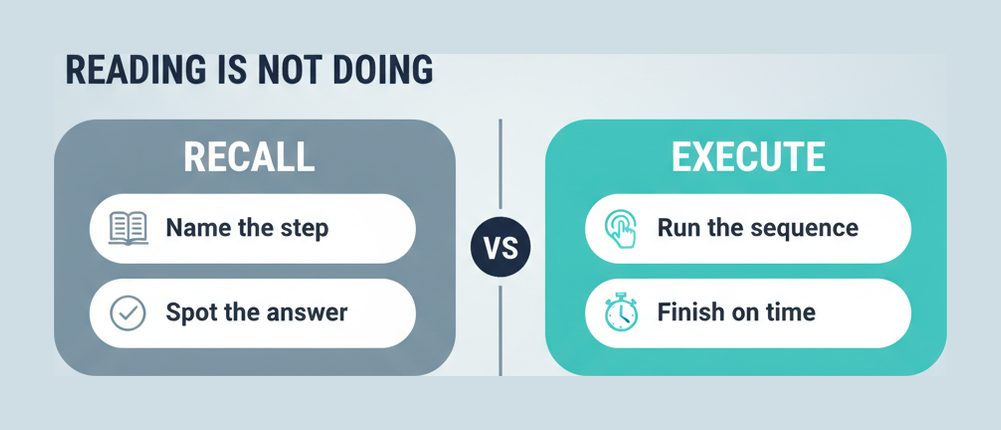
That single-activity structure changes the shape of exam day. There is no rhythm of reading, answering and moving on. There is a sustained piece of work, and hesitation on routine steps such as creating an order, running a planning job or posting a confirmation accumulates against you. Fluency matters as much as knowledge. That same single-activity structure now shapes the generative AI developer exam, where the work is building rather than configuring. The same structure governs SAP data titles as well, including the BW/4HANA data engineer credential.
It also changes what counts as revision. Reading about a transaction builds recognition; carrying it out builds the sequence memory the activity actually rewards. Candidates who prepare only by reading consistently report that the system asks for actions they can describe but have never performed.
The Seven Blueprint Areas, and Why None Carries a Weight
C_TS422 publishes seven blueprint areas and no percentage against any of them. They run from manufacturing master data, through supply chain planning and demand management, material requirements planning, capacity planning and evaluation, discrete shopfloor control, process manufacturing, and finally advanced planning with PP/DS.
| Blueprint area | What it covers |
|---|---|
| Manufacturing Master Data | Material and product master, bills of material including phantoms, co-products and variant BOMs, work centres and capacities, and routings or task lists including reference operation sets and engineering change management |
| Supply Chain Planning and Demand Management | How supply chain planning is structured and executed, setting up demand programs, and applying make-to-stock and make-to-order strategies so requirements flow correctly into the planning run |
| Material Requirements Planning | MRP Live and the classic planning run, predictive MRP, demand-driven replenishment, and evaluating results to manage the procurement and production proposals that come out |
| Capacity Planning and Evaluation | Capacity evaluation reports including the work centre load report and the Manage Work Center Capacity app, plus levelling with the tabular planning table, the capacity scheduling table and the scheduling board |
| Discrete Shopfloor Control and Production Orders | The production order lifecycle: creation and scheduling, material availability checks, release, goods issues, confirmations and goods receipts, and the integration back into planning |
| Process Manufacturing and Process Orders | Process-industry manufacturing through the process order lifecycle: analysing process master data, creating process orders, and executing release, goods issues, confirmations and goods receipts |
| Advanced Planning with PP/DS | Embedded Production Planning and Detailed Scheduling: PP/DS master data and the alert monitor, planning strategies and heuristics, detailed scheduling on the planning board, supply-creation-based confirmation, optimisation, and combining a multistep PP/DS run with MRP Live |
With no weightings and a single activity, the areas cannot be traded off against each other in the way a weighted paper allows. The blueprint is better read as a description of one connected process than as seven separable topics.
What Is the C_TS422 Exam Format?
One System-Based Assessment activity, a published cut score of 64 percent, and English as the published language. The credential is SAP Certified: SAP S/4HANA Cloud Private Edition, Production Planning and Manufacturing, at associate level, and its content applies to on-premise deployments as well as to the cloud private edition.
| Detail | Value |
|---|---|
| Credential | SAP Certified: SAP S/4HANA Cloud Private Edition, Production Planning and Manufacturing |
| Exam code | C_TS422 |
| Level | Associate |
| Format | System-Based Assessment, one hands-on activity |
| Cut score | 64% |
| Language | English |
| Learning journey | Roughly 77 hours across eleven courses |
| Typical preparation | Two to three months alongside a job |
| Applies to | SAP S/4HANA Cloud Private Edition and on-premise |
Because the assessment is one activity rather than a series of items, there is no question count to plan around, and any resource quoting one is describing a superseded version of the exam. The C_TS422 exam facts page sets out the format details, and the official SAP certification page remains the authority for current timing, which can change between exam versions.
One more scoping note that matters for job hunting: the credential is written against the cloud private edition but the manufacturing processes it examines are the same ones used in traditional on-premise projects, so the skills travel between both kinds of engagement.
Why Do Master Data Choices Decide Results Five Steps Later?
Because in production planning almost nothing is evaluated where it is configured. A routing, a work centre capacity or a planning strategy set in the master data area silently shapes what the planning run produces, what the capacity report shows, and how the production order schedules, several steps further down the chain.
That cause-and-effect distance is the single most common source of lost marks. A candidate configures something plausible, moves on, and only discovers the consequence when a later task produces an unexpected result with no obvious cause. By then the activity has moved past the point where it can be corrected cheaply.
The master data area itself is broad: material and product master, bills of material with phantom assemblies, co-products and variant BOMs, work centres with their capacities, and routings including reference operation sets and engineering change management. Each of those carries settings that reappear later, which is why the area is worth studying as a set of downstream effects rather than as a list of screens.
How Much MRP Does the Exam Expect?
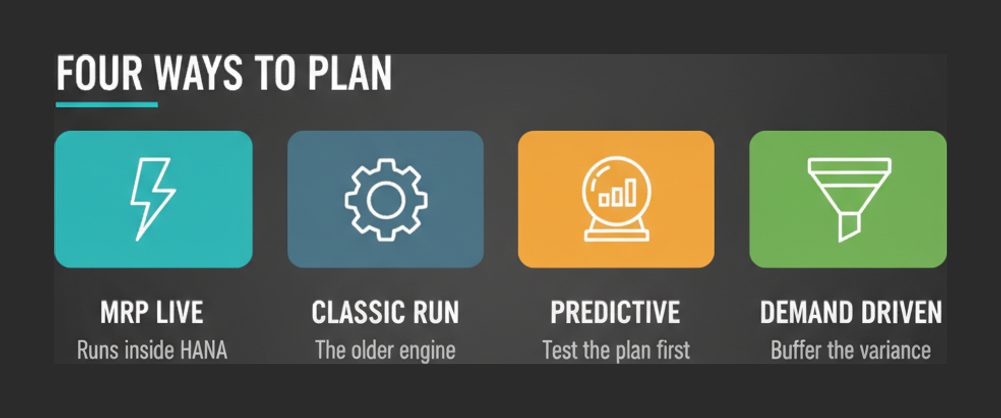
More than one planning method, and the ability to tell them apart. The blueprint names MRP Live and the classic planning run, then predictive MRP and demand-driven replenishment, then evaluating the results and managing the procurement and production proposals the run generates. Four planning approaches, and the exam expects you to work with them rather than merely name them.
MRP Live against the classic run
MRP Live pushes the planning calculation down into HANA and changes both performance and the way results appear. Knowing when each is appropriate, and what differs in the output, is standard C_TS422 territory.
Predictive MRP and demand-driven replenishment
These are the two newer additions and the ones candidates most often skip. Predictive MRP simulates a plan before committing it; demand-driven replenishment buffers against variability rather than forecasting through it. Both change what “correct” looks like in a planning task, so a candidate who has only ever run classic MRP is exposed here.
Lot-size and scheduling parameters sit underneath all four approaches and are named repeatedly as a difficulty area. They are the settings most likely to make a planning result look wrong when the configuration was in fact the problem. The SAP Help Portal is the reference of record for how each parameter behaves in the current release.
What Separates Discrete From Process Manufacturing Here?
The blueprint treats them as two separate areas with parallel lifecycles, and the exam expects you to work both. Discrete manufacturing runs on production orders; process manufacturing runs on process orders. The step names look almost identical, which is exactly why the distinction is examinable.
| Stage | Discrete manufacturing | Process manufacturing |
|---|---|---|
| Order object | Production order | Process order |
| Master data focus | Bills of material, routings, work centres | Process master data for the process industry |
| Before release | Order creation, scheduling and material availability check | Process order creation from process master data |
| Execution | Release, goods issue, confirmation, goods receipt | Release, goods issue, confirmation, goods receipt |
| Back into planning | Integration with production planning is named explicitly | Execution focus, with the same posting sequence |
Candidates from a single industry background tend to be strong in one column and thin in the other. Since neither area carries a published weight and the assessment is one connected activity, being thin in either is a genuine risk rather than an acceptable trade.
How Deep Does the PP/DS Area Go?
Deeper than any other area on the blueprint, and it is consistently named as the hardest. Advanced Planning with PP/DS covers its own master data and the alert monitor, planning strategies and heuristics, detailed scheduling on the planning board, supply-creation-based confirmation, optimisation, and combining a multistep PP/DS run with MRP Live.
The last of those is the one that separates candidates. Running PP/DS in isolation is one skill; sequencing a multistep PP/DS run alongside MRP Live so that both produce a coherent plan is another, and it requires holding the whole planning chain in your head at once.
Heuristics deserve their own study time. They are the rules PP/DS applies when it plans, and choosing the wrong one produces a valid-looking schedule that answers a different question from the one the scenario asked. For a comparison of how another SAP planning credential handles a demanding threshold, the SAP IBP cut score analysis is a useful companion.
How Long Is the Learning Journey?
Roughly 77 hours across eleven courses, and most candidates should plan two to three months alongside a job. The performance-based format means the course hours are a floor rather than a total, because hands-on repetition has to be added on top of the reading before the sequences become automatic.
- Start with the manufacturing basics course to build the end-to-end picture, because every later area assumes you know where it sits in the flow.
- Move to master data next, treating each setting as a downstream effect rather than a screen, since routings and work centre capacities decide planning and scheduling results later.
- Work production planning and the planning runs together, covering MRP Live, the classic run, predictive MRP and demand-driven replenishment as four approaches to one problem.
- Take discrete and process shopfloor control in sequence, because the two lifecycles look alike and are easiest to tell apart when learned side by side.
- Cover capacity planning and evaluation next, learning the work centre load report and the levelling tools well enough to use them without hesitating.
- Finish with advanced PP/DS, spending the most time on heuristics and on combining a multistep PP/DS run with MRP Live, then rehearse whole planning-to-production chains under a timer.
Candidates with existing manufacturing configuration experience can compress that considerably; those new to SAP production planning should budget the fuller end and add extra hands-on time. The earlier C_TS422 preparation guide covers the same scope from an earlier version of the exam and is a useful reference for the process content itself.
On whether the effort pays back, this credential targets the manufacturing consultant profile specifically, and published ranges for SAP consultant pay give a realistic picture of where an associate-level specialist sits. The certification signals project readiness in a mentored role rather than seniority, which is what the associate level is meant to mean.
Frequently Asked Questions
What is the cut score for the SAP PP certification?
Sixty-four percent, which is slightly above the 60 percent used by many SAP associate credentials. The higher bar reflects the breadth of the manufacturing scope and the performance-based format.
How is the C_TS422 exam delivered?
As a System-Based Assessment made up of one hands-on activity. You carry out configuration and transaction tasks inside a working SAP system and are scored on whether each task was completed correctly.
How many items does C_TS422 contain?
It is a single activity rather than a series of separate items, so there is no item count to plan around. Any resource quoting one is describing a superseded version of the exam.
Which product does the certification target?
SAP S/4HANA Cloud Private Edition, with content that also applies to on-premise deployments. The manufacturing processes examined are the same in both, so the skills transfer between project types.
What does the blueprint actually cover?
Seven areas: manufacturing master data, supply chain planning and demand management, MRP, capacity planning and evaluation, discrete shopfloor control, process manufacturing, and advanced planning with PP/DS.
Which topics do candidates find hardest?
Advanced PP/DS planning and detailed scheduling, MRP parameters such as lot-size and scheduling behaviour, and the way master data settings shape planning results several steps downstream.
Do the blueprint areas have percentage weightings?
No. Seven areas are published with no weights, which combined with the single-activity format means no area can be traded off against another during preparation.
Is hands-on system access necessary?
Strongly recommended. Because the assessment requires completing real configuration and transaction tasks, only working in a system builds the speed and accuracy the activity demands.
How long should preparation take?
Two to three months alongside a job. The learning journey runs roughly 77 hours across eleven courses, and the format means hands-on repetition has to be added on top of that.
Who is the credential aimed at?
Production planning and manufacturing consultants, and business users moving into an SAP manufacturing role, who need a recognised associate credential proving they can contribute to a project team under mentoring.
Conclusion
The number that defines C_TS422 is 64 rather than 60, and the reason is the format sitting behind it. One System-Based Assessment activity across seven unweighted areas covering master data, planning, capacity, discrete and process execution and advanced PP/DS leaves nowhere to hide a weak area, so SAP raised the bar to match.
Prepare for execution rather than recognition: learn the flow end to end, treat master data as a set of downstream effects, cover all four planning approaches, work both order lifecycles side by side, and give PP/DS heuristics the time they need. Then rehearse whole chains under a timer until the sequences are automatic, and check the current format details before booking so nothing on exam day is a surprise.


