A rate table built wrong in the first week of an SAP Incentive Management project does not fail in the first week. It fails at the calculation run, several configuration steps later, as a payout figure that a sales rep disputes and nobody can trace. That delayed failure is the whole character of the SAP Incentive Management certification: C_THR70, formally SAP Certified – SAP Incentive Management, is one Scenario-Based Assessment activity with a 60 percent pass score, and what it scores is whether you can keep a chain of dependent settings consistent from compensation elements through to the deposit a payee finally sees.
This article sets out what the credential proves, why it has no question count, what the seven blueprint areas ask of you, how credit, measurement, incentive and deposit rules hand results to one another, how C_THR70 differs from the Compensation and Variable Pay exams that sit beside it, which of the circulating exam codes is current, and how to rehearse for a scenario rather than a paper.
What Does the SAP Incentive Management Certification Prove?
The SAP Incentive Management certification, exam code C_THR70, proves that you can implement and administer SAP SuccessFactors Incentive Management as a mentored member of a project team: set the system up, model the data that compensation depends on, build plans from rules, run the calculation, support payees and publish analytics. SAP describes it as confirming the fundamental skills needed to implement compensation plans effectively.
The profile SAP attaches to it is the Consultant role, with Compensation Management, Analytics, Data Integration, Human Resources Information System and Reward Strategy listed as the skills it covers. ERPPrep describes the same reader from the other side: compensation and incentive-management consultants, and HR systems people moving into a sales-compensation implementation, who need an associate credential at project-participation depth rather than an architect’s.
The facts SAP displays are few, and they are the ones to plan around. The C_THR70 certification page shows a pass score, a format and a duration, and nothing about question counts or topic weightings, because a single scenario activity has neither.
| Exam detail | C_THR70 |
|---|---|
| Credential | SAP Certified – SAP Incentive Management |
| Level | Associate |
| Product | SAP SuccessFactors Incentive Management |
| Format | Scenario-Based Assessment, 1 activity |
| Passing score | 60 percent |
| Duration | 2 hours, as displayed by SAP; ERPPrep publishes no duration |
| Blueprint areas | 7, no weightings published |
| Languages | Vary by format: roleplay with AI guidance in English, Spanish, Italian, French, Japanese and 25 more; recorded video in English only |
| Learning journey | Implementing and Administering SAP Incentive Management, one core course (THR70) |
| Keeping the badge | SAP’s badge criteria say the assessment is completed once a year to stay certified |
Two gaps are deliberate. The certification page displays no fee, because attempts come from a Learning Hub subscription, and it displays no validity period as a number of years; what SAP’s badge criteria on Credly say instead is that the badge is kept valid by completing the assessment once a year. Any fee or expiry figure you find elsewhere is that site’s claim, not SAP’s.
Why Is C_THR70 One Activity and Not a Question Paper?
C_THR70 is one activity because SAP completed its move to performance-based certification in early 2026, and this exam is delivered as a Scenario-Based Assessment: you are given a realistic incentive-compensation situation and scored on the configuration decisions and the sequence of steps you take inside it. The 60 percent pass score applies to that single activity, not to a tally of correct items.
SAP now runs two performance-based formats. A System-Based Assessment, or SyBA, places you in a live-style system and scores whether configuration and execution tasks were completed correctly. A Scenario-Based Assessment, or SBA, gives you a business situation and scores the judgement you show in working through it. C_THR70 is the second kind, which is why its certification page offers two ways of presenting your reasoning, a roleplay with AI guidance or a recorded video, each with its own language list. Those are two deliveries of one scenario, not two different exams.
The practical consequence is that recognising a correct statement earns nothing. The scenario does not ask what a credit rule is. It describes a sales force with split deals, mid-period territory changes and returned orders, and expects you to decide which element, which rule type and which run setting produce a traceable, defensible payout, in the two hours SAP displays for the activity. Every one of those decisions belongs to a blueprint area, and the next section maps them.
Which Seven Blueprint Areas Does C_THR70 Cover?
The C_THR70 blueprint has seven areas and SAP publishes no weighting for any of them, so the working assumption is that the scenario can draw on all seven. Five follow the incentive-compensation lifecycle in order, from system setup to viewing results; the last two, payee communication and embedded analytics, cover what happens after the numbers exist and are the areas candidates most often leave until last.
The area names below are ERPPrep’s blueprint, and the lessons listed beside each are the units of SAP’s own Implementing and Administering SAP Incentive Management course, which follow the same seven headings.
| Blueprint area | What it asks you to handle | SAP course lessons under it |
|---|---|---|
| Getting Started & System Navigation | The incentive-compensation process end to end, the technical components of the product, and finding your way around the management portal and user interface | Describing the process, identifying technical components, exploring the portal, navigating the user interface |
| Starting the Implementation | System preferences, calendars, global values, a security structure, processing units, interface customisation, data integration including the Express Data Loader and backup and restore | System preferences, calendars, global values, security structure, processing units, user interface, data integration options, Express Data Loader, Data Manager self-service |
| Working with Compensation Elements | Organisation and classification records, versions and effective dates, roll relationships, territories, fixed values, rate and lookup tables, formulas and variables | Organisation data, searching a workspace, versions and effective dates, roll relationships, classification data, rule elements, territories, fixed values, rate tables, lookup tables, formulas, variables |
| Creating & Managing Compensation Plans | Translating a compensation requirement into plan logic through credit, measurement, incentive and deposit rules, and assigning the variables that let the plan calculate | Analysing requirements, types of plan rules, credit rules, measurement rules, incentive rules, deposit rules, assigning variables |
| Running the Calculation & Viewing Results | Pipeline tasks, calculation run preferences, executing the calculation, interpreting results, manual transactions, credits and deposits, and running a model before a live run | Pipeline tasks, run preferences, running the calculation, reviewing results, manual entries, running a model |
| Communicating with Payees | Communication options, document distribution, disputes and inquiries, dashboards, standard reports, and the built-in AI capabilities that support payee communication | Communication options, document distribution, disputes and inquiries, dashboards, standard reports, AI capabilities |
| Embedded Analytics & Stories | Using and administering embedded analytics to build stories, then scheduling and publishing them to stakeholders | Using embedded analytics, administering it, creating stories, scheduling and publishing stories |
Read the table as a dependency map rather than a syllabus to tick off. A global value defined while starting the implementation is what every plan references later; a rate table built as a compensation element is what an incentive rule reads at calculation time; a run preference decides what the payee’s dashboard shows. ERPPrep’s FAQ names the plan rule types, and the formulas, variables, rate and lookup tables that feed them, as the area candidates find hardest, because a value defined in one element changes the result several steps downstream. That is also why ERPPrep structures its C_THR70 scenario simulations and skill drills around the connected flow instead of around single screens: 24 scenario simulations and 120 skill drills across the seven areas, in the same shape as the exam itself.
How Do Credit, Measurement, Incentive and Deposit Rules Chain Together?
In SAP SuccessFactors Incentive Management a compensation plan is a chain of four rule types, and each one consumes what the previous one produced: credit rules decide who earned a transaction, measurement rules turn credits into attainment, incentive rules turn attainment into earnings, and deposit rules decide how much of those earnings is paid and when. C_THR70 scores whether you build that chain so the calculation produces the payout the business requirement described.
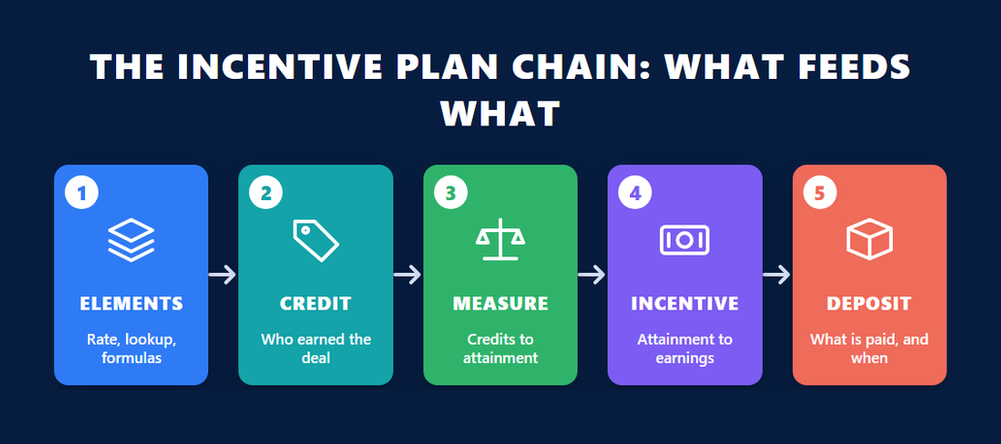
Before the chain starts there are the compensation elements, which is why the blueprint gives them an area of their own. Territories decide which transactions a position can be credited for; rate tables return the rate that applies to a band of attainment; lookup tables return a value for a key; fixed values and global values hold the figures every plan shares; formulas and variables let a rule refer to all of them without hardcoding a number. A plan that hardcodes a corporate accelerator threshold in every incentive rule works until the threshold changes, which is exactly the kind of situation a scenario puts in front of you.
Credit rules: who earned the transaction
A credit is an allocation of a transaction’s value to a participant, and a credit rule is what makes that allocation. On a large account three people may have contributed, a field rep, an inside rep and an overlay specialist, and the credit rule is where their proportions are set before anything is measured. Get this wrong and every later figure is wrong for the right reasons: the measurement is accurate, but it is measuring the wrong person’s credit.
Measurement rules: credits into attainment
Measurement rules aggregate credits for each position into a measured value, typically attainment against a target, and they can be restricted with a condition or a territory so that only qualifying credits count. SAP’s lesson on the types of compensation plan rules is the shortest in the course and the one worth reading first, because it fixes the order the other four lessons then fill in.
Incentive rules: attainment into earnings
An incentive rule applies the plan’s economics to the measured value: a percentage of credit, a rate read from a rate table for the band the position has reached, a bonus released when a threshold is crossed. This is where the rate table from the first paragraph of this article comes home. The rule itself may be correct and still return the wrong earning, because the table it reads was banded wrongly weeks earlier. For readers who want the general concept behind all of this rather than the SAP implementation, the Wikipedia entry on commission as remuneration covers the pay model the product exists to automate.
Deposit rules: what is paid, and when
Deposit rules determine how much of an earning is actually deposited for payment and when. SAP’s training distinguishes basic deposit rules, which take incentives as their input, from detail deposit rules, which take credits directly and are used when a plan does not calculate earnings through incentive rules at all. Holdbacks, draws and recoveries live here, and so does the question a scenario most likes to ask: if a transaction is reversed after payment, which rule and which run setting produce the clawback?
Only after the chain is built does the calculation pipeline run it, and only after a run does the payee see anything. ERPPrep’s own sample scenario makes the pre-production step explicit: before the first live calculation on a new plan, run it as a model on representative data so results can be inspected without paying anyone. The market the product sits in is being judged on the same connected view. The IDC MarketScape that named SAP a leader in sales performance management in 2025, quoted on SAP’s IDC MarketScape announcement, also reported that 39 percent of C-suite sales leaders named sales performance management their top technology initiative for 2025, and described SAP’s position this way:
“SAP brings deep industry expertise to sales performance management, leveraging decades of experience across diverse sectors. Its solutions are tailored to meet the unique compensation challenges of highly regulated and complicated industries such as manufacturing, healthcare, and financial services.”
A consultant who can keep the chain consistent in a regulated, complicated plan is the person that assessment is describing, and C_THR70 is the credential that says you can.
C_THR70, C_THR86 or C_THR87: Which SuccessFactors Pay Exam Is Yours?
C_THR70 is the SuccessFactors exam for variable pay that is earned transaction by transaction, meaning commission, quota and incentive plans for a sales force. C_THR86 covers SAP SuccessFactors Compensation, the salary and merit planning product, and C_THR87 covers SAP SuccessFactors Variable Pay, the bonus-plan product. All three are associate-level Scenario-Based Assessments with a 60 percent pass score, and they test three different products.
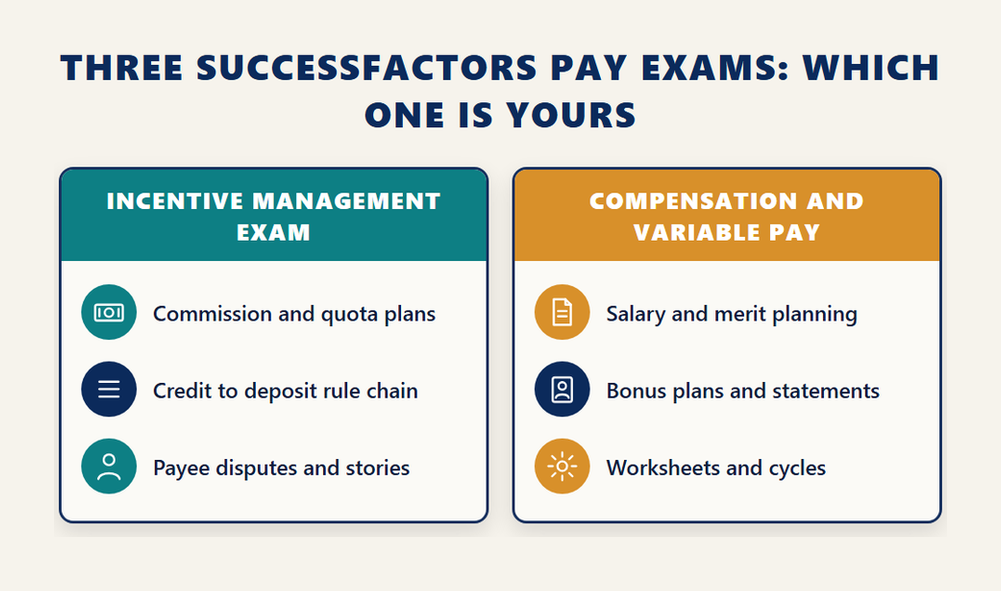
The confusion is understandable, because all three sit in the SuccessFactors catalogue and the broad query for SAP SuccessFactors certification draws several hundred impressions a month on this blog and on ERPPrep, far more than any single exam name. The table separates them by the question that actually decides it: whose pay, calculated from what.
| Question | C_THR70, Incentive Management | C_THR86, Compensation | C_THR87, Variable Pay |
|---|---|---|---|
| Whose pay | Sales reps and other payees on commission or incentive plans | Employees in a salary and merit cycle | Employees on bonus plans inside a variable-pay program |
| Calculated from | Transactions credited to positions, measured and run through plan rules | Compensation worksheets, budgets, eligibility rules and guidelines | Bonus plans and worksheets set up within the variable-pay program |
| Core objects | Compensation elements, credit, measurement, incentive and deposit rules, the calculation pipeline, disputes, stories | Compensation plans, worksheets, budgets, guidelines, results published to Employee Central, reports and statements | Variable-pay program, bonus plans, forms, worksheets, reward and personal statements, Employee Central integration |
| Format and pass score | Scenario-Based Assessment, 1 activity, 60 percent | Scenario-Based Assessment, 1 activity, 60 percent | Scenario-Based Assessment, 1 activity, 60 percent |
| Typical reader | Sales compensation consultant, incentive administrator | Rewards consultant, HRIS compensation lead | Rewards consultant handling bonus cycles |
If your week is spent explaining to a rep why a split deal paid what it paid, C_THR70 is the exam that describes you. If it is spent running a merit cycle or a bonus cycle inside SuccessFactors, one of the other two is. Consultants who cover the whole rewards stack tend to sit C_THR86 first because its product shares more with the rest of SuccessFactors; this blog has already compared the SuccessFactors certification options across the catalogue for anyone choosing an order.
Which Exam Code Is Current: C_THR70, C_THR70_2505 or C_THR70_2411?
The current exam code is C_THR70 with no release suffix. That is how SAP’s certification page displays it and how ERPPrep lists it. Suffixed codes such as C_THR70_2505, C_THR70_2411, C_THR70_2404 and C_THR70_2309 are earlier releases of the same credential, and material written for them describes an exam format that the current one does not use.
This matters more for C_THR70 than for most SAP exams, because the search demand still sits on the old codes. On ERPPrep, queries for C_THR70_2505 questions, C_THR70_2404 questions and plain C_THR70 questions together draw more than a hundred impressions a quarter, every one of them from a reader expecting a paper with a question count. This blog covered the C_THR70_2411 release when it was still a timed paper with a published item count and a percentage cut above 60; those figures belong to that release, not to the exam you would book today.
Three things carry over from release to release and are worth keeping. The product is the same, so the configuration skills in the seven areas do not expire with a code. The learning journey is the same single course, Implementing and Administering SAP Incentive Management. And the badge is maintained the same way, by completing the assessment once a year, which SAP’s badge criteria state outright. What changed is only how you are assessed, and that change is the reason to prepare differently.
One naming point, since the queries show it: third-party listings and some older course titles still call the product SAP Commissions. SAP’s certification page, learning journey and badge all use SAP Incentive Management, and the credential name on the badge is SAP Certified – SAP Incentive Management. If you find study material under the older product name, check which release of the exam it was written for before trusting its format.
How Should You Prepare for the C_THR70 Scenario?
Prepare for C_THR70 by rehearsing the incentive-compensation chain as one connected flow in a system until each decision is automatic, rather than by reading the course once and hoping to recognise answers. The Scenario-Based Assessment rewards reasoning you can defend across a whole situation, so practice has to be hands-on, sequenced the way the plan is sequenced, and timed to the two hours SAP displays.
- Work through the Implementing and Administering SAP Incentive Management journey in unit order, from getting started to embedded analytics, so that each stage is learned after the stage that feeds it.
- Build the compensation elements for one realistic plan yourself, including a territory, a rate table, a lookup table, a global value, a formula and a variable, and note which later rule reads each of them.
- Create the four rule types for that plan together, credit then measurement then incentive then deposit, assigning variables as you go, and trace a single transaction through all four on paper before running anything.
- Run the plan as a model on representative data, read the results, change one upstream element and run it again, so you learn to recognise which setting produced an unexpected figure.
- Rehearse the payee side and the analytics side under the clock, distributing documents, resolving a dispute, publishing a standard report and scheduling a story, and say aloud why each choice fits the situation as you would in the roleplay or recorded format.
ERPPrep’s FAQ puts the preparation window at roughly two months alongside a job, with the core course itself running about twelve hours of content and the rest of the time going to repetition in a system. The journey is on SAP Learning, and it is the only official preparation SAP names. If a live environment is not available, scenario simulations and skill drills that follow the same element-to-deposit sequence are the next best rehearsal, and reviewing why a step produced a given result is where the transferable understanding comes from. Candidates with no prior incentive-compensation exposure should plan the longer end of the window and start with the process overview rather than with rule configuration.
Frequently Asked Questions
What is the passing score for the SAP Incentive Management certification?
The passing score for C_THR70 is 60 percent, displayed by SAP and published by ERPPrep. It applies to the single Scenario-Based Assessment activity as a whole rather than to a count of correct items.
How many questions are on the C_THR70 exam?
None in the traditional sense. C_THR70 is one Scenario-Based Assessment activity in which you work through a realistic incentive-compensation situation and are scored on the decisions and configuration steps you take. SAP publishes no question count for it, and neither does ERPPrep.
How long is the C_THR70 exam?
SAP displays a duration of 2 hours on the certification page. ERPPrep does not publish a duration, so the SAP figure is the one to plan around.
Is C_THR70_2505 or C_THR70_2411 the current exam code?
Neither. SAP’s certification page and ERPPrep both show the code as C_THR70 with no release suffix. C_THR70_2505, C_THR70_2411, C_THR70_2404 and C_THR70_2309 are earlier releases of the same credential, and material written for them describes a format the current exam does not use.
Which languages is the SAP Incentive Management certification available in?
SAP states that available languages vary by format. The roleplay with AI guidance option lists English, Spanish, Italian, French, Japanese and 25 more; the recorded video option is English only. ERPPrep lists English.
Is C_THR70 the SAP Commissions certification?
It is the certification for the product that third-party listings still describe as formerly SAP Commissions. SAP’s own certification page, learning journey and badge call the product SAP Incentive Management, and the credential is SAP Certified – SAP Incentive Management.
What is the difference between C_THR70 and C_THR86?
C_THR70 covers SAP SuccessFactors Incentive Management, the product for commission and incentive plans calculated from credited transactions. C_THR86 covers SAP SuccessFactors Compensation, the salary and merit planning product. Both are associate-level Scenario-Based Assessments with a 60 percent pass score.
Do I need hands-on system access to pass C_THR70?
It is strongly recommended. The exam scores whether you can carry an incentive plan from compensation elements through rules, calculation and payee communication, and that fluency comes from configuring and running plans in a system or in scenario simulations that follow the same sequence, not from reading alone.
How long does the SAP Incentive Management certification stay valid?
SAP’s certification page displays no validity period in years. Its badge criteria state that the badge is kept valid by completing the assessment once a year to stay certified.
Conclusion
The SAP Incentive Management certification is one scenario, seven blueprint areas, a 60 percent pass score and a displayed two hours, and the thing it measures is consistency along a chain. Elements feed credit rules, credit rules feed measurement, measurement feeds incentive, incentive feeds deposit, and the calculation run is where any mistake upstream finally shows itself as a payout somebody has to explain. Learn the single course in unit order, build one plan end to end in a system, run it as a model and change things on purpose until you can name the setting behind any surprising figure. Choose C_THR70 over C_THR86 or C_THR87 only if transaction-based incentive pay is your work, ignore the item counts attached to C_THR70_2505 and C_THR70_2411, and treat the two hours as one connected compensation project rather than a list of things to remember.


