Most people who open the SAP IBP course catalogue assume the certification treats its modules as equals. Demand, inventory, S&OP, response and supply, the control tower and the Excel add-in each get their own courses, so it feels natural to give each one the same share of your study weeks. The C_IBP exam does not see it that way.
SAP’s own certification page for C_IBP, the SAP Certified – SAP Integrated Business Planning credential, lists three exam topics: Configuration at 21 to 30 percent, Supply at 21 to 30 percent, and Demand at 54 percent. More than half of the assessment sits on one topic. Add a 90 percent pass score and a single three hour system task, and the way you divide your time across the SAP IBP modules starts to matter a great deal. This guide maps each module to that weighting and turns it into a study plan.
How Does SAP Run the C_IBP Exam?
SAP runs C_IBP as one System-Based Assessment activity. You sign in to a working SAP Integrated Business Planning environment and carry out real planning and configuration tasks, and SAP’s certification page displays a 3 hour duration and a 90 percent pass score. It is an associate level credential, delivered in English, aimed at consultants who work under an experienced lead.
A System-Based Assessment is one of the two performance-based formats SAP now uses for certification. There is no list of separate items to pick answers from. You are scored on whether each task in the system was completed correctly, which is why reading about a planning operator is not the same as being ready to run one. If you want to rehearse that kind of hands-on work before the real attempt, ERPPrep builds C_IBP scenario simulations around the same system format.
| Field | ERPPrep study guide | SAP certification page |
|---|---|---|
| Exam code | C_IBP | C_IBP |
| Credential | SAP Certified – SAP Integrated Business Planning | SAP Certified – SAP Integrated Business Planning |
| Level | Associate | Entry-level qualification for the consultant profile |
| Format | System-Based Assessment (SyBA), 1 activity | 1 activity, System Based Assessment |
| Pass score | 90% | 90% |
| Duration | Not published | 3 hr |
| Language | English | Available in English |
The 90 percent bar is the figure that reshapes everything else. Many SAP exams set the bar near 60 percent, and SAP’s official C_IBP certification page shows that this one does not. At that level, a topic you skipped is not a small loss you can absorb elsewhere. It is very likely the difference between passing and failing.
Which SAP IBP Modules Does C_IBP Weigh, and How Much?
C_IBP weighs three exam topics on SAP’s certification page: Demand at 54 percent, and Configuration and Supply at 21 to 30 percent each. ERPPrep’s study guide breaks the same scope into seven blueprint areas covering the SAP IBP modules, from demand planning and inventory optimization to the Supply Chain Control Tower, the Excel add-in and model configuration.
The three topics SAP weights
| SAP exam topic | Weight shown by SAP |
|---|---|
| Demand | 54% |
| Configuration | 21-30% |
| Supply | 21-30% |
The seven blueprint areas ERPPrep maps out
- Demand Planning and Demand Sensing
- Inventory Planning and Optimization
- Sales and Operations Planning (S&OP)
- Response and Supply Planning
- Supply Chain Control Tower
- Model Configuration and Master Data
- Core Functions, Excel Add-In and Analytics
SAP does not publish which of these seven areas sit inside each of its three topics, and neither does ERPPrep. Some links are obvious: demand planning and demand sensing belong to Demand, response and supply planning to Supply, and planning areas, key figures and time profiles to Configuration. Others, such as S&OP, inventory optimization and the control tower, touch more than one topic. Treat the weights as a guide to emphasis, not as an exact map of every screen.
Why Does Demand Carry More Than Half of C_IBP?
Demand carries more than half of C_IBP because almost every other planning step in SAP IBP starts from the forecast. Inventory targets, the S&OP balance and the supply plan all consume the demand numbers, so SAP weights the topic at 54 percent. A candidate who cannot build, adjust and sense a forecast reliably cannot clear a 90 percent bar.
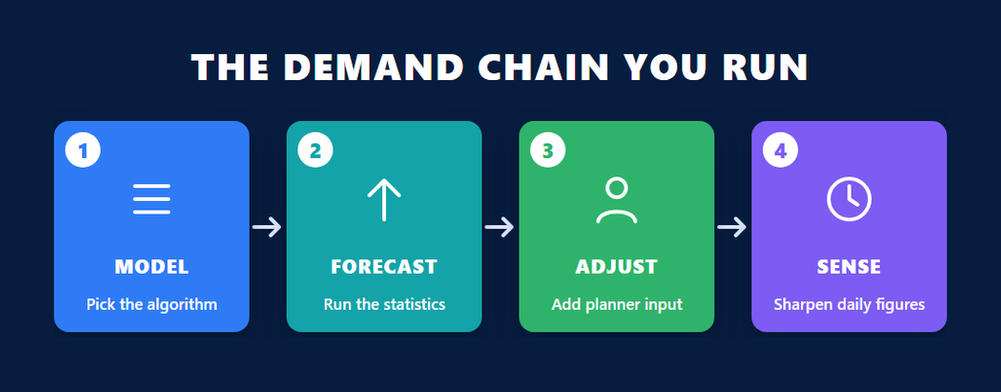
ERPPrep’s study guide describes the demand area as building statistical forecasts, refining them with business judgment, running the forecasting process with its key figures and algorithms, handling planning adjustments and consensus, and applying demand sensing to sharpen short-horizon daily forecasts. In system terms that is a long chain of decisions, and each link can go wrong in its own way.
What a demand task looks like in practice
- Pick a forecast model and algorithm that fits the history you are given.
- Run the statistical forecast and check the result against the key figures it feeds.
- Apply a planner adjustment or a consensus input without breaking disaggregation.
- Use demand sensing for the short horizon and confirm the daily figures move as expected.
The forecast is also where S&OP begins. Sales and operations planning is a process, typically run monthly, that reconciles the demand view with supply capacity and the financial plan, and IBP’s S&OP module is built to run it. If the demand figures are wrong, every later conversation in that cycle is wrong too.
“With SAP Services and Support, we successfully implemented SAP Integrated Business Planning for demand and SAP Supply Chain Control Tower, enabling precise and accurate demand planning.”
That project, described in SAP’s BYK customer story, started with IBP for demand and added later planning processes afterwards. It is a common order on real projects, and it is a good order for study as well.
What Changes Between Time-Series and Order-Based Supply Planning?
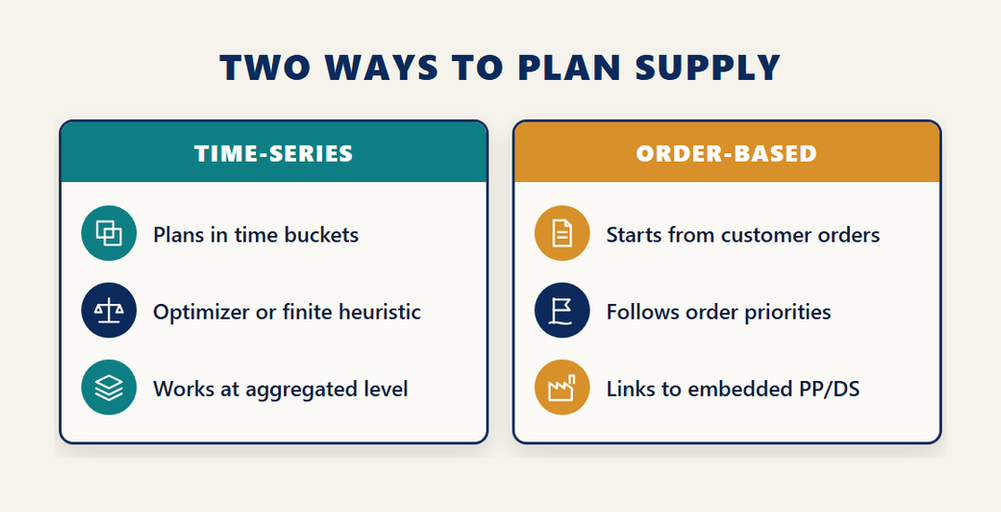
Time-series supply planning in SAP IBP balances aggregated demand and supply in planning buckets, using the optimizer or the finite heuristic. Order-based planning works from actual customer orders and their priorities, building a supply plan tied to specific orders. C_IBP’s Supply topic, weighted 21 to 30 percent, expects you to know when each one applies.
ERPPrep’s study guide flags this split as one of the most frequently examined distinctions, and the learning journey gives each approach its own course: IBP2700 for time-series planning and IBP2800 for order-based planning. The two use different logic, different master data and different results views, so a candidate who learns only one tends to misread a task written for the other.
Time-series planning
- Plans in time buckets across a horizon, at an aggregated level.
- Uses the optimizer or the finite heuristic to match supply to demand.
- Respects inventory, lead times and capacity as it balances the plan.
Order-based planning
- Uses historical and live order data rather than buckets.
- Builds supply plans tied to specific customer orders and their priorities.
- Connects with synchronized planning and embedded PP/DS, which the study guide lists in this area.
Supply also depends on supply-planning master data, such as sourcing rules and multilevel production, which ERPPrep places under model configuration. That overlap is one more reason to study the Supply and Configuration topics side by side rather than in separate weeks.
Why Is Model Configuration Where Small Errors Spread?
Model configuration in SAP IBP sets up the attributes, master data types, time profiles, planning areas, planning levels, key figures and their calculations that every planning run reads. C_IBP weights Configuration at 21 to 30 percent, but its real influence is larger, because a wrong key figure calculation or time profile silently changes the numbers a later demand or supply task produces.
ERPPrep’s FAQ names model configuration, key figure calculations and supply-planning operators as the areas candidates find hardest, and explains why: a setting chosen early shapes a result several steps later. In a single system activity you do not get a separate mark for each screen. If the planning area is wrong, the forecast built on it can be wrong as well.
The configuration objects to know cold
| Object | Why it matters in the exam |
|---|---|
| Planning area | The container every planning view and run works inside |
| Time profile | Decides the buckets your forecast and supply plan use |
| Key figures and calculations | Decide how a number aggregates, disaggregates and is derived |
| Master data types | Hold the products, locations and customers the plan refers to |
| Versions and reason codes | Separate scenarios and explain adjustments |
The courses behind this topic are IBP2300 for the main configuration and IBP3300 for advanced configuration, which adds currency and unit-of-measure conversion, planning operators, application jobs and alerts. Our earlier C_IBP blueprint walkthrough covers the wider exam, but this is the block to revisit hardest.
Where the Control Tower and Excel Add-In Fit
The Supply Chain Control Tower and the IBP Excel add-in are not exam topics of their own on SAP’s page, but you use both to complete tasks. The control tower handles custom alerts, case management and visibility, and the add-in is one of the two surfaces where you build planning views and change figures. Fluency with them saves time inside the three hour activity.
ERPPrep groups the add-in with the web UI, data integration, key figure functions, disaggregation, change history and dashboards in its core functions area. In practice this means you should be able to build a planning view from a template in the add-in, edit a key figure, and then confirm the same change in the web UI without hesitation. Slow navigation is a quiet way to run out of time on a single long task.
The control tower appears in the inventory and S&OP courses as well as its own IBP2500 course, which is why it does not sit neatly under one topic. Learn its alerts and case management as tools you use to check a plan, not as a separate subject to memorise.
How Should You Split Study Time Across the SAP IBP Modules?
Split your C_IBP study time roughly in line with SAP’s weights: about half on demand planning and demand sensing, and the rest shared between configuration and supply, with the Excel add-in and control tower practised inside those blocks. Follow the twelve-course learning journey for content, and rehearse every topic hands-on in a system.
- Start with the IBP2600 demand course and work the forecast chain end to end until it is routine.
- Study model configuration with IBP2300 and IBP3300 next, building planning areas, time profiles and key figures yourself.
- Learn time-series and order-based supply planning together with IBP2700 and IBP2800, comparing results on the same data.
- Add inventory optimization, S&OP and the control tower with IBP2400, IBP2200 and IBP2500 once the core chain is stable.
- Finish with full timed runs in the Excel add-in and web UI, checking every result against what you expected before moving on.
SAP’s Implementing SAP IBP journey is the content source, and ERPPrep lists twelve courses on it, ending with IBP3910 on the harmonized planning area. The order above front-loads Demand because it carries 54 percent, then puts Configuration second because it affects every result after it.
Who Is the C_IBP Certification Built For?
C_IBP is built for supply chain planning consultants, and for analysts or business users moving into an SAP Integrated Business Planning role, who need an associate credential. SAP positions it as an entry-level qualification for consultants who implement IBP on projects under the guidance of an experienced consultant, at project-participation depth.
SAP’s certification page tags the credential with the consultant role and skills such as supply chain planning, analytics, reporting tools, business process and user acceptance testing. That mix is a fair picture of the job: you configure, you plan, and you prove the result works. Prior exposure to forecasting concepts makes preparation noticeably smoother, because the heaviest topic is the one that assumes it.
If you already work in SAP supply chain on the execution side, such as supplier collaboration, IBP is often the planning layer that feeds it. Our guide to the SAP supply chain collaboration exam covers that neighbouring credential.
Frequently Asked Questions
What is C_IBP?
C_IBP is the exam code for SAP Certified – SAP Integrated Business Planning, an associate level SAP credential for consultants who implement SAP IBP on projects under an experienced lead.
Which SAP IBP modules does C_IBP cover?
ERPPrep lists seven areas: demand planning and demand sensing, inventory planning and optimization, S&OP, response and supply planning, the Supply Chain Control Tower, model configuration and master data, and core functions with the Excel add-in and analytics.
How is the C_IBP exam weighted?
SAP’s certification page shows three exam topics: Demand at 54 percent, Configuration at 21 to 30 percent and Supply at 21 to 30 percent.
What is the pass score for C_IBP?
The pass score is 90 percent. SAP’s certification page and ERPPrep’s study guide show the same figure.
How long is the C_IBP exam?
SAP’s certification page displays a 3 hour duration for the single System-Based Assessment activity. ERPPrep does not publish a duration.
Is C_IBP a system task or a set of separate items?
It is one System-Based Assessment activity. You complete planning and configuration tasks in a working SAP IBP system and are scored on whether each task was done correctly.
Which language is C_IBP offered in?
SAP’s certification page shows the exam as available in English, and ERPPrep lists English as well.
Is there a C_IBP_2601 version I should look for?
SAP’s certification page displays the code as C_IBP without a release suffix and shows no retirement or next-version note, so prepare for the C_IBP exam as SAP currently presents it.
Which module should I study first for C_IBP?
Start with demand planning and demand sensing. Demand carries 54 percent of the exam and its forecast feeds the inventory, S&OP and supply tasks that follow.
Conclusion
The SAP IBP modules are taught as equals, but C_IBP does not weigh them that way. SAP puts 54 percent of the exam on Demand, 21 to 30 percent each on Configuration and Supply, and asks for 90 percent on a single three hour system task. That combination rewards a candidate who can run the forecast chain without thinking, who builds planning areas and key figures with care, and who knows exactly when time-series planning gives way to order-based planning. Follow the learning journey, but spend your hours where SAP spends its marks: demand first, configuration second, supply alongside it, and every topic practised hands-on until the results come out the way you expected. Then book the attempt with confidence.


