Payroll has one property that almost no other HR process shares: a mistake does not stay where it was made. SAP’s C_HCMP exam, the SAP HCM Payroll for SAP S/4HANA certification, is now built around exactly that property, because the whole assessment is a single scenario you work through from start to finish.
That one constraint reshapes everything else. A wrong infotype value, a missed time entry or a wage type set up with the wrong valuation basis does not fail on the screen where you made it. It surfaces later, in the payroll result, the posting to Financial Accounting or the bank transfer file. SAP gives you two hours and a 60 percent pass score to show you can follow that chain, and the seven blueprint areas are simply the links in it.
Table of Contents
- Why does one scenario activity change the preparation?
- What does SAP publish about C_HCMP?
- What are the seven C_HCMP blueprint areas?
- Where does a payroll error start, and where does it surface?
- Schemas and calculation rules, the configuration core
- How is retroactive accounting tested?
- HCM Payroll or SuccessFactors payroll, which credential fits?
- How should you prepare for C_HCMP?
- Frequently Asked Questions
- Conclusion
Why does one scenario activity change the preparation?
C_HCMP is a Scenario-Based Assessment made of one activity. Instead of a long list of separate recall items, you reason through a single realistic payroll situation and carry each decision into the next. For the SAP HCM Payroll for S/4HANA certification, that means an early slip in master data or time data costs you again further down the chain.
SAP moved its certification portfolio to performance-based formats in 2026, and C_HCMP sits on the scenario side of that change. In a Scenario-Based Assessment you are given a business situation and asked to reason through the right decisions and the right order of steps. Nothing rewards recognising a correct statement in isolation, because nothing is presented in isolation.
For payroll, this is a better fit than it sounds. Payroll consultants rarely fix one field and walk away; they trace a wrong net pay back through the run, the wage types and the master data until they find the cause. Rehearsing that tracing is the preparation, and it does more than rereading course notes ever will.
The practical rule follows from it. Study the areas in the order data flows through them, and never finish a topic without asking what it changes downstream.
What does SAP publish about C_HCMP?
SAP’s certification card for C_HCMP shows a 60 percent pass score, one Scenario-Based Assessment activity and a duration of two hours. It lists the target roles as consultant, business user and support consultant. It publishes no weightings for the blueprint areas and no validity period on the card, so neither is given here.
| Field | What is published |
|---|---|
| Credential | SAP Certified – SAP HCM Payroll for SAP S/4HANA |
| Exam code | C_HCMP |
| Level | Associate |
| Format | Scenario-Based Assessment, one activity |
| Pass score | 60 percent |
| Duration | 2 hours |
| Product | SAP S/4HANA Enterprise Management, Human Capital Management |
| Target roles | Consultant, business user, support consultant |
| Blueprint areas | Seven, with no published weightings |
Two details on the official C_HCMP certification page are easy to miss. First, languages depend on the format you choose: roleplay with AI guidance is offered in English, Spanish, Italian, French, Japanese and more, while the recorded video option is English only. Second, attempts come through a Learning Hub subscription that includes certification attempts, and you need an SAP Universal ID with a secondary email set up before you book.
SAP describes the credential as proof of fundamental and core payroll knowledge within the HCM consultant profile, applied in projects under the guidance of an experienced consultant. It recommends it as an entry-level qualification. Read that as a statement about scope, not about difficulty: the scope is broad even if the depth expected is foundational.
If you have seen the older code C_HCMP_2311 in study material, SAP’s current record lists the credential simply as C_HCMP. Older product content is still largely useful; older descriptions of how the exam is sat are not.
What are the seven C_HCMP blueprint areas?
The seven C_HCMP blueprint areas run from HCM foundations and HR master data, through time data and payroll execution, to post-payroll activities and two configuration areas. No area carries a published weighting, so every one of them can decide how the single activity goes. The first five describe running payroll; the last two describe building it.
| Blueprint area | What it covers |
|---|---|
| SAP HCM Foundations and Core HR Processes on S/4HANA | Logging on, navigation, scope and components, the shared services principle, Fiori apps, the relationship to SAP SuccessFactors |
| Personnel Administration and HR Master Data | PA20 and PA30, fast entry with PA70, time constraints, personnel actions and dynamic actions |
| Time Management and Payroll-Relevant Data | Capturing and evaluating time data, the Cross-Application Time Sheet, which infotypes matter before a run |
| Payroll Process Execution and Scenarios | The control record, simulation, correction runs, retroactive accounting, payroll for employees who have left |
| Subsequent Activities, Reporting and Troubleshooting | Payroll reports, the posting run to Financial Accounting, bank transfers, typical payroll and customizing errors |
| Master Data Configuration and Organizational Structures | IMG projects, enterprise and personnel structures, payroll area and number range defaults, pay scale structures, wage type permissibility, infotype attributes |
| Payroll Configuration: Schemas and Calculation Rules | Copying schemas, personnel calculation rules, wage type valuation, derived wage types, absence valuation, counting classes, factoring, cumulation, average processing |
Notice how few of these are self-contained. Time constraints in personnel administration decide which records the run reads. Payroll-relevant infotypes decide whether the run has anything valid to calculate. The posting run only works on a clean result. The blueprint lists seven areas, but the activity treats them as one flow, which is why working through complete payroll scenario simulations prepares you better than studying each area on its own.
Where does a payroll error start, and where does it surface?
A payroll error in SAP HCM usually starts upstream, in HR master data, time data or configuration, and surfaces downstream in the payroll result, the posting to Financial Accounting or the bank transfer. C_HCMP tests whether you can connect the two ends. Knowing each step in isolation is not enough when the scenario only shows you the symptom.
The stakes outside the exam explain why SAP frames the credential this way. In a survey of 1,576 full-time employees run in July 2026, SAP’s Future of Work Research Lab found that 38 percent had experienced a payroll error, and those employees reported 13 percent lower trust in their organisation and 17 percent lower trust in the payroll function. The figures come from SAP’s autonomous payroll research.
“Payroll presents a unique paradox. It’s one of the business functions most suited to AI and automation because it’s highly structured, data-intensive, and compliance-driven. At the same time, it’s one of the most trust-sensitive functions in the enterprise because even small errors can have immediate consequences for employees’ financial well-being and confidence in their employer.”
The four links in the chain
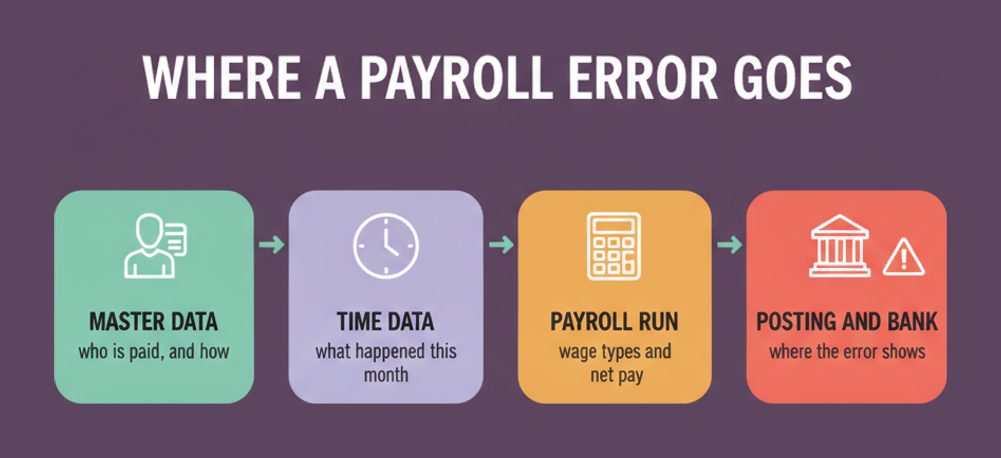
It helps to picture the scenario as four links, each feeding the next. Master data sets who the employee is and how they are paid. Time data adds what happened in the period. The payroll run turns both into wage types and a net amount. Subsequent activities push that result into Financial Accounting and the bank.
An error introduced in the first link can pass through the second and third without complaint and only become visible in the fourth. A posting that does not balance, or a bank transfer with the wrong amount, is often a master data problem wearing a disguise.
Working backwards from a symptom
The habit worth building is diagnosis. When a result looks wrong, check the payroll log for the wage type involved, then the valuation behind it, then the infotype that supplied it, then the time constraint that decided which record was read. Troubleshooting typical payroll and customizing errors is named in the fifth blueprint area for exactly this reason.
Schemas and calculation rules, the configuration core
The configuration core of C_HCMP is the payroll schema and its personnel calculation rules, together with wage type valuation. The schema orchestrates the run step by step, while the rules and valuation bases decide the amounts. Candidates find this the hardest area because a setting made here changes results several steps later.
The seventh blueprint area names the objects directly: copying schemas, creating personnel calculation rules, wage type valuation and derived wage types, absence valuation with counting classes, time wage type selection, factoring, cumulation wage types and average processing. Each one is concrete, and each one is easy to understand on its own.
Why the pairing matters
The difficulty is in the pairing. A schema can be perfectly correct and still produce the wrong amount because a valuation basis points at the wrong wage type. A calculation rule can work for full-month employees and fail for anyone who joined mid-period, because factoring was not considered. Scenario reasoning means holding the schema and the rule in your head at the same time.
Absence valuation and counting classes
Absences are where time data and payroll configuration meet. Counting classes, day rules and generation rules each shape how an absence is valued, and they interact. A scenario that describes an unusual leave pattern is almost certainly asking whether you know which of those three is doing the work.
Master data configuration, the sixth area, feeds straight into this. Pay scale structures, wage type permissibility per infotype and payroll area defaults are the inputs the schema expects to find. Configure them loosely and the schema inherits the problem.
How is retroactive accounting tested?
Retroactive accounting in C_HCMP is tested as a consequence of change. When master data for a past, already-paid period is corrected, SAP HCM Payroll recalculates that earlier period and carries the difference into the current run. You are expected to recognise when that happens and what it does to the current result.
This sits in the fourth blueprint area, alongside correction runs and payroll for employees who have left. The three belong together because each one breaks the simple pattern of one period, one run, one result.
- Correction runs follow a master data change made after a run has been released for correction.
- Retroactive runs reach back into periods that were already finished and paid.
- Leaver payroll handles employees whose employment has ended but who are still owed a final settlement.
The trap is the current period. It is easy to confirm that the past period recalculated correctly and forget that the difference now lands in this month’s posting and this month’s bank transfer. In a single scenario activity, that forgotten difference is exactly the kind of downstream effect the assessment is designed to catch.
Give it its own study block. Change a record in a past period, run payroll, and follow the difference all the way to the posting document before moving on.
HCM Payroll or SuccessFactors payroll, which credential fits?
C_HCMP covers SAP HCM Payroll running on SAP S/4HANA, which means payroll inside the Human Capital Management area of the ERP core rather than in a public cloud HR suite. SuccessFactors Employee Central Payroll is a separate cloud product with its own credential. Choose C_HCMP if the systems you work on, or will work on, run payroll inside SAP S/4HANA.
The two share a great deal of payroll logic, and much of the schema and wage type thinking carries across. What differs is the surrounding landscape: where the HR master data lives, how it reaches payroll and which tools you use to configure and monitor the run. The C_HCMP blueprint itself acknowledges the link by including the relationship to SAP SuccessFactors in its first area.
Role matters as much as product. SAP targets C_HCMP at consultants, business users and support consultants, so a payroll administrator who runs the monthly cycle and a consultant who configures it are both inside the audience. If you are earlier in the SAP HR path and still deciding between modules, the site’s overview of SAP HCM certification options sets out the wider landscape.
Payroll software in general has moved steadily towards integrated human capital management suites, a shift TechTarget’s payroll overview describes well. C_HCMP proves you understand the SAP version of that integration from the inside, which is why the posting to Financial Accounting sits in the blueprint at all.
How should you prepare for C_HCMP?
Prepare for C_HCMP by following SAP’s four-course learning journey in order, then rehearsing complete payroll scenarios until the sequence from master data to posting feels automatic. The journey has no prerequisites, so you can start with the overview course. Plan roughly two months alongside a full-time job.
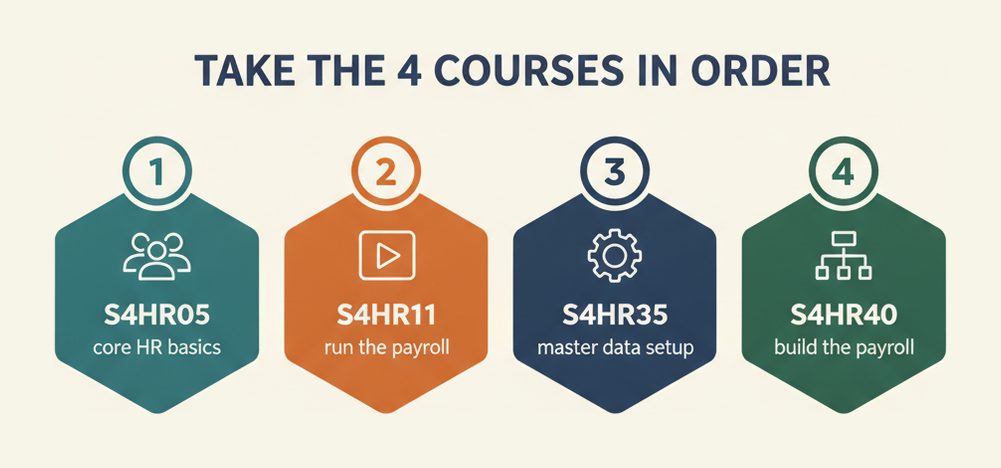
SAP’s Implementing SAP HCM Payroll journey bundles four courses that together run to roughly 50 hours. The order matters, because each course assumes the one before it.
- Start with S4HR05, Business Processes in SAP HCM on S/4HANA, to build the core HR picture before touching payroll.
- Work through S4HR11, Business Processes in HCM Payroll for S/4 HANA, for the control record, simulation, correction and retroactive runs.
- Take S4HR35, Master Data Configuration in SAP HCM for S/4HANA, for structures, pay scales and wage type setup.
- Finish with S4HR40, Payroll Configuration in SAP HCM for S/4HANA, for schemas, calculation rules and valuation.
- Rehearse full payroll cycles in a system, changing one input each time and following its effect to the bank transfer.
- Give retroactive accounting and absence valuation their own focused sessions.
Hands-on time is not optional
Reading builds understanding, but only system time builds the fluency a single activity demands. Hesitating over routine steps such as maintaining an infotype, starting a run or checking a posting eats into the two hours quickly. If direct system access is limited, scenario-based simulation that mirrors the same task sequences is the next best option.
If you have worked with the earlier version of this credential, the site’s earlier C_HCMP_2311 payroll tactics are still useful for the payroll content itself. Set aside anything in older material that describes how the exam used to be sat.
Frequently Asked Questions
What is the pass score for C_HCMP?
SAP publishes a 60 percent pass score for the SAP HCM Payroll for SAP S/4HANA certification.
How long is the C_HCMP exam?
SAP’s certification page gives a duration of two hours for the single Scenario-Based Assessment activity.
What format does C_HCMP use?
It is a Scenario-Based Assessment made of one activity. You reason through a realistic payroll situation and the order of steps it needs, rather than answering a long list of separate items.
Are the seven blueprint areas weighted?
No weightings are published. Treat all seven areas as capable of appearing in the activity, with the payroll run and payroll configuration at the centre.
Which languages is C_HCMP offered in?
SAP states that languages vary by format. Roleplay with AI guidance is available in English, Spanish, Italian, French, Japanese and more, while the recorded video option is English only.
Do I need prior SAP experience?
The learning journey lists no prerequisites and SAP positions the credential as entry level. Candidates without an HR or payroll background should plan extra weeks of hands-on work.
How much does the C_HCMP exam cost?
Neither SAP’s certification card nor ERPPrep publishes a per-exam fee. SAP states that attempts come through a Learning Hub subscription that includes certification attempts.
Is C_HCMP the same as the SuccessFactors payroll credential?
No. C_HCMP covers SAP HCM Payroll on SAP S/4HANA. SuccessFactors Employee Central Payroll is a separate cloud product with its own certification.
Is C_HCMP_2311 still current?
SAP’s current record lists the credential as C_HCMP. Product content written for C_HCMP_2311 remains broadly useful, but descriptions of the older exam format should be set aside.
Conclusion
C_HCMP is one Scenario-Based Assessment activity, two hours long, with a 60 percent pass score and seven unweighted blueprint areas that together describe how payroll data flows through SAP HCM on S/4HANA.
The constraint that shapes all of it is simple: payroll errors travel. A mistake in master data, time data or a calculation rule rarely shows where it was made; it shows in the result, the posting or the bank transfer. Prepare for that by studying the areas in the order data moves through them, giving schemas, valuation and retroactive accounting their own time, and rehearsing complete cycles in a system.
Work through the four courses in order, confirm your language and format on SAP’s page before booking, and then practise tracing symptoms back to their cause until it feels routine.


