
Three hours. One activity. Nothing to skip and come back to. C_DBADM is delivered as a System-Based Assessment, which means you spend the whole sitting inside a working SAP HANA system carrying out administration tasks, and the shape of that experience is nothing like what the older dated versions of this code prepared people for.
SAP Certified – Database Administrator – SAP HANA is the associate credential for people who keep HANA running, across both SAP HANA Cloud and SAP HANA, enterprise edition. The cut score is 73 percent, the scope runs from in-memory architecture through to cloud migration, and every part of it is examined by doing.
Table of Contents
- What does the SAP HANA database administrator certification prove?
- Three hours, one activity, and nothing to skip
- What does a System-Based Assessment actually ask you to do?
- Which blueprint areas does C_DBADM cover?
- Why do backup and recovery have to be learned together?
- Migration to SAP HANA Cloud is its own study block
- What happened to the dated C_DBADM codes?
- Who should sit it, and what should they already know?
- How should you prepare for C_DBADM?
- Frequently Asked Questions
- Conclusion
What does the SAP HANA database administrator certification prove?
The SAP HANA database administrator certification proves you can administer SAP HANA Cloud and SAP HANA on-premise databases at an associate level: deploying and upgrading them, configuring and optimising performance, monitoring and troubleshooting, and running the backup and recovery process. SAP states exactly that on its official C_DBADM certification page, and lists the skills it recognises as system administration, system monitoring and system recovery.
The dual product scope is the part that shapes preparation most. This is not a cloud credential with an on-premise appendix, nor the reverse. Both SAP HANA Cloud and SAP HANA, enterprise edition are in scope, the tooling differs between them, and the assessment can put you in either. Provisioning and modelling data on that same platform is assessed separately, in the C_HAMOD modelling assessment.
What it does not prove is modelling or development skill. Calculation views, SQLScript and application design belong to other credentials. This one is about keeping a database provisioned, healthy, secured and restorable. Administrators whose work sits on SAP Business Technology Platform rather than inside the database have their own route in the C_ADBTP administration exam.
Three hours, one activity, and nothing to skip
SAP publishes the format plainly: a single activity delivered as a System-Based Assessment, three hours long, with a 73 percent cut score, available in English. There is no item count, because there is no list of items to count.
| Field | Value |
|---|---|
| Credential name | SAP Certified – Database Administrator – SAP HANA |
| Exam code | C_DBADM |
| Level | Associate |
| Format | System-Based Assessment, one activity |
| Duration | 3 hours |
| Cut score | 73 percent |
| Language | English |
| Products in scope | SAP HANA Cloud and SAP HANA, enterprise edition |
| Role targeted | Administrator |
| Skills recognised | System administration, system monitoring, system recovery |
A single three hour activity changes the arithmetic of preparation. On a recall based assessment you can bank easy items early and spend the surplus later. Here there is no surplus: the work is sequential, an early misconfiguration follows you downstream, and the clock runs whether you are executing or reading. Rehearsing full length C_DBADM scenario simulations is the closest available substitute for that sustained, multi-step pressure.
The 73 percent cut score reads differently in this format too. On a recall assessment a partly remembered topic can still yield a correct guess. In a system, a task is either completed correctly or it is not, so partial familiarity converts into marks far less often.
What does a System-Based Assessment actually ask you to do?
A System-Based Assessment puts you in a configured SAP HANA environment and asks you to carry out administration work in it. For C_DBADM that means provisioning and configuring, changing parameters, reading monitors and traces, running backups and performing a recovery, using the tools an administrator actually has in front of them.
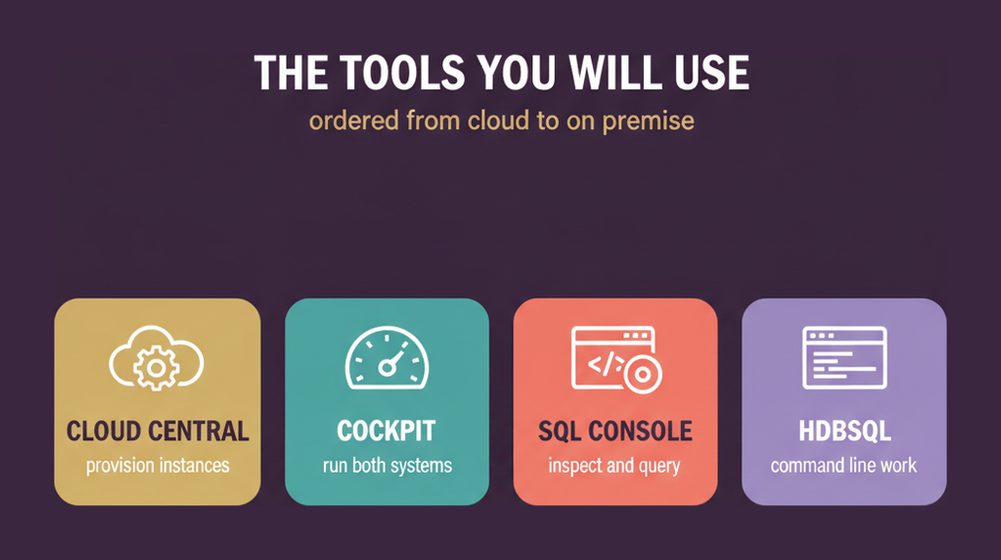
SAP names those tools, and they are worth listing because fluency in them is most of the exam:
- SAP HANA Cloud Central, for provisioning and managing cloud instances
- The SAP HANA cockpit, for administration across both deployments
- Database explorer and the SQL console, for inspecting and querying
- hdbsql, for command line work on on-premise systems
The distinction that matters is between knowing a setting exists and knowing where it lives. Under time pressure in a live system, hunting for a configuration parameter costs minutes that a sequential activity cannot spare. This is why hands-on access during preparation is not optional here in the way it might be for a recall based credential.
Which blueprint areas does C_DBADM cover?
The published blueprint sets out seven areas, and they follow the administration lifecycle rather than a product tour. No percentage weighting is published against any of them, so none can be treated as minor.
| Blueprint area | What it covers |
|---|---|
| SAP HANA Architecture and Cloud Database Strategy | How the in-memory platform is structured, why organisations move toward a cloud database approach, how SAP HANA Cloud is accessed through SAP BTP, and how it sits alongside the on-premise enterprise edition |
| Provisioning and Deployment | Deploying SAP HANA Cloud instances, selecting data tiering options, attaching integrated or standalone data lakes, increasing instance resilience, and the deployment and advanced installation choices for on-premise systems |
| Installation and Upgrade | Installing and upgrading on-premise SAP HANA: sizing, supported hardware and Linux prerequisites, post-installation steps, tenant database creation and deletion, the resident lifecycle manager, and the revision strategy governing updates |
| Administration Tools and Configuration | Operating Cloud Central, the cockpit, database explorer, the SQL console and hdbsql to start and stop the database, change configuration parameters, scale instances, and carry out routine administration and delta merge tasks |
| Monitoring and Troubleshooting | Watching instance performance, memory usage, persistence storage, services and SQL workload; configuring alert rules and notifications; examining traces to diagnose problems across cloud and on-premise systems |
| Backup and Recovery | Planning and running data and log backups, scheduling them, performing database recovery, creating fallback snapshots, and applying advanced backup and recovery techniques |
| Migration to SAP HANA Cloud and Security | Moving existing HANA databases to the cloud with self-service tooling from on-premise or SAP BTP sources while minimising downtime, plus user accounts, roles, authorisations, auditing and encryption across both deployment types |
One note on counting. The blueprint lists seven areas, while the practice catalogue for this exam is organised into eight domains, because it trains migration and security as separate subjects rather than as one combined area. The scope is identical either way; only the grouping differs.
Why do backup and recovery have to be learned together?
Backup and recovery is consistently named as one of the hardest parts of this credential, and the reason is causal rather than volumetric. A decision taken during backup configuration determines what a recovery is capable of, sometimes several steps later, and the assessment is built to expose that chain.
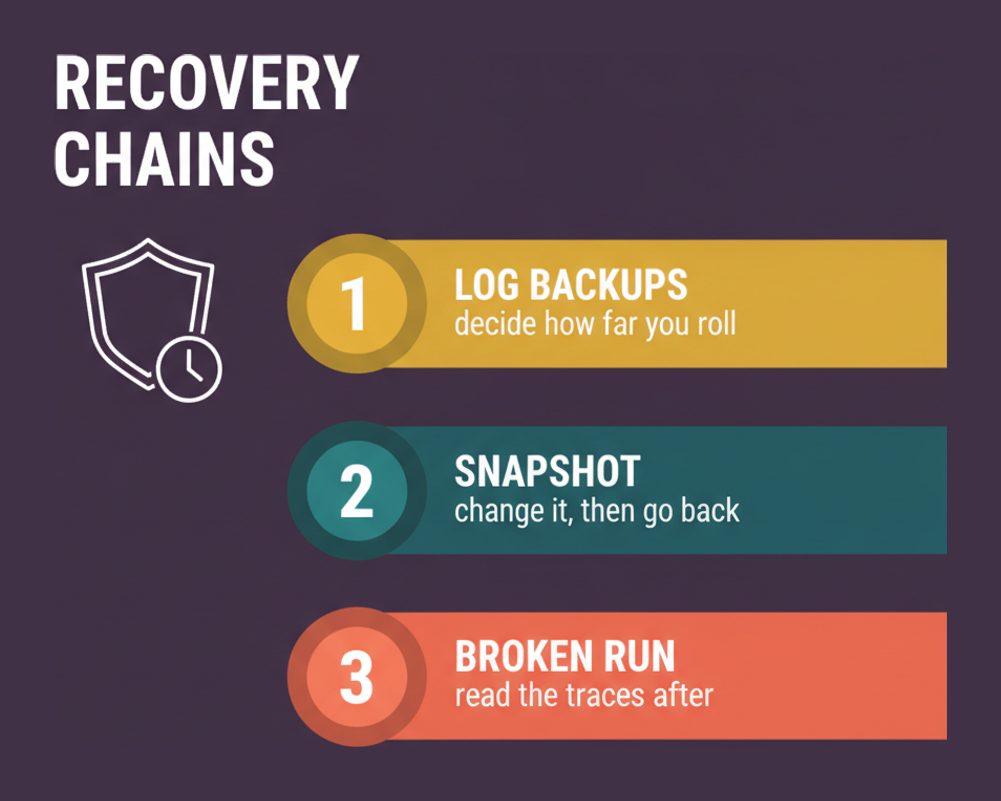
The clearest example is log backups. Whether they are running, how often they are scheduled and where they are written together decide how far forward a recovery can roll. A candidate who has rehearsed taking a data backup but never performed a point in time recovery against log backups has learned half of a single skill.
Three chains worth rehearsing end to end
Rather than practising the steps individually, run each of these as one continuous exercise in a system, because that is how the activity presents them.
- Configure log backups, let a workload run, then recover to a chosen point in time and confirm what was preserved
- Create a fallback snapshot before a change, apply the change, then return to the snapshot
- Schedule a data backup, interrupt it, and work out from the monitors and traces what state the database is in
The same reasoning applies to monitoring and troubleshooting, the other area candidates find hardest. Diagnosing a problem depends on knowing which signal lives where, across performance, memory, persistence storage, services and SQL workload, and that map is built by looking rather than by reading.
Migration to SAP HANA Cloud is its own study block
Migration sits in the seventh blueprint area alongside security, and it deserves separate treatment because it is the one topic that spans both products at once. The scope is the self-service move of an existing HANA database into SAP HANA Cloud, from an on-premise source or from SAP HANA Service on SAP BTP, with downtime kept to a minimum.
SAP’s learning journey gives it a dedicated course rather than folding it into the administration material, which is a reasonable signal of how much ground it covers. Preparing the source system, running the move and validating the result are three distinct activities, and the downtime constraint is what makes the sequencing matter.
The security half of the same area is broader than it first appears: user accounts, roles, authorisations, auditing and encryption, all of which must be understood across both deployment types rather than in one. Because the assessment can put you in either environment, learning authorisation management only in the cockpit or only in Cloud Central leaves a genuine gap.
What happened to the dated C_DBADM codes?
Older material for this credential carries dated codes such as C_DBADM_2404 and C_DBADM_2601. SAP’s current certification page carries the plain code C_DBADM with no date suffix, and describes the assessment as a single System-Based activity.
That matters for anyone assembling study material, because the dated versions belong to the previous recall based era. SAP completed its move to performance-based certification in early 2026, so guidance written for a fixed item bank describes an experience that no longer exists on this credential, even where the underlying HANA administration content remains accurate.
The practical test is simple: check whether a resource describes doing the work or recognising statements about it. Our earlier C_DBADM study materials guide is a useful record of the previous version’s scope, which is exactly what you want if you are working out how much of an older study plan still applies to the current format.
Who should sit it, and what should they already know?
C_DBADM targets the administrator profile: database administrators and SAP Basis professionals who already operate SAP HANA, and technical staff moving into a HANA administration role. SAP records the skills as system administration, system monitoring and system recovery, which is a fair description of the daily work rather than a marketing summary.
Three kinds of prior knowledge make preparation noticeably smoother. SQL, because the SQL console and hdbsql are named tools rather than optional extras. Database operations generally, because provisioning, monitoring and backup concepts transfer. And Linux, because the installation and upgrade area explicitly covers supported hardware and Linux prerequisites for on-premise systems, and the Linux Foundation material is a reasonable place to close that gap if your background is Windows administration.
It is a weaker fit for two groups. Developers and modellers will find most of the scope describes work they do not do. And anyone with no access to a HANA system at all will struggle, because a performance-based assessment cannot be prepared for by reading. If you are mapping the wider route into this role, our SAP database administrator preparation guide covers the surrounding career path.
How should you prepare for C_DBADM?
Two to three months alongside a job is a realistic plan. SAP’s certified database administrator learning journey runs to roughly 35 hours across three courses, and a performance-based assessment needs substantially more hands-on repetition on top of that. The order below follows SAP’s own course sequence, which also mirrors how the skills build in real operations work.
- Start with HC200 to learn provisioning and administering databases in SAP HANA Cloud, since it introduces the cloud tooling and the core operational tasks
- Work through HA200 next for on-premise installation and administration, which deepens configuration, monitoring, and backup and recovery on the enterprise edition
- Finish the coursework with HA2HC for the self-service migration into SAP HANA Cloud, including preparing a source system and minimising downtime
- Rehearse the administration lifecycle as one connected flow rather than as separate topics, tracing how a provisioning or configuration choice affects health, performance and restorability later
- Drill backup and recovery as combined chains, because data backups, scheduled backups and log backups together decide what a recovery can achieve
- Practise deliberately in both deployments, cloud through Cloud Central and the cockpit, on-premise through the cockpit, database explorer and hdbsql, since the tools differ even where the concepts overlap
- Rehearse monitoring and troubleshooting end to end, configuring alert rules and reading traces, then sit sustained multi-step simulations until three hours of continuous execution feels routine
The single most valuable habit is reviewing why a step produced a given result rather than only whether it worked. In a system-based format, understanding the cause and effect chain is what lets you recover when an early step goes differently from expected.
Frequently Asked Questions
What is the format of the SAP C_DBADM exam?
A System-Based Assessment consisting of one activity. You carry out administration tasks inside a working SAP HANA system rather than working through a list of items, which is the format SAP moved to in early 2026.
How long is the C_DBADM exam?
Three hours, stated plainly on SAP’s own certification page. Because it is a single activity, the whole three hours is one continuous piece of work.
What is the cut score for C_DBADM?
Seventy three percent. SAP publishes it directly, and the money site’s study guide gives the same figure. In a task-based format, partial familiarity with a topic earns marks far less often than it would on a recall based assessment.
Which SAP products does C_DBADM cover?
SAP HANA Cloud and SAP HANA, enterprise edition. Both are fully in scope, the administration tooling differs between them, and the assessment can place you in either.
Is the exam available in languages other than English?
English is the only language SAP lists for this certification. That matters more than usual in a system-based format, because you must read task instructions accurately and act on them under time pressure.
What is the difference between C_DBADM and C_DBADM_2404?
The dated codes belong to the earlier recall based versions of this credential. SAP’s current page carries the plain code C_DBADM and describes a single System-Based activity, so older guidance written for a fixed item bank no longer describes the experience.
Which topics do candidates find hardest?
Backup and recovery sequencing, monitoring and troubleshooting through traces and alerts, and the self-service migration to SAP HANA Cloud. All three are hard for the same reason: a choice made at one step changes system behaviour several steps later.
Do I need hands-on access to a HANA system to prepare?
In practice, yes. The assessment requires completing real administration tasks, and only practice in a system builds the speed and accuracy a three hour activity demands. Where direct access is limited, scenario-based simulation that mirrors the tool sequences is the next best rehearsal.
How long should preparation take?
Two to three months alongside a job is typical. SAP’s learning journey is roughly 35 hours across HC200, HA200 and HA2HC, and the performance-based format needs additional hands-on repetition beyond the coursework.
Does the certification expire?
SAP’s certification page for C_DBADM does not display a validity period, so no expiry date is quoted here. SAP’s own certification pages remain the authoritative place to confirm current terms before booking.
Conclusion
C_DBADM is an associate credential assessed the way the job is actually done: one three hour activity inside a live SAP HANA system, a 73 percent cut score, English only, and a scope spanning both SAP HANA Cloud and the on-premise enterprise edition across seven blueprint areas with no weightings to triage by.
Prepare for execution rather than recognition. Work the three courses in SAP’s order, then spend the larger share of your time in a system: configure log backups and actually recover from them, take a snapshot and roll back to it, read the traces when something breaks, and run a self-service migration end to end. Three hours of continuous administration work is a stamina problem as much as a knowledge one, and the only way to build that stamina is to do the work repeatedly before exam day.


