
There is no question bank behind C_AIG. Every page that tells you how many items to expect, or how long to spend per item, is describing a certification SAP no longer runs. The SAP Generative AI Developer certification is delivered as a System-Based Assessment: one guided, hands-on activity carried out inside a configured system, scored on whether you completed the work correctly.
That single structural fact reorganises everything else. Reading the blueprint areas as topics to revise will not help, because you are not being asked what the Generative AI Hub is. You are being asked to build something in it while a clock runs. The six blueprint areas describe capabilities to acquire rather than chapters to read, and this guide takes them in the order they build on each other, sets out what the assessment actually requires, and maps them to the SAP learning journey courses they come from.
What Is the SAP Generative AI Developer Certification?
C_AIG is the exam code for SAP Certified – SAP Generative AI Developer, an associate-level credential built around SAP AI Core. It validates that a developer can design prompts, orchestrate model calls, integrate large language models into enterprise workflows, and ground those models against an organisation’s own trusted data.
The credential sits inside SAP Business Technology Platform rather than inside any business module. That placement matters when you are deciding whether it belongs on your path: this is a developer credential about building AI capability on BTP, not a functional credential about using AI features inside a finance or logistics application. The wider SAP Business AI portfolio is what the first blueprint area asks you to be able to place this work within.
You may still see the older suffixed codes in search results and on training pages. C_AIG_2412 and C_AIG_2604 were the versioned forms under SAP’s previous naming, and the credential is now identified simply as C_AIG. If a resource is written against a suffixed code, check what it assumes about the assessment format before trusting its advice.
One framing point worth stating early. The blueprint explicitly covers applying large language models responsibly inside SAP environments, which puts governance inside the technical scope rather than beside it. Practitioners who want a vocabulary for that will find the AI Risk Management Framework a useful independent reference for the risks the blueprint expects you to design around.
What Does the C_AIG Assessment Format Mean?
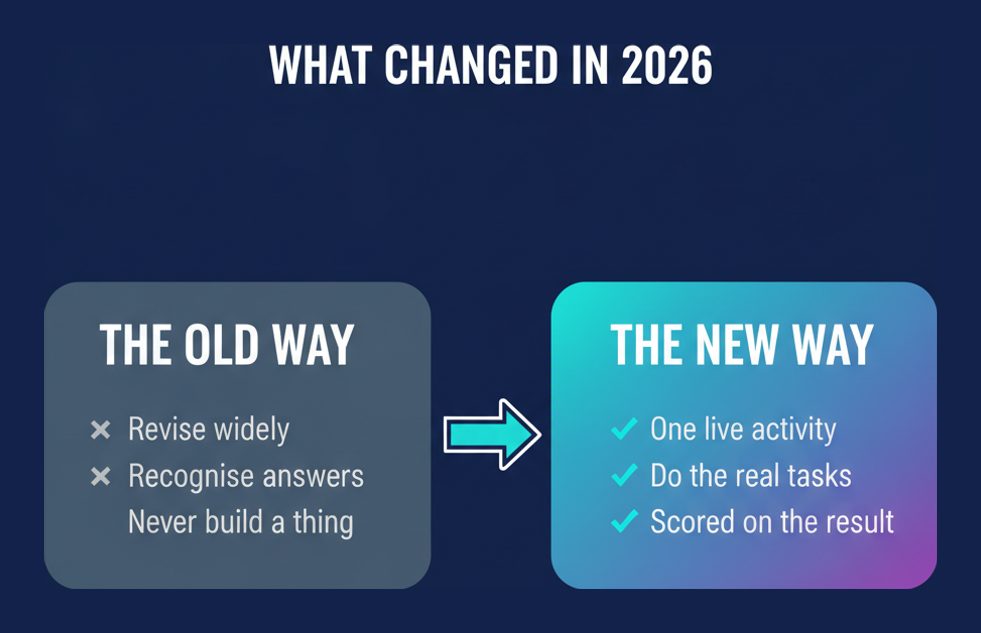
C_AIG is a System-Based Assessment, abbreviated SyBA, consisting of one activity. Rather than selecting answers, you carry out configuration and execution tasks inside a live-style system, and you are scored on whether the task was completed correctly. SAP completed its move to performance-based certification in early 2026, and this credential is delivered entirely in that model. The same format governs the SAP Build developer certification, which asks for 83 percent.
SAP runs two performance-based formats. A System-Based Assessment puts you inside a working system to do the work. A Scenario-Based Assessment gives you a realistic business situation and asks you to reason through the correct decisions and sequence. C_AIG is the first kind, which is the more demanding of the two for anyone who has only read about the tooling.
What changes in how you prepare
Under the old model, breadth won. You could revise widely, recognise the right answer among several, and pass without ever having built anything. Under a single-activity assessment, breadth is worthless if you cannot execute. Knowing that the Prompt Registry exists counts for nothing if you have never created a template in it.
The practical consequence is that hesitation costs more than ignorance used to. There is one activity, so a long pause spent working out which screen you need is time taken from finishing the task. ERPPrep’s performance style skill drills are built for exactly that gap, which is fluency rather than recall.
What Are the C_AIG Assessment Details?
C_AIG is an associate-level credential assessed as a single System-Based Assessment activity, with a passing score of 76 percent, delivered in English, and built on SAP AI Core. The absence of a question count and a per-item time budget is not missing information, it is a property of the format.
| Detail | Value |
|---|---|
| Certification name | SAP Certified – SAP Generative AI Developer |
| Exam code | C_AIG |
| Level | Associate |
| Format | System-Based Assessment (SyBA), one activity |
| Passing score | 76% |
| Languages | English |
| Product | SAP AI Core |
Seventy-six percent is a high bar for a format with no partial-credit safety net of the kind a long paper provides. On a hundred-item paper a weak area costs you a few marks. On a single activity, a step you cannot complete may take a whole capability with it, because the later steps often depend on the earlier ones.
The named product is worth noticing too. SAP AI Core is the runtime the assessment is built on, and the Generative AI Hub is the surface you work through, so preparation that happens only in documentation or only in a slide deck is preparation in the wrong place.
What Are the Six C_AIG Blueprint Areas?
The C_AIG blueprint has six areas: foundations of SAP Business AI and large language models, prompt engineering fundamentals and techniques, the Generative AI Hub and Orchestration Service, prompt development with the Registry and templates, building and evaluating with the SAP Cloud SDK for AI, and grounding with retrieval augmented generation and vector search.
| Blueprint area | What you have to be able to do |
|---|---|
| Foundations of SAP Business AI and large language models | Explain where models work well, where they fall short, and how they are applied responsibly from ideation to a productised use case |
| Prompt engineering fundamentals and techniques | Apply prompting patterns, use system, user and assistant roles, and harden prompts against misuse |
| The Generative AI Hub and Orchestration Service | Navigate the hub inside SAP AI Launchpad, reach hosted models, and coordinate multi-step workflows |
| Prompt development, Registry and templates | Design and manage prompts at scale so solutions stay consistent across many applications |
| Building and evaluating with the SAP Cloud SDK for AI | Call orchestration services programmatically, add multi-modal input, and compare prompt quality across models |
| Grounding, RAG and document grounding with vector search | Generate embeddings, use the SAP HANA vector engine, and deploy grounded solutions that answer from trusted data |
Read down the second column and the dependency chain is obvious. You cannot orchestrate what you cannot prompt, you cannot template what you have not designed, and you cannot ground what you have not built. The blueprint is published in that order for a reason, and studying it out of order is the most common way to arrive fluent in pieces and slow at the whole.
How Much of C_AIG Is Prompt Engineering?
Prompt work spans two of the six blueprint areas. The first covers the fundamentals: core principles, common prompting patterns, the use of system, user and assistant roles, and hardening prompts so they behave reliably and resist misuse. The second covers doing that at scale through the Prompt Registry and prompt templates.
Splitting it in two is a deliberate signal. Writing one good prompt in a playground is a different skill from managing a library of prompts that many business applications depend on, and SAP examines both. The Registry exists precisely so solutions are not rebuilt from scratch every time somebody needs a similar output.
Prompt hardening is a security objective
Securing and hardening prompts appears in the fundamentals area, which places prompt injection and misuse resistance inside the developer’s job rather than a separate security review. In an enterprise setting where a prompt sits between a user and business data, that is the right place for it, and it is the objective most likely to be underprepared by developers coming from personal experimentation with public models.
The roles distinction is worth rehearsing until it is automatic. System, user and assistant roles shape behaviour differently, and the assessment asks you to use them rather than to define them.
What Does Grounding and RAG Cover on C_AIG?
The grounding area covers connecting large language models to an organisation’s trusted data using retrieval augmented generation. Concretely, that means document grounding, generating vector embeddings, working with the SAP HANA vector engine, and then configuring and deploying a grounded solution that returns accurate, context-aware answers.
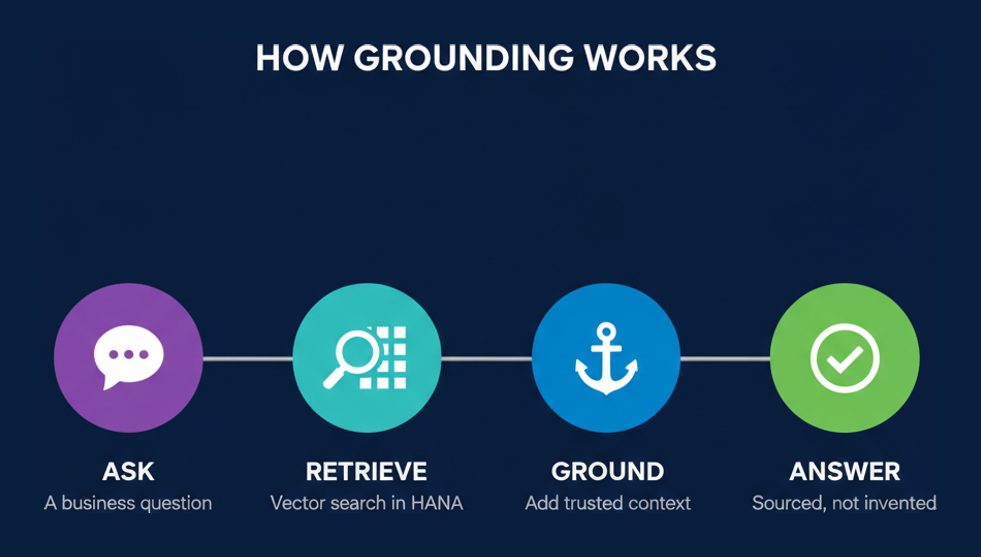
This is the area where SAP’s approach differs most from generic AI training. The vector engine is built into SAP HANA rather than bolted on as a separate database, so the grounding pattern you are expected to implement lives inside the same platform as the business data it retrieves from. Learning RAG on an external vector store teaches the concept and the wrong mechanics.
Document grounding is the part with the most moving pieces: getting content in, chunking and embedding it, storing the vectors, retrieving the right ones at query time, and assembling them into a prompt the model can answer from. Every one of those steps can be individually correct and still produce a poor answer, which is why the blueprint pairs grounding with deployment rather than treating it as theory.
Anyone who wants to see the pattern end to end before touching the assessment will find our walkthrough of building a RAG bot on SAP BTP with the HANA Cloud vector engine and AI Core covers the same components the blueprint names.
Which SAP Learning Courses Map to C_AIG?
SAP publishes five learning journey courses that the C_AIG blueprint draws on, and they map onto the six blueprint areas closely enough to use as a study order. One is a value-story opener, one covers model fundamentals, and three cover the Generative AI Hub from navigation through to advanced grounding.
| Course | Covers |
|---|---|
| SL_BAI101 | Discovering SAP Business AI: why generative AI matters before the technical work begins |
| AIG01 | Large language model fundamentals, prompt engineering, RAG and grounding, and evaluating a use case |
| AIG00 | Discovering the Generative AI Hub: its interface, model access, prompt management and the Orchestration Service |
| AIG02 | Solving business problems with prompts and models, the Prompt Registry, templates and the SAP Cloud SDK for AI |
| AIG03 | Advanced techniques: document grounding, vector embeddings and the SAP HANA vector engine |
The sequence to notice is AIG00, AIG02, AIG03. Those three are the spine of the credential, and they move from knowing where things are, to building with them, to grounding what you build. AIG01 sits underneath all three as the model theory, and SL_BAI101 frames why any of it is worth doing.
Treat the courses as a scaffold rather than as the preparation itself. They tell you what to be able to do; the doing has to happen in the hub.
How Should You Prepare for the C_AIG Assessment?
Preparation for a single-activity assessment is different in kind from preparation for a long paper. The goal is not coverage but fluency: being able to move through a full build without stopping to work out where anything lives. That argues for repetition of the whole flow rather than deep study of any one part.
- Study large language model fundamentals first, because knowing where models excel and where they need guardrails is what makes your later prompt and grounding decisions defensible rather than lucky.
- Build small end to end solutions in the Generative AI Hub repeatedly, moving through prompt, template, orchestration and grounding, until the whole flow is automatic well before you face the single activity.
- Practise prompt engineering deliberately, experimenting with system, user and assistant roles and rehearsing prompt hardening, since secure and well-structured prompts sit at the centre of the scope.
- Treat grounding as its own study block, working document grounding, vector embeddings and the SAP HANA vector engine until you can configure a grounded solution without reference material.
- Simulate the assessment under time pressure, completing a whole solution against a clock and reviewing where you slowed down, because speed and accuracy are what the performance-based format rewards.
The second step is the one that separates candidates. Building the same small solution five times feels repetitive and is precisely the point: the assessment measures whether the flow is in your hands, not whether it is in your notes.
If you are coming to this from an earlier version of the credential, our C_AIG study materials guide covers the resource landscape, though the format guidance in any pre-2026 material should be read with the move to performance-based assessment firmly in mind.
Frequently Asked Questions
What is the C_AIG certification?
C_AIG is the exam code for SAP Certified – SAP Generative AI Developer, an associate-level credential built on SAP AI Core. It validates prompt engineering, orchestration, SDK integration and grounding against enterprise data.
What format is the C_AIG assessment?
A System-Based Assessment, or SyBA, consisting of one activity. You carry out configuration and execution tasks inside a live-style system and are scored on whether the task was completed correctly.
What is the passing score for C_AIG?
Seventy-six percent. That is a high bar for a single-activity format, because later steps in the activity often depend on earlier ones, so an incomplete step can cost more than its own weight.
How many questions does C_AIG have?
None in the traditional sense. SAP completed its move to performance-based certification in early 2026, so C_AIG has no question bank at all. It is one guided hands-on activity in a configured system.
What is the difference between SyBA and SBA?
A System-Based Assessment puts you inside a working system to perform real configuration and execution tasks. A Scenario-Based Assessment presents a realistic business situation and asks you to reason through the correct decisions and sequence.
Is C_AIG the same as C_AIG_2412?
They refer to the same credential. C_AIG_2412 and C_AIG_2604 were versioned forms under SAP’s earlier naming, and the credential is now identified simply as C_AIG. Older material may assume the previous assessment format.
What product does C_AIG cover?
SAP AI Core, accessed through the Generative AI Hub inside SAP AI Launchpad. The Orchestration Service, the Prompt Registry, the SAP Cloud SDK for AI and the SAP HANA vector engine all sit within scope.
Does C_AIG cover retrieval augmented generation?
Yes. A full blueprint area covers grounding, RAG and document grounding, including generating vector embeddings and configuring the SAP HANA vector engine to return context-aware answers from trusted data.
Which SAP courses prepare you for C_AIG?
Five learning journey courses: SL_BAI101 for the value story, AIG01 for model fundamentals, and AIG00, AIG02 and AIG03 for the Generative AI Hub from navigation through building to advanced grounding.
Is C_AIG suitable for a functional SAP consultant?
Not really. It is a developer credential on SAP Business Technology Platform, and the activity requires building inside the Generative AI Hub rather than configuring AI features within a business module.
Conclusion
The SAP Generative AI Developer certification measures what you can build, not what you can recognise. One System-Based Assessment activity, a 76 percent bar, SAP AI Core underneath it, and six blueprint areas that run from model fundamentals through prompting and orchestration to grounding against a HANA vector engine.
Work the blueprint in its published order because each area feeds the next, build the same small end to end solution until the flow needs no thought, and rehearse it against a clock. Anything written before 2026 that describes an item count is describing a certification that no longer exists.


