
SAP calls this one an entry level certification. Then it asks you to bootstrap a runtime, bind an OData model, configure routing across a responsive layout, extend an annotation-driven floorplan and write integration tests. Entry level describes the expected experience, not the surface area.
The SAP Fiori developer certification, exam code C_FIORD, awards the SAP Certified – SAP Fiori Application Developer credential. It is delivered as a Scenario-Based Assessment made up of a single activity, runs for two hours against a 60 percent pass score, and spans seven blueprint areas covering the whole SAPUI5 and SAP Fiori elements toolchain.
Table of Contents
- What is the SAP Fiori developer certification?
- What does a single Scenario-Based Assessment involve?
- How is C_FIORD delivered and scored?
- What do the seven blueprint areas cover?
- Fiori elements is where the exam stops being SAPUI5
- Why is an entry level credential this wide?
- Is this the same as the Fiori administration credential?
- How should a front-end developer prepare?
- Frequently Asked Questions
- Conclusion
What is the SAP Fiori developer certification?
The SAP Fiori developer certification confirms that you can build SAP Fiori applications as a front-end developer rather than describe the framework. C_FIORD covers SAPUI5 fundamentals, views and controls, data binding through OData, routing and navigation, SAP Fiori elements, and extensibility with software quality practices, all at project-participation depth.
SAP positions it for the frontend developer profile and states plainly that it builds on formal SAP Learning training, preferably refined by practical work inside a Fiori development project in a mentored role. Read together, those two statements describe somebody who has written Fiori code under supervision rather than somebody who has finished a course.
The skills SAP associates with the credential are broader than the exam code suggests: developer work, user interface design, UI and UX design systems, computer science fundamentals, software development methodologies, and cloud application development. That list is a reasonable preview of the range of judgements the assessment asks for.
The associated products are the SAP Cloud Portal service and SAP Fiori itself, which places the credential firmly on the front end rather than in the back-end configuration world most SAP credentials occupy. Developers who also build the services behind those apps can compare it with the CAP backend developer exam, which runs from the CDS model and handlers through to deployment.
What does a single Scenario-Based Assessment involve?
C_FIORD is delivered as one Scenario-Based Assessment activity rather than as a long list of separate items. You are given a realistic development situation and you reason through it, choosing the approach a Fiori project would actually take and defending the decisions that follow from it. The format measures applied judgement rather than recall.
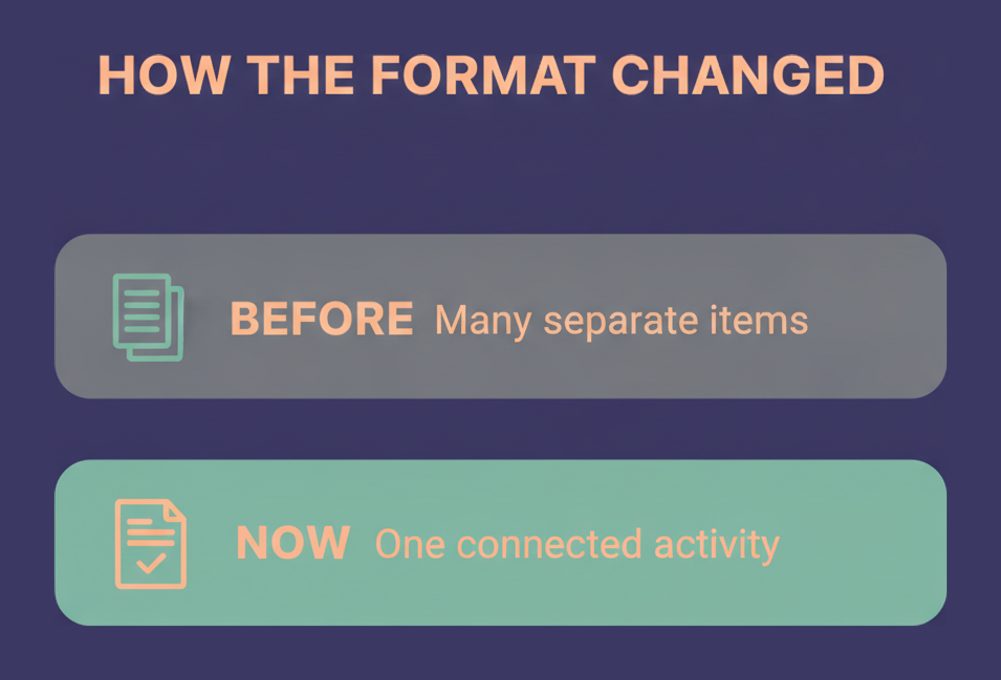
This matters because a great deal of published material still describes the previous structure. SAP completed its move to performance-based certification in early 2026, and any page that sets out an item count for this credential is describing an arrangement that no longer exists.
What changes in how you prepare
Under the old arrangement you could revise breadth and rely on recognition. A single scenario removes that safety net: there is no next item to move on to, and an early wrong decision, a component definition or a model choice, propagates through everything you build after it.
The practical consequence is that preparation has to be end to end rather than topic by topic. Building one small application through every layer teaches the dependencies between layers, which is exactly what a single connected activity examines.
Rehearsing the format itself is worth as much as rehearsing the content, and the money site’s C_FIORD scenario simulations are built to that shape rather than to the older one, so the pacing of a sustained multi-step activity stops being unfamiliar.
SAP publishes its own preparation aids for the format
SAP has an introduction to scenario-based assessments and an AI-supported tool for rehearsing one. Both exist because the format is new enough that candidates arrive unsure what the experience looks like, and twenty minutes with either removes that uncertainty cheaply.
How is C_FIORD delivered and scored?
C_FIORD is a two hour Scenario-Based Assessment of one activity with a 60 percent pass score, positioned at associate entry level. It requires a Learning Hub subscription that includes certification exam attempts and a valid SAP Universal ID, and the exam page reports subscription attempts and exam attempts separately.
| Field | Value |
|---|---|
| Credential | SAP Certified – SAP Fiori Application Developer |
| Exam code | C_FIORD |
| Level | Associate, entry level |
| Format | Scenario-Based Assessment, one activity |
| Duration | 2 hr |
| Pass score | 60 percent |
| Blueprint areas | 7, none weighted |
| Products | SAP Cloud Portal service and SAP Fiori |
| Learning journey | Developing SAPUI5 Applications, six courses, about 31 hours |
| Access | Learning Hub subscription including exam attempts, plus an SAP Universal ID |
A note on two fields
The duration above comes from SAP’s own credential page, which displays two hours in its header and again in its certification overview. Third-party summaries of this exam routinely omit it, so it is worth confirming against the source before planning your sitting.
Language availability works differently from most exams and is easy to misread. SAP does not publish one list. It publishes availability by assessment format: the roleplay format with AI guidance is offered in English, Spanish, Italian, French, Japanese and a long tail of further languages, while the recorded video format is English only. Check which format applies to your booking rather than assuming a single answer.
Sixty percent across a connected activity
A 60 percent threshold is the common bar across SAP associate credentials, but it behaves differently when the assessment is one connected piece of work. Marks are awarded against objectives within the scenario, so a candidate who is broadly competent across the blueprint clears it more comfortably than one who is excellent in two areas and absent in a third.
What do the seven blueprint areas cover?
The seven areas are Fiori fundamentals and architecture, loading and structuring SAPUI5 applications, views and controllers and fragments, models and data binding and OData and localisation, routing and navigation and application patterns, SAP Fiori elements and annotation-driven development, and extensibility with software quality and design guidelines. No weightings are published for any of them.
| Blueprint area | What it really asks |
|---|---|
| Fiori fundamentals and architecture | The launchpad and its personalisation, UI and data service technologies, the ABAP platform and S/4HANA underneath, and how content, catalogs, spaces and pages are managed and activated |
| Loading and structuring SAPUI5 applications | Bootstrapping and initialising the runtime, defining and consuming modules, structuring an app through components and the declarative API |
| Views, controllers, controls and fragments | XML views and their controllers, layout controls and densities, reusing UI parts through fragments instantiated where needed |
| Models, data binding, OData and localisation | Aggregation and element binding, data types, formatters, sorting, filtering, expression binding, reading and creating entities through an OData model, resource-model translation |
| Routing, navigation and application patterns | Hard-coded and parameterised routes, back navigation, invalid hashes, full-screen and list-detail patterns, responsive FlexibleColumnLayout behaviour |
| SAP Fiori elements and annotation-driven development | List Report, Object Page and Analytical List Page floorplans over OData V4 on CAP and ABAP RAP, with filter bars, tables, header areas and navigation |
| Extensibility, software quality and design guidelines | Custom controls, the flexible programming model, extension points, building blocks, controller extensions, QUnit and OPA5 tests, Git, the SAPUI5 golden rules |
Read as a sequence, those seven areas are the life of a real Fiori application: get it loaded, build the interface, connect the data, move between screens, adopt the standard floorplans, then extend and test what you have. That ordering is also the most efficient study order, because each area assumes the one before it.
With no weightings published there is no arithmetic to plan by, so the planning unit is the area rather than a percentage. The honest assumption is that anything in the blueprint can appear inside the scenario.
Fiori elements is where the exam stops being SAPUI5
Six of the seven blueprint areas describe building an application yourself. The sixth describes the opposite: generating one from annotations. SAP Fiori elements takes a List Report, Object Page or Analytical List Page floorplan and derives the interface from metadata on an OData V4 service, which is a genuinely different way of working.
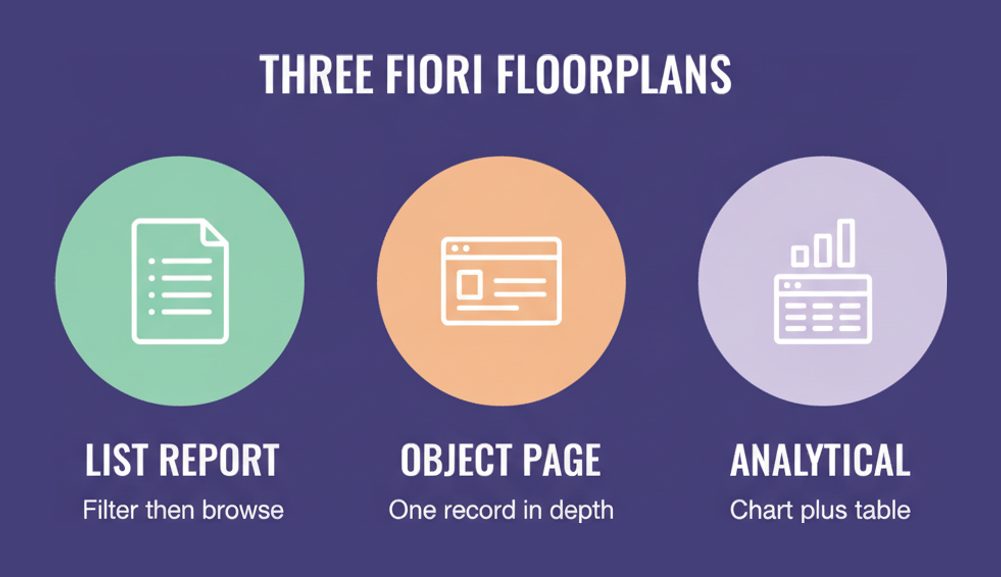
That difference is the most common source of difficulty on this credential, and the money site’s own preparation notes agree, naming Fiori elements annotations alongside OData binding and routing as the three areas candidates find hardest.
Two services, one floorplan model
The blueprint names both CAP and ABAP RAP as the sources of those OData V4 services, which means the annotations can arrive from a Core Data Services definition in ABAP or from a CAP model in the cloud. The floorplan behaves the same way; where the annotation lives does not.
Because everything here rests on OData, understanding the protocol as a specification rather than as an SAP feature pays back quickly. OData is published by the OASIS OData committee, and knowing what the protocol guarantees makes it much clearer which behaviours come from the standard and which from SAP’s annotation vocabulary.
Adapting rather than replacing
The seventh area picks up where the sixth stops. The flexible programming model, extension points, building blocks and controller extensions all exist so that a generated application can be adapted without being abandoned. The judgement the assessment looks for is knowing when to configure an annotation and when to reach for an extension, and those are not interchangeable.
The framework itself is open, and the OpenUI5 project repository is a practical place to see how a control is actually implemented when the documentation describes behaviour only at a high level.
Why is an entry level credential this wide?
Because entry level in SAP’s scheme describes the depth expected at each point rather than the number of points covered. C_FIORD asks you to contribute to a Fiori project under guidance, and contributing to a real project means touching every layer of the stack at least once, even if you own none of them outright.
That is a fair description of a junior front-end role on an SAP project, and it explains the shape of the blueprint. You are not expected to architect a launchpad strategy, but you are expected to know what the launchpad is doing to your application. You are not expected to design a CAP service, but you are expected to consume one.
The preparation numbers follow from that breadth rather than from difficulty. Six courses across roughly 31 hours cover the ground, and most candidates studying alongside a job plan one to two months, with the extra time going to hands-on work rather than reading.
- UX100 sets out Fiori from the end user, technology and architecture angles.
- UX400 builds the SAPUI5 foundations for developers who already know HTML and JavaScript.
- UX402 covers advanced SAPUI5, application patterns, custom controls and testing.
- UX405 builds a Fiori elements application over a CAP OData V4 service.
- UX406 does the same over an ABAP RAP service.
- UX410 applies the golden rules, the launchpad and the design guidelines on top.
Two of those six courses are devoted to Fiori elements alone, which is a reliable signal of how much of the assessment can land there.
Is this the same as the Fiori administration credential?
No. SAP publishes a separate Fiori administration credential for the people who configure, deploy and operate the launchpad, and C_FIORD is the developer counterpart. They share the product name and almost nothing else: one builds applications, the other runs the platform those applications live on.
The confusion shows up in search behaviour, where administration and developer terms sit side by side under the same Fiori certification heading. A developer who lands on administration material first comes away expecting content that is not on this blueprint at all.
The overlap, such as it is, sits in the first blueprint area. C_FIORD does ask about the launchpad, catalogs, spaces and pages, because a developer needs to know where an application is surfaced and how it is activated. It stops well short of asking you to administer any of it.
If you are weighing the two, the site’s C_FIORD preparation guide sets out the developer path in more detail, and an earlier walkthrough of the previous C_FIORD version is useful for seeing how the blueprint has evolved, though its description of the assessment structure predates the 2026 change.
How should a front-end developer prepare?
Prepare in the order the application is built rather than in the order the blueprint is listed, because each layer only makes sense once the one below it is solid. The sequence below follows that dependency chain and ends with the format rehearsal a single activity rewards.
- Get the SAPUI5 fundamentals genuinely solid first, bootstrapping, modules, components and the pattern of views and controllers, so every later topic has a stable base.
- Practise data binding and OData together, covering models, aggregation and element binding, data types, formatters, sorting and filtering, and reading and creating entities.
- Drill routing and navigation alongside the application patterns, since route configuration and view synchronisation are usually examined as one connected build task.
- Treat SAP Fiori elements as its own study block, working through how annotations shape the List Report, Object Page and Analytical List Page floorplans.
- Build the same small application twice, once over a CAP service and once over an ABAP RAP service, so the annotation source stops mattering to you.
- Extend a generated application deliberately, using the flexible programming model, an extension point and a controller extension, and notice which problems each one solves.
- Write QUnit unit tests and OPA5 integration tests on your own code and keep it in Git, because software quality is a named part of the blueprint rather than an optional habit.
- Apply the SAPUI5 golden rules and the Fiori design guidelines to something you have already built, which is faster than learning them abstractly.
- Rehearse one end-to-end development scenario under a two hour clock, so the pacing of a single sustained activity is familiar before the day itself.
Hands-on access matters more here than on most credentials. A development environment such as SAP Business Application Studio turns the middle six steps from reading into building, and the assessment is built to tell the difference.
For the framework reference itself, the SAPUI5 demo kit is the working documentation most Fiori developers keep open, and its samples map closely onto the controls and patterns the blueprint names.
Frequently Asked Questions
What format is the SAP C_FIORD exam?
A Scenario-Based Assessment made up of a single activity. You work through one realistic development situation rather than moving between separate items, and the assessment measures applied judgement rather than recall.
How long is the C_FIORD assessment?
Two hours, as published on SAP’s own credential page, where it appears in the header and again in the certification overview. Several third-party summaries omit the duration entirely.
What is the passing score for C_FIORD?
Sixty percent, which is the common threshold across SAP associate credentials. Because the assessment is one connected activity, broad competence across the blueprint clears it more reliably than depth in two areas.
Is C_FIORD really an entry level certification?
Yes, by SAP’s own classification, and that describes the expected depth rather than the breadth. It assumes formal SAP training plus some mentored project experience, at the level of somebody contributing to a Fiori project rather than leading one.
Which topics do candidates find hardest?
SAP Fiori elements annotations, OData model binding, and routing and navigation. All three share a property: a decision in one layer changes behaviour in another, so they reward a mental model rather than memorised syntax.
What languages is C_FIORD available in?
Availability varies by assessment format rather than being a single list. The roleplay format with AI guidance covers English, Spanish, Italian, French, Japanese and many more, while the recorded video format is English only.
How long does preparation usually take?
Roughly one to two months alongside a job. The official learning journey runs about 31 hours across six courses, and the scenario format means budgeting extra time for building rather than reading.
Do you need system access to prepare?
Strongly recommended. The assessment rewards applied development, so working through views, binding, routing and annotation-driven floorplans in an environment such as SAP Business Application Studio is what builds the fluency it looks for.
Does C_FIORD cover both CAP and ABAP RAP?
Yes. The Fiori elements area names OData V4 services built on both, and the learning journey devotes a separate course to each. The floorplan behaviour is the same; where the annotations come from is not.
Can you take C_FIORD without SAP experience?
Yes, though a foundation in HTML and JavaScript makes it far smoother. Newcomers should follow the learning journey in order and pair every topic with hands-on coding, budgeting extra weeks for scenario rehearsal.
Conclusion
The label on this credential and the shape of it pull in different directions, and the label is the less useful of the two. Entry level tells you how deep each topic goes. The blueprint tells you that there are seven of them and that they connect, which is what a single scenario activity is designed to examine.
Prepare in build order, spend disproportionate time on Fiori elements and the OData binding underneath it, and get hands on early. A candidate who has built and extended one complete application will recognise most of what the scenario asks; one who has read about seven areas separately will not.
Rehearsing a full scenario end to end under a two hour clock is the last piece, and it is the one that turns broad familiarity into the applied confidence this format rewards.


