
Anyone looking for an SAP Fieldglass certification has to choose before they study, because SAP offers two administrator exams for the product and they cover different work. C_TFG61 is the services procurement one: projects bought from suppliers under a statement of work. Its sibling covers contingent staffing. SAP’s certification card shows C_TFG61 as one Scenario-Based Assessment activity with a 60 percent pass score and a 2 hour duration, so the choice decides which process you will be asked to reason through.
This guide explains what C_TFG61 certifies and how to tell it from the contingent workforce exam, how the scenario is delivered and scored, the six blueprint areas on the money-site study guide, the configuration that decides most outcomes (master data, rates, approvals and statement of work templates), where analytics and integrations come in, how Fieldglass relates to SAP Ariba, and how to prepare.
Table of Contents
- What does the C_TFG61 SAP Fieldglass certification cover?
- C_TFG61 or C_TFG51: which SAP Fieldglass exam is yours?
- How is C_TFG61 delivered and scored?
- Which six blueprint areas does C_TFG61 cover?
- Why does every statement of work depend on master data?
- How do rate structures and approvals control what services cost?
- What happens across the statement of work lifecycle?
- What does maintaining the services module involve?
- How do analytics and integrations finish the job?
- How does SAP Fieldglass relate to SAP Ariba?
- How should you prepare for the C_TFG61 scenario?
- Frequently Asked Questions
- Conclusion
What does the C_TFG61 SAP Fieldglass certification cover?
C_TFG61 is the exam for SAP Certified – Administrator – SAP Fieldglass Services Procurement, an Associate level credential. SAP says it verifies the core skills of configuration, administration, analytics and integration required for services procurement, with an overall understanding of the workflow that can be applied in projects in a mentored role.
SAP Fieldglass is SAP’s system for managing an external workforce and the services a company buys from outside suppliers. Services procurement is the part concerned with work bought as a defined project: a supplier agrees to deliver something under a statement of work, often called an SOW, and is paid against milestones, deliverables or time. The money-site study guide describes the audience as SAP Fieldglass administrators, and business users or consultants moving into a services procurement role.
What SAP’s card shows
The role tag on SAP’s page is Administrator, and the skills listed are Strategic Workforce Planning, Workforce Management and Service Management. To sit the exam you need a Learning Hub subscription that includes certification attempts and an SAP Universal ID with a secondary email address. Older material refers to suffixed codes such as C_TFG61_2211 and C_TFG61_2405, while SAP’s page lists plain C_TFG61.
C_TFG61 or C_TFG51: which SAP Fieldglass exam is yours?
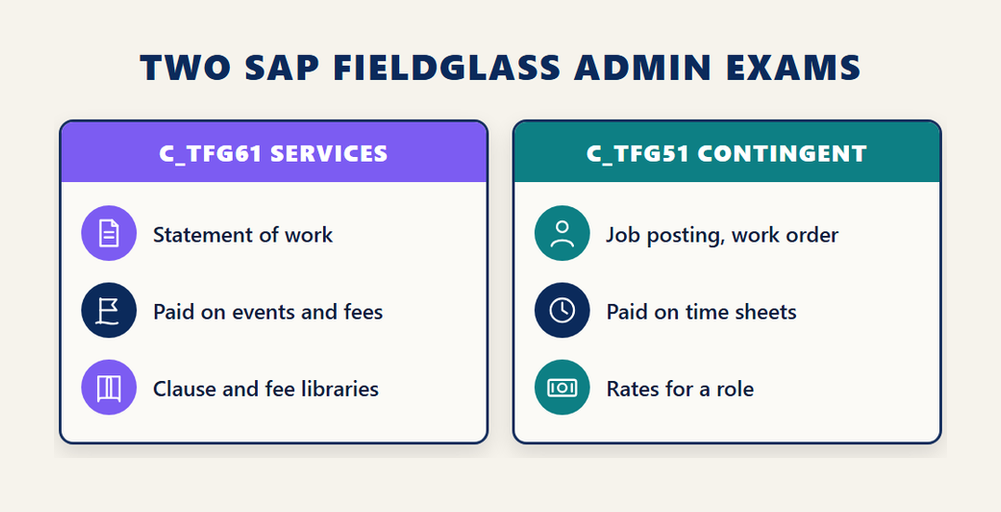
Take C_TFG61 if your work is buying and managing services delivered under statements of work. Take C_TFG51 if your work is contingent staffing, where temporary workers are requested, engaged and paid for their time. Both are Associate level administrator exams, and SAP’s pages show the same format for each, so the difference lies entirely in the process examined.
| Question | C_TFG61 | C_TFG51 |
|---|---|---|
| Credential | Administrator, SAP Fieldglass Services Procurement | Administrator, SAP Fieldglass Contingent Workforce Management |
| What is bought | A project or service with agreed outcomes | A person’s time in a role |
| Central document | Statement of work | Job posting and work order |
| How payment arises | Milestones, deliverables, fees and, where used, time and expenses | Time sheets at agreed rates |
| Format shown by SAP | 1 Scenario-Based Assessment activity, 60 percent, 2 hours | 1 Scenario-Based Assessment activity, 60 percent, 2 hours |
What the two exams share
Administration is common ground. Company structure, users, roles, suppliers, rates, approvals, reporting and integrations sit underneath both processes, and SAP describes both credentials with the same four skills of configuration, administration, analytics and integration. If you administer a Fieldglass environment that runs both processes, the shared foundation means the second exam is far less work than the first.
How to decide
Ask what your organisation or your client actually buys through Fieldglass. A consultancy engaged for a fixed-scope project is services procurement. Agency staff covering a busy season is contingent workforce. The money-site FAQ is explicit that C_TFG61 examines the services procurement workflow specifically, not contingent staffing.
How is C_TFG61 delivered and scored?
C_TFG61 is one Scenario-Based Assessment activity with a 60 percent pass score. You are given a realistic services procurement situation and work out the configuration and administration steps it requires. SAP’s card displays a 2 hour duration and says the available languages vary by assessment format.
| Field | Value |
|---|---|
| Exam code | C_TFG61 |
| Credential | SAP Certified – Administrator – SAP Fieldglass Services Procurement |
| Level | Associate |
| Format | Scenario-Based Assessment (SBA), 1 activity |
| Passing score | 60 percent |
| Duration | 2 hours, as displayed by SAP; the money-site pages publish no duration |
| Languages | Vary by format, as displayed by SAP: roleplay with AI guidance in English, Spanish, Italian, French, Japanese and more; recorded video in English only |
| Product | SAP Fieldglass Services Procurement |
| Blueprint areas | 6, with no published weightings |
What a Fieldglass scenario looks like
The situations are administrative problems with consequences. Approvers in one region can suddenly see requests from another. An inbound data load rejects records because something it depends on is missing. Leadership wants one view that reconciles committed and actual services spend. In each case you have to identify what was configured wrongly, or what must be configured first, and explain the fix.
Two formats
SAP lists a roleplay with AI guidance, offered in many languages, and a recorded video format in English only. It also provides an AI-powered scenario tool for a trial run and a Technical Readiness Checklist for your computer.
Which six blueprint areas does C_TFG61 cover?
The money-site study guide lists six blueprint areas for C_TFG61 and publishes no weightings. They start with Fieldglass foundations and the services workflow, move through administration, rates and financial configuration, reach the statement of work itself and the maintenance of the services module, and end with analytics, reporting and integration.
| Blueprint area | What it asks of you |
|---|---|
| SAP Fieldglass Foundations & Services Procurement Workflow | Navigate the home page and transactions, follow the services workflow from procuring services to engaging service workers, understand vendor management system concepts |
| Administration & Master Data Configuration | Configure business units, cost centers, sites, legal entities, labor types, users, roles, suppliers, messaging and the admin menu |
| Rates, Workflows & Financial Configuration | Build rate components, groups, grids and schedules; configure workflows, approval groups and alert or escalation thresholds; manage currencies, expense codes, general ledger accounts and invoice settings |
| Statement of Work (SOW) & Services Procurement | Create and manage statements of work, select classification, supplier and template, add clauses and characteristics, set up SOW workers, handle time, expenses and invoicing, run the SOW bid process, close projects |
| Maintaining the Services Module | Configure SOW types and classifications, clause, event, fee and schedule libraries, template details and rules, worker roles and characteristics, consolidated invoicing and independent-consultant SOWs |
| Analytics, Reporting & Integration | Build custom reports, charts and dashboards, control report access, manage connectors, file transfer, web services and single sign-on in Configuration Manager |
The money-site FAQ lists rate configuration, workflow and approval setup, SOW template maintenance and the integration topics as the hardest, because a choice in one of them changes how the process behaves later. ERPPrep’s Fieldglass scenario skill drills follow that pattern, with situations such as restoring a regional visibility boundary for approvers or finding the one prerequisite an inbound load is missing.
Why does every statement of work depend on master data?
Master data describes the organisation to SAP Fieldglass: its business units, cost centers, sites, legal entities and labor types, and the users, roles and suppliers that act within them. A statement of work is created against those objects, so its visibility, approvals, costing and invoicing are only as correct as the master data underneath.
Company structure
Business units, sites and cost centers say where work happens and who pays for it. Legal entities matter for contracting and invoicing. These objects are associated with one another, and with users and suppliers, and those associations are what limit a user to the right part of the company. A regional approver who can see another region’s requests usually points to an association or a role, not to the request itself.
Users, roles and suppliers
A user role defines what someone may do, and the user’s associations define where they may do it. Suppliers are set up with the business units, sites and services they are allowed to serve. The study guide tells candidates to practise this core setup until it is automatic, because every later task depends on it.
Why loads fail
Master data is often loaded from other systems. A record that refers to a cost center, site or supplier that does not yet exist in Fieldglass is rejected. When a scenario describes rejected inbound records, the usual answer is the order of loading: the object being referred to has to exist before the object that refers to it.
How do rate structures and approvals control what services cost?
Rates decide what a supplier may charge, and workflows decide who has to agree. The blueprint groups rate components, groups, grids and schedules with workflows, approval groups, thresholds and financial data such as currencies, expense codes, general ledger accounts and invoice settings. Together they control how services are priced and approved.
Rate building blocks
A rate component is one element of a price. Components are collected into rate groups, and rate grids set agreed values for particular combinations, such as a type of role at a particular site. The study guide advises treating rate configuration as a study block of its own, because the pieces interact and a small difference changes how a statement of work and its invoices behave.
Workflows, approval groups and thresholds
A workflow routes a document to approvers, an approval group names who those approvers are, and thresholds raise an alert or an escalation when a value or a waiting time passes a limit. The interesting cases combine them: a project above a spending limit that must go to an extra approver, or an approval that must not hold up the financial close. Answers that solve the routing while ignoring the deadline, or the reverse, are the traps.
Financial data
Currencies, expense codes and general ledger accounts decide how a charge is recorded once it is approved. If spend appears against the wrong account in a report, the cause is normally in this configuration or in the cost allocation on the statement of work, not in the report.
What happens across the statement of work lifecycle?
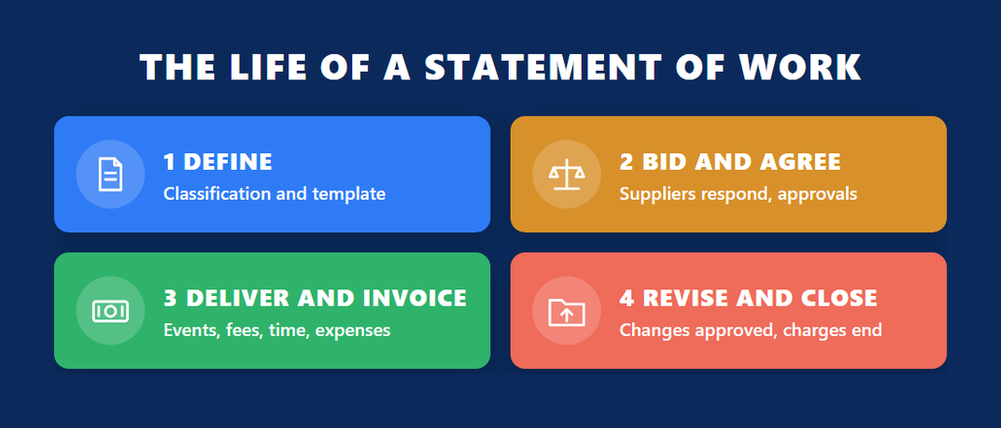
A statement of work in SAP Fieldglass is defined, sent to one or more suppliers, agreed, delivered against, invoiced, revised when the project changes and finally closed. The study guide expects you to carry out each stage and to know which earlier setup governs it, from the classification and template chosen at the start to the way the project is closed.
Defining the SOW
Creating a statement of work means describing the project and selecting its classification, supplier and template. The template brings in clauses, which are the contract wording, and characteristics, which describe how the work is structured and paid, for example events tied to deliverables, schedules and fees. Choosing the wrong template at this point means the wrong clauses and the wrong approval path later. For the contract thinking behind this, the Chartered Institute of Procurement and Supply publishes independent contract management guidance.
Bids, workers, time and invoices
Where several suppliers could do the work, the SOW bid process collects and compares their responses. Once a supplier is engaged, SOW workers are set up so the people doing the work can be given access and tracked. Depending on the characteristics, payment arises from completed events, from fees, or from time and expenses that workers record, and invoices follow from those.
Revising and closing
Projects change. A revision alters the agreed scope, dates or value and goes back through approval. Closing a project ends the ability to charge against it. Leaving finished projects open is a common real-world fault, because it keeps committed spend on the books and lets late charges through.
What does maintaining the services module involve?
Maintaining the services module means keeping the building blocks of statements of work in good order: SOW types and classifications, the clause, event, fee and schedule libraries, template details and rules, and worker roles and characteristics. The blueprint also includes two capabilities to enable where needed, consolidated invoicing and independent-consultant SOWs.
Libraries and templates
A library holds reusable items. A clause library holds approved contract wording, an event library holds standard milestones, and fee and schedule libraries hold standard ways of charging. A template draws on those libraries and adds rules about what the person creating a statement of work may change. Well-kept libraries mean that a buyer assembles a statement of work from approved parts instead of writing one from nothing.
Why template maintenance is hard
The money-site FAQ lists SOW template maintenance among the most difficult topics. The reason is reach. A template is used by many statements of work, so a change to a rule or a default affects every project created from it afterwards. Before changing a template in a scenario, work out which projects it serves and whether the change belongs in the template or in a single SOW.
Independent consultants and consolidated invoices
An independent-consultant SOW handles the case where the supplier is one self-employed person, which raises its own questions about worker setup. Consolidated invoicing combines charges into a single invoice. Both are capabilities that an administrator switches on and configures, and both are named in the blueprint.
How do analytics and integrations finish the job?
The last blueprint area covers what makes a Fieldglass environment useful to the rest of the company: reports, charts and dashboards built in the analytics module, with controlled access, and integrations managed through Configuration Manager using connectors, file transfer, web services and single sign-on.
“We have full visibility. We know the number of contractors, we know our demand per geography, per business line, and we know the cost rates we pay for certain roles, and we measure how the cost rates evolve over time.”
Reports that answer a question
That kind of visibility is the goal of the analytics topics. A custom report starts from a question, for instance how committed spend on statements of work compares with what has been invoiced, and the build follows from it: the right data, the right filters, a chart or a dashboard, and access limited to the people who should see it. The money-site FAQ notes that candidates who have never built a report tend to struggle here.
Configuration Manager
Configuration Manager is where integrations are enabled and adjusted. A connector is a prepared integration for a kind of data, file transfer and web services are the ways data moves, and monitoring shows what was sent and what failed. Single sign-on lets users reach Fieldglass through the company’s identity provider. It commonly relies on SAML, an open standard published by OASIS and described on the OASIS SAML standard page. When some users are suddenly unable to sign in while others are fine, the difference between the two groups, such as how each is identified, is the place to look.
How does SAP Fieldglass relate to SAP Ariba?
SAP Fieldglass and SAP Ariba both belong to SAP’s spend management products, and they handle different kinds of spend. Fieldglass manages external workers and services delivered under statements of work. SAP Ariba manages sourcing and the purchase of goods and general services. Each has its own certifications, and C_TFG61 is specific to Fieldglass.
The two meet in practice. A large company may source a category of services through one and run the resulting projects through the other, and SAP positions Fieldglass as integrating with both SAP Ariba and SAP SuccessFactors. For C_TFG61 that context is background: the scenario stays inside Fieldglass administration. If procurement of goods is closer to your work, ERPQnA’s guide to the SAP Ariba procurement exam covers that credential.
How should you prepare for the C_TFG61 scenario?
Prepare for C_TFG61 by learning the services procurement workflow as one connected process and practising the administration behind it. The money-site FAQ puts the learning journey at about 39 hours across six courses and suggests roughly two months of preparation alongside a job, with extra time for hands-on repetition.
- Learn the services procurement workflow as one connected flow of engaging, managing and evaluating providers, so you can trace how master data and supplier setup affect the SOW, invoicing and evaluation.
- Drill core administration configuration hands-on, covering company structure, users, suppliers and master data associations, until it is automatic.
- Treat rate configuration as its own study block, because rate components, groups, grids and schedules interact and small differences change how a statement of work and its invoices behave.
- Practise the SOW lifecycle end to end, from creating a statement of work and setting up SOW workers to revising and closing, together with the template and approval group configuration that governs it.
- Rehearse analytics and integration tasks, building custom reports and enabling connectors in Configuration Manager, since these are easy to under-practise.
The six courses
SAP’s Fieldglass services procurement journey maps to the exam. The money-site study guide lists six courses: FG111 Introducing SAP Fieldglass, FG200 Exploring SAP Fieldglass Administration, FG600 Procuring Services Using SAP Fieldglass, FG610 Maintaining the Services Module in SAP Fieldglass, FG310 Enhancing SAP Fieldglass Analytics and FG410 Using SAP Fieldglass Integrations Configuration Manager. The FAQ recommends that order, with analytics and integrations added after the services courses.
Before you book
Open SAP’s C_TFG61 certification page to confirm the format, the pass score and your available attempts. ERPQnA’s older services procurement preparation guide lists the earlier topic areas for the same credential, and its format details describe the exam before the move to Scenario-Based Assessments.
Frequently Asked Questions
What is the exam code for the SAP Fieldglass services procurement certification?
The exam code is C_TFG61, for SAP Certified – Administrator – SAP Fieldglass Services Procurement. SAP’s certification page lists the code without a suffix, although older material mentions C_TFG61_2211 and C_TFG61_2405.
What is the passing score for C_TFG61?
The passing score is 60 percent, on a single Scenario-Based Assessment activity.
How long is the C_TFG61 exam?
SAP’s certification page displays a duration of 2 hours. The money-site pages do not publish a duration, so SAP’s page is the source for that figure.
What is the difference between C_TFG61 and C_TFG51?
C_TFG61 covers services procurement, where work is bought under a statement of work. C_TFG51 covers contingent workforce management, where temporary workers are engaged and paid for their time. SAP’s pages show the same format for both.
Which languages is C_TFG61 offered in?
SAP’s page says available languages vary by format. It lists English, Spanish, Italian, French, Japanese and more for the roleplay with AI guidance, and English only for the recorded video format.
How many blueprint areas does C_TFG61 have?
The money-site study guide lists six blueprint areas and publishes no weightings for them.
Which C_TFG61 topics are hardest?
The money-site FAQ names rate configuration, workflow and approval setup, SOW template maintenance, and the integration and Configuration Manager topics, with custom reporting also catching out candidates who have not practised it.
What is a statement of work in SAP Fieldglass?
It is the document that defines a services project: what the supplier will deliver, under which clauses, and how the work is structured and paid, for example through events, schedules and fees.
Is C_TFG61 an SAP Ariba certification?
No. C_TFG61 is specific to SAP Fieldglass Services Procurement. SAP Ariba has its own certifications for sourcing and procurement.
Conclusion
Choosing the right SAP Fieldglass certification comes down to what is being bought. If it is project work under statements of work, C_TFG61 is the exam: one Scenario-Based Assessment activity, 2 hours by SAP’s display, passed at 60 percent, across six blueprint areas that run from master data to integrations. The outcomes are decided early in the chain, by associations between company structure, users and suppliers, by rate components and approval groups, and by the templates and libraries every statement of work is built from. Follow the six courses from FG111 to FG410, practise the full SOW lifecycle from definition to closure, build at least a few reports yourself, and book once you can trace any problem in a project back to the setting that caused it.


