Search for the SAP FICO certification and you will not find an exam with that name. FICO is the shorthand consultants use for two SAP modules, Financial Accounting (FI) and Management Accounting, still called Controlling (CO), and SAP certifies them separately. C_TS4FI covers Financial Accounting in SAP S/4HANA Cloud Private Edition. C_TS4CO covers Management Accounting in the same product. They are two exams, two codes and two credentials.
That split matters before you book anything. The two exams share a format, a clock and a language, and their pass marks sit one point apart, yet they test different work: FI is about how a company records and reports its money to the outside world, CO is about how it measures cost and profit for its own managers. This comparison sets the two side by side, walks through the exam topics SAP weights for each, shows where FI and CO meet in a live system, and ends with a way to decide which exam to take first and how to prepare for it.
Is There One SAP FICO Certification?
No. SAP has no single exam called SAP FICO. The finance pair is certified as two associate exams: C_TS4FI, which SAP titles for SAP S/4HANA Cloud Private Edition, Financial Accounting, and C_TS4CO, titled for SAP S/4HANA Cloud Private Edition, Management Accounting. A consultant who wants both halves of FICO on paper passes both exams, one at a time.
The confusion is understandable. Job adverts ask for an SAP FICO consultant, training courses are sold as FICO, and many projects staff one person across both modules. SAP’s certification catalogue, though, follows the product’s own structure, and in that structure Financial Accounting and Management Accounting are separate lines of business with separate learning journeys. That is why people searching for a single SAP FICO certification code never find one.
Two practical consequences follow. First, a FICO credential is really a choice of which half to prove first. Second, the codes on SAP’s pages are shown plainly as C_TS4FI and C_TS4CO, so check the certification page itself rather than relying on an older code with a year or release suffix attached.
How Do C_TS4FI and C_TS4CO Compare Side by Side?
C_TS4FI and C_TS4CO are delivered the same way: SAP runs each as one System-Based Assessment activity of 3 hours, in English, for the consultant role in SAP S/4HANA Cloud Private Edition. The pass marks are 60 percent for C_TS4FI and 59 percent for C_TS4CO. What separates them is the content, the topic weighting and the kind of finance work each one certifies.
| Factor | C_TS4FI | C_TS4CO |
|---|---|---|
| FICO half | FI, Financial Accounting | CO, Management Accounting (Controlling) |
| Level | Associate | Associate |
| Format | 1 activity, System-Based Assessment | 1 activity, System-Based Assessment |
| Duration | 3 hours | 3 hours |
| Pass score | 60% | 59% |
| Language | English | English |
| Exam topics SAP weights | Nine, led by Accounts Payable at 21 to 30% | Five, led by Overhead Cost Controlling at 31 to 40% |
| Audience the numbers serve | Outside readers: auditors, tax authorities, investors | Inside readers: managers deciding on cost and margin |
| Who it suits | Consultants and finance staff who set up ledgers, payables, receivables, banks and assets | Consultants and controllers who set up cost centers, internal orders, product costing and profitability |
A System-Based Assessment is not a recall exam. You work inside a configured SAP system and carry out configuration and transaction tasks, and the score reflects whether those tasks were completed correctly. Both exam pages also point candidates to a practice system inside the recommended learning journey, which is the closest preview of the real activity. For a closer look at the Financial Accounting blueprint areas, the ERPPrep C_TS4FI study guide lists the seven areas and the SAP courses behind them.
What Does C_TS4FI Test in Financial Accounting?
C_TS4FI tests whether you can configure and run Financial Accounting in SAP S/4HANA, from establishing a company code to posting payables, receivables and assets. SAP’s certification page lists nine weighted exam topics. Accounts Payable carries the most weight at 21 to 30 percent, creating a new document type follows at 11 to 20 percent, and the other seven topics each carry 10 percent or less.
| Exam topic (as SAP names it) | Weight |
|---|---|
| Accounts Payable | 21 to 30% |
| Create a new Document Type | 11 to 20% |
| Perform Value Adjustments for Overdue Receivables | 10% or less |
| Accounts Receivable | 10% or less |
| Create a House Bank, Configure and Execute the Payment Run | 10% or less |
| Perform Customizing, Acquisition, and Depreciation Postings | 10% or less |
| Asset Accounting | 10% or less |
| Establish a new Company Code | 10% or less |
| General Ledger | 10% or less |
Read the topic names as tasks rather than chapters. Several of them start with a verb: create a document type, establish a company code, create a house bank and execute the payment run, perform value adjustments. That wording tells you what the activity looks like: you are asked to build or run something in the system, and the check is whether it works.
The weight on Accounts Payable makes sense for a system task. Vendor invoices, payment terms and outgoing payments touch master data, document control and the bank configuration at once, so one payables scenario can exercise several settings. ERPPrep’s blueprint areas fill in the rest of the scope: organizational units and master data, document and posting control, closing, and financial statements and reporting.
What Does C_TS4CO Test in Management Accounting?
C_TS4CO tests whether you can configure and run Management Accounting in SAP S/4HANA: collecting overhead on cost centers and internal orders, costing products and analysing profitability. SAP lists five weighted exam topics. Overhead Cost Controlling (CO-OM) leads at 31 to 40 percent, three topics sit at 11 to 20 percent each, and Profitability Analysis carries 10 percent or less.
| Exam topic (as SAP names it) | Weight |
|---|---|
| Overhead Cost Controlling (CO-OM) | 31 to 40% |
| Product Cost Controlling (CO-PC) | 11 to 20% |
| Cost Center Accounting (CO-OM-CCA) | 11 to 20% |
| Internal Orders (CO-OM-OPA) | 11 to 20% |
| Profitability Analysis (CO-PA) | 10% or less |
The topic codes reveal the real balance. Cost Center Accounting and Internal Orders are both parts of Overhead Cost Controlling, so overhead work, counted together, is where most of the activity is likely to sit. If you come from a manufacturing background and expect product costing to dominate, adjust your plan: CO-PC is one of four topics rather than the centre of the exam.
ERPPrep’s study guide adds the depth behind each topic: cost elements, activity types and statistical key figures as master data, allocations and settlement at period end, material cost estimates with and without a quantity structure, work in process and variance calculation, and both costing-based profitability analysis and margin analysis.
Where Do FI and CO Meet in a Live System?
FI and CO meet at the posting. When a cost such as a vendor invoice for rent or energy is posted in Financial Accounting, the same posting carries a cost center or internal order, and that is how the cost arrives in Management Accounting. FI decides how the money is recorded and reported externally; CO decides where the cost belongs internally and what it means for margin.
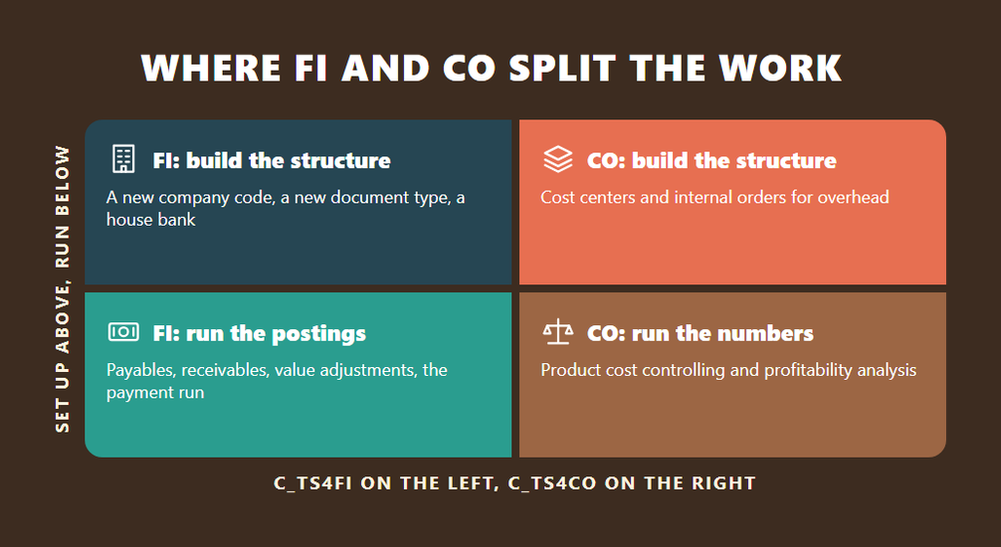
The audiences are what keep the two apart. Financial accounting produces statements for outside readers, so its output answers to external reporting rules such as the IFRS Accounting Standards. Management accounting serves people inside the company, which is why the discipline of management accounting is built around decisions, budgets and cost behaviour rather than statutory formats.
For the exams, this shared posting has a practical meaning. An FI candidate who never looks at the account assignment on an expense posting misses how CO receives its data, and a CO candidate who cannot read the FI document behind a cost center line has a blind spot when a number looks wrong. Neither exam asks you to master the other module, but each is easier when you understand the hand-off.
Which Exam Should You Take First?
Take the exam that matches the work you do now or the role you are being staffed into. If your days revolve around ledgers, vendors, customers, banks and assets, start with C_TS4FI. If they revolve around cost centers, internal orders, product costs and margin reports, start with C_TS4CO. If you are new to both, Financial Accounting is the natural foundation.
Signs that C_TS4FI should come first
- You configure or support accounts payable, accounts receivable or the payment run.
- Your project tasks include company codes, document types, house banks or asset accounting.
- You come from general accounting, accounts payable or financial reporting.
Signs that C_TS4CO should come first
- You work with cost centers, internal orders or overhead allocations.
- You are involved in product costing, work in process or variance analysis.
- You come from controlling, cost accounting or management reporting.
Why FI as the default foundation? Every CO number starts life as an FI posting, so understanding documents, accounts and posting control first makes the controlling side easier to follow. That is a preparation logic rather than an SAP rule: neither certification page lists the other exam as a prerequisite, and you can sit C_TS4CO without holding C_TS4FI. Our earlier article on the C_TS4FI preparation guide goes deeper into the Financial Accounting scope if that is your first exam.
If you want the full FICO picture on your profile, plan both exams in sequence rather than together. Each is its own 3 hour system activity, and the topics that carry the most weight differ enough that two focused preparation blocks work better than one blended one.
How Should You Prepare for Either Exam?
Prepare for C_TS4FI or C_TS4CO by working through SAP’s recommended learning journey for that exam, rehearsing the tasks in the practice system it contains, and checking your technical set-up and subscription before the day. SAP names Implementing Financial Accounting in SAP S/4HANA for C_TS4FI and Implementing Management Accounting in SAP S/4HANA for C_TS4CO.
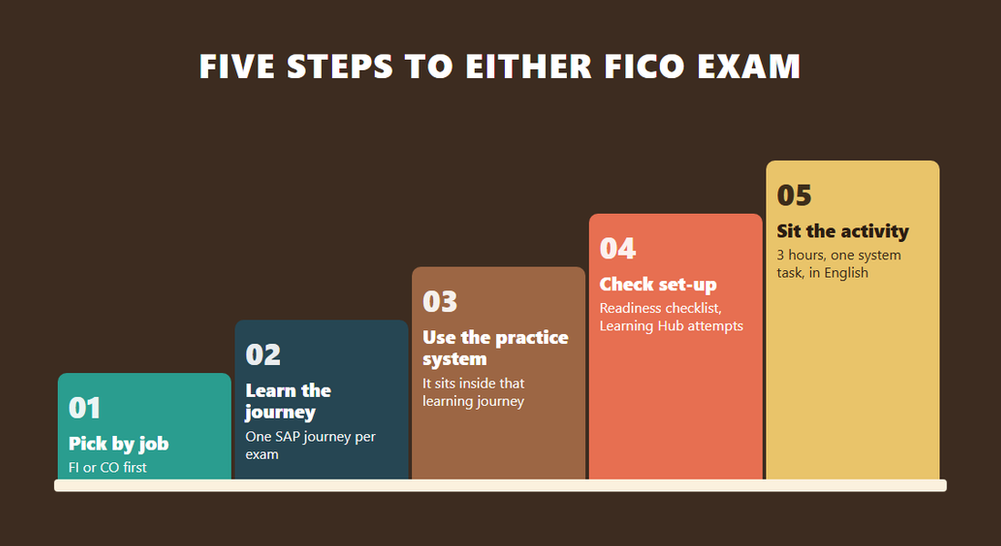
- Choose the exam that fits your role, using the signs in the previous section.
- Work through the recommended learning journey, in order, for that exam.
- Rehearse in the practice system that SAP places inside the learning journey, repeating each task until you can finish it without notes.
- Follow the Technical Readiness Checklist and confirm your Learning Hub subscription includes certification attempts and your SAP Universal ID has a secondary email.
- Sit the 3 hour System-Based Assessment activity in English.
Preparing for C_TS4FI
Spend the most time where SAP puts the most weight: payables, from vendor master data through the payment run, then document types and the company code set-up. Build one company code from nothing in the practice system, post into it, and trace each document so you know why it posted the way it did. Leave the smaller topics, such as value adjustments for overdue receivables, for a second pass, but do not skip them.
Preparing for C_TS4CO
Treat overhead controlling as the backbone. Set up cost centers and internal orders, post costs to them, then run allocations and settlement until the period-end sequence feels routine. Add product cost controlling once overhead is solid, and keep profitability analysis for last, since it carries the least weight. Our management accounting certification article follows how costs cascade through these steps.
Frequently Asked Questions
What is the SAP FICO certification code?
There is no single code. Financial Accounting is certified by C_TS4FI and Management Accounting (Controlling) by C_TS4CO, both for SAP S/4HANA Cloud Private Edition. Holding both is what people usually mean by being FICO certified.
Are SAP FI and SAP FICO the same?
No. FI is Financial Accounting, one module. FICO is shorthand for FI together with CO, Controlling, which the SAP certification title calls Management Accounting. SAP certifies each module with its own exam.
What is the SAP FICO exam pattern?
Both exams are a single System-Based Assessment activity of 3 hours in English. You carry out configuration and transaction tasks in a live SAP system. SAP’s pages show no question count, because the exam is one hands-on activity rather than a set of separate items.
What score do I need to pass C_TS4FI and C_TS4CO?
SAP shows a 60 percent pass score for C_TS4FI and 59 percent for C_TS4CO.
How much does the SAP FICO certification cost?
Neither SAP certification page shows an exam fee. SAP says attempts come from a Learning Hub subscription that includes certification exam attempts, so check the current subscription terms on SAP’s site before you plan.
Do I need C_TS4FI before I can take C_TS4CO?
No. Neither SAP certification page lists the other exam as a prerequisite. Many candidates still take C_TS4FI first because every controlling figure starts as a financial accounting posting.
Which SAP S/4HANA edition do these exams cover?
Both are titled for SAP S/4HANA Cloud Private Edition. ERPPrep notes that much of the C_TS4CO content also applies to on-premise deployments, but the exams are framed around the Private Edition consultant role.
Which FICO exam is harder?
Neither has a published difficulty rating, and the pass marks are one point apart. The real difference is weighting: C_TS4FI leans on Accounts Payable, C_TS4CO on overhead cost controlling. The exam that matches your daily work will usually feel easier.
Can I take both exams?
Yes. They are separate certifications, so you can earn both. Plan them as two preparation blocks, one per learning journey, rather than studying both at once.
Conclusion
The SAP FICO certification is really two exams. C_TS4FI proves you can configure and run Financial Accounting, with Accounts Payable carrying the most weight. C_TS4CO proves you can configure and run Management Accounting, with overhead cost controlling at its centre. Both are one 3 hour System-Based Assessment activity in English, at 60 and 59 percent pass scores. Pick the one that matches your work, use SAP’s learning journey and practice system to rehearse the tasks, and add the second exam when the first is done. Start with SAP’s own C_TS4FI certification page or the C_TS4CO certification page, confirm the details there, and book the exam that fits.


