C_S4EWM is the SAP Certified Associate credential for SAP S/4HANA Cloud Private Edition, Extended Warehouse Management. It is delivered as a System-Based Assessment built around one hands-on activity, published in English, with a cut score of 65 percent.
There is no question count, because the assessment does not have questions in the sense candidates remember. SAP completed its move to performance-based certification in early 2026, and this credential now puts you inside a configured system and asks you to carry out warehouse configuration and transaction work. Whether you pass depends on whether the tasks were completed correctly. This article covers what that format changes, walks the seven blueprint areas, and sets out a preparation approach that survives contact with a live system.
What Changed About the SAP EWM Certification?
The assessment format did, and it changed completely. C_S4EWM is now a System-Based Assessment: one connected activity carried out inside a working system, scored on whether the configuration and transaction steps were completed correctly. It replaced a long list of recall items with a demonstration of applied capability.
That is not a cosmetic revision. Under the old shape, a candidate could read widely, memorise settings, and pass without ever opening a warehouse. Under this one, the assessment watches what you actually do. Reading is still necessary; it is simply no longer sufficient.
Why SAP made the change
Because a warehouse credential that never watched anyone configure a warehouse was measuring the wrong thing. Extended Warehouse Management is unusually interconnected: a storage control setting made early determines how movements execute several steps later, and that dependency is invisible in a recall format. Watching someone work through the sequence exposes whether they understand it. The same chain of dependencies runs through freight planning, which is why the C_S4TM transportation certification is assessed the same way.
Why Do Some Searches Still Show a Year Suffix on the Code?
Because SAP used to version its exam codes with a year and quarter suffix, producing forms like C_S4EWM_2023 and C_S4EWM_2601. The current credential is the unsuffixed C_S4EWM. If you arrive on a suffixed code, you are looking at an older naming convention rather than a different exam.
This matters practically when you are gathering study material. Content written against a suffixed code predates the format change, which means its advice about how to prepare is aimed at a different kind of assessment even where the warehouse content is still accurate. The same caution applies to the C_TS470 service exam and to every other credential SAP has moved across.
How to tell which era a resource belongs to
Check what it says about the format rather than what code it carries. Anything describing a fixed count of items, a timed run through a list, or memorisation strategy is pre-2026 material. Anything describing tasks completed in a system is current.
The underlying product has not been renamed the way the exam code has. SAP still markets the line as Extended Warehouse Management, and the documentation set continues under the same name.
What Does a System-Based Assessment Actually Ask You to Do?
It gives you a configured system and a connected set of warehouse tasks to carry out inside it. You define structures, maintain master data, and execute the receipt-to-issue cycle as work rather than as description. Each step you complete correctly contributes toward the 65 percent threshold.
The word connected is the important one. This is not a set of independent exercises. The tasks form a sequence, so an early decision constrains what is possible later, which is exactly how the product behaves in a real implementation.
What that means for someone who has only studied
The gap between recognising a screen and operating it is much wider than it looks from a course. Candidates with genuine configuration experience generally find the assessment manageable; candidates who have read thoroughly but never built anything tend to find the execution demands harder than they expected.
Depth over breadth
Because everything happens inside one activity, partial familiarity across many areas is worth less than fluency through a complete flow. Rehearsing an end-to-end warehouse cycle repeatedly is a better use of an evening than skimming another area you will not be asked to touch.
What Are the Seven Blueprint Areas?
Warehouse structure and master data, inbound logistics and goods receipt, outbound logistics and goods issue, storage control and internal movements, warehouse operations, system configuration and integration, and physical inventory with additional functions. No percentage weightings are published, so all seven are examinable ground.
| Blueprint area | What it covers |
|---|---|
| Warehouse Structure and Master Data | Storage bins, staging areas and work centers, warehouse product data, packaging specifications, availability groups |
| Inbound Logistics and Goods Receipt | Goods receipt processing, direct putaway, putaway rules, capacity checks, posting receipt for embedded EWM |
| Outbound Logistics and Goods Issue | The goods issue process, stock-removal strategies, exception handling, shipping preparation, cross-docking, direct outbound deliveries |
| Storage Control and Internal Movements | Process-oriented and layout-oriented storage control, posting changes, stock transfers, ad hoc movements, replenishment |
| Warehouse Operations | Waves, two-step picking, the radio-frequency framework and mobile devices, resource management, work distribution, pick pack and pass |
| System Configuration and Integration | ERP to EWM integration, delivery-document integration, warehouse process types, warehouse orders, the Post Processing Framework |
| Physical Inventory and Additional Functions | Inventory procedures and counts, serial numbers, batch handling, quality inspection, value-added services, kitting, replenishment methods |
Read as a whole, the seven areas trace one warehouse from empty to running. That is the shape the assessment follows too, which is why the money site’s C_S4EWM scenario simulations are built as end-to-end flows rather than isolated exercises.
How Do Inbound and Outbound Logistics Differ Here?
They are mirror images that fail differently. Inbound covers goods receipt processing, direct putaway, putaway rules, capacity checks, and posting goods receipt for embedded EWM. Outbound covers the goods issue process, stock-removal strategies, exception handling, and preparing goods for shipping, plus cross-docking and direct outbound deliveries.
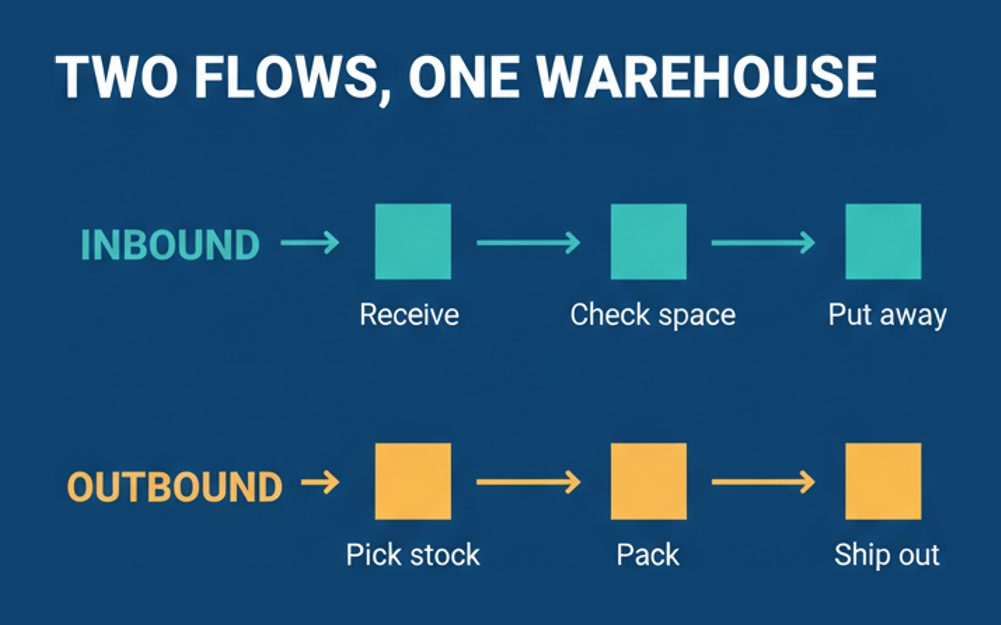
The symmetry is useful for study but misleading in practice. On the inbound side the system is deciding where stock should go, constrained by capacity. On the outbound side it is deciding which stock to take, constrained by strategy: first expired first out, batch requirements, or whatever the business rule says.
Where each side gets difficult
Inbound difficulty concentrates in putaway rules and capacity checks, because a rule that looks correct on paper produces surprising bin assignments once real dimensions are involved. Outbound difficulty concentrates in exception handling, since the interesting case is always the one where the expected stock is not there.
Cross-docking and direct outbound
Both are named separately in the outbound area because both skip steps the standard flow performs. Cross-docking moves goods from receipt straight toward shipping without a full putaway cycle. Direct outbound delivery bypasses parts of the normal document chain. Knowing when each is appropriate is more valuable than knowing where the settings live.
Why Is Storage Control the Highest-Leverage Topic?
Because it governs multi-step material flows, and a single setting there changes how every later movement executes. The blueprint names two forms: process-oriented storage control, which sequences the steps a material passes through, and layout-oriented storage control, which routes movements according to the physical shape of the warehouse.
That downstream effect is what makes it high leverage in both directions. Get it right and the rest of the flow behaves predictably. Get it wrong and you will spend the assessment debugging movements that are executing exactly as configured, just not as intended.
The internal movements half
Alongside storage control, this area covers posting changes, stock transfers, ad hoc movements, and replenishment. These are the everyday internal operations that never appear in a receipt-to-issue diagram but occupy a real warehouse team most of the day.
Because the two forms of storage control interact, studying them together and hands-on is the only approach that works. Reading about process-oriented control in isolation gives you the vocabulary without the behaviour.
What Does Warehouse Operations Cover Day to Day?
Four named things: combining items into waves, two-step picking, the radio-frequency framework with mobile devices, and resource management with work distribution. The pick, pack and pass process ties them together. This is the area closest to what a warehouse floor actually looks like in operation.
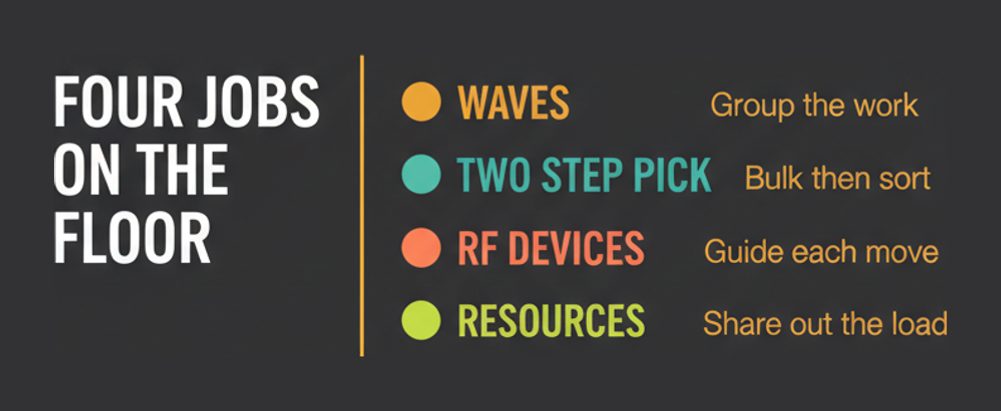
Wave management is the scheduling layer. Rather than releasing every outbound item individually, items are grouped into waves so that picking work is batched sensibly, by route, by carrier cut-off, or by zone. Two-step picking extends that by separating a bulk pick from a subsequent sort into individual orders.
The radio-frequency framework
RF is how instructions reach the person doing the work. Mobile devices present the next task, confirm it, and update the system in real time, which is what makes the stock position trustworthy at any given moment. The barcode and identification standards underneath that data capture are maintained by GS1 event capture standards, and understanding what an identification key represents makes the handling-unit material considerably clearer.
Resources and work distribution
Resource management decides who or what does the work: which operator, which forklift, which queue they draw from. Work distribution then balances that across the floor. Candidates who have run a warehouse recognise this area immediately; those who have only configured one often underestimate it.
Readers who worked through the previous generation of this credential will find the earlier treatment in ERPQnA’s C_S4EWM_2023 exam guide, which covers much of the same warehouse content under the older assessment shape.
How Much Integration and Configuration Is Assumed?
A full blueprint area of it. System configuration and integration covers the mandatory customizing that ties EWM to the ERP core: SAP ERP to EWM integration, delivery-document integration, warehouse process types, warehouse orders, and the Post Processing Framework. None of it is optional background.
Embedded EWM runs inside the S/4HANA core rather than as a separate system, so the integration question is about how documents and stock move between the warehouse component and everything around it. Delivery-document integration in particular is where a misconfiguration produces symptoms that look like a warehouse problem and are not.
Warehouse process types and warehouse orders
A warehouse process type classifies what kind of movement is happening, and that classification drives which settings apply. Warehouse orders then package the resulting tasks into units of work an operator receives. Between them they connect the configuration layer to the operations layer, which is why they sit in this area rather than in operations.
The Post Processing Framework handles what happens after a document event, such as printing or messaging. It is the least glamorous item on the blueprint and a common source of quiet failure. SAP’s EWM documentation set is the reference for all of it.
What Is the Level, Format and Pass Mark?
Associate level, System-Based Assessment format built around one activity, 65 percent to pass, published in English. The credential name in full is SAP Certified – SAP S/4HANA Cloud Private Edition, Extended Warehouse Management, and the content applies to the on-premise deployment as well as the cloud private edition.
| Specification | Detail |
|---|---|
| Exam code | C_S4EWM |
| Credential | SAP Certified – SAP S/4HANA Cloud Private Edition, Extended Warehouse Management |
| Level | Associate |
| Format | System-Based Assessment, one activity |
| Passing score | 65% |
| Language | English |
| Product | SAP S/4HANA Cloud Private Edition and on-premise, Extended Warehouse Management |
| Target profile | Consultant at project-participation depth, working in a mentored role |
That target profile is worth reading carefully, because it describes an implementation consultant rather than a warehouse operator. It is a role with its own market, and the compensation range that PayScale reports for SAP consultants reflects the implementation side of the work rather than the floor side.
On pricing, and why this article does not state a figure
No fee is published on the exam’s specification pages, and SAP’s own certification pages could not be read to confirm one. Rather than repeat a number from an unverified source, this article leaves it out. Check current pricing through SAP’s own learning platform, where certification access is bundled with subscription options that change from time to time.
The named preparation route runs through five SAP courses: S48100 for the overall business processes, EWM110 for basic customizing, EWM115 for resource management, EWM120 for advanced customizing, and SL_RISE419 for the RISE with SAP delivery methodology. All sit within SAP’s published learning journeys.
How Should You Prepare for a Hands-On Assessment?
Get access to a system and use it. That sounds obvious and it is the whole answer: an assessment that measures completed tasks cannot be prepared for by reading, and candidates who try consistently report that the execution demands caught them out. Structure your time around doing rather than covering.
- Learn the warehouse as one connected flow first, from structure and master data through goods receipt and putaway to stock removal and goods issue, so you can trace how an early configuration choice shapes every downstream movement.
- Practise both process-oriented and layout-oriented storage control hands-on, since multi-step material flows are the highest-leverage area on the blueprint and a single setting changes how later movements execute.
- Treat warehouse operations as its own study block, rehearsing wave management, two-step picking, the radio-frequency framework and resource distribution until moving work across the floor feels routine under time pressure.
- Drill ERP to EWM and delivery-document integration alongside warehouse process types, because the assessment tests how the embedded component exchanges documents and stock with the surrounding S/4HANA core.
- Rehearse physical inventory and the additional functions end to end, including serial numbers, batches, quality inspection, value-added services and replenishment, so the less frequent tasks are as fluent as the core receipt-to-issue cycle.
One scheduling note. Because the assessment is a single connected activity, a rehearsal that stops halfway teaches you less than a shorter one carried through to completion. Prefer whole cycles over partial ones, even simplified. The wider SAP credential landscape, and where this one fits within it, is set out on ERPQnA’s SAP certification overview.
Frequently Asked Questions
What format is the SAP C_S4EWM exam?
A System-Based Assessment built around one hands-on activity. You carry out warehouse configuration and transaction tasks inside a configured system, and the result depends on whether those tasks were completed correctly.
What is the passing score for C_S4EWM?
65 percent. Because the assessment is task-based, that threshold reflects how much of the required configuration and operational work you completed correctly rather than how many items you recognised.
How many activities are in the exam?
One. The whole assessment is a single connected activity rather than a series of separate exercises, which means depth through a complete flow matters more than partial familiarity across many areas.
Which languages is C_S4EWM offered in?
English is the published language. Because the assessment is delivered through hands-on system work, comfort with English EWM terminology such as putaway, stock removal, wave and staging genuinely helps.
Why do I see C_S4EWM_2023 and C_S4EWM_2601 in search results?
Those are SAP’s older year-and-quarter suffixed code forms. The current credential is the unsuffixed C_S4EWM. Material carrying a suffix predates the 2026 format change, so its preparation advice targets a different kind of assessment.
How difficult is the SAP EWM certification?
Moderately challenging. It spans the full warehouse lifecycle and is delivered hands-on, so candidates with real configuration experience usually find it manageable while theory-only candidates struggle under exam conditions.
Does it cover on-premise EWM or only cloud?
Both. The credential is named for SAP S/4HANA Cloud Private Edition, and the money site states the content applies to on-premise deployments as well. The focus is the embedded EWM component inside the S/4HANA core.
Which blueprint area is hardest?
Storage control, for most candidates. It governs multi-step material flows, and because a single setting changes how later movements execute, mistakes there surface as confusing behaviour several steps downstream.
What experience does the credential assume?
The target profile is a consultant working at project-participation depth in a mentored role. Hands-on familiarity with warehouse master data and with inbound and outbound flows makes the material far more approachable.
Which SAP courses are recommended?
Five: S48100 for business processes, EWM110 for basic customizing, EWM115 for resource management, EWM120 for advanced customizing, and SL_RISE419 for the RISE with SAP implementation methodology.
Conclusion
SAP EWM certification is no longer something you can revise your way into. C_S4EWM hands you a system and a connected set of warehouse tasks, and 65 percent of them have to be right. Seven blueprint areas trace a warehouse from structural definition through to physical inventory, and storage control quietly decides how much of the rest behaves.
Prepare it by building. Run whole receipt-to-issue cycles rather than reading about them, spend disproportionate time on storage control, and treat integration with the S/4HANA core as core content rather than background. Check the current blueprint and format on the money site before you book, and make sure any study material you rely on was written for the assessment as it is now.


