Put the two spec sheets side by side and they look like twins. C_LIXEA and P_SAPEA are both one Scenario-Based Assessment activity, both run for 2 hours, and both are cleared at a 60 percent pass score. The languages line is the same too. If you stopped reading there, you might think the only difference is the letter at the front of the code.
The letter is the whole story. C_LIXEA is an associate credential for consultants who run enterprise architecture work inside SAP LeanIX. P_SAPEA is a professional credential for people who perform the SAP enterprise architect role itself, shaping a model of the business and its technology that follows company strategy. One proves you can operate the tool well; the other proves you can own the architecture the tool describes. This guide treats the SAP enterprise architecture certification pair as a climb: what SAP actually requires before each step, what each exam tests, what changes between the levels, and how to plan the move from the first to the second.
Is C_LIXEA a Prerequisite for P_SAPEA?
No. SAP does not list C_LIXEA, or any other SAP credential, as a requirement for P_SAPEA. The learning journey behind P_SAPEA asks for knowledge instead: TOGAF foundation knowledge, preferably TOGAF certification, and a good understanding of business and IT strategy. The LeanIX learning journey behind C_LIXEA lists no prerequisites at all.
That makes the path a choice rather than a gate. SAP’s own pages describe two separate credentials at two different levels, each with its own learning journey, and neither page points at the other as a required first step. Anyone who tells you that you must hold the associate credential before booking the professional one is adding a rule SAP does not state.
The prerequisites SAP does display for the professional exam are worth reading word for word on the Becoming an SAP Enterprise Architect learning journey. The three lines are:
- TOGAF foundation knowledge, preferably TOGAF certified
- Good understanding of business strategy, organization, functional and process concepts
- Good understanding of IT strategy, organization, applications, data, and technology concepts
None of those lines mentions a tool. That is the first hint about how different the two exams are, even though their format is identical.
How Do the Two Exams Compare on Format and Scoring?
On format and scoring the two exams match exactly. Each is one Scenario-Based Assessment activity lasting 2 hours, each needs a 60 percent pass score, and for both SAP shows languages that vary by format. SAP shows no question count and no exam fee on either page, so the difference lies in level and scope, not in the mechanics.
| Fact | C_LIXEA | P_SAPEA |
|---|---|---|
| Level | Associate | Professional |
| Format | Scenario-Based Assessment, 1 activity | Scenario-Based Assessment, 1 activity |
| Duration | 2 hours | 2 hours |
| Pass score | 60% | 60% |
| Languages | Roleplay with AI guidance: English, Spanish, Italian, French, Japanese and 25 more; recorded video: English only | Roleplay with AI guidance: English, Spanish, Italian, French, Japanese and 25 more; recorded video: English only |
| Role SAP names | Consultant | Architect |
| Product or method | SAP LeanIX Enterprise Architecture Management | SAP Enterprise Architecture Framework |
Durations and languages come from SAP’s certification pages for the LeanIX consultant exam and the enterprise architect exam, which show more than the independent study guides do. For the professional exam’s seven blueprint areas, the P_SAPEA study guide lays them out with a preparation sequence for each.
Both exams are attempted through a Learning Hub subscription that includes certification exam attempts, with a valid SAP Universal ID, and SAP offers an AI-powered scenario-based assessment tool to try before exam day. Because the format is shared, time spent getting comfortable with a scenario activity for C_LIXEA carries straight over to P_SAPEA.
What Does Each Exam Actually Test?
C_LIXEA tests whether you can set up SAP LeanIX, model an application landscape in it and run its core enterprise architecture use cases as a project team member. P_SAPEA tests whether you can lead an architecture engagement with the SAP Enterprise Architecture Framework, from vision and business architecture through the application, data and technology layers to a roadmap.
The seven C_LIXEA blueprint areas
- LeanIX Fundamentals and Meta Model
- Modeling Guidelines and Fact Sheets
- Populating the Inventory (Data Import)
- Application Portfolio Assessment Use Case
- Advanced Fact Sheet Types and Meta Model Configuration
- Adoption, Collaboration and Automation Settings
- Diagrams, Application Rationalization and Integrations
The seven P_SAPEA blueprint areas
- SAP Enterprise Architecture Framework Foundations
- Preliminary Phase, Requirements, Risk and Decision Management
- Architecture Vision
- Business Architecture
- Application and Data Architecture
- Technology Architecture
- Opportunities, Solutions and Roadmaps
Neither list carries published weightings, so plan by area rather than by percentage. Read the two lists together and a pattern shows: every C_LIXEA area is about the tool and the data inside it, while every P_SAPEA area is a phase or layer of an architecture method. The associate exam lives inside one product. The professional exam lives inside a way of working that a product like LeanIX supports.
How Does SAP LeanIX Work Connect to the Architect Role?
SAP LeanIX holds the inventory an enterprise architect reasons about: applications, IT components, platforms, initiatives and the relations between them. The two use cases at the heart of C_LIXEA, application portfolio assessment and application rationalization, are the same evidence an architect needs when building the application layer and the roadmap that P_SAPEA examines.
Seen that way, the overlap between the exams is real but narrow. SAP LeanIX gives you the current state, cleanly modeled. The professional exam asks what you do with it: which target state the business strategy calls for, which risks and decisions shape the route, and how the change is sequenced.
Where the associate skills reappear
- A well-scoped inventory makes the application and data architecture layer credible, because you can show what exists before proposing what should.
- Portfolio assessment trains the habit of judging applications against business value, which is the core move in business and application architecture.
- Rationalization work produces candidate retirements and consolidations, the raw material of opportunities, solutions and roadmaps.
- Data quality settings in the meta model teach you why an architecture decision is only as good as the data behind it.
Where they stop helping
None of the LeanIX areas covers the preliminary phase, architecture vision, requirements and decision management, or technology architecture as a design discipline. Those are method skills, and you build them through the framework and through real engagements rather than through deeper tool knowledge.
What Changes Between the Associate and Professional Levels?
The level changes what you are trusted to decide. SAP describes the associate credential as proving you can participate as a member of a project team with a focus on enterprise architecture using SAP LeanIX. It describes the professional credential as verifying that you can perform the SAP enterprise architect role and build a holistic model aligned with business strategy.
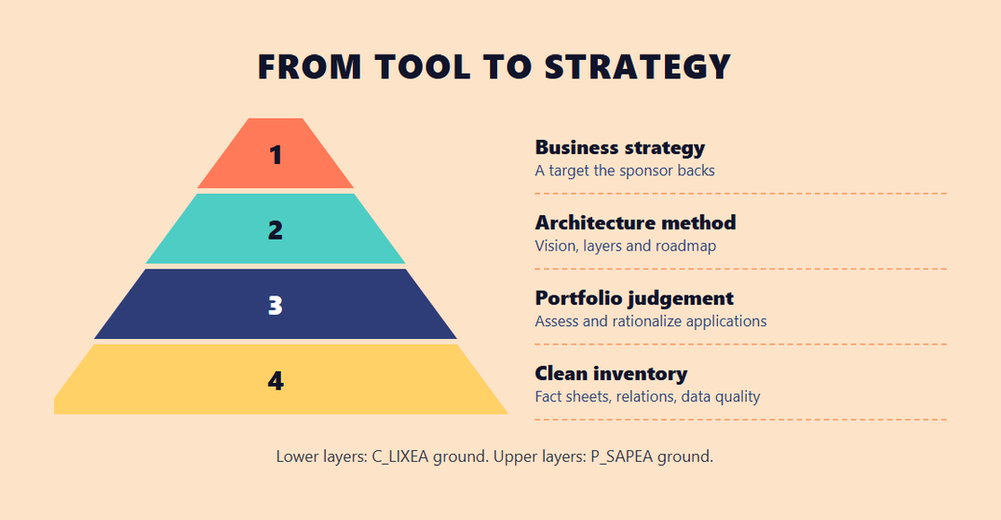
The skills SAP attaches to each page make the same point. For C_LIXEA it names Enterprise Application Integration, Business Architecture and Enterprise Architecture, under the Consultant role. For P_SAPEA it names Enterprise Architecture, Information Architecture and Data Modeling, under the Architect role. The words overlap; the altitude does not.
From answering inside a scenario to owning it
In a C_LIXEA scenario the right answer is usually the correct way to model, import, assess or rationalize something in the tool. In a P_SAPEA scenario the right answer is a decision you can defend across every layer that follows it, because a choice made at the vision stage has to hold when you reach technology architecture and the roadmap. That is why reading more does less for the professional exam than rehearsing complete engagements does.
Who Should Start With C_LIXEA, and Who Can Go Straight to P_SAPEA?
Start with C_LIXEA if your daily work is building or running an SAP LeanIX workspace, or if you are moving into enterprise architecture from a project, data or administration role. Go straight to P_SAPEA if you already lead architecture engagements, know TOGAF at foundation level or better, and can explain business and IT strategy in your own words.
The LeanIX learning journey names administrators, architects, data scientists, consultants and project managers as its audience, which fits people still building their enterprise architecture experience. The professional journey names only the architect role. If you are unsure which describes you, ask whether you would be comfortable defending a target architecture to a business sponsor tomorrow.
A quick decision guide
| Your situation | Sensible first exam |
|---|---|
| You configure or run SAP LeanIX for a team | C_LIXEA |
| You are new to enterprise architecture and moving from project, data or admin work | C_LIXEA |
| You lead architecture engagements and know TOGAF | P_SAPEA |
| You hold C_LIXEA and now shape roadmaps with business sponsors | P_SAPEA |
If you start at the associate level, our guide to the C_LIXEA modeling decisions walks through the fact sheet choices that most often go wrong in that scenario.
How Should You Plan the Step From C_LIXEA to P_SAPEA?
Plan the step as a shift from tool fluency to method fluency. Once C_LIXEA is behind you, fill the TOGAF gap SAP names in its professional prerequisites, learn the SAP Enterprise Architecture Framework vocabulary, then rehearse full engagements from vision to roadmap until a scenario no longer feels like a set of separate questions.
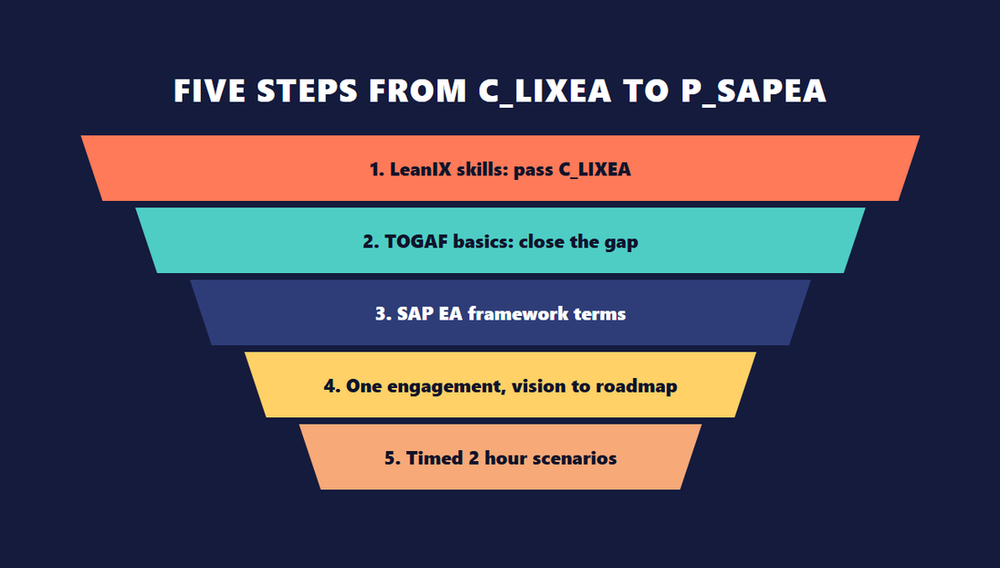
- Pass C_LIXEA or confirm you already handle the LeanIX use cases confidently in real work.
- Close the TOGAF foundation gap that SAP lists as prior knowledge for the professional exam.
- Learn the SAP Enterprise Architecture Framework terms through the Becoming an SAP Enterprise Architect learning journey.
- Rehearse one complete engagement from architecture vision to transition roadmap, carrying a single thread through every layer.
- Repeat fresh scenarios under a 2 hour limit until you can justify each decision against the business strategy.
Steps four and five matter most. P_SAPEA rewards a consistent line of reasoning, so a candidate who has walked through several whole engagements tends to do better than one who has memorised each phase separately.
Where Does TOGAF Fit in the SAP Enterprise Architect Exam?
TOGAF sits underneath P_SAPEA. The SAP Enterprise Architecture Framework tailors the TOGAF development method, and SAP lists TOGAF foundation knowledge, preferably certification, as prior knowledge for the professional learning journey. C_LIXEA does not depend on TOGAF, which is one more reason the two exams demand different preparation.
The TOGAF Standard is published by The Open Group and gives the phase vocabulary, from the preliminary phase and architecture vision through to migration planning, that the P_SAPEA blueprint areas follow. Knowing that vocabulary lets you read a scenario the way the exam frames it.
If enterprise architecture as a discipline is still new to you, start with the general idea before the framework details, because the professional exam assumes you already think in layers. For the SAP specific detail of each blueprint area, our P_SAPEA exam walkthrough covers the seven areas one by one.
Frequently Asked Questions
Do I need C_LIXEA before I can take P_SAPEA?
No. SAP lists no SAP credential as a requirement for P_SAPEA. Its learning journey asks for TOGAF foundation knowledge, preferably certification, plus a good understanding of business and IT strategy.
Are C_LIXEA and P_SAPEA the same format?
Yes. Both are one Scenario-Based Assessment activity of 2 hours with a 60 percent pass score, and both offer languages that vary by format.
Which languages can I use for these exams?
SAP shows roleplay with AI guidance in English, Spanish, Italian, French, Japanese and 25 more languages, while the recorded video format is available in English only, for both exams.
How many questions are on C_LIXEA or P_SAPEA?
SAP shows each exam as one activity rather than a set of numbered questions, and it publishes no question count for either.
How much do the SAP enterprise architecture certification exams cost?
SAP’s certification pages show no exam fee. Attempts are taken through a Learning Hub subscription that includes certification exam attempts, so check the attempts available on your own subscription.
Is P_SAPEA harder than C_LIXEA?
It sits at a higher level. The scoring is the same, but P_SAPEA expects you to perform the enterprise architect role across every architecture layer, while C_LIXEA expects you to work in SAP LeanIX as a project team member.
Does P_SAPEA test SAP LeanIX?
Its seven blueprint areas are phases and layers of the SAP Enterprise Architecture Framework, not LeanIX product features. LeanIX experience helps with the application layer and roadmaps, but it is not the subject of the exam.
Which exam should a LeanIX administrator take first?
C_LIXEA. The LeanIX learning journey names administrators in its audience, and its blueprint matches the setup, modeling, import and collaboration work an administrator does every day.
Conclusion
C_LIXEA and P_SAPEA share a format and a pass score, but they sit at different heights. The associate exam proves you can run enterprise architecture work inside SAP LeanIX; the professional exam proves you can own the architecture itself, from vision to roadmap, on a TOGAF-based method. SAP does not require one before the other, so choose your starting point by the work you do today. If you live in the LeanIX workspace, begin there and then close the TOGAF gap. If you already lead engagements, book the professional exam and spend your time rehearsing whole scenarios rather than rereading phases.


