
There is no bank of items to work through here. P_SAPEA is delivered as a single extended activity, and everything you are credited with comes out of how you handle that one situation. One scenario, a 60 percent cut score, and every architectural decision you make judged against the ones you made before it.
That shape decides how the credential should be prepared for, and it is the reason most study habits transfer badly to it. Reading seven blueprint areas separately produces seven separate understandings. The SAP Enterprise Architect certification asks you to carry one coherent line of reasoning from a business strategy through business, application, data and technology architecture and out into a roadmap, and it will notice if the technology decision no longer serves the vision you set in the first ten minutes. This guide covers the format, all seven blueprint areas, the validity model, and how to rehearse for an assessment built this way.
What Does the SAP Enterprise Architect Certification Assess?
The SAP Enterprise Architect certification verifies that you can perform the enterprise architect role: developing a holistic architecture model aligned with an organisation’s business strategy, keeping its IT landscape supporting those goals, and stewarding the ongoing evolution of its hardware, software and services. It sits at professional level and centres on the SAP Enterprise Architecture Framework.
Two things follow from that definition. The credential is product-agnostic in a way most SAP certifications are not, because the subject is the discipline of architecture rather than configuration inside a module. And it is explicitly about alignment: the assessment cares whether your technology choices remain traceable back to the strategy you started from. Architects who want the tool side of the role can look at the SAP LeanIX certification, an Associate level credential built around modelling and assessing an application landscape in SAP LeanIX.
SAP describes the skills it recognises as spanning enterprise architecture, information architecture and data modelling. That breadth is the point. An architect who is strong on application landscape design but cannot articulate the business capability model underneath it is not doing the whole job, and the assessment is built to expose that.
What Are the P_SAPEA Assessment Details?
P_SAPEA is a single Scenario-Based Assessment containing one activity, with a cut score of 60 percent. It sits at professional level and centres on the SAP Enterprise Architecture Framework. The credential carries no published retirement date. The C_FSM field service exam uses the same one activity Scenario-Based format, also with a 60 percent cut score.
| Field | Value |
|---|---|
| Credential | SAP Certified – SAP Enterprise Architect |
| Exam code | P_SAPEA |
| Level | Professional |
| Format | Scenario-Based Assessment, one activity |
| Cut score | 60% |
| Language | Varies by activity format |
| Validity | 12 months, extendable |
| Product | SAP Enterprise Architecture Framework |
One continuous activity is a different kind of pressure from a paper split across many small tasks. There is no early section to bank marks in and no opportunity to move on from something that is not going well. The time is spent building one artefact, and the pacing decision is how much of it to spend on the earlier phases before the later ones become impossible to reach.
The 60 percent cut score is more forgiving than it looks for a professional credential, and deliberately so. Architecture has more than one defensible answer, and the marking has to absorb reasonable variation between candidates who both reach a workable target state by different routes. What it does not absorb is inconsistency inside a single answer. SAP publishes the full record on its own P_SAPEA certification page.
What Is a Scenario-Based Assessment?
A Scenario-Based Assessment presents a realistic business situation and asks the candidate to reason through the correct decisions and the correct sequence of steps. It is one of the two performance-based formats SAP moved to when it completed the shift away from recall-based certification in early 2026, alongside System-Based Assessment, in which a candidate carries out configuration tasks inside a live-style system.
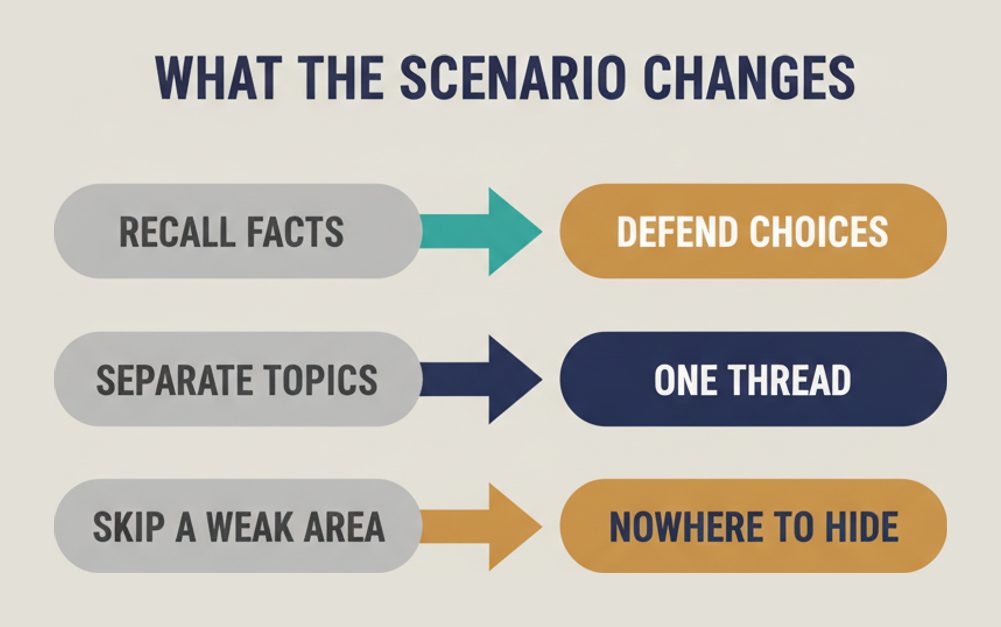
P_SAPEA uses the scenario format rather than the system one, which fits the role. An enterprise architect’s output is a set of defensible decisions and a roadmap, not a configured object, so the assessment asks for the reasoning rather than the clicks.
What changes for the candidate
Three things, and all of them affect preparation. Recall stops being sufficient, because being able to name a phase does not demonstrate you can run it. Consistency starts being scored, because every decision sits inside the same situation as every other. And there is nowhere to hide a weak area, since a scenario that spans business through technology architecture will reach into whichever layer you know least well.
What does not change
The vocabulary still matters, and arguably matters more. Reasoning framed in the method’s own terms is easier to mark and easier to follow, so time spent getting the framework’s terminology exact is not wasted even in a format that does not test definitions. The most direct way to find out how the format feels is to work full P_SAPEA scenario simulations rather than reading about them.
What Do the Seven Blueprint Areas Cover?
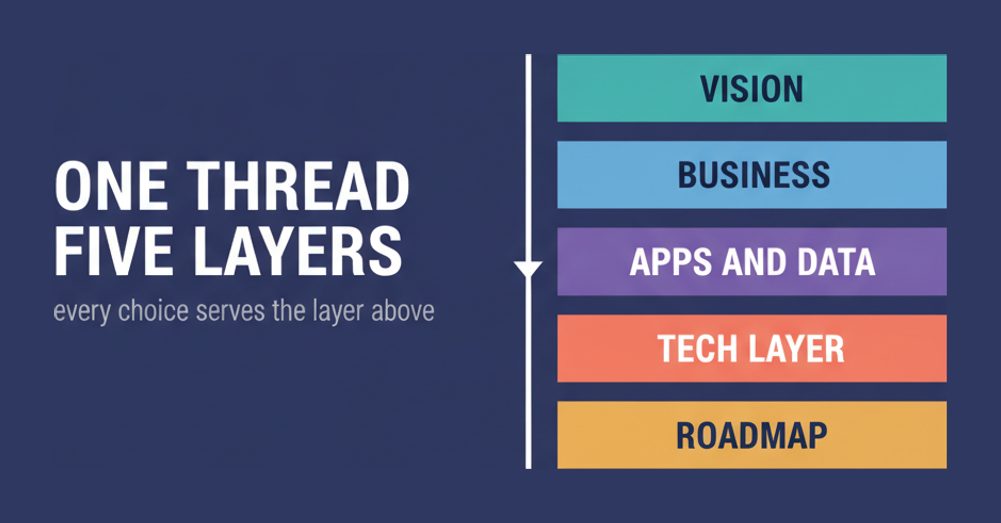
P_SAPEA publishes seven blueprint areas with no weightings attached: framework foundations, the preliminary phase with requirements, risk and decision management, architecture vision, business architecture, application and data architecture, technology architecture, and opportunities, solutions and roadmaps. Read in order they describe a single engagement from setup to actionable plan.
| Blueprint area | What it covers |
|---|---|
| SAP Enterprise Architecture Framework Foundations | What enterprise architecture is, how the framework tailors the development method, and how its methodology, reference content, tooling and services fit together |
| Preliminary Phase, Requirements, Risk and Decision Management | Setting up an engagement, then handling requirements, risk and decisions as concerns that persist across the whole method |
| Architecture Vision | Connecting the engagement to business strategy, framing scope and stakeholder expectations so the later layers have direction |
| Business Architecture | Capabilities, processes and organisational context, so technology decisions demonstrably serve business goals and stay traceable |
| Application and Data Architecture | Designing robust, scalable application landscapes and data architecture that supports analytics while respecting clean-core principles |
| Technology Architecture | The infrastructure and platform layer underneath applications and data, consistent with the vision and able to support it at scale |
| Opportunities, Solutions and Roadmaps | Identifying candidate solutions and sequencing transition roadmaps that turn design into an implementation path |
The absence of weightings is not an oversight. In a single scenario there is no fixed share for any area, because how much business architecture the situation demands depends on the situation. What it means practically is that every area is reachable and none can be written off.
The area candidates most often underweight is the last one. Producing a target architecture is satisfying and feels like the answer; sequencing the move to it, with dependencies and interim states, is the part that makes the work usable. The blueprint gives roadmaps their own area for exactly that reason.
Why Do Requirements, Risk and Decisions Sit Across the Whole Method?
The second blueprint area pairs the preliminary phase with requirements, risk and decision management, and describes those three as cross-cutting concerns that persist across the entire method rather than sitting in a single step. That placement is a deliberate statement about how the framework expects an engagement to run.
In a linear reading of any architecture method, requirements are gathered early and referred to later. The framework rejects that. A requirement surfaced during technology architecture work is as real as one captured in the preliminary phase, and the method expects it to be handled rather than deferred to a change request.
Decision management is the part with the sharpest exam consequences. In a scenario spanning several architecture layers, you will make a decision in one layer that constrains another, and the assessment can reasonably ask you to justify it later. Recording why a choice was made, and what was rejected, is the discipline the area is testing.
Risk works the same way. The interesting risks in an architecture engagement rarely appear at the start. They emerge when a business capability turns out to depend on a system nobody planned to keep, and the method wants that surfaced when it is found rather than at the end.
How Does the SAP Framework Relate to TOGAF?
The SAP Enterprise Architecture Framework tailors the TOGAF development method rather than replacing it. The phase names, the sequence from preliminary through vision to business, application, data and technology architecture, and the move into opportunities, solutions and roadmaps all follow the TOGAF architecture development method, with SAP reference content, tooling and services layered on top.
That inheritance is genuinely useful for anyone who already holds a TOGAF credential, because the method is familiar and only the content is new. It is equally useful in reverse: a candidate without TOGAF background can read The Open Group’s TOGAF material and recognise the skeleton of what SAP is asking for.
What SAP adds is specificity. The framework carries reference architecture content, defined tooling and a services layer intended to shorten engagements and mature an architecture practice, and those are the parts a generic method cannot supply. The broader discipline also has a formal standard behind it: ISO/IEC/IEEE 42010 defines how architecture descriptions are structured, which is worth knowing as background to why architecture views are organised as they are.
The anchor course for the credential, IEA10, covers the framework and how it accelerates engagements, then works through applying the method and tooling to build a company-specific roadmap across the vision, business, application, data and technology phases. It is published as Intelligent Enterprise Architecture Fundamentals.
How Long Does the Credential Last?
The SAP Enterprise Architect certification is valid for 12 months. That period extends by a further 12 months each time the holder successfully completes an assessment, and SAP sends notifications so the expiry date does not arrive unannounced. It is a considerably shorter cycle than most vendor credentials run.
This is the fact most likely to change the calculation before you commit. A credential that has to be maintained annually is a standing commitment rather than a one off achievement, and it is worth confirming your employer treats it that way before starting.
The reasoning behind the model is defensible. SAP’s landscape changes fast enough that a certification awarded once and never revisited says progressively less about current capability, and an annual cycle keeps the credential meaning something. Whether that is worth the upkeep depends on whether your work genuinely tracks those changes.
The practical read for most architects is that the credential suits someone whose day job already keeps them current. If you are shaping SAP landscape decisions regularly, the annual assessment is a check rather than a project. If you are not, the maintenance will feel disproportionate. The ERPQnA SAP certification overview sets out how the tiers and their maintenance obligations compare.
How Should You Prepare for P_SAPEA?
Preparation for a single extended scenario works differently from preparation for a set of discrete tasks. The goal is not coverage of seven areas but fluency in moving between them without losing the thread, because the assessment scores whether the later decisions still serve the earlier ones.
- Rehearse a full architecture engagement from vision through to roadmap, so you can carry one coherent thread through business, application, data and technology architecture the way a single scenario activity demands.
- Ground your terminology in the SAP Enterprise Architecture Framework and its tailored development method early, because precise method vocabulary keeps your reasoning aligned with how the assessment frames each phase.
- Work requirements, risk and decision management as concerns that run across the whole engagement rather than as a single step, since they shape later architecture choices.
- Drill the application and data architecture layer against clean-core and scalability considerations, because trade-offs there ripple into technology architecture and into the resulting roadmap.
- Simulate fresh scenarios repeatedly rather than re-reading notes, so interpreting an open business situation and producing a defensible architecture becomes habit under time pressure.
- Practise sequencing a roadmap explicitly, including interim states and dependencies, because turning a target architecture into a transition path is its own blueprint area and the one most often left thin.
Scenario simulations and skill drills are the right shape of preparation here, because they exercise the same thing the assessment does. The ERPQnA enterprise architect study materials guide collects the reading side of that.
Who Should Take This Rather Than an Associate Credential
P_SAPEA is aimed at practising enterprise architects and senior consultants who already guide how an organisation’s technology landscape supports its strategy. It suits people who own or contribute to architecture roadmaps, reference models and transformation planning, and who work across business and IT rather than inside one functional module.
The professional tier is doing real work in that description. An associate credential is designed to be reachable through study; a professional one assumes the experience already exists and tests whether it is organised. Someone who has never run an architecture engagement will find a two hour scenario an uncomfortable place to discover what one involves.
There is a useful self-test. Read the seven blueprint areas and ask whether you could describe, from your own work, what you produced in each. If four or five of them produce a concrete answer, the credential is testing something you have. If two do, an associate-level route into the SAP architecture space is the better first step, and the LeanIX enterprise architecture consultant credential exists for that purpose.
Frequently Asked Questions
What format is the P_SAPEA assessment?
A Scenario-Based Assessment containing one extended activity. You are given a realistic business situation and reason through the correct decisions and sequence, rather than working through a set of discrete items.
How long is the SAP Enterprise Architect assessment?
SAP does not publish a time limit for P_SAPEA. Its certification page gives the format and the cut score but no duration, so confirm the length when you book. There is no separate section to bank marks in either, so pacing across the earlier and later phases of the scenario is a real decision.
What is the cut score for P_SAPEA?
60 percent. That is comparatively forgiving for a professional credential, because architecture allows more than one defensible route to a workable target state.
What language is the exam offered in?
SAP does not publish a single exam language for this credential. Its certification page states that available languages vary by the format of the activity: a roleplay activity guided by AI is offered in English, Spanish, Italian, French and Japanese among others, while a recorded video activity is English only.
How long is the certification valid?
12 months. The period extends by another 12 months each time you successfully complete an assessment, and SAP notifies holders before the expiry date.
Does P_SAPEA have prerequisites?
No formal prerequisite is published, but it is a professional-tier credential written for practising architects. The scenario assumes experience running engagements rather than familiarity with the method alone.
How many blueprint areas are there?
Seven, published without weightings: framework foundations, preliminary phase with requirements, risk and decisions, architecture vision, business architecture, application and data architecture, technology architecture, and opportunities, solutions and roadmaps.
Is the SAP framework the same as TOGAF?
No, it tailors TOGAF. The phase sequence follows the TOGAF development method, with SAP reference architecture content, tooling and services layered on top to shorten engagements.
Which course prepares for it?
IEA10, Intelligent Enterprise Architecture Fundamentals, is the anchor course of the learning journey. It covers the framework and then applies the method and tooling to build a company-specific roadmap.
Is the credential still current?
Yes. SAP publishes no retirement date for it, and the year-suffixed URLs for earlier releases redirect to the current unsuffixed certification page.
Conclusion
The whole of P_SAPEA turns on one property: it is a single scenario, so consistency is the thing being measured. Seven blueprint areas with no weightings between them, one continuous activity moving through as many as the situation demands, and 60 percent to clear.
Prepare accordingly. Rehearse whole engagements rather than reading areas, fix the method vocabulary early because it keeps the reasoning legible, and practise the roadmap step properly since it is where a good target architecture most often stops short of being usable. Then weigh the 12 month validity honestly: this credential rewards architects whose work already keeps them current, and asks a lot of anyone else.


