A truck delivers the first half of a steel tube order to a plant in Mexico, the warehouse posts what it received, and the supplier invoices for the whole order anyway. Three screens away, in accounts payable, that invoice is now blocked, and the clerk who has to explain why is the person C_IEE2E is designed to certify: the SAP Certified – Implementation Consultant – End-to-End Business Processes in SAP credential from SAP checks whether you can run a business event from the department where it starts to the ledger where it ends. The exam is one System-Based Assessment activity in a working SAP system, with a 64 percent pass score, a 3 hour duration displayed by SAP, and seven blueprint areas that span accounting, human resources, procurement, production, sales and service.
This article explains what the SAP end-to-end business processes certification actually measures, names the seven areas exactly as the money-site study guide publishes them, follows each of the five process flows to the posting it leaves in finance, shows why the enterprise structure and the central data objects decide what every later step can do, sets out what changed when the exam became a live-system assessment, and ends with a preparation order built on SAP’s own nine-unit course.
Table of Contents
- What does the SAP end-to-end business processes certification test?
- Which seven blueprint areas does C_IEE2E cover?
- How do the five process flows hand off to finance?
- Why do enterprise structure and central data objects come first?
- What changed when C_IEE2E became a System-Based Assessment?
- How should you prepare for C_IEE2E in a live system?
- Frequently Asked Questions
- Conclusion
What does the SAP end-to-end business processes certification test?
C_IEE2E tests whether you can execute the core end-to-end business processes of SAP Business Suite in a working SAP S/4HANA Cloud system, as a mentored member of an implementation project team. It is an Associate level credential delivered as one System-Based Assessment activity, with a 64 percent pass score, English delivery, and a 3 hour duration that SAP displays on the certification page.
| Field | Value |
|---|---|
| Exam code | C_IEE2E |
| Credential | SAP Certified – Implementation Consultant – End-to-End Business Processes in SAP |
| Level | Associate, an entry-level qualification at project-participation depth |
| Format | System-Based Assessment (SyBA), 1 activity |
| Duration | 3 hours, as displayed by SAP; the money-site pages publish none |
| Passing score | 64 percent |
| Languages | English |
| Product | SAP Business Suite (SAP S/4HANA Cloud Public and Private Edition) |
| Blueprint areas | 7, with no published weightings |
| Exam fee | Not published on the exam card; access comes through an SAP Learning Hub subscription that includes certification attempts |
One activity, scored on what you did in the system
A System-Based Assessment puts you inside a configured SAP system and asks you to carry out process tasks: post a document, release an order, run a period-end step, correct a setting that is making a later step fail. There is no list of separate items to collect marks from. What is scored is whether the task was completed correctly, which is why the 64 percent threshold behaves differently from a cut score on a recall exam. A step done wrong early tends to break the step that depends on it.
SAP’s C_IEE2E certification page states the assessment type, the pass score and the duration, and maps the credential to one role, Consultant, and six skills: Sales Process, Purchasing, Manufacturing Processes, SAP Business Suite, Financial Accounting and Management Accounting. That skill list is the exam in miniature. Four of the six are the operational flows, and two are the accounting views those flows post into.
Who it is written for
The money-site study guide describes the audience as implementation consultants and business users moving into a cross-process SAP role, at the depth of someone who participates in a project rather than leads one. In practice that covers three groups: new consultants who need a first recognised SAP credential, single-module specialists widening into end-to-end work, and business users on a transformation project who are asked to understand what happens after their own step. SAP’s learning journey for the exam lists both Business User and Consultant as target roles, which confirms the breadth. Sales and presales colleagues have their own route, and the C_BCSBS positioning exam is a scenario assessment built around positioning the SAP strategy to customers.
Which seven blueprint areas does C_IEE2E cover?
C_IEE2E covers seven blueprint areas: SAP Business Suite Foundations & Integration Challenges; Enterprise Structure & Central Data Objects; Record-to-Report: Financial & Management Accounting; Recruit-to-Retire: Human Experience Management; Source-to-Pay: Procurement; Design-to-Operate: Production; and Lead-to-Cash: Sales & Service. No weightings are published for any of them, so plan preparation by process flow rather than by percentage.
| Blueprint area | What it asks you to handle |
|---|---|
| SAP Business Suite Foundations & Integration Challenges | What the suite is, how its cloud ERP solutions and the Business Technology Platform fit together, and why processes that cross departments create the integration problems an implementation has to solve, worked through on a sample manufacturing company mapped to SAP best practices |
| Enterprise Structure & Central Data Objects | Defining organizational units, and understanding how master data, transaction data and business documents relate and how those shared objects shape behaviour across every application that uses them |
| Record-to-Report: Financial & Management Accounting | The accounting cycle from posting to reporting: general ledger basics and integration, payables and receivables, asset accounting, parallel accounting with ledgers, and planned against actual figures in overhead cost controlling |
| Recruit-to-Retire: Human Experience Management | The employee lifecycle in SAP SuccessFactors: recruiting and hiring, onboarding, maintaining records in Employee Central, and running payroll with results posted back into finance |
| Source-to-Pay: Procurement | Requisition and contract handling, purchase orders, goods movements, warehouse processing, invoice handling and outgoing payments to suppliers |
| Design-to-Operate: Production | Production master data and product cost calculation, demand planning, material requirements planning, production order execution and period-end closing |
| Lead-to-Cash: Sales & Service | Sales master data, presales and order management, delivery, shipping and billing, customer payments, plus service contracts, recurring service and service analytics |
Read the list as a sequence rather than a menu. The first area explains why integration is hard, the second gives you the structures and objects every later flow depends on, and the remaining five are the flows themselves, each of which ends with a posting in finance. That is also the order SAP’s course presents them in, so a candidate who studies top to bottom is rehearsing the dependency the activity scores. Candidates who want the sales side of that chain in depth can go on to the C_TS462 sales assessment, which tests order to cash on its own in a 3 hour System-Based Assessment.
The ERPPrep C_IEE2E study guide publishes these seven area names, the recommended course and the format facts on one page, and it is the source the table above was taken from. Its five preparation pointers are worth reading before the course, because they name the places candidates lose marks: the hand-offs where a goods receipt or a payroll run leaves its home department and arrives in accounting.
One count worth settling before you go further. The study guide and the free sample page on the money site both list seven blueprint areas, while the exam page on the same site organises its skill drills into eight domains. The eight are a drill grouping rather than an extra topic: Lead-to-Cash is split into a Sales set and a Service set, the two foundation areas are merged into one, and a Cross-Process Integration and Fit-to-Standard set is added to drill the hand-offs on their own. The seven published names remain the blueprint.
How do the five process flows hand off to finance?
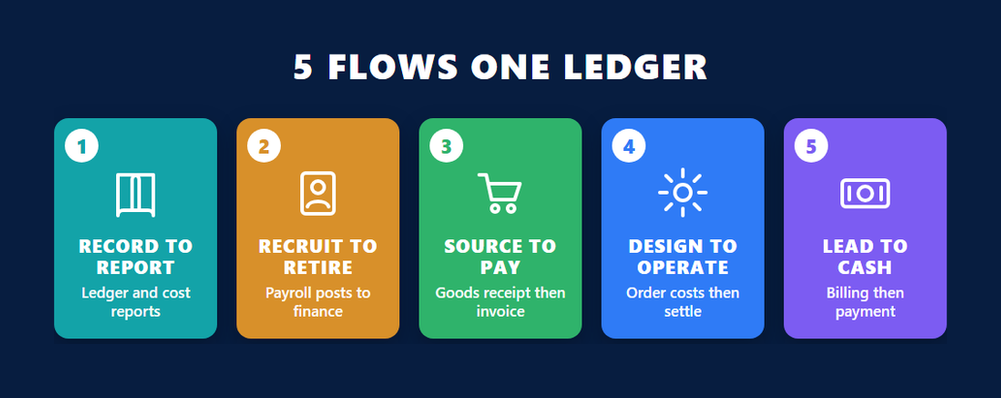
Every process flow in C_IEE2E ends in financial accounting: a goods receipt posts to inventory and a clearing account, a payroll run posts personnel costs, a billing document posts a receivable, a production confirmation posts actual costs to the order, and period-end settlement moves those costs to their final receivers. The exam scores whether you can run each flow far enough for that posting to be correct.
| Flow | Starts with | Reaches finance as |
|---|---|---|
| Record-to-Report | A business transaction posted to the general ledger | Ledger balances, payables, receivables, asset values and overhead cost reports |
| Recruit-to-Retire | A requisition and a hire in SAP SuccessFactors | Payroll results posted back into financial accounting |
| Source-to-Pay | A purchase requisition or a contract call-off | A goods receipt posting, a matched invoice and an outgoing payment |
| Design-to-Operate | A demand plan and a planning run | Actual production costs on the order, then settlement at period end |
| Lead-to-Cash | A sales order or a service contract | A billing document, a receivable and the customer payment that clears it |
Procurement: the three-way match holds until the goods are in
The money site’s first free drills are built on these hand-offs, and the invoice case from the opening of this article is one of them. A buyer orders steel tube against a long-term contract, the warehouse posts a partial goods receipt for the first truckload, and the supplier invoices the full quantity. The invoice is held because the received quantity is below the invoiced quantity, and nothing about the contract, the business partner or the payment terms changes that. The remaining goods have to be received before the full invoice can match and release. A candidate who reaches for the contract or the partner record has misread which department the block belongs to.
Production: overhead before settlement, not after
The production flow carries the longest chain. Master data and a cost estimate set the standard price, a planning run creates the demand, production orders are released and confirmed, and goods movements post the components and the finished product. Period-end closing then has an order of its own. In one sample case several production orders refuse to settle cleanly while others on a different line settle fine, and the cause is that the overhead surcharge was never run for the period, so the orders held only direct costs when settlement executed. The fix is a sequence, not a write-off: run overhead calculation, then settle again.
Sales: no billing without a delivery and a goods issue
Lead-to-Cash looks like the simplest flow and is where candidates most often skip a step. A sales order can be saved, priced and free of incompletion messages and still not be billable, because nothing has been delivered and no goods issue has been posted. The document flow tells you which prerequisite is missing. Creating the delivery and posting goods issue is what makes customer billing available; releasing a billing block on the partner or recalculating pricing does nothing for an order that has not shipped. The service half of the same area adds contracts and recurring service, which bill on a schedule rather than on a shipment.
Accounting: two ledgers can both be right
Record-to-Report includes parallel accounting with ledgers, and the sample drill on it is a useful corrective for anyone who assumes a single truth. A brake supplier runs a leading ledger for group reporting and a second ledger for local statutory valuation, and after a depreciation run the two show different net book values for the same machines. Both are correct. Each ledger depreciates on its own useful life, and no corrective posting is needed. A group that reports under the IFRS Accounting Standards while a subsidiary files under a local standard with shorter useful lives is exactly the situation parallel ledgers exist for, and the exam expects you to recognise expected behaviour before you try to fix it.
SAP itself names the suite’s end-to-end processes slightly differently from the money-site blueprint. Its Business Suite material lists procure-to-pay, design-to-operate, hire-to-retire, lead-to-cash and record-to-report; the study guide’s Source-to-Pay and Recruit-to-Retire are the same flows under the names the exam course uses. The executive responsible for the suite’s product management put the reason the exam is built this way plainly.
“Businesses today need resilient processes running seamlessly across different lines of business. As we’ve seen time and again, point solutions can’t solve for the challenges and opportunities of today’s business world. This is why we’ve developed a seamless, integrated suite that can allow our customers to move faster, whether responding to a problem or ensuring readiness when opportunity knocks. Imagine if your key business processes like lead-to-cash or hire-to-retire were harmonized with seamless data flows.”
That passage comes from his June 2025 SAP News feature on the suite, and it describes the candidate C_IEE2E is looking for: someone who sees a lead-to-cash chain as one process with several owners rather than five screens in five departments.
Why do enterprise structure and central data objects come first?
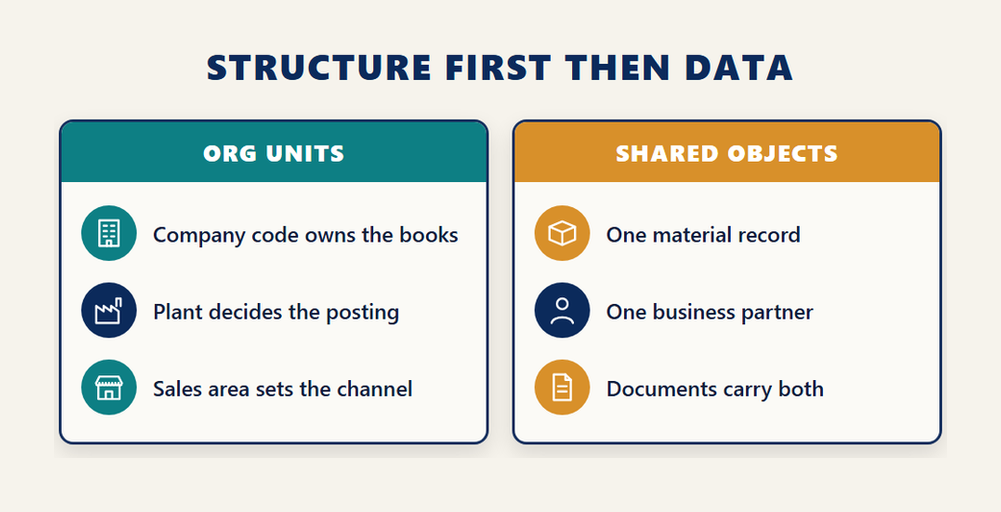
Enterprise structure and central data objects come first in C_IEE2E because every process flow inherits its behaviour from them. The company code a plant is assigned to decides whose books a goods issue posts to, the sales area decides how a customer and a material sell through a channel, and shared master data decides whether two departments describe the same thing. Get these wrong and nothing later can be right.
The plant decides the books
The clearest sample case on the money site is a powertrain manufacturer with a German entity and a newly incorporated Spanish entity that must file separately. During go-live a single production plant is assigned under the German company code, and when the Spanish sales team posts goods issues for local deliveries, the accounting documents land in the German books and the Spanish statutory ledger shows no cost of goods sold. The material master and the business partners are correct and shared. The repair is structural: create a plant for the Spanish entity, assign it to that company code, and let Spanish deliveries draw stock from it. Redirecting individual delivery documents, duplicating the material master or revaluing stock after the fact all treat a structure problem as a transaction problem.
Reuse the object, extend the structure
The second structural case runs the other way. A fastener supplier opening a new distribution channel is tempted to copy every customer and material master so the channel has its own data. The fit-to-standard answer is to represent the new channel through the sales-area structure, so the same central objects sell through both channels with channel-specific pricing and output. That keeps the core clean and keeps one record per real-world thing, which matters because master data that drifts apart across channels is precisely the integration challenge the first blueprint area describes.
Together the two cases explain why the study guide tells candidates to learn organizational units, master data and documents before any flow. Organizational units such as company codes, plants, purchasing organizations and sales areas are the frame. Master data such as materials, business partners and cost centres are the shared objects. Transaction data and business documents, from a purchase order to a billing document, are what the flows produce, and every one of them carries the structure and the master data it was created with.
What changed when C_IEE2E became a System-Based Assessment?
C_IEE2E moved from a release-suffixed, item-based exam to a single System-Based Assessment activity when SAP completed its shift to performance-based certification in early 2026. Older pages still describe the credential as C_IEE2E_2404 and name it End-to-End Business Processes for the Intelligent Enterprise, or for SAP Business Suite. SAP’s current page lists it simply as C_IEE2E, End-to-End Business Processes in SAP.
System-Based and Scenario-Based are different formats
SAP now runs two performance-based formats. A Scenario-Based Assessment, used for credentials such as the SAP LeanIX or SAP Signavio consultant exams, gives you a business situation and scores the decisions you reason through. A System-Based Assessment, which is what C_IEE2E uses, puts you in a live-style system and scores the tasks you complete. The distinction matters for preparation: reading about a goods receipt prepares you for the first kind, and only posting goods receipts until the screens are familiar prepares you for the second. The money-site FAQ calls out time management for the same reason, because hesitation on routine navigation eats into the single activity.
Three names, one credential
Search demand still arrives under the two older titles, and the money site’s own statistics show the longest credential-name query still carrying the words “for SAP Business Suite”. If you hold a certificate issued under either earlier name, it is the same credential at an earlier release; if you are booking now, the exam you sit is the one described on SAP’s page, in English, as one activity. An overview of the five flows as SAP’s course presents them, written before the format change, is in our SAP Business Suite process overview, and the process content there is still current even though the assessment that tests it is not.
What SAP asks you to check before you book
The certification page sets out three readiness steps. Confirm your hardware, software and connectivity against SAP’s Technical Readiness Checklist. Confirm that your SAP Learning Hub subscription includes certification attempts and that your SAP Universal ID has a secondary email, noting that subscription attempts and exam attempts are counted separately and each exam attempt consumes one subscription attempt. Then watch SAP’s introduction to system-based assessments and open the practice system inside the learning journey, which is the closest rehearsal of the format you can get.
How should you prepare for C_IEE2E in a live system?
Prepare for C_IEE2E by working SAP’s course Exploring End-to-End Business Processes in SAP in unit order and repeating every flow in the practice system until the hand-offs are automatic. SAP displays the course at 32 hours 42 minutes across nine units, the money site suggests one to two months alongside a job, and the largest units are the three flows with the longest chains.
| Unit | Topic | Displayed time |
|---|---|---|
| 1 | Identifying End-to-End Business Processes and their Integration Challenge | 22 min |
| 2 | Describing the Key Components of the Autonomous Enterprise | 31 min |
| 3 | Discussing Central Concepts and Objects in SAP Solutions | 58 min |
| 4 | Performing the Record-to-Report Process: Focus on Financial and Management Accounting | 5 hr 53 min |
| 5 | Performing the Recruit-to-Retire Process: Focus on Human Experience Management | 1 hr 29 min |
| 6 | Performing the Source-to-Pay Process: Focus on Procurement | 4 hr 7 min |
| 7 | Performing the Design-to-Operate Process: Focus on Production | 6 hr 12 min |
| 8 | Performing the Lead-to-Cash Process: Focus on Sales | 4 hr 5 min |
| 9 | Performing the Lead-to-Cash Process: Focus on Service | 3 hr 51 min |
The unit times are a planning signal in themselves. Production, accounting and procurement account for more than 16 of the 32 hours, and they are the same three areas the money-site FAQ names as the most detailed. The IEE2E course page rates the course Intermediate and is the single course the study guide recommends; the journey it sits in lists one prerequisite, Getting Started with Support from SAP.
The preparation sequence
- Complete units 1 to 3 of the course before touching any flow, so that company codes, plants, sales areas, master data and document types are in place in your head before a task depends on them.
- Work the Record-to-Report unit next and post each document type yourself in the practice system, from a general ledger entry through a payable, a receivable and a depreciation run across two ledgers, so that expected parallel-accounting differences stop looking like errors.
- Run Source-to-Pay and Design-to-Operate end to end in the practice system, including a partial goods receipt against a full invoice and a period-end close where overhead is calculated before settlement, because those two chains carry the most steps.
- Run Lead-to-Cash for sales and then for service, creating the delivery and posting goods issue before you attempt billing, and reviewing the document flow after every step.
- Rehearse whole scenarios under a clock in the final two weeks, with the money site’s scenario simulations and skill drills grouped by domain, so that routine navigation is automatic and the exam time goes on the decisions that vary.
The IEE2E practice system is preconfigured with the data the course exercises need and comes with guided exercises and a setup guide, which makes it the right place for steps two to four. It is a subscription resource, so plan the booking window around the weeks you will actually spend in it.
Older preparation pages for this credential, including our own earlier C_IEE2E preparation page, were written for the release-suffixed version of the exam and describe a delivery that has since changed. Use them for topic coverage, which has stayed close, and take the format, the duration and the readiness steps from SAP’s current page. Recruit-to-Retire is the shortest unit and the one candidates report fumbling at the hand-over into payroll, so give it a second pass even though the clock says it is small.
Frequently Asked Questions
What is the C_IEE2E exam format?
C_IEE2E is a System-Based Assessment delivered as one activity. You carry out end-to-end process tasks inside a configured SAP system, and the activity is scored on whether each task was completed correctly. SAP lists the assessment type as System Based on the certification page, and the money-site study guide publishes the same format.
What is the passing score for the SAP end-to-end business processes certification?
The pass score is 64 percent. SAP displays it on the C_IEE2E certification page and the money-site study guide publishes the same figure. Because tasks in the single activity depend on one another, a structural mistake early in a flow can cost marks at several later steps, so treat 64 percent as a floor to clear with room rather than a target.
How long is the C_IEE2E exam?
SAP displays a 3 hour duration on the certification page. The money-site study guide, FAQ and exam page publish no duration, so SAP’s page is the only visible source for it. Plan the activity as a sustained three hours of system work rather than a sprint through a list.
Is C_IEE2E available in languages other than English?
No. SAP’s certification page shows the exam as available in English, and the money-site study guide lists English as well. The course that prepares for it is offered in German, Spanish, French, Japanese, Korean, Portuguese and Chinese, but the assessment itself is delivered in English.
How many blueprint areas does C_IEE2E have?
Seven: SAP Business Suite Foundations and Integration Challenges; Enterprise Structure and Central Data Objects; Record-to-Report: Financial and Management Accounting; Recruit-to-Retire: Human Experience Management; Source-to-Pay: Procurement; Design-to-Operate: Production; and Lead-to-Cash: Sales and Service. No weightings are published. The money site’s exam page groups its drills into eight domains, which is a regrouping of the same seven areas.
Which SAP course prepares for C_IEE2E?
Exploring End-to-End Business Processes in SAP, course code IEE2E, inside the learning journey Applying End-to-End Business Processes in SAP. SAP displays it at 32 hours 42 minutes across nine units at Intermediate level, and the money site names it as the single recommended course. The journey lists one prerequisite, Getting Started with Support from SAP.
Is C_IEE2E a good first SAP certification for a graduate?
It is one of the few SAP credentials that touches every core department, which makes it a sensible first certificate for a graduate heading into implementation consulting or a business-process role. It targets entry-level, mentored project participation and assumes no prior SAP line-of-business experience, though the money-site FAQ advises newcomers to budget the fuller end of one to two months and to spend most of that time in a system.
How does C_IEE2E differ from a single-module SAP implementation consultant certification?
A single-module credential such as C_TS4FI for financial accounting or C_TS452 for sourcing and procurement goes deep into one flow and its configuration. C_IEE2E goes wide: it covers all five flows at process-execution depth and scores the hand-offs between them. Candidates who already hold a module credential usually find the other four flows the new material.
Do I need hands-on system access to pass C_IEE2E?
Yes. The exam is a System-Based Assessment, so the skill it measures is executing process steps in a live-style system, and the money-site FAQ calls hands-on access strongly recommended. SAP provides a preconfigured practice system inside the learning journey with guided exercises, and scenario simulations that mirror the task sequences are the next best rehearsal where direct access is limited.
What does the C_IEE2E exam cost?
SAP’s exam card does not publish a fee. Access to the exam comes through an SAP Learning Hub subscription that includes certification attempts, and the certification page shows subscription attempts and exam attempts separately, with each exam attempt counting as one attempt from the subscription.
Conclusion
The SAP end-to-end business processes certification is easy to summarise and demanding to earn: one System-Based Assessment activity, a 64 percent pass score, a 3 hour duration displayed by SAP, and seven blueprint areas with no weightings to hide behind. What makes C_IEE2E different from a module exam is the hand-off. A plant under the wrong company code, an overhead run skipped before settlement, a billing attempt on an order that never shipped: each is a small action in one department and a wrong posting in another. Learn the enterprise structure and the central data objects first, then run every flow in the practice system until the document flow reads the way you expect, and rehearse whole scenarios under a clock. Then read SAP’s readiness steps, confirm your attempts, and book C_IEE2E knowing where each of the five flows ends.


