A marketer who sends Emarsys campaigns every week might expect this exam to be easy, and a consultant who has never opened the platform might expect it to be out of reach. Both guesses are off. SAP states that previous project experience is not a prerequisite, yet the exam still asks you to make implementation decisions inside a realistic marketing case.
The SAP Emarsys certification, code C_C4H22, carries the full title SAP Certified – Implementation Consultant – SAP Engagement Cloud – Emarsys Edition. SAP runs it as one Scenario-Based Assessment activity with a 2 hour duration and a 60 percent pass score. This article explains what the credential proves, why the product now carries two names, the six blueprint areas, how the three official courses lead to the exam, where candidates usually lose marks, and how to prepare for a single scenario. The exam sits inside SAP’s customer experience portfolio, so its six blueprint areas mirror the decisions a consultant makes on a real Emarsys implementation.
What Does the SAP Emarsys Certification Prove?
The SAP Emarsys certification proves novice consultant capability on SAP Engagement Cloud, Emarsys Edition. C_C4H22 confirms that you understand the platform and can use that knowledge to plan and implement it in a mentored role, from contact data and segmentation through email, journeys, omnichannel channels, analytics and data integrations.
The wording on SAP’s C_C4H22 certification page matters. It talks about a novice implementation consultant working in a mentored role, and it says plainly that previous project experience is not needed to pass. That places the credential at the start of a CX consulting path, not at the end of one.
SAP lists the target role as Consultant and names three skills: campaign management, account planning and account management. The first one is what most marketers already do. The other two describe the consultant side of the job: setting up the account, its users and its data so that campaigns can run at all.
What it is not
It is not a marketing strategy exam. Nobody asks you to judge creative copy or plan a media budget. The exam is about configuring and operating the platform correctly for a stated business need, which is why SAP puts it under implementation consultant rather than marketing user.
Emarsys or Engagement Cloud: Why Does the Exam Carry Two Names?
The exam carries two names because SAP renamed SAP Emarsys to SAP Engagement Cloud, and the certification title now reads SAP Engagement Cloud, Emarsys Edition. SAP’s product page labels the product as formerly SAP Emarsys, while search behaviour still runs on the older name, so candidates meet both in study material and job adverts.
The rename was reported in February 2026 as more than a label change. In an interview with MarTech’s coverage of the rename, the head of the product described the aim as extending engagement beyond marketing campaigns into enterprise orchestration.
“We just saw a much bigger opportunity than everything being marketing-owned or siloed,”
For exam purposes the practical point is simpler. The SAP Engagement Cloud product page and the course titles use the new name, while older guides, including ours, covered an earlier exam code, C_C4H225_12, under the SAP Emarsys Customer Engagement Implementation name. Check the code and the full title before you trust any resource.
How Does SAP Run the C_C4H22 Exam?
SAP runs C_C4H22 as a single Scenario-Based Assessment activity with a 2 hour duration and a 60 percent pass score. You read one realistic marketing situation and decide how to set up and run the platform for it. The format is performance-based: you reason through a described case rather than recall isolated facts.
| Detail | C_C4H22 |
|---|---|
| Full title | SAP Certified – Implementation Consultant – SAP Engagement Cloud – Emarsys Edition |
| Level | Associate |
| Format | Scenario-Based Assessment (SBA), 1 activity |
| Duration | 2 hours |
| Pass score | 60 percent |
| Languages | Roleplay with AI guidance: English, Spanish, Italian, French, Japanese and 25 more; recorded video: English only |
| Target role | Consultant |
| Project experience | Not a prerequisite |
Two points follow from the table. First, the language list depends on how you respond. SAP lists a long set of languages for the roleplay route and English only for the recorded video route, so pick the response format before you plan revision. Second, there is no bank of separate items to memorize. Searches for C_C4H22 questions are looking for something the exam no longer uses; what you need instead is fluency in the decisions the case asks for.
SAP does not publish a fee or a validity period on the certification card, so neither is stated here. Check your Learning Hub subscription for available attempts before booking, as SAP’s page advises.
Which Six Blueprint Areas Does C_C4H22 Cover?
C_C4H22 covers six blueprint areas: platform fundamentals and contact data, segmentation and personalized email, automation and customer journeys, omnichannel channels and campaign execution, analytics and optimization, and data inputs, integrations and implementation configuration. Neither SAP nor ERPPrep publishes a weighting for these areas, so plan by coverage rather than by percentage.
The areas below follow the C_C4H22 study guide, which lists them in the order an Emarsys implementation usually unfolds.
| Blueprint area | What it asks you to handle |
|---|---|
| Platform Fundamentals and Contact Data Management | Core platform concepts, creating and maintaining contacts, and importing contact data manually |
| Segmentation and Personalized Email Campaigns | Segment types, criteria-based and combined segments, templates, email settings and dynamic content |
| Automation and Customer Journeys | Automations and tactics that trigger engagement from contact behaviour and data |
| Omnichannel Channels and Campaign Execution | Web channel and web push, mobile-first design, mobile wallet, SMS and Mobile Engage, loyalty and digital ads |
| Analytics and Marketing Optimization | Email analytics, program reporting and best practices for measuring campaign impact |
| Data Inputs, Integrations and Implementation Configuration | Configuration information, account and user administration, datasets, external events and content, relational data, plug-ins and SAP CX connectors |
The last area is the one marketers most often underrate. It is the consultant’s part of the job, and it is where the course list gets longest.
Why Do Upstream Data and Segment Choices Decide the Scenario?
Upstream choices decide the C_C4H22 scenario because each later step depends on an earlier one. How contacts are imported shapes which fields a segment can use, the segment decides who an automation reaches, and the data mapping decides whether personalization works. One wrong early setting shows up as several visible errors later in the case.
ERPPrep’s exam FAQ describes cross-domain dependency as the way this exam tests depth: a campaign’s personalization depends on how contact data was imported and how segments were defined upstream. In practice that gives the scenario a direction you can learn.
The chain to keep in your head
- Data first: contact fields and imports decide what the platform knows about each person.
- Segments next: criteria-based and combined segments decide who is in scope.
- Content and journeys: email templates, dynamic content and tactics act on that audience.
- Channels: web push, mobile, wallet, SMS, loyalty and ads extend the same audience beyond email.
- Measurement: analytics shows whether the chain worked and where to change it.
The web push channel is a good example of why the chain matters. Browser push rests on an open delivery protocol, described in the IETF’s HTTP push specification, but a push message is only as useful as the segment and data behind it. The exam rewards knowing that order, not the protocol detail.
Which Courses Lead to the Exam, and in What Order?
Three SAP courses lead to C_C4H22, taken in order: Getting started with SAP Engagement Cloud, Emarsys Edition (2 hours 3 minutes, beginner), Exploring Omnichannel Marketing Capabilities (2 hours 23 minutes, beginner) and Implementing Data Inputs and Integrations (3 hours 35 minutes, intermediate). Together they make the Implementing SAP Engagement Cloud learning journey.
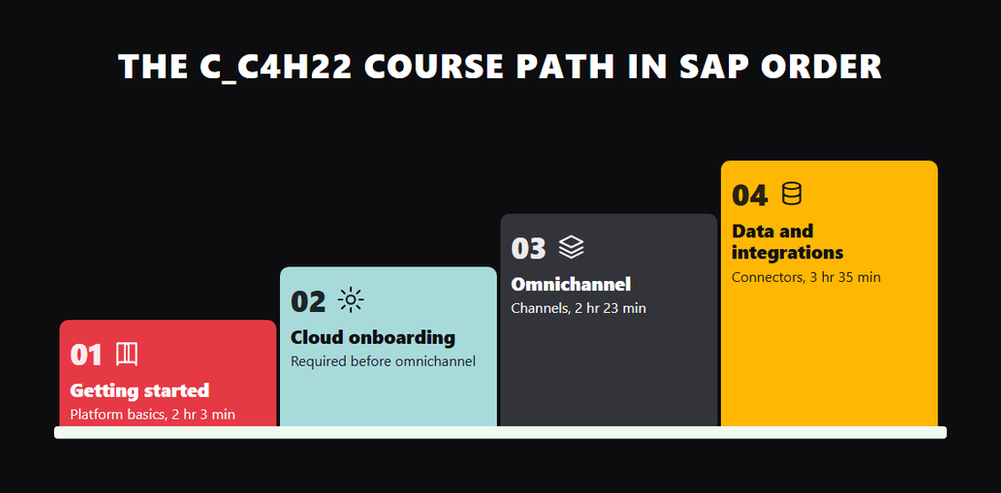
SAP sets the order through prerequisites. The getting started course has none. The omnichannel course requires it plus Cloud Onboarding for SAP Engagement Cloud. The integrations course requires all three before it, which tells you the consultant layer sits on top of everything else.
| Course | Length and level | What it covers |
|---|---|---|
| Getting started (C4H220) | 2 hr 3 min, beginner, 7 units | Key features, data and contacts, segmentation, personalized email, journey automation, optimization, Joule for consultants |
| Exploring omnichannel (C4H250) | 2 hr 23 min, beginner, 7 units | Loyalty and digital ads, web channel and web push, mobile first, mobile wallet, mobile campaigns, measuring impact |
| Data inputs and integrations (C4H251) | 3 hr 35 min, intermediate, 4 units | Implementation process, data management, additional data input, connecting systems and integrating data |
The biggest units are worth noting. Automating customer journeys is the longest unit of the first course at 38 minutes, and working with mobile campaigns is the longest of the second at 43 minutes. In the third course, data management alone runs 1 hour 10 minutes. The data inputs and integrations course is also offered in German, Spanish, French, Japanese, Korean, Portuguese and Chinese.
Where Do Candidates Usually Lose Marks?
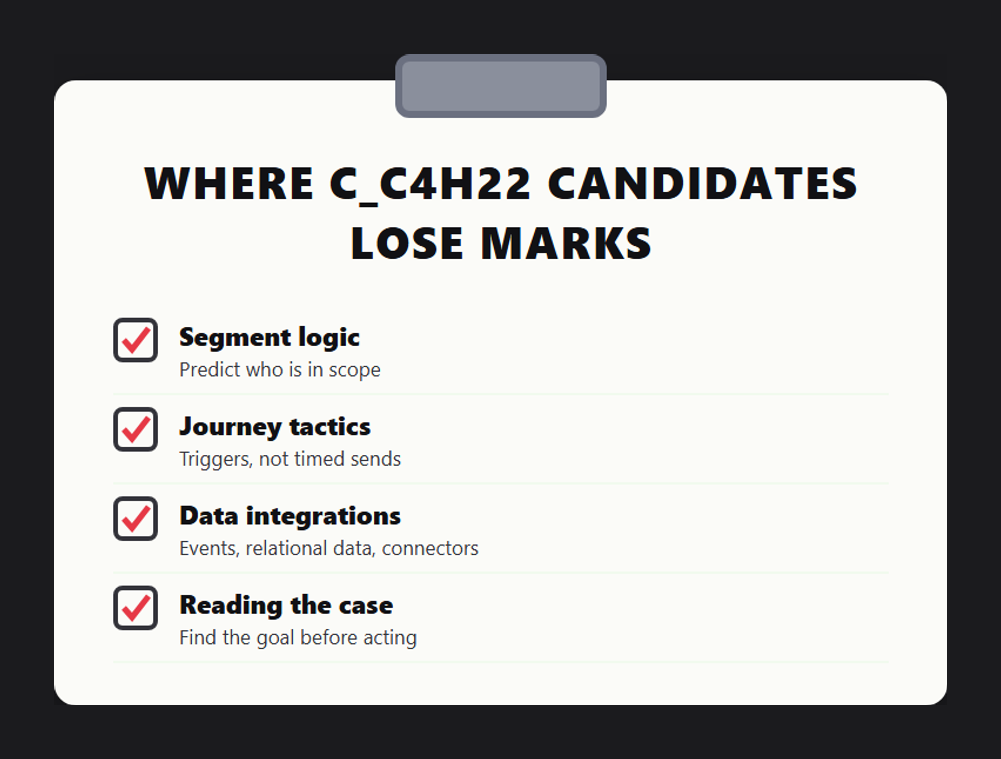
Candidates usually lose marks on C_C4H22 in three places: segmentation logic, journey automation with tactics, and the data-integration layer of external events, relational data and SAP CX connectors. ERPPrep’s exam FAQ names these as the hardest topics, because a setting in one place changes behaviour somewhere else in the scenario.
Segmentation logic
Combined segments are where reading a definition and predicting its result come apart. If you cannot say which contacts a definition captures, every later answer in the case rests on a guess.
Journeys and tactics
Automation is about triggers from behaviour and data, not a timed send. Marketing automation as a discipline is the background, but the exam asks for the Emarsys way of doing it: which tactic fits the stated goal and which audience it starts from.
The integration layer
External events, external content, relational data, plug-ins and CX connectors are the least familiar topics for marketers. They are also the longest course in the path, so give them their own study block rather than squeezing them in at the end.
A fourth, quieter cause is misreading the case. The right segment, channel or tactic changes with the situation described, so extract the goal before you act.
How Should You Prepare for One Marketing Scenario?
Prepare for C_C4H22 by following the three courses in SAP’s order, practising each platform task hands-on, and then rehearsing complete scenarios that run from data to measurement. Because the exam is one activity, steady reasoning across the whole chain matters more than deep strength in one channel.
- Work through the getting started course first and build a clean set of test contacts so later steps have real data to act on.
- Drill criteria-based and combined segments until you can predict which contacts each definition captures.
- Build personalized email campaigns with dynamic content, then connect them into automated journeys using tactics.
- Rehearse the omnichannel channels as one set and note how each reuses the same audience.
- Give the data inputs and integrations course its own study block, covering account and user administration, datasets, external events and CX connectors.
- Choose your response format early, roleplay or recorded video, because the available languages differ between them.
ERPPrep suggests roughly four to eight weeks alongside a job, with the official course time at around eight hours. That gap is the point: the courses explain the platform, and the extra weeks are for applying it. Full scenario simulations and focused skill drills on segments, tactics and integrations are a sensible way to spend them.
Who Should Take C_C4H22, and What Sits Next to It?
C_C4H22 suits CX and marketing implementation consultants, and business users or administrators moving into an Emarsys delivery role. SAP’s course pages list administrators, business users, consultants and developers among the audiences. It works as a first SAP CX credential because SAP does not require project experience to pass it.
If you already run campaigns, the exam mostly adds the consultant layer: account set-up, data strategy and integrations. If you come from another SAP area, expect the marketing vocabulary to be the new part. Our earlier Emarsys preparation guide covered the previous exam generation and is still useful for platform background.
Next to it sit other SAP customer experience credentials. ERPPrep lists C_C4H320, C_C4H510, C_C4H620 and C_C4H630 as related exams, and a solution architect path for SAP Customer Experience also draws on the getting started course.
A reasonable order for a consultant is C_C4H22 first for the engagement platform, then a second CX credential for the system you integrate with most often. Readers who sat the older code can compare notes with our C_C4H225_12 exam walkthrough, keeping in mind that the format has since moved to a single scenario.
Frequently Asked Questions
What is the C_C4H22 certification?
C_C4H22 is SAP Certified – Implementation Consultant – SAP Engagement Cloud – Emarsys Edition, an associate-level credential that confirms you can plan and implement SAP Engagement Cloud, Emarsys Edition in a mentored consultant role.
Is SAP Emarsys the same as SAP Engagement Cloud?
Yes. SAP renamed SAP Emarsys to SAP Engagement Cloud, and its product page labels it as formerly SAP Emarsys. The certification title uses SAP Engagement Cloud, Emarsys Edition.
How long is the C_C4H22 exam?
SAP’s certification page shows a duration of 2 hours for the single Scenario-Based Assessment activity.
What score do you need to pass C_C4H22?
The pass score is 60 percent, as shown on both SAP’s certification page and the ERPPrep study guide.
Does C_C4H22 have a bank of separate questions?
No. It is one Scenario-Based Assessment activity. You work through a realistic marketing case and make configuration and execution decisions, so memorizing items does not prepare you for it.
Do you need project experience to pass C_C4H22?
No. SAP states that previous project experience is not a prerequisite. Hands-on practice with the platform still makes a large difference.
In which languages can you take C_C4H22?
SAP lists English, Spanish, Italian, French, Japanese and 25 more languages for the roleplay with AI guidance route, and English only for the recorded video route.
Are the C_C4H22 blueprint areas weighted?
Neither SAP nor ERPPrep publishes weightings. There are six blueprint areas that follow one implementation from contact data to integrations, so cover all of them.
Which courses does SAP recommend for C_C4H22?
The Implementing SAP Engagement Cloud learning journey: Getting started with SAP Engagement Cloud, Emarsys Edition, then Exploring Omnichannel Marketing Capabilities, then Implementing Data Inputs and Integrations.
Conclusion
The SAP Emarsys certification tests whether you can set up the platform for a business need, not whether you know feature names. C_C4H22 gives you one marketing case, two hours and a 60 percent bar, and it follows a chain from contact data and segments through journeys and channels to analytics and integrations. Learn the rename so old and new resources line up, cover all six blueprint areas evenly, take the three courses in SAP’s order, and give the integration layer real time. Then rehearse complete scenarios until each upstream decision and its downstream effect feel obvious. That is the preparation the single activity rewards.


