
Until 2026, an SAP associate exam handed you a long list of recall items and a clock. C_BDCDA does not. The SAP Certified – Data Architect – SAP Business Data Cloud credential is delivered as a Scenario-Based Assessment made up of a single activity, and the pass mark is 60 percent. You read a realistic business situation and make the architecture decisions it calls for, in sequence, with each choice constraining the next. There is no partial credit for recognising a definition. This article works through the seven blueprint areas the assessment draws on, why two enterprise architecture frameworks that have nothing to do with SAP sit inside an SAP exam, which external data platforms the integration area actually names, and what preparing for a single connected scenario looks like in practice.
What Does the SAP Data Architect Certification Actually Certify?
C_BDCDA confirms that you hold the core knowledge of an SAP data architect and can apply it as a contributing member of a data project team. It is pitched at the Architect profile at a foundational, project-participation depth rather than at deep specialist mastery, and it is examined entirely against SAP Business Data Cloud rather than a generic warehouse. Before the architect scenario, many candidates take the C_BCBDC associate exam, which covers the platform itself at associate level.
That framing matters more than it looks. The credential is not asking whether you can administer a platform. It is asking whether you can turn a business requirement into a defensible data architecture, explain why it is the right one, and see how an early modelling decision constrains a governance or federation choice several steps later. Architects who also build the warehouse itself often pair this with the C_BW4H data engineer exam.
The scope spans architecture foundations and modelling, modern paradigms and integration patterns, governance, security and data strategy, communicating data value to stakeholders, and the advanced design work of unifying SAP and external data using data mesh and data fabric patterns. SAP’s official certification page is the place to confirm booking details before you register.
If you are still deciding whether the platform itself is worth building a credential around, our Business Data Cloud preparation guide covers the product side before the exam side.
Why Does C_BDCDA Run One Activity Instead of a Question Bank?
The Scenario-Based Assessment format is made up of one activity rather than a long list of isolated items. It measures applied judgment: you reason through a realistic situation and choose a sound approach, instead of recognising a correct-sounding statement. The published cut score is 60 percent, and SAP’s certification page gives the activity a duration of 2 hours. Languages depend on the format you choose: roleplay with AI guidance is offered in English, Spanish, Italian, French, Japanese and 25 more, while the recorded video option is English only.
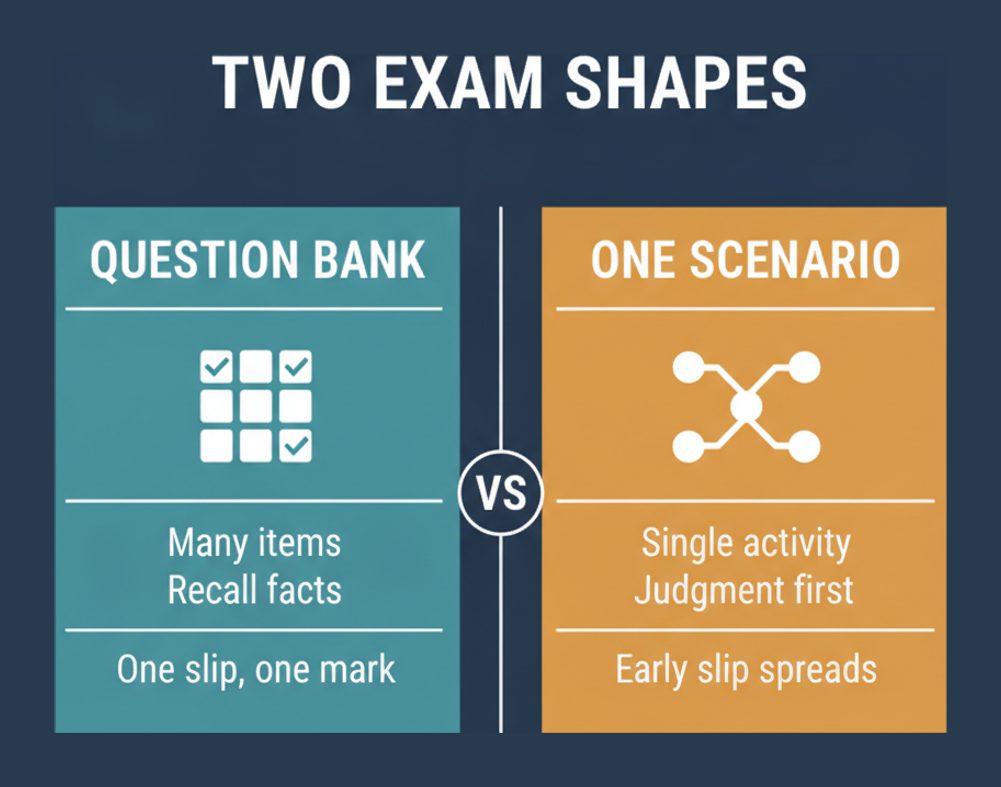
SAP completed its move to performance-based certification in early 2026, and it changes what preparation has to look like. A candidate who has memorised every definition in the learning journey can still fail, because the assessment never asks for a definition in isolation. It asks what you would do, given a business context, and then carries your answer forward. The same shift reaches the security track, and the C_SEC exam guide shows how that role is now assessed.
The practical consequence is that an early misreading is expensive. In a question bank a wrong answer costs one mark. In a single connected scenario, misreading the business requirement at the start can compromise every design decision that follows it. Time management therefore means understanding the scenario fully before committing, not answering quickly. The same holds at professional level, which the P_SAPEA certification guide sets out in detail.
Because the format is unfamiliar to most SAP candidates, rehearsing it matters more than reading about it. Working through full scenario simulations in the same shape as the real activity is the fastest way to find out whether your reasoning holds up under a connected chain of decisions.
| Field | Published value |
|---|---|
| Exam code | C_BDCDA |
| Full title | SAP Certified – Data Architect – SAP Business Data Cloud |
| Level | Associate |
| Format | Scenario-Based Assessment, one activity |
| Duration | 2 hours, as displayed on SAP’s certification page |
| Passing score | 60 percent |
| Languages | Vary by format: roleplay with AI guidance in English, Spanish, Italian, French, Japanese and 25 more; recorded video in English only |
| Product examined | SAP Business Data Cloud |
| Blueprint areas | Seven, published without percentage weightings |
Note what is absent from that table. SAP publishes no question count for this exam, because there is no question bank to count, and no percentage weighting per area. Treat every one of the seven areas as examinable rather than trying to rank them by likely marks.
What Are the Seven Areas C_BDCDA Examines?
The blueprint runs from architecture fundamentals through to advanced platform design across seven named areas. They are published as a list rather than a weighted breakdown, so no area can be safely deprioritised. Four of them are conceptual, one is about influence and communication, and two are specific to designing on SAP Business Data Cloud itself.
| Blueprint area | What it examines |
|---|---|
| Data Architecture Foundations and Data Modeling | Architecture principles and reference frameworks, turning business concepts into data models, and classifying metadata so governance and downstream consumption stay consistent |
| Modern Data Paradigms and Integration Patterns | Recognising contemporary patterns, choosing the paradigm that fits a need, comparing ETL, ELT and pipelines, and treating curated datasets as reusable data products |
| Data Governance, Security and Strategy Impact | Practical governance structures, the security controls that protect enterprise data, and connecting governance decisions to measurable business outcomes |
| Communicating Data Value and Architect Leadership | Conveying technical worth in language executives act on, framing information holdings as an enterprise asset, and leading change conversations |
| Data Strategy for the Agentic AI Era | Making an organisation AI ready, modernising the architecture behind advanced AI workloads, and measuring whether the strategy is succeeding |
| Enterprise Architecture Frameworks Integration | Blending TOGAF, DAMA-DMBOK and SAP’s enterprise architecture framework, then applying that combined lens to mesh, fabric and generative AI designs |
| SAP Business Data Cloud Integration and Advanced Data Design | Connecting the platform to external data services, tuning federation performance, and designing fabric, mesh, semantic model and knowledge graph solutions |
Read down that list and a pattern emerges. The first three areas build the vocabulary, the fourth tests whether you can sell a design, the fifth places it in the AI context SAP is positioning the platform for, and the last two are where the marks get hard. Candidates consistently report framework integration and advanced platform design as the most difficult material.
Why Do TOGAF and DAMA-DMBOK Appear in an SAP Exam?
Because SAP does not treat data architecture as a product-specific discipline. One of the seven areas asks you to blend TOGAF, DAMA-DMBOK and SAP’s own enterprise architecture framework into a single lens, then apply that lens to mesh, fabric and generative AI designs. They are examined together, as a combined view, not as three separate bodies of theory.
TOGAF, maintained by The Open Group, supplies the enterprise architecture method: how you move from a business requirement to a target state through defined phases. It is the structure a scenario expects you to work inside when the situation describes a transformation rather than a single system.
The data management side comes from the DAMA-DMBOK body of knowledge, which defines the knowledge areas a data function is expected to cover, from governance and metadata through to quality and integration. Where TOGAF tells you how to run the change, DMBOK tells you what a mature data capability has to contain.
For the exam, the useful skill is not reciting either framework. It is knowing which one answers the question in front of you, and being able to say why a design satisfies both the architecture method and the data management discipline at once. That synthesis is exactly what candidates find hardest, and it is why the area exists.
Which External Platforms Does the Integration Area Cover?
The advanced design area names four external platforms as its examples: Databricks, Snowflake, Microsoft Fabric and Google BigQuery. SAP describes these as existing partners in its open data ecosystem, so treat them as the ones to know rather than a closed list. Extending that ecosystem by connecting SAP Business Data Cloud to those services, and tuning federation performance across them, is examinable material rather than background context.
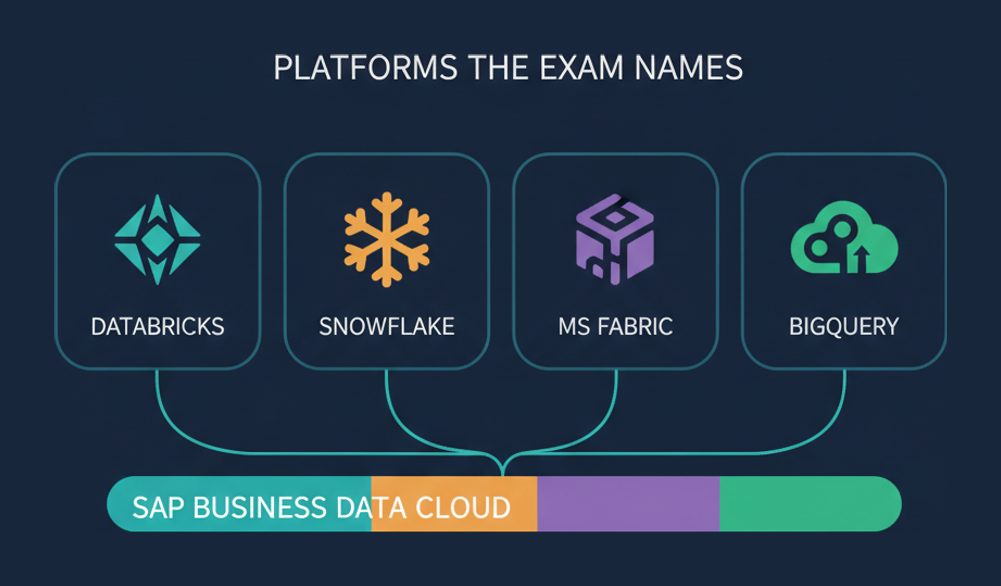
That list is the clearest signal of what this credential is really about. SAP Business Data Cloud is designed to unify SAP data and govern it while connecting outward to third party data, and the certification examines the architect who has to make those connections perform. Federation is not free, and the exam expects you to reason about where a query should run and what it costs to move data.
“SAP Business Data Cloud will help us unlock the value of our data and drive innovation across our business. Its semantically rich data products and deep Databricks integration will connect and enhance our existing data products, ensuring long-term adaptability.”
The phrase worth holding onto there is semantically rich data products. A curated dataset published as a reusable product, carrying its business meaning with it, is the unit the platform is built around, and it is the unit the exam expects you to design in. Integration questions are rarely about connectivity. They are about whether meaning survives the journey.
Data Fabric or Data Mesh: How Does the Exam Test the Choice?
It tests the choice through context rather than definition. The paradigms area asks you to recognise contemporary patterns and pick the one that fits a given need, and to compare movement approaches such as ETL, ELT and pipelines against that same need. There is no universally correct answer, which is precisely why a scenario format suits it.
A data fabric leans on a unified metadata and integration layer that lets data stay where it is while access is virtualised over it. A data mesh distributes ownership to domain teams who publish their own data products against shared standards. One is primarily a technical integration answer, the other primarily an organisational one, and a scenario that describes fragmented domain ownership is pointing at a different solution than one that describes latency and duplication.
“Compute can happen anywhere, data can stay at the source when needed, but business context is managed once, centrally, in SAP Business Data Cloud.”
That sentence describes the fabric side of the trade in one line, and it is a useful test to apply in the assessment. If the scenario’s real problem is that meaning is inconsistent across systems, centralising business context is the move. If the real problem is that a central team has become a bottleneck for every domain, distributing ownership is.
Movement style follows from the same reasoning. ETL suits a case where transformation must happen before data lands under governance, ELT suits a platform with the compute to transform in place, and federation suits a case where copying is the thing you are trying to avoid.
Why Is Communicating Data Value a Graded Area?
Because SAP has defined the architect role as one that includes influence, and it examines the role rather than the toolset. A whole blueprint area covers conveying the worth of technical work in language executives act on, framing an organisation’s information holdings as a lasting enterprise asset, and building the presence needed to lead change conversations.
Candidates from a hands-on engineering background tend to underestimate this area, and it is the one most often skipped in preparation. That is a mistake in a scenario format, because the assessment can put a stakeholder in front of you and score how you justify a decision rather than whether you can name the pattern.
The practical preparation is not soft-skills theory. It is rehearsing a specific translation: taking a design decision you already believe in and expressing it as a business outcome, a cost, and a risk avoided. If you cannot state why a federation choice matters to a finance director in one sentence, the area is not yet covered.
Who Should Take the SAP Data Architect Certification?
It is aimed at data architects and technically minded data professionals, including practitioners moving into an SAP data architect role, who want an associate credential proving they can design, communicate and deliver data architectures on SAP Business Data Cloud as a contributing member of a project team.
Background in data modelling, integration or governance helps most, because the exam expects reasoning rather than recall. Exposure to enterprise frameworks and to fabric and mesh thinking gives a genuine head start on the scenario. Candidates without SAP experience can pass, but should budget extra weeks and lean harder on applied practice than on reading.
It is worth being clear about what this credential is not. It sits at associate level and assumes a mentored, project-participation role, so it is not the professional-grade architecture credential. Anyone whose target is the broader enterprise architecture track should look at the SAP enterprise architect certification instead, and can treat C_BDCDA as a data-focused step on the way.
How Should You Prepare for a Scenario-Based Assessment?
Plan roughly one to two months alongside a job. The official learning journey is only two courses, which is deceptively small, because the scenario format needs far more time applying the concepts than absorbing them. The two courses are the core material and they are meant to be taken in order.
- Start with BDCDA1, Becoming an SAP Data Architect, which builds architecture principles, data modelling, metadata and governance, integration patterns and the value-communication skills the role rests on.
- Move to BDCDA2, Mastering SAP Data Architecture, which covers target-state design, data as a strategic asset for AI readiness, framework synthesis, and unifying SAP Business Data Cloud with external platforms.
- Learn the foundations as one connected chain, because principles, modelling and metadata classification feed the governance and consumption decisions that come later in every scenario.
- Practise the framework blend deliberately, applying TOGAF, DAMA-DMBOK and SAP’s framework as a single combined lens to mesh, fabric and generative AI designs rather than as isolated theory.
- Rehearse platform integration end to end, connecting external services such as Databricks and Snowflake and reasoning aloud about federation performance until the trade-offs are automatic.
- Finish by working complete scenarios under time, justifying every decision out loud, so the assessment is the second connected scenario you have reasoned through rather than the first.
Both courses sit inside SAP’s learning journey for this credential. Direct system access helps but matters less here than on a configuration exam, because you are being assessed on design judgment rather than on transactions.
Frequently Asked Questions
How many questions are on the C_BDCDA exam?
There is no question count. C_BDCDA is delivered as a Scenario-Based Assessment made up of one activity, so you work through a single realistic situation rather than a bank of separate items.
What is the passing score for C_BDCDA?
Sixty percent. Because the assessment is scenario based, that threshold reflects sound architecture decisions across a connected situation rather than isolated correct answers.
Are the seven blueprint areas weighted?
No percentage weightings are published for this exam. All seven areas should be treated as examinable, which removes the usual tactic of concentrating on the heaviest domain.
What level is the SAP data architect certification?
Associate. It targets the Architect profile at a foundational, project-participation depth rather than deep specialist mastery of a single tool.
Which language is the exam available in?
It depends on the format. SAP’s certification page lists roleplay with AI guidance in English, Spanish, Italian, French, Japanese and 25 more languages, and the recorded video option in English only. Comfort with terms such as data fabric, data mesh, governance and federation still speeds up scenario interpretation considerably.
How long does preparation usually take?
Around one to two months while working. The learning journey itself is two courses, BDCDA1 and BDCDA2, but the scenario format needs substantial extra time on applied practice.
Which topics do candidates find hardest?
Framework integration and advanced platform design. Synthesising TOGAF, DAMA-DMBOK and SAP’s framework, then applying it to mesh and fabric designs, is where early choices constrain later ones.
Do you need prior SAP experience?
No, though it takes longer without it. The credential assumes core knowledge rather than years of expertise, so newcomers should follow the journey in order and prioritise scenario practice over reading.
Which external platforms does the exam name?
Databricks, Snowflake, Microsoft Fabric and Google BigQuery, named as examples rather than a closed list. Connecting SAP Business Data Cloud to them and tuning federation performance is examinable material in the advanced design area.
Conclusion
C_BDCDA is a different kind of SAP exam. Removing the question bank removes the strategy most candidates rely on, and replacing it with one connected scenario means your first decision is graded twice: once on its own merits, and again through everything it constrains. Seven unweighted areas, a 60 percent bar, and no way to trade a weak domain against a strong one.
Prepare for it as an architect rather than as an exam candidate. Learn the foundations as a chain, treat TOGAF and DAMA-DMBOK as one combined lens, get fluent in what federation to Databricks or Snowflake actually costs, and rehearse saying why a design is right in language a business sponsor would accept. Work complete scenarios until the reasoning is habit, then book it.


