Read the full title of this exam and one word jumps out: legacy. Many candidates take it as a warning that the credential is on its way out. It is not. On SAP’s certification page the exam is open for booking, carries no retirement notice, and still runs as a current Scenario-Based Assessment. The label belongs to the product: SAP Concur now sells a new Concur Travel experience, and C_CT325 tests configuration of the classic Professional Edition, from company settings and user permissions to travel policy and agency booking.
The SAP Concur Travel certification, code C_CT325, is titled SAP Certified – Configuration Consultant – legacy Concur Travel Professional Edition. SAP runs it as one scenario activity of 2 hours with a 60 percent pass score. This article explains what the word legacy refers to, how the exam runs, its seven blueprint areas, how the two administration areas split the work, where travel policy and the Travel Configuration Page get tricky, and how to prepare.
What Does Legacy Mean in the C_CT325 Title?
In the C_CT325 title, legacy names the product edition, not the state of the certification. SAP Concur now offers a new Concur Travel experience beside the classic one, and this exam covers the classic Professional Edition, which SAP labels legacy. The SAP Concur Travel certification itself remains bookable, with no retirement date shown.
The Concur Travel product page describes Concur Travel as a corporate booking and management tool for flights, hotels, rental cars and rail, used by more than 20,000 organizations and supporting travel programs in more than 150 countries. The same page invites customers to experience the new Concur Travel, which is why SAP has to say which edition an exam is about.
For a consultant, the label is useful rather than worrying. A customer site built on the classic edition still needs someone who understands its company settings, its policy rules and its booking options, and that is exactly the person C_CT325 is written for.
What the exam is not
It is not a traveler exam and it is not a test of how to book a trip. Every blueprint area is about configuring and administering the tool so that travelers see the right options, follow the right policy and reach the right agency.
How Does SAP Run the C_CT325 Exam?
SAP runs C_CT325 as a single Scenario-Based Assessment activity with a duration of 2 hours and a pass score of 60 percent. There is no bank of separate items to work through: you read one customer situation and reason through the configuration it calls for; the task is to apply configuration knowledge to a stated need.
| Exam detail | C_CT325 |
|---|---|
| Full title | SAP Certified – Configuration Consultant – legacy Concur Travel Professional Edition |
| Level | Associate |
| Format | Scenario-Based Assessment, 1 activity |
| Duration | 2 hours |
| Pass score | 60% |
| Languages | Roleplay with AI guidance: English, Spanish, Italian, French, Japanese and 25 more; recorded video: English only |
| Roles named by SAP | Consultant, Support Consultant |
The figures above come from SAP’s C_CT325 certification page and the C_CT325 study guide, which agree on the format, the associate level and the 60 percent pass score. SAP’s page adds the duration and the language list, both of which depend on how you choose to take the scenario.
SAP does not show an exam fee or a question count on the certification page, and this article does not state either. Attempts come from a Learning Hub subscription that includes certification exam attempts, and you need an SAP Universal ID with a secondary email set up before exam day.
Which Seven Areas Does C_CT325 Cover?
C_CT325 covers seven blueprint areas that move from company and user setup, through travel administration and policy, to agency booking, the Travel Configuration Page and a full customer site with Joule. No weightings are published for the seven areas, so plan your study by how the settings depend on one another rather than by percentages.
| Blueprint area | What it includes |
|---|---|
| Company Administration Settings | Workflows, company structure, approval queues, locations, org units, custom user and trip fields, authentication and single sign-on, legal entities |
| User Administration & Permissions | Creating and deactivating user profiles, non-employee users, permissions, company groups |
| Travel Administration & Data Retention | Corporate and virtual ghost cards, travel reporting, card BIN restrictions, unused tickets, data retention |
| Travel Policy Configuration | Rule classes, approvers, rule conditions, LLF settings, the rule builder, violation reasons, vendor exclusions |
| Company Tree & Agency Booking Configuration | Company Tree, travel queues, trip cancel settings, virtual payment credentials, corporate discounts, non-GDS hotels |
| Travel Configuration Page Options | Air, hotel, car and rail options and connectors, sorting, agency and email options, form of payment, trip cloning |
| Customer Site Implementation & Joule | Customer requirements, key options, testing and validation, go-live readiness, an introduction to Joule |
Two areas hold most of the detail: Travel Policy Configuration and Travel Configuration Page Options. Both are covered in their own sections below, because a scenario that touches either one tends to touch several settings at once.
Company Administration or Travel Administration: Where Does Each Setting Live?
C_CT325 spans two administrative areas in legacy Concur Travel. Company Administration holds the structure of the organization: locations, org units, custom fields, authentication and legal entities. Travel System Administration holds what shapes booking: policy, ghost cards, the Company Tree, agency settings and the Travel Configuration Page. Knowing which area owns a setting is half of every scenario.
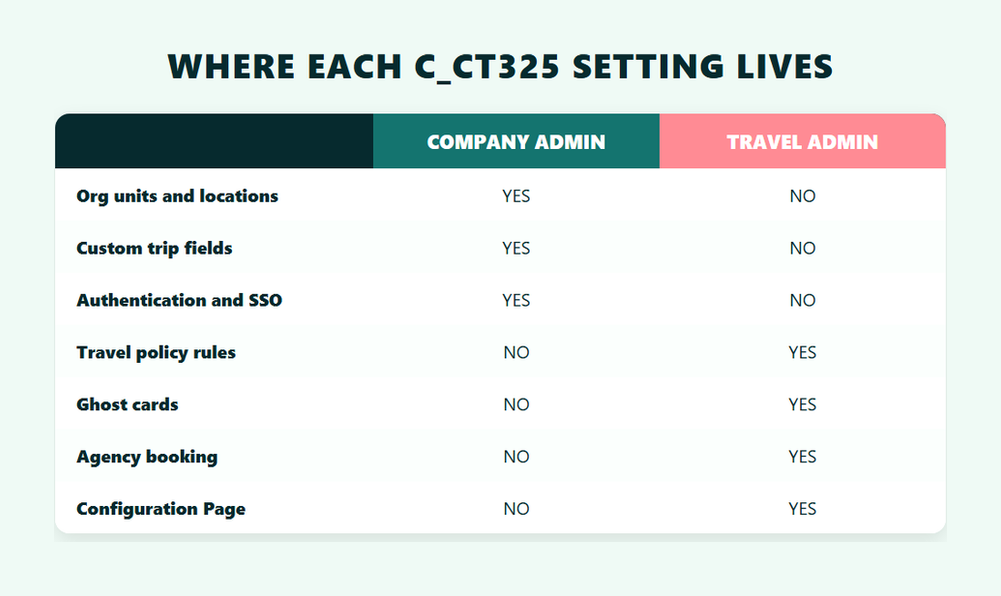
SAP’s learning journey describes the goal in the same terms: to manage the main features of both administrative areas, understand how complex they are and how they relate, and configure a Concur Travel site from the customer’s requirements. The relationship is the part that trips people up.
How an early setting shapes later booking
A custom trip field created in Company Administration, with an if/then condition, decides what a traveler is asked during booking. An org unit or a location decides which policy and which agency configuration apply later. When a scenario describes a booking that behaves wrongly, the cause is often a company-level setting that was made weeks before anyone opened the travel screens.
Users and permissions sit in between
User administration links the two worlds. Creating a profile, assigning a legal entity, handling a non-employee guest and granting permissions through company groups all decide who can book, who can arrange travel for others and who can change configuration.
Why Is Travel Policy the Densest Area to Configure?
Travel policy is the densest C_CT325 area because one policy is built from several linked pieces: rule classes, assigned approvers, rule conditions and LLF settings, all set through the rule builder and its templates. A change to one piece alters how the others behave, so a scenario rarely asks about one rule in isolation.
Policy also carries the visible parts of compliance. Violation reasons decide what a traveler must state when a choice falls outside policy, vendor exclusions decide which suppliers never appear, and custom text explains the rules at the moment of booking. Regional hotel rates and travel alternatives round out the area.
- Rule class: the container that groups travelers who share the same policy.
- Rule conditions: what happens when a fare or rate breaks a rule, from a warning to an approval.
- Approvers: who reviews an exception before the trip is ticketed.
- Violation reasons: the explanations a traveler picks when booking outside policy.
Travelfusion suppliers also appear here and again under company-specific configuration, where their credentials are set. Expect a scenario to connect the two.
What Changes When You Edit the Travel Configuration Page?
The Travel Configuration Page in legacy Concur Travel controls what travelers see and can do in the booking wizard: air, hotel, car and rail options and their connectors, result sorting, search options, agency handling of cancel, hold and change requests, split ticketing, email options, form of payment, policy options and trip cloning. C_CT325 treats it as its own blueprint area.
Small option differences change the wizard. Turning on a rail connector adds a mode of travel; a different sort order changes which hotel appears first; a form of payment setting decides whether a ghost card or a personal card is used. A scenario may describe the symptom a traveler sees and ask you to find the option behind it.
Connectors matter because Concur Travel sits inside a wider travel ecosystem. Its booking content arrives from airline and hotel sources, many through a global distribution system, which is why the blueprint separately names non-GDS hotels and Travelfusion suppliers.
How Does a Customer Site Come Together From Requirements to Go-Live?
The final C_CT325 area pulls every setting into one customer site. You learn the customer and their business requirements, configure the key travel options, test and validate the settings, and prepare the site for go-live. A scenario at this level rewards a complete, connected setup rather than correct answers about separate screens.
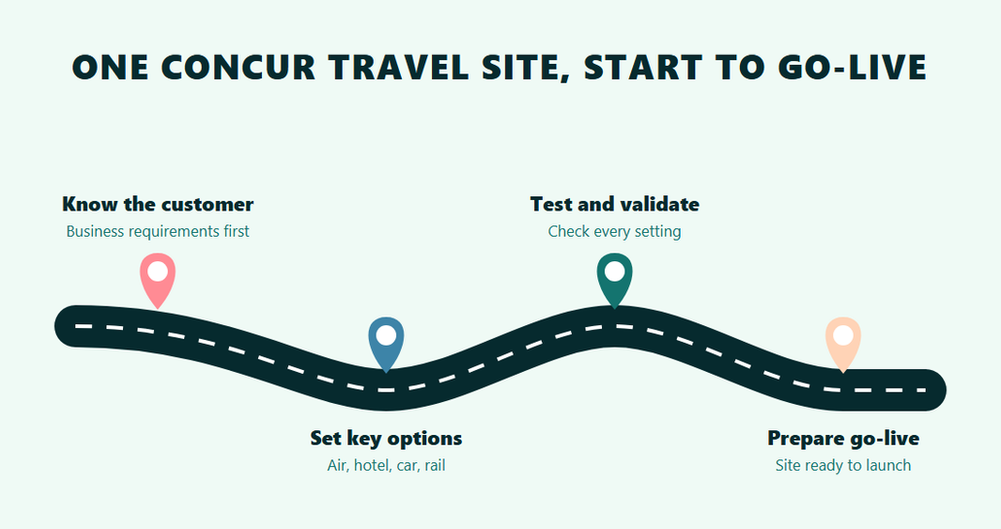
- Understand the customer and their requirements before you open a setting.
- Configure the main travel options the requirements call for.
- Test and validate every setting against those requirements.
- Prepare the site for go-live.
The same area introduces Joule, SAP’s AI assistant, through a beginner-level course on how it supports SAP Concur solutions. Treat it as context rather than configuration depth.
The habit this area builds is the same one the Concur Expense credential asks for, where configuration order matters just as much. Our C_CE325 Concur Expense guide walks through that side of the product.
How Should You Prepare for C_CT325?
Prepare for C_CT325 by following SAP’s learning journey, which links the exam to nine courses, then rehearsing a full customer site end to end. SAP lists two prerequisites for the journey: Getting Started with legacy Concur Travel for Business Users, and Getting Started with Support from SAP. Practise configuration hands-on wherever you have system access.
The SAP learning journey for C_CT325 groups the courses by area. They cover company administration, user administration, travel administration and data retention, travel policy, the Company Tree, company-specific configuration, the Travel Configuration Page, Joule with SAP Concur solutions, and configuring a customer site.
A study order that follows the dependencies
- Start with company and user administration, because every later setting depends on structure, fields and permissions.
- Move to travel administration and travel policy, building rule classes and conditions together.
- Study the Company Tree, agency booking and company-specific configuration as one block.
- Give the Travel Configuration Page its own block, option by option.
- Finish by configuring a complete customer site from requirements to go-live.
SAP also offers an introduction to scenario-based assessments and an AI-powered tool to try the format before the exam. Use it once you can explain why each setting exists, because the scenario rewards reasoning you can defend, not recall of screen names.
Who Is the SAP Concur Travel Certification For?
The SAP Concur Travel certification is for configuration consultants, support consultants and administrators who implement or maintain legacy Concur Travel. SAP names Consultant and Support Consultant as the roles, with skills in business process management, system administration, travel planning and system configuration. It suits people who need proof they can contribute to a Concur Travel project team.
Partners have one extra point to check. SAP’s certification page notes that the SAP Concur Service Partner Program is not yet part of SAP PartnerEdge. Partners may earn SAP Concur certifications, but to deliver projects a partner organization must be in the SAP Concur Service Partner Program, apply for approval and sign the master service partner agreement. Japan partners follow Japan-specific requirements.
Travel rarely runs alone in a Concur site. Requests for trip approval often come before booking, and our SAP Concur Request certification article covers C_CR125, the credential for that part of the process.
Frequently Asked Questions
Is the C_CT325 certification being retired because it says legacy?
No retirement is announced. Legacy names the classic edition of Concur Travel. SAP’s certification page shows the exam as bookable with no retirement notice.
How long is the C_CT325 exam?
SAP shows a duration of 2 hours for the single scenario activity.
What score do you need to pass C_CT325?
The pass score is 60 percent, as shown on SAP’s certification page and the ERPPrep study guide.
How many questions are on C_CT325?
SAP does not publish a question count. The exam is one Scenario-Based Assessment activity in which you reason through a customer situation.
In which languages can you take C_CT325?
It depends on the format. Roleplay with AI guidance is offered in English, Spanish, Italian, French, Japanese and 25 more languages. A recorded video is English only.
What are the prerequisites for the C_CT325 learning journey?
SAP lists Getting Started with legacy Concur Travel for Business Users and Getting Started with Support from SAP as prerequisites for the learning journey.
How many blueprint areas does C_CT325 have?
Seven, from Company Administration Settings to Customer Site Implementation and Joule. No weightings are published for them.
Can SAP partners deliver Concur Travel projects after passing?
Passing gives the credential. To deliver projects, the partner organization must also be in the SAP Concur Service Partner Program and have its application approved.
Does C_CT325 cover Joule?
Yes, at an introductory level. A beginner course on Joule with SAP Concur solutions is part of the learning path.
Conclusion
C_CT325 is a current SAP Concur Travel certification for the classic Professional Edition, and the word legacy in its title describes the product, not the credential. SAP runs it as one Scenario-Based Assessment activity of 2 hours with a 60 percent pass score, across seven blueprint areas and two administrative worlds that depend on each other.
Prepare in the order the settings depend on each other: company and users first, then policy, agency booking and the Travel Configuration Page, then a full customer site. Read SAP’s certification page for the current details, follow the learning journey, and practise until you can explain why every setting in a scenario sits where it does.


