
Passing C_CR125 does more than add a line to a CV. SAP’s certification page states that a successful candidate becomes eligible to request the unrestricted Request Configuration Administrator permission, the access that lets someone change how Concur Request behaves for a whole company. The exam exists to decide who should hold that permission.
That makes the SAP Concur Request certification an unusually practical credential. Its full title is SAP Certified – Configuration Administrator – Concur Request Professional Edition, and SAP runs it as one Scenario-Based Assessment activity with a 2 hour duration and a 60 percent pass score. This article explains how the exam runs, the seven blueprint areas ERPPrep maps out, how a request moves from creation to approval, the configuration chain that catches candidates out, where Concur Expense comes in, and how to prepare.
What Does Passing C_CR125 Actually Give You?
Passing C_CR125 makes you eligible to request the unrestricted Request Configuration Administrator permission in Concur Request, according to SAP’s certification page. Your organization must have Concur Request enabled to use it, and some further permissions may need additional certifications or can only be assigned by a role administrator or an authorized support contact.
That link between a credential and a system permission is what sets the SAP Concur family apart from many other SAP exams. A configuration administrator can reshape request forms, approval routing and policies for every traveller in the company, so the vendor wants evidence of skill before handing over that access. The exam is therefore less about knowing what Concur Request is and more about proving you can be trusted to change it.
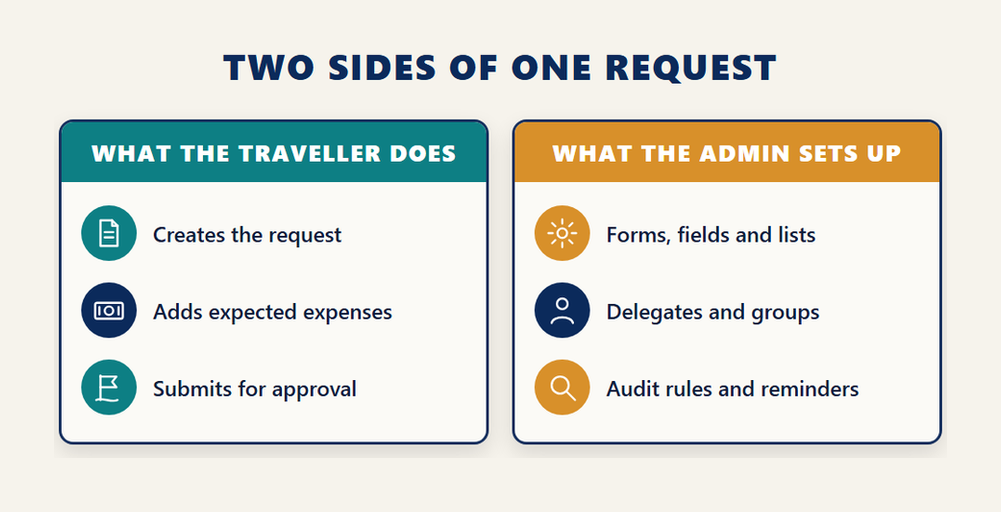
Concur Request is the pre-spend part of SAP Concur, the travel and expense software line that SAP acquired in 2014 and that the SAP Concur reference entry describes in more detail. A traveller uses it to ask for approval, with expected costs, before a trip or purchase happens. The configuration administrator decides what that request looks like and who must approve it.
What the permission does not cover
SAP is careful to say the certification makes you eligible to request the permission, not that it grants every access right automatically. Some additional permissions sit behind other certifications, and some can only be assigned by a role administrator or requested by an authorized support contact inside your organization. Plan for that conversation with your own Concur administrators before you assume the credential alone changes what you can do in the tenant.
A note for SAP partners
SAP’s page also notes that the SAP Concur Service Partner Program is not yet part of SAP PartnerEdge. Until that migration completes, partner consultants can earn SAP Concur certifications, but to deliver projects their organization must belong to the SAP Concur Service Partner Program, apply for approval and sign the program’s master service partner agreement. Japan partners follow Japan-specific program rules.
How Does the C_CR125 Exam Run?
C_CR125 runs as a single Scenario-Based Assessment activity. SAP’s certification page displays a 2 hour duration and a 60 percent pass score, and ERPPrep lists the level as Associate. You work through one realistic Concur Request situation and make the configuration and administration decisions a project team member would make, rather than answering a long series of isolated recall items.
A Scenario-Based Assessment is one of the two performance-based formats SAP now uses for certification. You are handed a business requirement, for example a company that wants requests over a certain amount routed to a finance approver instead of the line manager, and you reason through the correct setup and the order of the steps. Judgment is what gets scored.
| Field | ERPPrep study guide | SAP certification page |
|---|---|---|
| Exam code | C_CR125 | C_CR125 |
| Level | Associate | Not displayed |
| Format | Scenario-Based Assessment, 1 activity | 1 activity, Scenario Based Assessment |
| Pass score | 60% | 60% |
| Duration | Not published | 2 hours |
| Languages | Not published by SAP | Vary by format |
| Product | Concur Request, Concur Expense (professional edition) | Concur Request |
How languages work for this exam
The official C_CR125 certification page shows that available languages vary by format. The roleplay with AI guidance format is offered in English, Spanish, Italian, French, Japanese and further languages, while the record a video format is English only. Check the format you intend to use when you book, because the choice decides which languages are open to you.
What SAP asks you to check before exam day
SAP lists three preparation steps on the same page: run the Technical Readiness Checklist for hardware, software and connectivity, confirm you hold a Learning Hub subscription that includes certification attempts and a valid SAP Universal ID with a secondary email, and try the AI-powered scenario-based assessment tool SAP provides. Subscription attempts and exam attempts are shown separately on the exam page.
Which Seven Blueprint Areas Does C_CR125 Cover?
ERPPrep’s study guide organizes C_CR125 into seven blueprint areas, running from the business-user basics of Concur Request through the configuration framework to site settings, auditing and the Concur Expense integration. No area carries a published weighting, so the safe assumption is that the single scenario can draw on any of them, and usually on several at once.
The first three areas describe what a request is and how people use it. The last four describe the tools a configuration administrator uses to control that experience. ERPPrep’s C_CR125 scenario simulations follow the same split, which is a useful way to check that your preparation covers both halves.
| Blueprint area | What it covers |
|---|---|
| Concur Request Fundamentals and Business-User Processes | The purpose of Concur Request and how users create requests, including the request assistant, cash-advance requests and quick requests |
| Building and Submitting Requests | Adding travel segments, expected expenses and travel allowances, allocating across cost objects, and submitting into approval |
| Approval Review and Request Processor Tools | Reviewing pending requests and using processor tools such as ad hoc search, queries, group filtering, list settings and exports |
| Configuration and Administration Framework | The primary and secondary configuration tools, the administration tools and roles, and turning business requirements into a configuration approach |
| Lists, Forms, Fields and Feature Hierarchies | List management and connected lists, header, entry and allocation forms and fields, and feature hierarchies |
| Workflows, Policies, Groups and Delegates | Approval workflows, segment types, request policies, request groups and delegate configurations |
| Site Settings, Auditing and Concur Expense Integration | Site settings, attendees, locations, audit rules, travel agency offices, email reminders, printed reports, company administration, and the integration with Concur Expense |
How to read an unweighted blueprint
Without weightings, the temptation is to spread study time evenly. A better guide is how often an area feeds the others. Forms, lists and feature hierarchies shape what every workflow and policy can act on, so time spent there pays off across the whole scenario, while a narrow topic such as printed reports is worth knowing but rarely drives the outcome.
How Does a Request Move From Creation to Approval?
A Concur Request moves through a clear lifecycle: a user creates it, adds travel segments, expected expenses and any travel allowances, allocates the cost, and submits it. It then enters an approval workflow, where approvers review it and processors monitor it with search and query tools. C_CR125 expects you to understand this flow before you configure it.
SAP teaches this foundation in the CR0000 business-user course, a beginner course of about 3 hours across five units. It covers introducing Concur Request, creating a request, working with an existing request, reviewing a request as an approver, and the processor tools. Even experienced consultants benefit from it, because the scenario often describes a problem in business-user terms first.
The parts of a request candidates should know
- Request header: the top-level information, such as the purpose and dates, captured on the header form.
- Segments: the planned travel itself, such as an air, hotel or car segment, controlled by segment types.
- Expected expenses: the estimated costs the approver sees before money is spent.
- Allocations: how the cost is split across cost objects such as departments or projects.
- Cash advances: money requested ahead of the trip, with its own request type.
Why travel allowances matter
Travel allowances let a request carry a daily rate for meals or lodging rather than itemized estimates. Many organizations base those rates on published per diem tables, such as the US federal per diem rates, so a configuration administrator needs to understand how the allowance a traveller sees is produced and where it flows next.
Why Do Lists, Forms and Feature Hierarchies Trip Candidates Up?
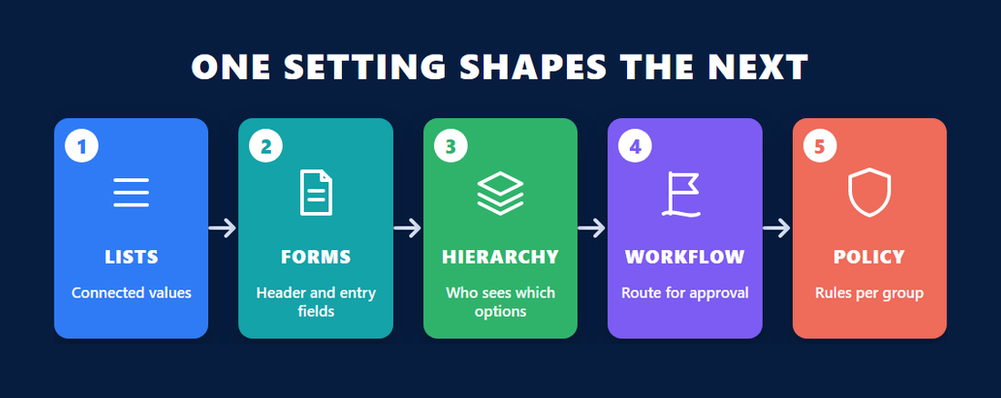
Lists, forms and feature hierarchies trip candidates up because a setting in one quietly changes what the next can do. ERPPrep’s FAQ names connected lists and forms, workflow and approval logic, and the Concur Expense touchpoints as the hardest areas. In C_CR125 you are scored on the outcome, so a missed downstream effect costs marks even when each screen looks right.
A connected list supplies the values a form field offers. The form decides which fields a user sees on the request header, entry or allocation. The feature hierarchy decides which group of users gets which configuration. Change any one of them and the workflow and policy that rely on that data can behave differently, even though nobody touched them directly.
SAP’s CX3503 configuration course works through this chain in order. It is an intermediate course of about 7 hours and 10 minutes across twenty units, starting with the configuration and administration tools and business requirements, then list management, forms and fields, feature hierarchies, workflows, segment types, request policies, request groups and delegates, and ending with site settings, audit rules, reminders, printed reports, company administration and the Concur Expense integration.
Primary and secondary configuration tools
The blueprint asks you to explain how the primary and secondary configuration tools relate. In practice this means knowing which change belongs where, and which change in one tool requires a matching change in another. A scenario that asks for a new mandatory field on the request header is rarely solved by the form alone, because the list behind the field and the users the field applies to also have to be right.
How Do Workflows, Policies, Groups and Delegates Fit Together?
Workflows, request policies, request groups and delegates decide who can act on a request and under which rules. A request group links users to a request policy, the policy sets the rules and the workflow attached to it, and delegates let one person prepare or approve on behalf of another. C_CR125 typically tests these as one connected task, not four separate settings.
The study guide’s own advice is to drill these four together, because approval routing depends on how they are combined. A scenario might describe a requirement such as international trips needing a second approval, a group of executives whose assistants submit requests for them, or a policy that should only apply to one division. Each one touches more than one of these tools.
Segment types
Segment types sit alongside workflows in the same blueprint area. They define the kinds of travel a request can contain and which fields each segment shows. A policy that should stop users from adding a car segment, or that needs a different set of details for rail travel, is solved here rather than in the workflow.
A simple way to rehearse routing
Write out one requirement in plain words, then list every tool you would touch to meet it and the order you would touch them in. If you cannot explain why each step comes where it does, that is the part of the configuration framework to revisit before the exam.
Where Does Concur Expense Come Into the Exam?
Concur Expense comes into C_CR125 through its final blueprint area and through the CX3503 course, which ends with a unit on integrating with Concur Expense. The exam expects you to configure Request and Expense as one joined-up solution, covering policies, site settings, forms and fields, audit rules and workflows, rather than treating Request as a standalone tool.
The link is practical. An approved request carries expected costs, and the expense report that follows needs to connect to it so the two can be compared. If the forms, policies or audit rules on the two sides do not agree, the integration breaks in ways a traveller notices straight away, which is exactly the kind of fault a scenario is built around.
SAP’s learning journey for C_CR125 lists the Concur Expense configuration consultant journey as a recommended prerequisite, so many candidates arrive with Expense experience already. If you are earning both, our article on the C_CE325 Expense exam covers the configuration side of Concur Expense and is a sensible companion read.
Site settings and auditing
The same blueprint area covers site settings, attendees, locations, audit rules, travel agency offices, email reminders, printed reports and company administration. Audit rules matter most for the integration, because they are where a company flags a request or expense that breaks policy, and the two products should flag the same things in the same way.
How Should You Prepare for C_CR125?
Prepare for C_CR125 by learning the request lifecycle as one flow, then studying the configuration tools as a connected system, then rehearsing full scenarios under time. ERPPrep’s FAQ suggests one to two months of study alongside a job, with SAP’s two learning journey courses together running a little over ten hours before hands-on practice is added.
The order below follows the study guide’s own preparation steps and the sequence of SAP’s two courses:
- Learn the request lifecycle as one connected flow, from creation, segments and expected expenses through allocation, submission and approval.
- Study the configuration tools as a system, so you know how a change to a connected list, form field or feature hierarchy affects the workflows and policies that depend on it.
- Drill workflows, request policies, request groups and delegate configurations together, because approval routing depends on how they combine.
- Practise the Concur Expense integration end to end, across policies, site settings, forms and fields, audit rules and workflows.
- Rehearse full configuration scenarios under a timer, checking each outcome against the stated requirement.
Why hands-on access matters
ERPPrep’s FAQ recommends hands-on system access, because only practice in a system shows how settings interact further down the chain. If direct access is limited, scenario practice that follows the same task sequence is the next best option. Reading alone tends to produce recognition of screen names without the ability to use them under time.
Practising against the clock
With 2 hours for one activity, pace matters less than accuracy, but a scenario still needs a plan. Read the requirement fully, list the tools it touches, and confirm each result before moving on. Candidates who change a setting, then discover a dependency later, lose time going back.
How Does C_CR125 Sit Among the Other SAP Concur Certifications?
C_CR125 is one of several SAP Concur configuration certifications, each tied to a product in the travel and expense line. It covers Concur Request, the pre-spend approval product. Concur Expense and Concur Invoice have their own credentials, and SAP recommends the Concur Expense configuration journey as preparation for this one, which tells you how closely the products are connected.
Each of these exams follows the same pattern of tying a credential to the ability to configure one product. That makes the family easy to plan as a sequence rather than a one-off: Expense first for many consultants, then Request to cover the approval before spend, and then Invoice if the role reaches supplier invoices.
If your role extends into supplier billing, our piece on the Concur Invoice credential explains C_CI325 and how it differs from the Request and Expense exams.
Who Is the Concur Request Certification For?
The SAP Concur Request certification is meant for administrators, consultants, support consultants and data analysts who configure and manage Concur Request, professional edition. SAP’s page lists those four roles and the skills of product support, product lifecycle management and system administration. It suits people moving from business-user familiarity into a configuration role on a project team.
SAP describes the credential as proof of a comprehensive understanding and deep technical skills to contribute to a project team. In practice it fits three groups: in-house Concur administrators who want the configuration permission, implementation consultants who deliver Concur projects, and support consultants who troubleshoot request setups for customers.
What it does not cover
C_CR125 does not test Concur Travel booking configuration or Concur Invoice, and it treats Concur Expense only where it meets Request. If your work is mostly expense report configuration, the Expense credential is the closer fit. Pick the exam that matches the product you will be trusted to change.
Frequently Asked Questions
What is the C_CR125 certification?
C_CR125 is SAP Certified – Configuration Administrator – Concur Request Professional Edition. It confirms that you can configure and manage Concur Request and contribute to a project team.
What permission does passing C_CR125 give?
SAP states that passing makes you eligible to request the unrestricted Request Configuration Administrator permission. Your organization must have Concur Request enabled, and some other permissions need further certifications or a role administrator.
How long is the C_CR125 exam?
SAP’s certification page displays a 2 hour duration for the single Scenario-Based Assessment activity.
What is the C_CR125 pass score?
The pass score is 60 percent, as shown on both SAP’s certification page and the ERPPrep study guide.
Is C_CR125 a scenario-based or system-based exam?
C_CR125 is a Scenario-Based Assessment with one activity. You reason through a realistic Concur Request situation and make the configuration decisions it requires.
Which languages is C_CR125 available in?
Languages vary by format. SAP lists English, Spanish, Italian, French, Japanese and further languages for the roleplay with AI guidance format, and English only for the record a video format.
Which SAP courses prepare you for C_CR125?
SAP’s learning journey uses two courses: CR0000, Getting Started with Concur Request for Business Users, Professional Edition, and CX3503, Integrating Concur Request with Concur Expense, professional edition.
Do I need Concur Expense knowledge for C_CR125?
Yes, to a degree. The final blueprint area covers integrating Concur Request with Concur Expense, and SAP recommends the Concur Expense configuration consultant journey as preparation.
How long should I prepare for C_CR125?
ERPPrep suggests roughly one to two months alongside a job. Candidates with Concur configuration experience can usually go faster, while newcomers should allow the longer end.
Conclusion
C_CR125 is a credential with a direct practical payoff: it makes you eligible to request the Request Configuration Administrator permission that controls how Concur Request works for a company. SAP tests that trust with one 2 hour scenario at a 60 percent pass score, drawing on seven blueprint areas that run from the request lifecycle to the Concur Expense integration. The hardest part is the chain of lists, forms, feature hierarchies, workflows and policies, where one setting shapes the next. Work through CR0000 and CX3503, rehearse full scenarios in a system, and treat Request and Expense as one solution. When you can explain every step a requirement needs and why it comes in that order, you are ready to book.


