Three years. That is the line SAP draws in front of P_C4H34, and it does not phrase it as advice. The certification page says three years of practical experience on SAP Commerce Cloud is required, which makes this one of the few SAP credentials that openly tells newcomers it was not written for them.
The SAP Commerce Cloud developer certification, officially SAP Certified – Developer – SAP Commerce Cloud, is a professional-level exam delivered as one System-Based Assessment activity. SAP displays a 3 hour duration and a 65 percent pass score. This article explains what that activity asks you to do, how SAP weights its six exam topics, the seven study areas ERPPrep maps out, how a single type definition travels through the platform, where the composable storefront fits, which backend processes catch people out, and how to prepare.
What Does the P_C4H34 Exam Ask a Developer to Do?
P_C4H34 asks you to carry out real development and configuration work inside a working SAP Commerce Cloud system. SAP delivers it as a single System-Based Assessment activity with a 3 hour duration and a 65 percent pass score. You are scored on whether the tasks are completed correctly, so knowing the platform by name is not enough to pass.
A System-Based Assessment is one of the two performance-based formats SAP now uses for certification. Instead of reading statements and judging them, you work in a live-style system: extend the data model, load data, query it, wire up services, and deploy. The exam is built around doing the job, which is why the experience requirement matters so much.
| Field | ERPPrep study guide | SAP certification page |
|---|---|---|
| Exam code | P_C4H34 | P_C4H34 |
| Level | Professional | Not displayed |
| Format | System-Based Assessment, 1 activity | 1 activity, System Based Assessment |
| Pass score | 65% | 65% |
| Duration | Not published | 3 hours |
| Languages | English | English |
| Experience | About three years recommended | Three years of practical experience required |
Two fields need a note. ERPPrep publishes no duration, while the official SAP certification page displays 3 hours, so plan around 3 hours. On experience, ERPPrep describes three years as a recommendation, but SAP’s own wording is that it is required, and SAP’s wording is the one to trust. Neither source publishes a fee or an item count, so none is given here.
ERPPrep builds its P_C4H34 scenario simulations around this format, with twelve full scenarios and 120 skill drills grouped into twenty skill domains. Those domains are a finer practice grouping of the same syllabus described below, not a separate one.
What SAP asks you to check before exam day
SAP lists three readiness steps on the certification page. Run the technical readiness checklist for hardware, software and connectivity. Confirm a Learning Hub subscription that includes certification exam attempts, plus an SAP Universal ID with a secondary email. Then watch SAP’s introduction to system-based assessments and use the practice system inside the learning journey, so the environment is familiar before an attempt counts.
Why Does SAP Require Three Years of Commerce Cloud Experience?
SAP requires three years of practical SAP Commerce Cloud experience for P_C4H34 because the exam is a professional credential that tests applied development, not recall. A single activity spans the type system, services, data loading, deployment and the storefront, and only repeated project work builds the speed to do all of that accurately inside 3 hours.
The requirement makes more sense once you look at what the platform is. SAP Commerce Cloud began life as Hybris, a Munich commerce software company that SAP acquired in 2013 for about 1.5 billion dollars and rebranded as SAP Commerce Cloud in 2018. It is a large Java platform with its own extension model, build framework and data layer, and much of its behaviour is set through configuration rather than visible code.
SAP’s learning journey states the technical baseline plainly: intermediate knowledge of Java, J2EE concepts and patterns, and the Spring Framework. Spring matters more than many candidates expect. The Spring Framework core supplies dependency injection, events and data binding, and Commerce Cloud uses it to wire services, facades and converters together. If bean definitions and their overrides feel unfamiliar, that is the first gap to close.
What the documentation access rule means
SAP also expects candidates to study the SAP Commerce Cloud suite documentation, and notes that it needs SAP customer or partner access. In practice this favours developers already working on a Commerce Cloud project, which is the same audience the experience requirement describes. If you cannot reach that documentation, arrange access through your employer or partner before you book.
How Does SAP Weight the Six P_C4H34 Exam Topics?
SAP lists six exam topics for P_C4H34 and shows each as a range rather than an exact share. Product Data Modeling, Services, Order Management, Commerce and Integration each sit at 11 to 20 percent, while Web Content Management carries up to 10 percent. No single topic dominates, so a weak area costs more here than on most SAP exams.
| SAP exam topic | Weighting shown by SAP | Where it lives in the platform |
|---|---|---|
| Product Data Modeling | 11-20% | Type system, product content and classification |
| Services | 11-20% | Service layer, facades and data conversion |
| Order Management | 11-20% | Order process, process engine and fulfilment flow |
| Commerce | 11-20% | Storefront, search, promotions and coupons |
| Web Content Management | Up to 10% | WCMS pages, components and content |
| Integration | 11-20% | ImpEx, web services and connected systems |
The right-hand column is a study map, not part of SAP’s list. SAP names the topics and their ranges; how each maps onto platform features is drawn from the ERPPrep study areas and the learning journey. SAP also tags the credential with the skills it expects: extension methods, the service layer, the object model, and software and application deployment.
Because five of the six topics share the same range, the practical rule is simple. Plan roughly equal time for each of the five, give Web Content Management a smaller block, and expect tasks that cross topic boundaries rather than staying neatly inside one.
Which Seven Study Areas Does ERPPrep Map Out?
ERPPrep’s P_C4H34 study guide breaks the syllabus into seven study areas: platform foundations and configuration; data and product modeling; the service layer and facades; ImpEx and Flexible Search; build, deployment and security; business processes and Backoffice; and the storefront, search and web services. They cover the same ground as SAP’s six topics, grouped by how a developer works.
| ERPPrep study area | What it asks of you | Main course |
|---|---|---|
| Platform Foundations, Architecture and Configuration | Build framework, extensions, properties, initialization and update, the administration console, and how Spring underpins the platform | C4H34B |
| Data Modeling and Product Modeling | Type system with collections, relations, deployment and localization; product content, classification and variants | C4H34B |
| Service Layer, Facades and Business Logic | Model objects and life cycles, transactional methods, service layer direct, DTOs and the conversion process | C4H34B |
| Data Handling: ImpEx and Flexible Search | ImpEx syntax and invocation, distributed ImpEx, basic and advanced Flexible Search and the query APIs | C4H34B |
| Build, Deployment and Security | Cloud Portal builds and deployments from a connected code repository; type-based access rights, search restrictions and Spring Security | C4H34I |
| Business Processes, Backoffice and Backend Modules | Backoffice framework, process engine, events, order management, cronjobs, workflows, validation and WCMS | C4H34I |
| Storefront, Personalization, Search and Web Services | Composable storefront, personalization, standard and adaptive search, promotions and coupons, and Omni Commerce Connect | C4H34A |
The three course codes come from SAP’s Implementing SAP Commerce Cloud learning journey. C4H34B explores the technical essentials, C4H34I expands on them with deployment and backend processes, and C4H34A completes the set with the storefront and web services. SAP notes that each sub-course includes hands-on practice in a dedicated system, and ERPPrep puts the whole journey at roughly 31 hours.
How the two lists line up
SAP’s Services topic matches ERPPrep’s service layer area, Product Data Modeling matches data and product modeling, and Commerce matches the storefront area. ERPPrep pulls platform foundations and deployment out as their own areas because they underpin everything else, even though SAP folds them into its topics. Study by ERPPrep’s seven areas and check your coverage against SAP’s six.
How Does One Type Definition Travel Through the Platform?
In SAP Commerce Cloud, a type defined in the type system shapes everything downstream: how ImpEx loads data into it, how Flexible Search reads it back, which model the service layer handles, and what the facade converts into a DTO for the storefront or the OCC web services. P_C4H34 tasks often follow that chain, so one early mistake spreads.
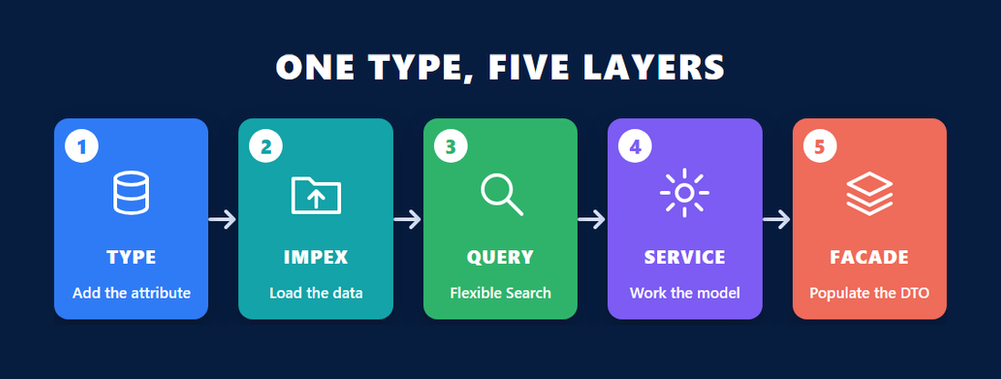
ERPPrep’s FAQ names this as the area candidates struggle with most: the service and facade layers, DTO handling, and the interaction between the type system, ImpEx and Flexible Search. A choice in one layer changes behaviour several steps later, so knowing each layer in isolation is not enough. You need to predict the downstream effect of an upstream change.
A worked path through the layers
- Type system: add an attribute or a relation to an item type, decide its deployment and localization, and run an update so the platform knows about it.
- ImpEx: write the header and value lines that load data into the new attribute, and check that the import actually ran.
- Flexible Search: query the type to confirm the data, and know when a restriction or a different access method is the better choice.
- Service layer: work with the generated model object inside a transaction, keeping its life cycle in mind.
- Facade and DTO: extend the converter and populator so the new value reaches the data object the storefront or OCC API exposes.
Practise this path until it is routine. It touches four of SAP’s six exam topics in one pass, which is exactly the kind of cross-topic task a single three hour activity rewards.
Where Do the Composable Storefront and OCC Web Services Fit?
The composable storefront and the Omni Commerce Connect web services form the top of the P_C4H34 stack. OCC exposes commerce data and actions as RESTful services, and the composable storefront, an Angular application, talks to SAP Commerce Cloud only through that REST API. ERPPrep places both in its final study area, alongside personalization, adaptive search, promotions and coupons.
The storefront has a public history worth knowing. SAP’s Spartacus repository on GitHub explains that from version 5.0, SAP Commerce Cloud, composable storefront is the name for the official release of the Spartacus libraries, that it is included in the Commerce Cloud license at no extra cost, and that from release 2211.19 its version numbers follow SAP Commerce Cloud’s own.
For the exam, the practical link is the facade layer. A custom DTO or a custom web service in OCC is only as good as the data the facade feeds it, so storefront tasks often fail because of a converter several layers below. Treat custom OCC DTOs and services as the last step of the platform path above, not as a separate subject.
“SAP Commerce Cloud provided us with the tools to create a portal that has exceeded our customers’ expectations again and again.”
Search, promotions and personalization
Standard and adaptive search, promotions and coupons, and personalization are all configuration-heavy. ERPPrep notes that adaptive search and the OCC web services trip people up, because the result a shopper sees depends on settings spread across several places. Practise changing one setting at a time and checking the storefront result, so you learn which setting controls which outcome.
Which Backend Processes Catch Candidates Out?
The backend modules that catch P_C4H34 candidates out are the ones that run without a user in front of them: the process engine and the order management process, the event system, cronjobs, collaboration workflows and the validation framework. Each triggers and chains differently, and a scenario that spans several of them punishes anyone who only knows them individually.
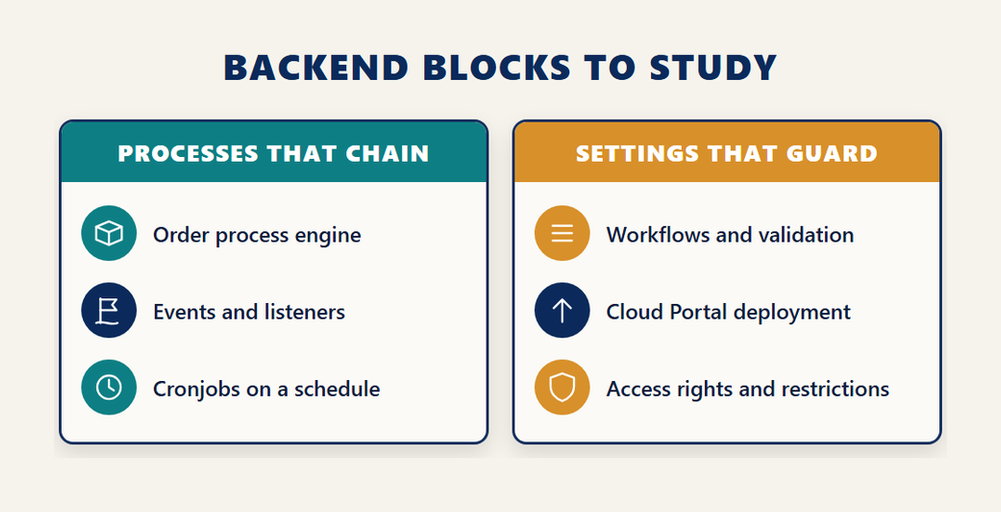
ERPPrep’s advice is to study them as one block of their own rather than scattering them through other topics. Learn what starts each one, what it changes, and what it hands on to the next step. A cronjob that runs a job on a schedule, an event that a listener reacts to, and a business process that moves an order through its actions all look similar from a distance, but they fail in different ways.
Deployment is a skill, not a step
Building and deploying through the SAP Commerce Cloud Portal is easy to underrate. You connect the code repository, run the build and manage the deployment, and a mistake there can block everything else in a single activity that depends on a working system. Security belongs in the same block: type-based access rights, search restrictions and Spring Security decide what a user can see and change, and they are easy to misconfigure under time pressure.
How Should You Prepare for a Three Hour System-Based Assessment?
Prepare for P_C4H34 by doing the work, not reading about it. Follow the three learning journey courses in order, practise every task in a system, and rehearse full multi-step scenarios under a timer. ERPPrep suggests two to three months for most people studying alongside a job, with less for developers already deep in Commerce Cloud projects.
- Treat the platform layers as one connected stack, so you can predict how a type definition flows through ImpEx, Flexible Search, services and facades.
- Drill the service and facade layers together, because model objects, transactions and the DTO conversion logic are often examined as one implementation task.
- Practise Cloud Portal build and deployment hands-on, from connecting the code repository to managing the deployment.
- Rehearse the storefront and web services layer end to end, including the composable storefront, adaptive search, promotions and custom OCC DTOs.
- Work the backend business processes as their own study block, learning how the process engine, events, cronjobs, workflows and validation trigger and chain.
Start with C4H34B for the technical foundation, then C4H34I for deployment, security and backend processes, and finish with C4H34A for the storefront and web services. That order mirrors how the platform layers build on each other, so each course reinforces the one before.
Using older ERPQnA material
ERPQnA has covered this credential under an earlier release code. The P_C4H34_2411 study materials page is useful background on the platform modules, but rely on SAP’s current certification page for the format, the duration and the pass score, since the exam has since moved to the System-Based Assessment.
Developer or Business User: Which SAP Commerce Cloud Certification Fits?
SAP offers two SAP Commerce Cloud credentials at different levels. P_C4H34 is the professional developer exam for people who build, extend and deploy the platform. C_C4H32, SAP Certified – Business User – SAP Commerce Cloud, is aimed at people who run the commerce site day to day through the business tools. Choose by the work you actually do.
| Question | P_C4H34 Developer | C_C4H32 Business User |
|---|---|---|
| Level | Professional | Associate |
| Who it suits | Developers who write and deploy Commerce Cloud code | Business users who manage the commerce site |
| Format | System-Based Assessment | System-Based Assessment |
| Core skills | Type system, services, ImpEx, deployment, OCC | Business-side configuration and content |
If you write Java against the platform, P_C4H34 is the one that reflects your job. If your days are spent in the business tools managing products, content and promotions, the business user credential fits better. Check its own SAP certification page for its format and pass score before you book. ERPQnA’s earlier business user study materials describe that exam’s modules in more detail.
Frequently Asked Questions
What is P_C4H34?
P_C4H34 is the exam code for SAP Certified – Developer – SAP Commerce Cloud, a professional-level credential that confirms you can configure, customize, extend and deploy SAP Commerce Cloud as a developer.
How is the P_C4H34 exam delivered?
As one System-Based Assessment activity. You carry out development and configuration tasks inside a working SAP Commerce Cloud system, and SAP’s certification page displays a 3 hour duration.
What is the pass score for P_C4H34?
The pass score is 65 percent. SAP’s certification page and ERPPrep’s study guide show the same figure.
Do I need experience before taking P_C4H34?
Yes. SAP’s certification page states that three years of practical experience on SAP Commerce Cloud is required, and the learning journey expects intermediate knowledge of Java, J2EE patterns and the Spring Framework.
How are the P_C4H34 exam topics weighted?
SAP shows Product Data Modeling, Services, Order Management, Commerce and Integration at 11 to 20 percent each, and Web Content Management at up to 10 percent.
Which languages is P_C4H34 available in?
English. SAP’s certification page lists it as available in English, and ERPPrep’s study guide shows the same.
Which courses prepare you for P_C4H34?
The three sub-courses of SAP’s Implementing SAP Commerce Cloud learning journey: C4H34B on the technical essentials, C4H34I on deployment and backend processes, and C4H34A on the storefront and web services.
Is P_C4H34 the same exam as P_C4H34_2411?
It is the same credential. Older releases carried a suffix such as _2411, while SAP’s current certification page lists the code as P_C4H34 and delivers it as a System-Based Assessment.
Was SAP Commerce Cloud formerly called Hybris?
Yes. SAP acquired Hybris in 2013 and rebranded the platform as SAP Commerce Cloud in 2018, so older material and job adverts often still use the Hybris name.
Conclusion
The SAP Commerce Cloud developer certification is built for people who already do the job. P_C4H34 runs as one System-Based Assessment activity over 3 hours with a 65 percent pass score, and SAP requires three years of practical Commerce Cloud experience before you sit it. Its six exam topics are weighted almost evenly, so prepare across all of them, with extra time on the chain from the type system through ImpEx, Flexible Search, services and facades. Follow the C4H34B, C4H34I and C4H34A courses in order, practise every task in a system, and rehearse full scenarios under a timer. When you are ready, book the exam through SAP’s certification page.


