On 31 December 2027, mainstream maintenance for SAP Solution Manager ends, and SAP recommends that customers finish moving to SAP Cloud ALM before that date. That deadline is the reason the SAP Cloud ALM certification matters more now than it did two years ago. The exam behind it is C_STC, SAP Certified – Solution Transformation Consultant with SAP Cloud ALM, and SAP’s certification card displays a 60 percent pass score, one Scenario-Based Assessment activity and a 2 hour duration. You are not walked through the product screen by screen. You are handed a transformation in progress and asked what the consultant should do next.
This article explains what C_STC covers and how it is scored, the six blueprint areas on the money-site study guide, why the hand-off from implementation to operations sits at the centre of the scenario, what has to be set up before a tenant shows any data, how RISE with SAP and Clean Core are examined, what the exam expects on the move away from Solution Manager, and a preparation order that follows the way a real project runs.
Table of Contents
- What is the SAP Cloud ALM certification?
- How is C_STC delivered and scored?
- Which six blueprint areas does C_STC cover?
- Why does C_STC treat implementation and operations as one journey?
- What has to be set up before a tenant shows anything?
- How do RISE with SAP, Clean Core and the toolchain fit in?
- Solution Manager to SAP Cloud ALM: what does the exam expect?
- How should you prepare for the C_STC scenario?
- Who should take C_STC, and when does another exam fit better?
- Frequently Asked Questions
- Conclusion
What is the SAP Cloud ALM certification?
The SAP Cloud ALM certification is C_STC, SAP Certified – Solution Transformation Consultant with SAP Cloud ALM. It is an Associate level credential that validates application lifecycle management skills and core SAP Cloud ALM knowledge for the Solution Transformation Consultant profile: someone who leads a project team through a transformation using SAP Cloud ALM as the working backbone.
SAP’s own description is specific about the role. The certification shows the skills needed to lead a project team as a solution transformation consultant and to guide that team through the transformation journey with SAP Cloud ALM. SAP tags the credential with the Consultant role and six skills: Solution Architecture, Software Testing Life Cycle, Product Lifecycle Management, Software Testing Methodologies, Software Development Methodologies and Software Deployment. Two of the six are about testing, which tells you where a good share of the scenario’s judgement lies.
Who the credential is aimed at
The money-site study guide describes the audience as application lifecycle management and transformation consultants, and project leads moving into a Solution Transformation Consultant role, who want proof that they can guide an implementation team through an S/4HANA transformation with SAP Cloud ALM alongside SAP LeanIX and SAP Signavio. This is a lead-the-team credential. It does not test a functional module, and it does not ask you to configure finance or logistics.
One code, no release suffix
Earlier releases of this exam carried suffixed codes such as C_STC_2405, and many older descriptions on the web still describe that version with a fixed number of items and a different cut score. SAP’s certification card now shows the plain code C_STC with a single scenario activity. If a page describes a count of items for this exam, it is describing the format SAP has moved away from, and the figures on it should not be used for planning.
How is C_STC delivered and scored?
C_STC is delivered as one Scenario-Based Assessment activity and passed at 60 percent, a figure published by both the money-site study guide and SAP’s certification card. SAP’s card also displays a duration of 2 hours. There is no list of separate items: you work through one connected transformation situation and apply SAP Cloud ALM and methodology judgement to it.
| Field | Value |
|---|---|
| Exam code | C_STC |
| Credential | SAP Certified – Solution Transformation Consultant with SAP Cloud ALM |
| Level | Associate |
| Format | Scenario-Based Assessment (SBA), 1 activity |
| Duration | 2 hours, as displayed by SAP; the money-site pages publish no duration |
| Passing score | 60 percent |
| Languages | Vary by format, as SAP displays them: Roleplay with AI guidance in English, Spanish, Italian, French, Japanese and 25 more; Record a video in English only |
| Product | SAP Cloud ALM |
| Role | Consultant |
| Blueprint areas | 6, with no published weightings |
What a Scenario-Based Assessment asks of you
SAP’s 2026 certification formats come in two families. A System-Based Assessment, or SyBA, places you in a working system and scores whether tasks were completed. A Scenario-Based Assessment, or SBA, gives you a business situation and scores how you reason through it. C_STC is the second kind. The money-site FAQ describes it as a single guided scenario activity that asks you to apply transformation and Cloud ALM judgement, and it warns that partial understanding of a topic rarely earns easy partial credit, because the decisions are connected.
The free worked transformation scenarios on the money site show the kind of reasoning involved. In one, a pharmaceutical manufacturer records test results in spreadsheets and moves changes between systems by hand, and an auditor cannot reconstruct which tests ran for which change. The answer that holds up uses test management to plan and execute the tests and deployment management to govern how the changes move, so one platform produces the evidence. The weaker answers each sound reasonable alone: add a sign-off email, manage only the requirements, test in production. The scenario rewards the candidate who sees that testing and deployment have to be traceable together.
Languages and the two ways to take it
The language field is where the two sources differ. The money-site study guide says a language is not published by SAP. SAP’s certification card does display language information, as a format-dependent list: the Roleplay with AI guidance option is offered in English, Spanish, Italian, French, Japanese and 25 more languages, and the Record a video option in English only. The SAP C_STC certification page is the place to confirm this before you book, since SAP can change it between releases.
SAP also lists what you need before exam day: a Learning Hub subscription that includes certification exam attempts, and a valid SAP Universal ID with a secondary email. The card points candidates to an introduction to scenario-based assessments and an AI-powered tool for trying the format first, which is worth an hour of anyone’s time if the format is new to them.
Which six blueprint areas does C_STC cover?
C_STC covers six blueprint areas on the money-site study guide: SAP Cloud ALM Fundamentals and Value; Implementation with SAP Cloud ALM; Operations and Monitoring with SAP Cloud ALM; Onboarding, Setup and Administration; RISE, Clean Core and the Integrated Toolchain; and Transition from SAP Solution Manager. No weightings are published, so plan by theme, not by percentage.
| Blueprint area | What it asks you to do |
|---|---|
| SAP Cloud ALM Fundamentals & Value | Explain what SAP Cloud ALM is, who it serves, and how to judge its value for implementing and for operating cloud and hybrid SAP landscapes |
| Implementation with SAP Cloud ALM | Design the to-be solution, set up projects and distributed teams, maintain process hierarchies and documents, and manage requirements, deployment, development and configuration, testing and analytics |
| Operations & Monitoring with SAP Cloud ALM | Use business process, integration and exception, real user, job and automation, and health monitoring after go-live, and explain the value for service delivery |
| Onboarding, Setup & Administration | Request and onboard a tenant, provision users, assign roles, set up landscape management and work through the configuration options |
| RISE, Clean Core & the Integrated Toolchain | Align Cloud ALM with the RISE with SAP methodology and the LeanIX, Signavio and Cloud ALM toolchain, support Clean Core, and measure adherence through the methodology dashboard |
| Transition from SAP Solution Manager | Plan the move to Cloud ALM, compare the two tools’ functionality and apply the recommended transition approach for RISE and hybrid landscapes |
Reading the six areas as a sequence
The areas are easier to hold as a timeline than as a list. Fundamentals is the conversation before a project starts. Onboarding and setup is day one of the tenant. Implementation is the build. Operations is life after go-live. RISE and Clean Core is the standard the build is held to, and the Solution Manager transition is where many customers are starting from. The money-site FAQ names the hand-off from implementation to operations, the onboarding and configuration setup, and the alignment with RISE and Clean Core as the parts candidates find hardest, and all three are joints between areas, not areas themselves.
Why does C_STC treat implementation and operations as one journey?
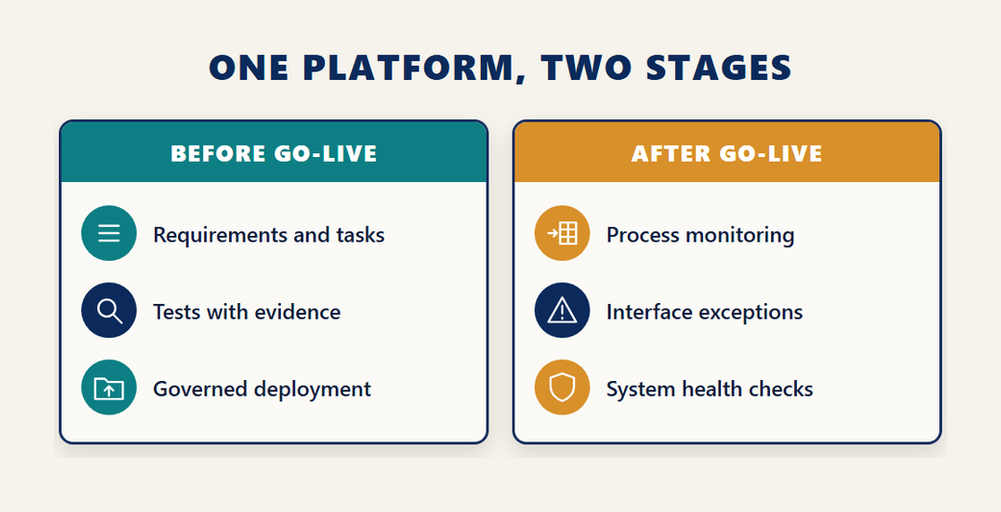
C_STC treats implementation and operations as one journey because SAP Cloud ALM is one platform with a capability for each stage, and a decision made during the build decides what can be monitored after go-live. The money-site study guide tells candidates to learn the two together, since the scenario often bridges them, and the worked examples repeatedly test whether you pick the capability that fits the stage.
The build side: requirements through testing
SAP Cloud ALM for Implementation gives a project one place for its process scope, requirements, tasks, documents, deployment and tests. The first worked example on the money site is a dairy co-operative that keeps requirements in one spreadsheet, tasks in another and design decisions in a shared document, with information lost between them. Its sponsor also wants to watch the core processes run after go-live without buying a second toolset. The answer that fits is to use the implementation capability for the build and the operations capability afterwards. The tempting wrong answer runs the build inside the operations apps, on the theory that monitoring screens can double as a task tracker. They cannot, and knowing why is the point of the example.
Testing deserves separate attention, because two of SAP’s six skill tags name it. A consultant is expected to plan test cases against requirements, execute them with evidence, and tie the result to the deployment of the change. The vocabulary is not SAP’s alone. ISO/IEC/IEEE 29119-2, the international standard for software test processes, describes generic processes for governing, managing and implementing testing in any organisation or project, and its split between managing tests and executing them maps closely onto how Cloud ALM separates test preparation from test execution.
The run side: five kinds of monitoring
After go-live, the blueprint names five monitoring capabilities, and a scenario will usually describe a symptom and ask which one applies. The second worked example is a rail operator whose interface to a logistics application drops some messages while batch jobs finish on time and resource usage looks normal. That description rules out three capabilities in turn and leaves Integration and Exception Monitoring.
| Capability | What it watches | A symptom that points to it |
|---|---|---|
| Business Process Monitoring | How end-to-end business processes are actually running | Orders stuck at one step, backlogs building in a process |
| Integration and Exception Monitoring | Messages and exceptions between connected systems | Interface messages that never arrive at the receiving system |
| Real User Monitoring | How users experience the applications they work in | Users reporting slow or failing screens |
| Job and Automation Monitoring | Background jobs and automated runs | A scheduled run that fails, is late or never starts |
| Health Monitoring | The technical health of systems and services | Resource shortages and unavailable services |
Where the hand-off goes wrong
The hand-off fails when the project treats go-live as the end of Cloud ALM’s job. If the process hierarchy maintained during the build is not the one operations will monitor, the monitoring starts from a blank page. If systems were never registered properly, there is nothing for the operations apps to read. In a scenario, look for the early decision that caused the late problem. The money-site FAQ puts it plainly: a decision about implementation setup or landscape configuration shapes what happens later in operations, and the activity rewards candidates who see that chain.
What has to be set up before a tenant shows anything?
A new SAP Cloud ALM tenant shows no systems and no monitoring data until landscape management is set up and users hold the right roles. C_STC’s onboarding area covers requesting the tenant, provisioning users, assigning roles, setting up landscape management and working through the configuration options for service, operations and implementation, and it is a frequent source of scenario decisions.
The money-site worked example is a mining group whose analysts open a freshly provisioned tenant, find every dashboard empty and suspect a faulty delivery. Three of the four responses are plausible to someone who has never set one up: ask SAP for a replacement tenant, give everyone administrator rights, or wait for the data to appear. None works. The tenant is fine. It is empty because the setup prerequisites have not been completed, and the right advice is to finish landscape management and assign the appropriate roles. The blanket administrator option is worth noticing, because it shows up in different clothes across many SAP exams and is almost never the answer.
Who is entitled to a tenant
Fundamentals and value questions often turn on cost, and here SAP’s position is explicit. SAP states that there is no licence for SAP Cloud ALM: usage rights are included in SAP cloud service subscriptions containing Enterprise Support, cloud editions, and in SAP Enterprise Support, and entitled customers may use one tenant per customer number free of charge. SAP’s SAP Cloud ALM support page sets out the usage rights. In a scenario where a sponsor objects to buying another tool, that fact changes the conversation.
How do RISE with SAP, Clean Core and the toolchain fit in?
C_STC expects you to align SAP Cloud ALM with the RISE with SAP methodology, to support Clean Core across processes, extensibility, data, integration and operations, and to measure adherence through the RISE with SAP methodology dashboard. It also expects you to explain how SAP LeanIX, SAP Signavio and SAP Cloud ALM work as one integrated toolchain instead of three separate products.
Clean Core as something you measure
The study guide lists five Clean Core dimensions: processes, extensibility, data, integration and operations. The exam’s interest is less in the definition than in what a consultant does when the principle is under pressure. In the money-site example, a telecom operator’s technical lead wants to modify the standard core to hit a date, while the sponsor wants evidence that Clean Core is being followed. The answer that holds up favours approved extensibility over core modification and uses Cloud ALM to track and measure adoption, for instance through the methodology dashboard. Recording the modification in Cloud ALM for reference later is the trap: it documents the breach without preventing it.
If the methodology side is where you feel least sure, the companion article on the RISE with SAP methodology exam covers that ground in more depth than C_STC needs, and is a useful second read.
Three tools, one flow
The toolchain is examined as a flow. Broadly, SAP LeanIX describes the application landscape and where it is heading, SAP Signavio describes and analyses the business processes, and SAP Cloud ALM turns the resulting scope into requirements, tasks, tests and deployments, then monitors the result. The money-site FAQ also names WalkMe in the wider toolchain context. It lists studying the toolchain products in isolation among the most common mistakes on this exam, so practise explaining what passes from one tool to the next, not what each tool does alone.
Solution Manager to SAP Cloud ALM: what does the exam expect?
The exam expects you to plan the move from SAP Solution Manager to SAP Cloud ALM deliberately: understand SAP’s application lifecycle management strategy, compare what the two tools do, and apply the recommended transition approach for RISE and hybrid landscapes. It does not expect a copy of the old setup, because SAP Cloud ALM is a different, cloud-native tool and not a newer version of Solution Manager.
The money-site example makes the wrong instinct concrete. A drinks manufacturer under time pressure proposes exporting its Solution Manager configuration and importing it unchanged. Other tempting options are to run both tools indefinitely or to rebuild every process on one cutover date. The sound recommendation is to compare functionality, follow the transition recommendations and adopt capabilities in stages. Not every Solution Manager function has a like-for-like equivalent, so the comparison is the work, not a formality before it.
SAP’s head of Global Customer Support has been direct that the deadline is not the main argument for moving.
“While SAP Solution Manager’s end of mainstream maintenance in itself is a call to action, it isn’t the primary business case. The real need for transitioning lies in the value that SAP Cloud ALM delivers: accelerated implementations, AI-powered and autonomous operations, continuous feature innovation, lower TCO, and a platform purpose-built for modern, cloud-first landscapes.”
That is the framing a scenario answer should carry: value first, date second. The same SAP article on the Solution Manager transition gives the practical first steps SAP recommends, including requesting a tenant, joining the onboarding welcome session and running the SAP Readiness Check tool for SAP Cloud ALM to understand the current Solution Manager footprint. A candidate who can name a readiness assessment as the opening move, before any migration, is reasoning the way the blueprint describes.
How should you prepare for the C_STC scenario?
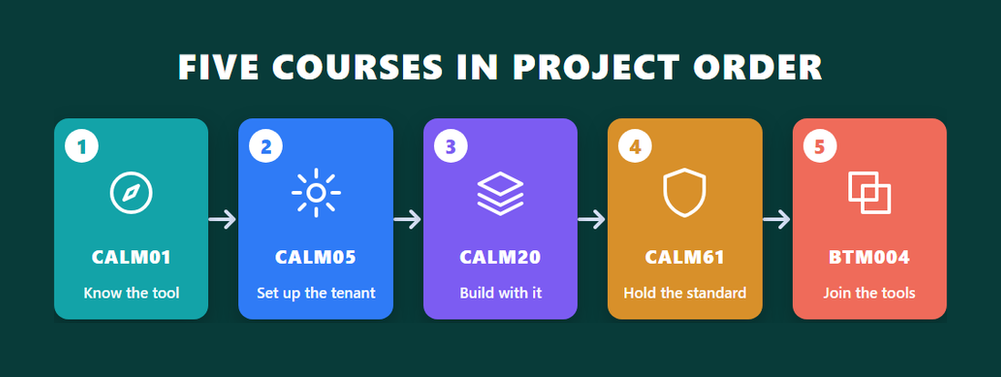
Prepare for C_STC by learning SAP Cloud ALM as one connected backbone and rehearsing whole transformation journeys, not isolated screens. The money-site FAQ suggests roughly one to two months alongside a job, and describes SAP’s learning journey, Transforming for Success with SAP Cloud ALM, as about 35 hours across five courses. The five steps below follow the study guide’s own order.
- Study SAP Cloud ALM as a single transformation backbone, tracing how onboarding and setup feed implementation and how implementation choices shape the monitoring you configure after go-live.
- Learn the implementation side and the operations side together, with project setup, requirements, deployment and testing on one hand and business process, integration and health monitoring on the other.
- Treat the RISE with SAP methodology and Clean Core as their own study block, covering extensibility, clean data, integration and the methodology dashboard.
- Practise the onboarding and administration path hands-on where you can, including user provisioning, role assignment and landscape management.
- Work through the Solution Manager transition and the LeanIX, Signavio and Cloud ALM toolchain as connected topics, so you can explain how the tools pass work to each other.
The five courses, in a workable order
The money-site FAQ recommends starting with CALM01, then CALM05, CALM20 and CALM61, with BTM004 framing the toolchain and the transformation context. That order mirrors a real project: understand the tool, set it up, build with it, then hold the build to the methodology.
| Course | Title | What it gives you for the scenario |
|---|---|---|
| CALM01 | Introducing SAP Cloud ALM | The value argument for implementation, operations and service, and the transition path |
| CALM05 | Onboarding, Setting Up, and Administering SAP Cloud ALM | Tenant request, users, roles and landscape management |
| CALM20 | Implementing with SAP Cloud ALM | Projects, teams, process hierarchies, requirements, deployment, testing and analytics |
| CALM61 | Harnessing SAP Cloud ALM for Effective Transformation Execution with RISE | RISE methodology, Clean Core and the methodology dashboard |
| BTM004 | Navigating RISE with SAP Transformations Leveraging the Integrated Toolchain | How LeanIX, Signavio and Cloud ALM work together in a case study |
SAP hosts all five in the Cloud ALM learning journey. The site’s older C_STC preparation guide lists further reading for the same credential, though it was written for an earlier release and its format details predate the scenario activity.
Rehearse out loud
Because the activity is a conversation or a recorded explanation, silent reading under-prepares you. Take a symptom, such as an empty dashboard or a dropped interface message, and explain aloud what you would check, what you would recommend and why the obvious shortcut fails. If you cannot give the reason in two sentences, you know the topic by recognition only. The money-site FAQ calls preparing by reading instead of reasoning the most common mistake on this exam.
Who should take C_STC, and when does another exam fit better?
C_STC suits consultants and project leads who guide SAP transformations and need to show they can run one on SAP Cloud ALM, including people moving off Solution Manager work. It fits less well for someone whose job is inside one functional module, or for an architect whose main output is the landscape design, where a different credential describes the work more accurately.
The money-site FAQ says candidates with hands-on Cloud ALM and transformation project experience generally find the exam manageable, while those relying on reading alone struggle once the scenario needs real judgement. It also says prior Cloud ALM experience is not strictly required: the credential is aimed at an associate, team-guiding role, and a newcomer can prepare by following the learning journey in order and budgeting the longer end of the one to two month range.
Three situations point elsewhere. If your work is the methodology itself, across phases and quality gates, the RISE with SAP methodology credential is closer. If you design the target landscape and its roadmap, an enterprise architecture credential fits better. And if you are a project manager who plans and governs delivery without owning the tooling, SAP’s project management credentials describe that role. C_STC sits between them: it is for the person who makes the transformation run day to day in the tool the customer will keep using after the project team leaves.
Frequently Asked Questions
What is the exam code for the SAP Cloud ALM certification?
The code is C_STC, and the credential is SAP Certified – Solution Transformation Consultant with SAP Cloud ALM. Earlier releases used suffixed codes such as C_STC_2405. SAP’s certification card now shows the plain code C_STC with one Scenario-Based Assessment activity.
What is the passing score for C_STC?
The passing score is 60 percent. Both the money-site study guide and SAP’s certification card publish that figure. SAP can change a cut score between releases, so confirm it on SAP’s card before you book.
How long is the C_STC exam?
SAP’s certification card displays a duration of 2 hours for C_STC, in the card header and again in the certification overview. The money-site pages do not publish a duration, so SAP’s card is the source for this figure.
Does C_STC have a fixed number of items to answer?
No. C_STC is delivered as a single Scenario-Based Assessment activity. Neither the money-site study guide nor SAP’s card publishes a count of items, because the exam is one connected scenario and not a list of separate ones.
In which languages can I take C_STC?
SAP’s card shows that languages vary by format. Roleplay with AI guidance is offered in English, Spanish, Italian, French, Japanese and 25 more languages, and Record a video is offered in English only. Check SAP’s card for the current list.
Which topics does C_STC cover?
The money-site study guide lists six blueprint areas: SAP Cloud ALM fundamentals and value, implementation, operations and monitoring, onboarding with setup and administration, RISE with Clean Core and the integrated toolchain, and the transition from SAP Solution Manager. No weightings are published.
Do I need hands-on access to an SAP Cloud ALM tenant to prepare?
It helps but is not strictly required, according to the money-site FAQ, because the assessment tests applied reasoning. Working in a real tenant shows how onboarding, implementation and operations settings interact. Without access, rehearsing full transformation scenarios is the next best preparation.
How long should I plan to prepare for C_STC?
The money-site FAQ suggests roughly one to two months alongside a job. It describes SAP’s learning journey as about 35 hours across five courses, and recommends extra time for rehearsing how the stages of a transformation connect.
Is SAP Cloud ALM a new version of SAP Solution Manager?
No. SAP Cloud ALM is a separate, cloud-native application lifecycle management solution. Not every Solution Manager function has a like-for-like equivalent, which is why C_STC expects a planned, staged transition based on a functional comparison instead of a copy of the old configuration.
Conclusion
C_STC is a short exam on paper: one Scenario-Based Assessment activity, 2 hours by SAP’s display, a 60 percent pass score and six blueprint areas with no weightings. What makes it demanding is that the six areas are examined at their joins. Setup decides what implementation can do, implementation decides what operations can monitor, and Clean Core and the Solution Manager transition frame every recommendation you make. Prepare by following the five courses in project order, then rehearse whole journeys aloud until you can explain why each shortcut fails. With Solution Manager’s mainstream maintenance ending on 31 December 2027, the consultants who can lead that move are the ones customers will be asking for. Start with the free worked scenarios, find the joins you cannot yet explain, and build your study plan around those.


