The full name of the C_THR81 credential is SAP Certified – SAP SuccessFactors Employee Central Core and Position Management. The word doing the damage is “and”. This is not one module with a feature bolted on; it is two configuration areas taught in two separate academies, sitting on a platform layer taught in a third. Candidates routinely prepare for one of them and then sit all three.
Getting that scope right at the start changes the whole plan, because SAP no longer measures this with a list of recall items. The SAP SuccessFactors Employee Central certification is delivered as a System-Based Assessment: one guided, hands-on activity in a working system, with a published cut score of 59 percent, in English, at associate level. This guide covers the seven blueprint areas, what that format changes, and how to work the three academies.
Why Does the C_THR81 Title Carry Two Product Areas?
Because SAP certifies them together. Employee Central Core covers the person and employment data at the centre of the HR system, and Position Management covers the organisational structure those people occupy. They are configured separately, they have separate business rules, and SAP teaches them in separate academies, but C_THR81 examines both in a single sitting.
Underneath both sits a third thing the title does not mention: the SuccessFactors platform itself. Provisioning access, the Admin Center, company settings, scheduled jobs and the check tool are all in scope, and they are the layer everything else is configured through. That is why the learning journey starts with a platform academy rather than with Employee Central.
The practical consequence for scoping your study
Three bodies of material, not one. A candidate who has spent six months configuring Employee Central on a live project may still have never touched the position organisation chart or incumbent lifecycle handling, because on many implementations Position Management is a later phase or a different consultant’s job. That gap is invisible until the assessment asks for it.
The reverse gap is rarer but real: someone who arrived through an organisational-design route may know positions well and be shaky on the succession data model. Either way, the honest first step is to audit the three areas separately rather than assuming that experience with the product covers the credential.
What Are the Seven C_THR81 Blueprint Areas?
C_THR81 publishes seven blueprint areas and no weightings for any of them. They run from the platform foundation and its security model, through data models and business rules, foundation objects, employee data and lifecycle management, and transactions and workflows, and close with Position Management configuration and integration.
| Blueprint area | What it covers |
|---|---|
| Platform Foundations and Administration | Provisioning access, the Admin Center, company and system settings, scheduled jobs, the check tool and the administrator toolkit |
| Security and Role-Based Permissions | Role-based permissions, proxy management and access controls so the right users see and edit the right data |
| Data Models, MDF and Business Rules | The metadata framework, the succession data model through the business configuration UI and XML, picklists, and creating and triggering business rules |
| Foundation Objects and Corporate Data | Foundation objects and their associations, legacy and MDF object definitions, and country and region-specific fields |
| Employee Data and Lifecycle Management | Hire and termination screens, importing new employees, updating records via import, mass changes and HRIS synchronization |
| Employee Central Transactions and Workflows | Self-service, workflows, alerts and notifications, event reasons, and optional features such as quick actions and internal job history |
| Position Management Configuration, Lifecycle and Integration | Enabling and configuring Position Management, the position object and settings, the position organization chart, incumbent and lifecycle handling, position business rules, and integration with Recruiting and Succession Management |
The absence of weightings matters more here than it would on a conventional paper. On an exam made of independent items, unweighted areas at least give you an even-distribution assumption to plan against. On a single guided activity there are no independent items to distribute, so the only safe reading is that any of the seven can appear inside the task you are given.
The named skill areas SAP associates with the credential reinforce that: workflow management, data management, data import and export, corporate data management, and access control through role-based permissions. Every one of those is a verb attached to a system, not a topic to describe.
What Is the C_THR81 Exam Format?
C_THR81 is delivered as a System-Based Assessment, or SyBA: one guided, hands-on activity carried out in a working environment, scored on whether the configuration task was completed correctly. The published cut score is 59 percent, the assessment is offered in English, and the credential sits at associate level against SAP SuccessFactors Employee Central.
| Specification | Detail |
|---|---|
| Exam code | C_THR81 |
| Credential | SAP Certified – SAP SuccessFactors Employee Central Core and Position Management |
| Level | Associate |
| Format | System-Based Assessment (SyBA), one activity |
| Passing score | 59 percent |
| Language | English |
| Product | SAP SuccessFactors Employee Central |
What 59 percent means when there is one activity
On a paper made of many independent items, 59 percent is a comfortable-sounding bar because weak areas are diluted by strong ones. On a single guided activity it works differently: clearing the threshold means executing most of the task accurately, and partial familiarity with a step rarely converts into partial credit. There is no lucky guess available on a configuration screen.
That is why breadth beats depth here. Confident command across the whole Employee Central Core and Position Management scope is worth more than expert knowledge of one area, because the activity decides which areas it touches, not you. Rehearsing full end-to-end sequences with C_THR81 scenario simulations is closer to the real thing than reading about the steps.
Two things are worth saying plainly because neither source publishes them: there is no stated assessment duration and no stated validity period on either the money-site pages or any readable SAP page. Confirm both on SAP’s own Learning page when you book rather than relying on a figure quoted elsewhere.
What Does a System-Based Assessment Change About Preparation?
It removes the gap between knowing and doing. A SyBA puts you in front of a working system with a guided task, and the score reflects whether the configuration is correct at the end. Preparation that produces recognition, the ability to pick the right answer when you see it, does not transfer to a screen where nothing is offered to pick from.
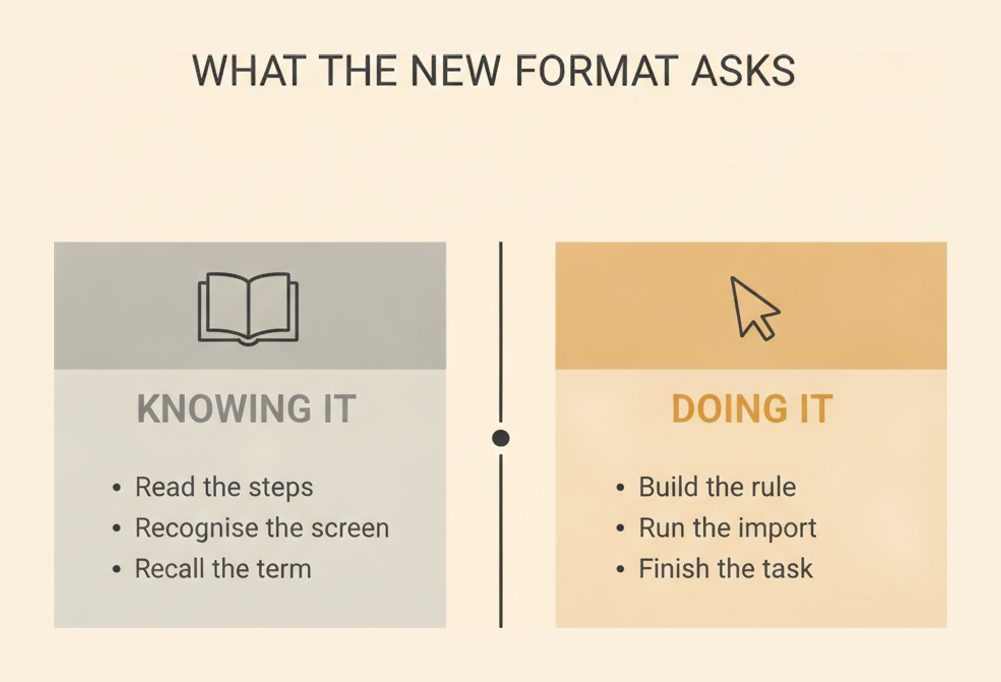
The practical shift is from reading sequences to executing them. Knowing that a business rule can trigger on a foundation object change is recognition. Being able to build that rule, attach it to the right event, and have it fire correctly is execution, and only the second one survives contact with the assessment.
Where candidates lose time
The common failure is not ignorance, it is hesitation. Someone who has read about importing employee data but never run an import spends the first part of the activity working out where the screen is, and the clock does not care that they know what an import does. Familiarity with navigation is worth more here than it has ever been on an SAP credential.
This is not unique to C_THR81. SAP completed its move to performance-based certification in early 2026 across the portfolio, and a fuller account of what changed and which formats now apply sits in this SAP certification format guide. If your mental model of an SAP exam predates that change, it is the first thing to update.
How Deep Does the Data Models and Business Rules Area Go?
Deep enough that it underpins four of the other six areas. This area covers the metadata framework, configuring the succession data model through both the business configuration user interface and XML, maintaining picklists, and creating and triggering business rules. It is where the shape of the customer’s HR data is actually decided.
The dual configuration route is the part that catches people. The business configuration UI is the friendly path and it does not expose everything; XML is the complete path and it is unforgiving. A consultant who has only ever used the UI has a real gap, because some of what the credential expects is only reachable the other way.
Business rules are the multiplier
Rules are what make the system behave rather than merely store. They validate entries, default values, drive workflows and control position behaviour, which means a rule configured wrongly does not fail loudly in one place, it produces subtly wrong outcomes in several. That property is exactly why the area is examinable in a hands-on format.
Picklists look trivial next to that and are worth a deliberate half hour anyway, because they are referenced by foundation objects, employee data fields and rules alike. A missing picklist value is one of the quickest ways to make a correct configuration appear broken.
What Does Position Management Add on Top of Employee Central Core?
A second structure that people occupy rather than are. Position Management introduces the position object and its settings, the position organization chart, incumbent handling and position lifecycle events, position-specific business rules, and integration with Recruiting and Succession Management. It is organisational design expressed as configuration.
The conceptual step is separating the role from the person. In Employee Central Core an employee record carries a job. With Position Management, the position exists independently, can be vacant, can be filled by an incumbent, and can be inherited when someone leaves. Every downstream behaviour follows from getting that distinction right.
The integration objectives are where the two SuccessFactors worlds meet. A vacant position is what Recruiting hires against, and a position is what Succession Management plans for, so the configuration here has consequences in modules the candidate may never touch. That is a large part of why SAP examines Core and Position Management together rather than separately.
For readers arriving from outside HR technology, the underlying category is worth ten minutes of orientation. The general concept of an HR management system explains why organisational structure and person data are modelled separately in the first place, which makes the position object feel less arbitrary.
Why Do Role-Based Permissions Break More Projects Than Anything Else?
Because they fail silently. Role-based permissions decide which users see and edit which data, and a misconfiguration does not produce an error message. It produces a workflow that never reaches its approver, a field that is invisible to the person who needs it, or a manager who can see something they should not. Nothing crashes, so nothing gets reported until later.
The credential treats this as its own blueprint area for that reason, alongside proxy management and access controls generally. Proxy in particular is easy to underestimate: it lets one user act as another, which is genuinely useful and genuinely dangerous, and the configuration around who may proxy for whom is examinable.
Study it as a block, not as a footnote
The temptation is to treat permissions as administrative housekeeping to be picked up alongside everything else. Resist it. Permissions interact with every other area on the blueprint, so a gap here shows up as an apparent failure in workflows, in employee data visibility, or in the position organisation chart, and diagnosing it backwards from the symptom is slow.
The useful mental test while studying is to ask, for any configuration you build, who can see it and who can change it. If you cannot answer both quickly, the permission model is not yet solid enough for a hands-on assessment.
How Should You Work the Three Academies?
In order, and the order is not optional. SAP anchors C_THR81 to a single learning journey rated at intermediate level, made up of three academies totalling roughly fifty hours plus hands-on practice systems. Each one assumes the groundwork the previous one lays, so working them out of sequence costs you the benefit.
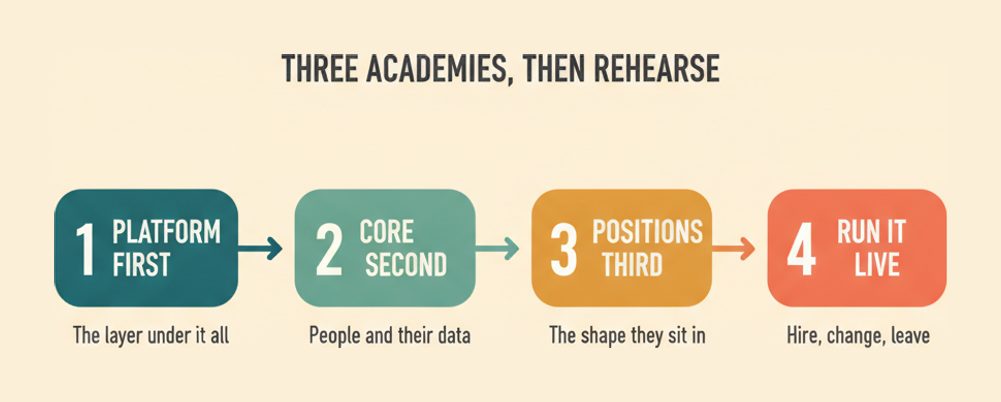
- Start with the platform introduction academy, covering provisioning, the Admin Center, role-based permissions, the metadata framework and business rules, because every configuration in the two later academies is performed through that layer.
- Move to the Employee Central Core academy next, working through data model and picklist imports, permission assignment, foundation objects, employee data and the succession data model, and transactions such as workflows and self-service.
- Take the Position Management academy last, enabling the feature, configuring the position object and settings, navigating the position organization chart, and applying business rules and the integrations with other SuccessFactors solutions.
- Finish by rehearsing the full employee lifecycle end to end in a practice system, hiring, updating by import, applying a mass change and terminating, because those complete sequences are what a hands-on assessment actually asks you to execute.
Roughly fifty hours is the journey’s own estimate for the courses, and it is a floor rather than a total. The execution rehearsal in step four sits on top of it, and for a candidate without daily access to a SuccessFactors instance it is the part that needs deliberate scheduling rather than opportunistic practice.
The official journey itself is published as SAP’s configuring Employee Central journey, and it is worth opening before you plan a schedule so that the three academies are budgeted separately rather than as one block.
Who Is the C_THR81 Credential Actually For?
Primarily SAP partner consultants implementing SuccessFactors Employee Central for customers, and secondarily HR systems specialists and analysts moving into a configuration role. The credential is explicitly pitched at entry-level project-participation depth: it certifies that you can apply these skills on a delivery under the guidance of a more experienced consultant.
That framing is unusually honest and worth taking at face value. C_THR81 does not claim you can lead an implementation. It claims you can be trusted with core HR configuration as a mentored member of a team, which is exactly the hiring signal a growing practice needs and exactly the wrong signal for someone positioning as a solution architect.
The career case is reasonable. SAP consulting work sits well above general IT support and administration on published SAP consultant salary data, and an associate credential in a core HCM module is one of the more direct routes into that work for someone already inside an HR function.
Where it fits worst is the HR generalist hoping to understand the system better without configuring it. This is a configuration credential examined by configuring, and the wider SuccessFactors landscape is better approached through the SuccessFactors module overview before committing to a hands-on assessment in one of them.
Frequently Asked Questions
What is the passing score for C_THR81?
Fifty-nine percent, published by SAP. Because the assessment is one guided activity rather than many independent items, clearing it means executing most of the configuration task accurately.
What format is the C_THR81 exam?
A System-Based Assessment, or SyBA: one guided, hands-on activity carried out in a working system, scored on whether the configuration task was completed correctly.
What does C_THR81 cover?
Seven blueprint areas spanning the SuccessFactors platform layer, security and permissions, data models and business rules, foundation objects, employee data and lifecycle, transactions and workflows, and Position Management.
Is Position Management really part of the same credential?
Yes. The full credential name is Employee Central Core and Position Management, and SAP teaches the two in separate academies while examining them in a single assessment.
Which language is the C_THR81 assessment offered in?
English. That matters more than usual here, because a hands-on assessment requires reading task instructions precisely and carrying them out on English-language SuccessFactors screens.
How long does preparation take?
The learning journey’s three academies total roughly fifty hours and are rated at intermediate level. Treat that as a floor, with end-to-end execution rehearsal in a practice system on top.
What level is the C_THR81 certification?
Associate. SAP positions it as certifying that you can apply these skills on an implementation project under the guidance of a more experienced consultant, rather than lead one.
Are there weightings for the C_THR81 blueprint areas?
None are published. On a single guided activity there are no independent items to distribute anyway, so the safe reading is that any of the seven areas can appear.
How does C_THR81 differ from C_THR82?
They cover different modules. C_THR81 is Employee Central Core and Position Management, the core HR data and organisational structure. C_THR82 covers Performance and Goals.
Do you need SuccessFactors experience before attempting it?
It is not stated as a prerequisite, but the format makes it close to essential. Familiarity with navigation is what separates candidates who execute the activity from those who spend it searching.
Conclusion
C_THR81 is two configuration areas on a shared platform foundation, examined as one guided hands-on activity at a 59 percent cut score, in English, at associate level. Seven blueprint areas, no published weightings, and a learning journey of three academies totalling roughly fifty hours.
Plan for the conjunction in the title rather than the first half of it. Work the three academies in order because each assumes the one before, treat role-based permissions as a study block in its own right because it fails silently everywhere else, and spend real time executing complete lifecycle sequences rather than reading them. A System-Based Assessment rewards fluency on the screen, and there is no way to acquire that except on the screen.


