There is nothing left to memorise. SAP rebuilt this credential around a single performed activity, so the preparation method almost everyone used, working through remembered items until the answers became familiar, no longer maps onto what happens on the day. The exam asks you to do the work.
That is the whole of the SAP C_FSM exam format now: a Scenario-Based Assessment of one activity, at a 60 percent cut score, across seven blueprint areas spanning SAP Field Service Management from account administration to embedded artificial intelligence. Material written for the older code describes something else.
Table of Contents
- What is the C_FSM exam format now?
- Does C_FSM_2211 material still apply?
- What does SAP publish, and what does it not?
- What do the seven blueprint areas cover?
- Where field execution differs from the back office
- What does the AI content in the integration area mean?
- Who should take C_FSM?
- How do you prepare for an activity?
- Frequently Asked Questions
- Conclusion
What is the C_FSM exam format now?
A Scenario-Based Assessment consisting of one activity. You are given a realistic field-service situation and you carry out the configuration and process steps it calls for, inside a configured system, rather than selecting from a fixed set of items. The cut score is 60 percent.
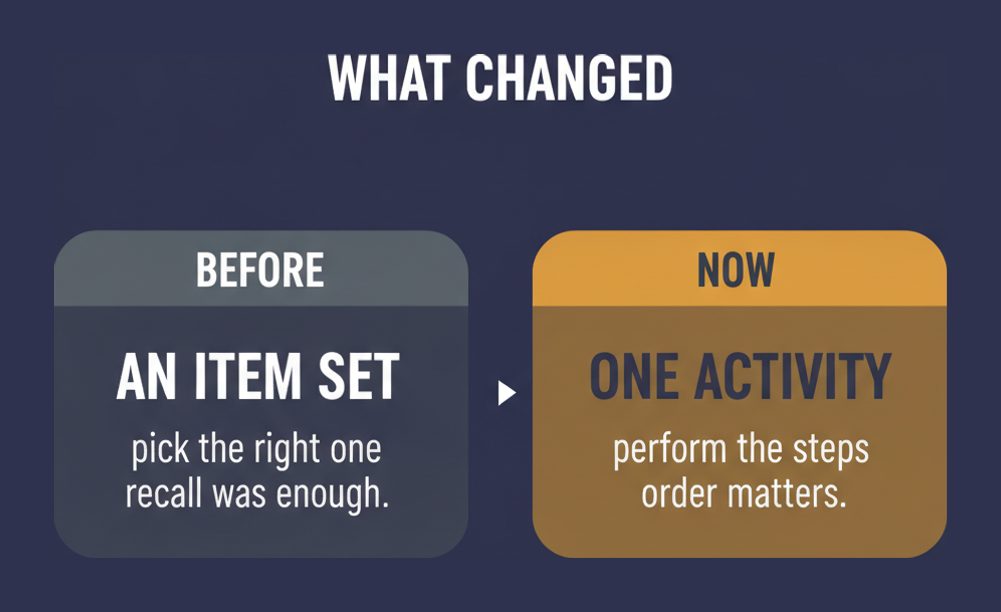
This is SAP’s performance-based direction applied to Field Service Management. The difference is not cosmetic. An item-based assessment measures whether you recognise a correct statement; an activity measures whether you can complete connected steps in the right order. Partial familiarity with a topic, which might once have been enough to guess well, produces very little here.
It also changes what “knowing the product” means. The exam spans both the web and mobile applications, and the administrator, dispatcher and technician scenarios, so the activity can land anywhere across that surface. Someone who has configured only the back office will feel the gap immediately, because field service management as a discipline is defined by what happens away from the desk.
The practical consequence for preparation is that repetition has to be repetition of the work. Running the same scenario until the sequence is automatic is the closest analogue to the exam itself, which is why working through full scenario activities matters more here than any amount of reading.
Does C_FSM_2211 material still apply?
Partly, and the part that does not is the part people most rely on. SAP’s certification record now gives the exam code as C_FSM with no version suffix, superseding C_FSM_2211. Guides written for the older code describe an assessment structure that no longer exists, even where their product content is still broadly sound.
Split old material into two piles. Anything describing how FSM is configured, what master data it needs, how dispatching works or how SmartForms are built is still largely useful, because the product did not change when the assessment did. Anything describing how the exam is sat, how long it takes, how many items it contains or how to pace yourself through them should be set aside.
The confusion is visible in what people search for. Queries for the 2211 code still draw steady traffic, and so do queries containing the word “new”, which is people trying to work out which of two accounts of the same exam is current. This one is.
One more thing worth saying plainly: a code that looks like C_FSM with a date suffix appears occasionally in search results. SAP’s own certification record lists the object identifier as C_FSM at release 1, and the exam catalogue lists it unversioned, so treat any dated variant as a guess until SAP publishes one.
What does SAP publish, and what does it not?
SAP publishes the credential name, the level, the format and the cut score. It does not publish a duration, a language list or a validity period anywhere that can be read, and neither does the exam catalogue. That gap is worth knowing before you plan around an assumption.
| Field | Value |
|---|---|
| Credential | SAP Certified – SAP Field Service Management |
| Exam code | C_FSM |
| Level | Associate |
| Format | Scenario-Based Assessment, one activity |
| Cut score | 60 percent |
| Role | Consultant |
| Product | SAP Field Service Management |
| Blueprint areas | 7, none weighted |
| Duration | Not published |
| Languages | Not published |
| Validity period | Not published |
The cut score is the one figure confirmed twice, appearing both in the exam catalogue and in SAP’s own certification record on the official certification page. Where two independent sources agree, you can plan against it.
The three unpublished rows are stated as unpublished on purpose. It would be easy to repeat a duration figure circulating elsewhere, and several sites do, but no source that a candidate can actually open states one for this exam. A number you cannot verify is worse than an acknowledged gap, because it invites you to pace yourself against something imaginary.
Check your own booking confirmation and your SAP account for the details that apply to your attempt. That is where the authoritative answer for your sitting lives, and it is the advice SAP gives for its other credentials too.
What do the seven blueprint areas cover?
The full FSM solution, from administrative setup through to integration, with no weighting attached to any area. Seven areas across a single activity means the scenario you are given could draw on any of them, so breadth matters more than depth in any one.
| Blueprint area | What it covers |
|---|---|
| Account Administration and Data Management | Account-level settings, company configuration, and the day-to-day data management that keeps the solution running consistently |
| Master Data Management | Equipment, service objects, business partners and related records that requests, planning and mobile execution all draw on |
| Planning, Dispatching and Scheduling | Assigning and sequencing work, including automated and assisted scheduling |
| Mobile Field Service and SmartForms | The mobile applications technicians use, and the structured forms they complete on site |
| Business Rules, Analytics and Reporting | The rules that drive behaviour and the reporting that shows what happened |
| Crowd Service and Customer Self-Service | Extending work to an external partner pool, and letting customers act for themselves |
| Integration and Artificial Intelligence | Connecting FSM to the wider landscape, now including embedded AI |
Read as a sequence, the first three areas are the setup and the plan, the middle two are the execution and the feedback loop, and the last two extend the model outward, to people outside the organisation and to systems outside FSM. A realistic scenario tends to cross several of them, which is exactly the point of assessing it as one activity.
Because nothing is weighted, there is no area you can safely leave until last. The two most often neglected are crowd service and customer self-service, because many implementations never switch them on, and they are still examinable.
Where field execution differs from the back office
Two of the seven areas describe work that happens away from a desk, and they behave differently from everything else on the blueprint. Mobile field service and SmartForms cover what a technician does on site, often without a reliable connection, and that constraint shapes the configuration decisions the exam expects you to make.
SmartForms are the clearest example. They are the structured capture a technician completes at the job: checks performed, readings taken, parts used, a signature. Configuring one badly produces data nobody can report on later, which is why this area connects directly to the analytics area rather than sitting apart from it.
Dispatching sits between the two worlds. Automated and assisted scheduling decide who goes where, and the quality of those decisions depends entirely on the master data underneath them: equipment records, service objects, business partner details. A scenario that appears to be about scheduling is frequently testing whether you understand what the scheduler is reading. SAP’s Field Service Management documentation is the reference for how those objects relate.
If your own experience is administrative rather than operational, this is where to spend disproportionate time. The back-office areas reward familiarity with settings screens; these reward having watched what happens when a technician arrives and the data is wrong.
What does the AI content in the integration area mean?
It means the blueprint now names embedded artificial intelligence as part of integration, rather than treating it as a separate topic or an optional extra. For a candidate, it signals that AI-assisted capability inside FSM is examinable current functionality, not a roadmap item to read about.
Placing it inside integration rather than giving it its own area is itself informative. The exam frames AI as something that connects to and augments existing processes, scheduling suggestions, service insight, assistance in the flow of work, rather than as a separate product to configure. Understanding where it plugs in matters more than understanding how it is built.
This is also the clearest marker that the current blueprint is recent. Nothing written for the older code addresses this material at all, which is one more reason to treat old guides as product background rather than exam preparation.
Keep the expectation proportionate. This is an associate credential for a mentored team member, so the depth expected is recognising what the capability does and where it belongs in a field-service process, not architecting a model.
Who should take C_FSM?
Implementation consultants and business users who configure and support SAP Field Service Management, and people moving into an FSM project role from a dispatcher, service administrator or technician position. It is positioned as an entry-level qualification for the consultant profile.
The framing matters and it is unusually honest. The credential certifies that you can perform core functional configuration as a mentored member of a delivery team, not that you can lead an implementation. If you are choosing between credentials on the basis of what a hiring manager will infer, that is the inference this one supports: project-ready, not independent.
It fits well if you already work around FSM without owning its configuration, because the blueprint’s breadth forces you across parts of the product your day job avoids. It fits poorly if you want a strategic or architectural credential, or if your role never touches field service at all, since almost nothing here transfers to another SAP module.
Anyone approaching this without prior FSM exposure should expect the product breadth rather than the assessment to be the difficulty. The site’s FSM preparation guide covers the solution scope in more detail than the blueprint summary does.
How do you prepare for an activity?
By doing the work repeatedly until the sequences are automatic, and by covering all seven areas rather than deepening the ones you already use. Reading about a configuration step and performing it are different skills, and only one of them is assessed.
- List the seven blueprint areas and mark the ones you have never configured, because an unweighted blueprint gives you nowhere to hide.
- Get access to a system, however limited, since an activity-based assessment cannot be prepared for entirely on paper.
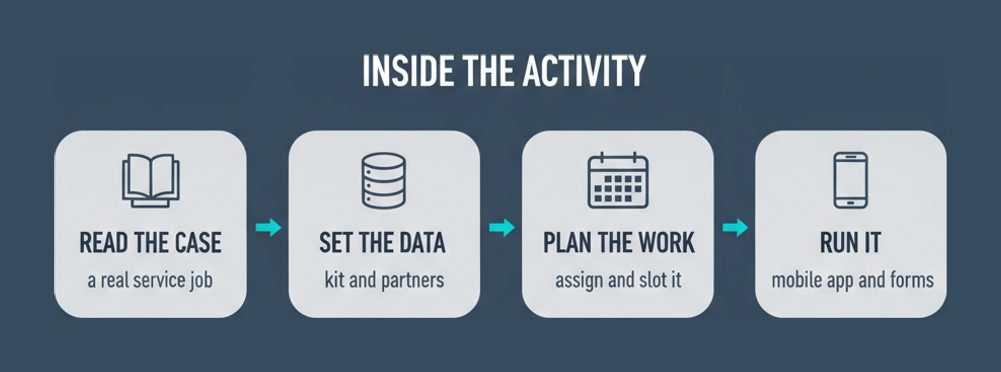
- Work a complete scenario end to end, from master data through dispatch to mobile execution, rather than practising isolated steps.
- Repeat that scenario until the order of operations comes without thinking, then change one condition and run it again.
- Spend deliberate time on crowd service and customer self-service, which most implementations never switch on and most candidates therefore skip.
- Read the current material on embedded AI in the integration area, since nothing written for the older code covers it.
- Treat old guides as product background only, and take nothing from them about how the assessment is structured.
SAP’s own Implementing SAP Field Service is the named starting point, and the recommended path also includes the RISE with SAP methodology material, which is worth knowing if your FSM work sits inside a wider transformation programme. That methodology has its own credential for anyone whose role spans both.
Frequently Asked Questions
What is the C_FSM exam format?
A Scenario-Based Assessment made up of one activity. You interpret a realistic field-service situation and carry out the configuration and process steps it requires, inside a configured system.
What is the cut score for C_FSM?
Sixty percent. That figure appears both in the exam catalogue and in SAP’s own certification record, so it is confirmed by two independent sources.
How long does the exam take?
No duration is published anywhere that can be read, so this guide does not state one. Check your booking confirmation and your SAP account for what applies to your attempt.
Is C_FSM the same as C_FSM_2211?
It is the same credential under a current, unversioned code. C_FSM_2211 is superseded, and material written for it describes an assessment structure that no longer applies.
What are the seven blueprint areas?
Account administration and data management, master data management, planning and dispatching and scheduling, mobile field service and SmartForms, business rules and analytics and reporting, crowd service and customer self-service, and integration and artificial intelligence.
Are the blueprint areas weighted?
No weightings are published, so cover all seven. A single scenario can draw on any of them.
Is there still a question bank to work through?
No. The move to a Scenario-Based Assessment replaced the fixed item set with one performed activity, which is why preparation now means running scenarios rather than reviewing items.
What level is the certification?
Associate, positioned as an entry-level qualification for the consultant profile and certifying that you can contribute as a mentored member of an implementation team.
What languages is it offered in?
SAP does not publish a language list for this exam, and the exam catalogue records the same, so none is stated here.
Does the exam cover artificial intelligence?
Yes. Embedded AI sits inside the integration area of the current blueprint, framed as capability that connects to existing field-service processes.
Conclusion
C_FSM is now one performed activity at a 60 percent cut score, across seven unweighted blueprint areas covering SAP Field Service Management end to end. The assessment changed; the product did not.
That distinction is the practical takeaway. Keep old material for what FSM does and discard it for how the exam runs, cover the areas your implementations never switched on, and prepare by repeating whole scenarios rather than isolated steps until the order of operations is automatic.
Plan around what is actually published: the format, the level and the cut score. Nothing readable states a duration, a language list or a validity period, so take those from your own booking rather than from any figure circulating elsewhere, including this page.


