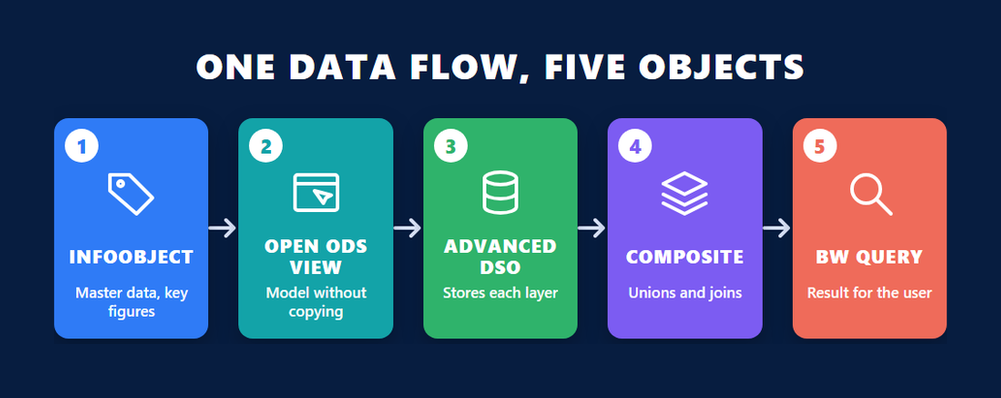
Read the list of modeling objects for E_BW4HE and one familiar name is missing: the InfoCube. The objects that remain are InfoObjects, the advanced DataStore Object, Open ODS views, CompositeProviders and BW queries, and that short list is a fair summary of what the SAP BW/4HANA delta certification asks a classic BW consultant to relearn.
E_BW4HE carries the title SAP Certified – SAP BW/4HANA Delta. SAP delivers it as one hands-on System-Based Assessment activity with a 3 hour duration and a 70 percent pass score, and it is written for consultants who already know classic SAP BW. This article covers how the exam runs, the three weighted topics SAP lists, what “delta” means in practice, the modeling objects, data tiering, extraction through Operational Data Provisioning, hybrid models with SAP HANA, a preparation plan, and how the exam compares with C_BW4H.
How Does SAP Run the E_BW4HE Exam?
SAP runs E_BW4HE as a single System-Based Assessment activity. You work inside a configured SAP BW/4HANA system and complete modeling, loading and configuration tasks, and the result depends on whether the work is done correctly. SAP displays a 3 hour duration and a 70 percent pass score, and the exam is available in English.
A System-Based Assessment is one of the two performance-based formats SAP now uses for certification. There is no list of options to choose from. You act in the system the way a BW consultant would on a project, which rewards people who have built data flows by hand and exposes anyone who has only read about them.
| Field | ERPPrep study guide | SAP certification page |
|---|---|---|
| Exam code | E_BW4HE | E_BW4HE |
| Title | SAP Certified – SAP BW/4HANA Delta | SAP Certified – SAP BW/4HANA Delta |
| Level | Specialist | Not shown as a label |
| Format | System-Based Assessment, 1 activity | 1 activity, System Based Assessment |
| Pass score | 70% | 70% |
| Duration | Not published | 3 hours |
| Languages | English | Available in English |
| Product | SAP BW/4HANA | SAP BW/4HANA |
The two sources agree on every field they both publish. ERPPrep gives no duration, while the official SAP certification page displays 3 hours, so that is the figure to plan around. Neither source publishes a fee, a question count or a validity period, and attempts come with an SAP Learning Hub subscription, so none of those figures is given here.
What SAP asks you to check before exam day
The certification page lists three readiness steps. Run the technical readiness checklist for hardware, software and connectivity. Confirm a Learning Hub subscription that includes certification exam attempts and an SAP Universal ID with a secondary email. Then watch SAP’s introduction to system-based assessments and use the practice system inside the learning journey, so the environment feels familiar before an attempt counts.
Which Three Topics Carry the Weight on E_BW4HE?
SAP lists three weighted exam topics for E_BW4HE: Data Tiering Optimization at 31 to 40 percent, Modeling a Data Flow at 31 to 40 percent, and Data Processing at 21 to 30 percent. Two of the three can each reach two fifths of the exam, so data tiering and data flow modeling together decide most of the result.
| SAP exam topic | Weighting | What it means in the system |
|---|---|---|
| Data Tiering Optimization | 31-40% | Deciding where data lives over time and configuring the temperature tiers |
| Modeling a Data Flow | 31-40% | Building the objects and flow from source to query |
| Data Processing | 21-30% | Loading, transforming and running the data through the warehouse |
The ERPPrep study guide breaks the same scope into seven blueprint areas without weightings: fundamentals and architecture, modeling artifacts, data extraction and Operational Data Provisioning, data acquisition and the layered architecture (LSA++), hybrid and mixed modeling with SAP HANA, data lifecycle management and data tiering, and operating and migrating SAP BW/4HANA. Read the seven areas as a study map and SAP’s three topics as the weighting. Where they differ, the SAP page is the published position, so the weightings above come from SAP.
ERPPrep turns that map into E_BW4HE scenario simulations, full multi-step scenarios and skill drills built for the System-Based format. They are a way to rehearse the tasks, not a different syllabus.
What Does “Delta” Mean for a Classic SAP BW Consultant?
In E_BW4HE, “delta” means the difference between classic SAP BW and SAP BW/4HANA. SAP says the certification verifies the knowledge of implementing and modeling SAP BW/4HANA that the profile of an SAP BW consultant needs, and that it builds on BW/4HANA training and practical experience gained as a member of an SAP BW team.
So the exam assumes you already understand what a data warehouse is for, how master data and transaction data differ, and how a load chain is monitored. It tests what changed. SAP BW has a long history: the first version shipped in 1998, and the product later became BW/4HANA to run natively on the SAP HANA in-memory database, as the SAP BW history on Wikipedia summarises. Running on HANA lets heavy calculations move into the database, and that is why several classic objects were folded into fewer, more flexible ones.
SAP’s recommended preparation is the learning journey called Upskilling from SAP BW Classic. ERPPrep names its two courses: BW400, Getting Started Building an On-Premise Data Warehouse using SAP BW/4HANA, and DBW462, Upgrading Your SAP BW Skills to SAP BW/4HANA. The second course is the delta itself: new tools, new modeling objects, hybrid models, LSA++, loading through ODP, running the system and migrating from SAP BW.
The platform is still a live choice for large companies. When the fashion retailer Bonprix completed its SAP BW/4HANA and SAP Datasphere implementation, its BI engineer described BW/4HANA as the core of the platform.
“The Bonprix business intelligence data based on SAP solutions is adeptly designed for the future, leveraging the robust capabilities of SAP BW/4HANA at its core to manage and efficiently process vast volumes of data.”
SAP published that statement in its Bonprix customer story. It is a useful reminder that a BW/4HANA consultant often works next to Datasphere rather than instead of it.
Which Modeling Objects Do You Need to Know Cold?
The E_BW4HE modeling scope centres on five objects: InfoObjects, the advanced DataStore Object, Open ODS views, CompositeProviders and BW queries, plus semantic groups and BAdI providers. Knowing when to reach for each one matters more than memorising field settings, because the exam asks you to build a flow, not to describe an object.
The advanced DataStore Object does the heavy lifting
In SAP BW/4HANA the advanced DataStore Object takes over the persistence jobs that several classic objects used to share. Practise creating one, choosing its type for the layer it sits in, and loading it, until you can do it without looking anything up. Most later tasks depend on a correctly built aDSO.
Open ODS views and CompositeProviders connect without copying
An Open ODS view lets you model on data that is not yet stored in BW objects, which is the natural bridge to external tables and SAP HANA views. A CompositeProvider combines providers through unions and joins and is usually what a BW query sits on. The ERPPrep FAQ points out that a choice made in one object quietly shapes behaviour several steps later, for example how a CompositeProvider is built affects query results, so trace each build to the query before you call it finished.
InfoObjects and queries are where classic skills carry over
InfoObjects still hold characteristics, key figures and master data, and BW queries still deliver the result to the user. Expect these to feel familiar, and spend your time on what changed around them rather than on what stayed the same.
Why Does Data Tiering Optimization Carry So Much Weight?
Data Tiering Optimization carries 31 to 40 percent of E_BW4HE because deciding where data lives is one of the main operational changes in SAP BW/4HANA. Data that is used often stays in fast memory, older data moves to cheaper storage, and you configure those tiers per object instead of building separate archiving projects.
The ERPPrep study guide describes this area as configuring data tiering optimization and data lifecycle management to control where data lives over time, balancing performance against storage cost across the warehouse layers. In a task, that means three things to practise:
- assigning a temperature tier to an advanced DataStore Object or its partitions
- moving data between tiers and checking the result
- understanding how the tier choice affects load and query behaviour later in the flow
The concept is not unique to SAP. Any data warehouse design has to balance the speed of recent data against the cost of keeping years of history. What the exam checks is whether you can carry out that balance in BW/4HANA’s own tools, because small parameter differences change how the system behaves.
How Does Operational Data Provisioning Change Extraction?
In SAP BW/4HANA, data reaches the warehouse through the Operational Data Provisioning framework, ODP. E_BW4HE covers its main contexts: classic extractors, CDS-view-based extraction, BW InfoProvider sources, SAP HANA calculation view sources and SLT-based replication. Each context behaves differently, and the exam often frames extraction as a configuration task for one of them.
For a classic BW consultant the shift is that ODP becomes the standard path instead of one option among several. Drill the contexts side by side, as the ERPPrep study guide recommends, so you can tell from a requirement which source type fits and what the setup involves.
| ODP context | Typical source | What to practise |
|---|---|---|
| Classic extractors | SAP ERP DataSources | Replicating and loading an existing DataSource through ODP |
| CDS views | SAP S/4HANA ABAP CDS views | Finding an extraction-enabled view and loading it |
| BW InfoProviders | Another BW system or object | Using a BW provider as a source |
| SAP HANA calculation views | Native HANA models | Consuming a calculation view as a source |
| SLT replication | Tables replicated in real time | Setting up an SLT-based source |
CDS-based extraction deserves extra time, since it is how BW/4HANA usually meets SAP S/4HANA. Our walkthrough on enhancing ODP_CDS DataSources shows that path in a real system and is good hands-on reading for this topic.
Where Do LSA++ and Hybrid SAP HANA Models Fit?
LSA++ is the layered architecture for organising a BW/4HANA warehouse, and hybrid modeling combines BW objects with native SAP HANA calculation views. E_BW4HE expects you to place data in the inbound, corporate memory, data warehouse and virtualization layers, and to build mixed scenarios where BW and HANA models consume each other.
LSA++ keeps the warehouse maintainable
The enhanced Layered Scalable Architecture gives each layer one job: take data in, keep a corporate memory of it, harmonise it for reporting, and expose virtual views where copying is not needed. Use SAP’s delivered BW/4HANA content as a reference for how those layers are usually built, and be ready to explain why an object belongs in one layer and not another.
Hybrid models are a frequent source of multi-step tasks
The ERPPrep material lists three moves to rehearse end to end: explore an SAP HANA calculation view, consume it from SAP BW/4HANA, and generate calculation views from BW models. Add remote source connections to that list. A hybrid task chains several steps, so one wrong choice early on shows up only at the end.
Operating and migrating close the scope
The last study area covers running the system and leaving classic BW behind: optimising loads and query processing, maintaining process chains, statistics, authorizations, housekeeping and data privacy, and choosing a migration approach with its supporting tools. Know the main migration paths at the level of when each one fits.
How Should You Prepare for a Three Hour System-Based Task?
Prepare for E_BW4HE by doing, not reading. Work through SAP’s learning journey, then repeat each modeling, extraction and tiering task in a system until the steps feel routine, because the single activity rewards fluent execution. Give extra time to the chains candidates most often miss: ODP contexts, hybrid models and data tiering.
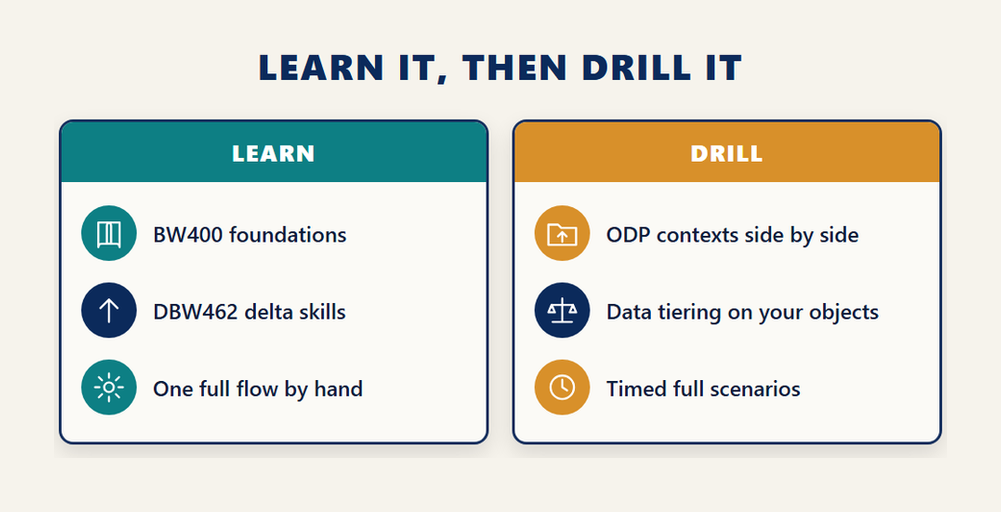
- Start with the BW400 course to rebuild the end-to-end picture of SAP BW/4HANA, from the role of SAP HANA to InfoObjects, InfoProviders and the data flow.
- Work through DBW462 for the delta skills: the new tools and modeling objects, hybrid models, LSA++, ODP loading, running the system and migration.
- Build one complete data flow by hand, from an ODP source through an advanced DataStore Object and a CompositeProvider to a BW query, and check the query result.
- Drill each ODP context side by side until you can pick the right one from a short requirement.
- Configure data tiering on the objects you built and watch how loads and queries respond.
- Rehearse a hybrid scenario end to end, then finish with timed full scenarios in the practice system.
The ERPPrep FAQ suggests several weeks to a couple of months of preparation for someone studying alongside a job. Use the practice system in SAP’s learning journey early, because the environment itself is part of what you need to get used to.
E_BW4HE or C_BW4H: Which SAP BW/4HANA Exam Fits You?
Choose E_BW4HE if you already work with classic SAP BW and need to prove the move to BW/4HANA. Choose C_BW4H, SAP Certified – Data Engineer – SAP BW/4HANA, if you are newer to BW: ERPPrep describes it as an entry-level, project-participation credential for the data engineer profile. Both are single-activity System-Based Assessments on the same product.
| Point | E_BW4HE | C_BW4H |
|---|---|---|
| Title | SAP Certified – SAP BW/4HANA Delta | SAP Certified – Data Engineer – SAP BW/4HANA |
| Profile | SAP BW consultant moving from classic BW | Data engineer at entry level |
| Assumes | BW/4HANA training plus BW project experience | A starting qualification |
| Focus | What changed: tiering, data flows, ODP, hybrid, migration | The full data engineer scope |
| Format | System-Based Assessment, 1 activity | System-Based Assessment, 1 activity |
The deciding question is your starting point. If you have never run a BW project, the delta exam assumes knowledge you do not have yet, and C_BW4H is the better first step. Our guide to the C_BW4H data engineer exam covers its areas in detail.
Frequently Asked Questions
What is the E_BW4HE certification?
E_BW4HE is SAP Certified – SAP BW/4HANA Delta. It verifies that an SAP BW consultant can implement and model SAP BW/4HANA, building on BW/4HANA training and practical experience on an SAP BW team.
How is the E_BW4HE exam delivered?
It is one System-Based Assessment activity. You complete modeling and configuration tasks inside a configured SAP BW/4HANA system rather than choosing answers from a list.
What is the pass score and duration for E_BW4HE?
SAP displays a 70 percent pass score and a 3 hour duration on the certification page. ERPPrep also gives 70 percent and publishes no duration.
Which topics are weighted most heavily?
SAP lists Data Tiering Optimization at 31 to 40 percent, Modeling a Data Flow at 31 to 40 percent, and Data Processing at 21 to 30 percent.
In which language can I take E_BW4HE?
SAP shows the exam as available in English, and ERPPrep lists English as well.
Do I need classic SAP BW experience for E_BW4HE?
It is strongly assumed. It is a delta credential for consultants moving from classic BW, so newcomers should build basic BW/4HANA knowledge first, starting with BW400.
Which SAP courses prepare you for E_BW4HE?
SAP’s learning journey Upskilling from SAP BW Classic to SAP BW/4HANA, which includes BW400 and DBW462. DBW462 covers the delta skills directly.
Does SAP publish a question count or exam fee for E_BW4HE?
No question count applies to a single System-Based Assessment activity, and neither SAP’s page nor ERPPrep shows a separate fee. Attempts come with an SAP Learning Hub subscription.
Should I take E_BW4HE or C_BW4H?
Take E_BW4HE if you already work with classic SAP BW and need to prove the move to BW/4HANA. Take C_BW4H if you are earlier in your BW career.
Conclusion
E_BW4HE is a narrow, practical credential. It assumes you already know classic SAP BW and checks that you can do the BW/4HANA version of the job in a live system: build a data flow from the modern modeling objects, configure data tiering, load through the right ODP context, combine BW and SAP HANA models, and run the result. SAP weights data tiering and data flow modeling at up to 40 percent each, which tells you where to spend most of your practice. Work through BW400 and DBW462, build complete flows by hand, drill the ODP contexts, and rehearse full scenarios under time pressure. Pass the single 3 hour activity at 70 percent and you have shown the move from classic BW is finished.


