Between 2021 and 2024 SAP bought three companies that had never been sold together: Signavio for process management, LeanIX for enterprise architecture and WalkMe for digital adoption. Today SAP sells them as one portfolio called Business Transformation Management, and C_BCBTM is the credential that checks whether you can sell them that way.
The SAP Business Transformation Management certification, officially SAP Certified – Positioning Business Transformation Management Solutions, is written for presales and sales people rather than consultants. There is no system to configure. SAP runs it as one Scenario-Based Assessment activity of 2 hours with a 60 percent pass score, and the whole result depends on how well you connect a customer’s problem to the right mix of the three tools. This article covers who the credential is for, how the activity works, the seven blueprint areas, what each product answers in a sales conversation, how to tailor the story for different buyers, where Joule and SAP Business AI come in, and a preparation plan built on SAP’s own learning journey.
What Does the SAP Business Transformation Management Certification Prove?
The SAP Business Transformation Management certification proves that you can position, explain and recommend SAP Signavio, SAP LeanIX and WalkMe as one portfolio. SAP says C_BCBTM verifies the core skills of these solutions and the expertise to articulate their capabilities, architectural principles and strategic value. It is a commercial credential for presales and sales roles, not a configuration exam.
SAP lists Presales and Sales as the roles on the certification page, and its learning journey adds marketing and customer engagement teams. The skills tagged on the page tell you the vocabulary you are expected to use: applications architecture, process mining, enterprise architecture, business architecture, business process analysis and business process transformation.
In practice that means three things. You need to know what each product does well enough to describe it in plain business terms. You need to see how the three reinforce each other, because a recommendation that treats them as separate purchases misses the point of the portfolio. And you need to turn a customer’s stated problem into a short, value-led recommendation that a decision-maker would accept. Feature recall alone will not carry the activity.
ERPPrep places the credential at associate level. Prior experience is helpful but not demanded: the exam assumes you have followed the learning journey, not that you have run a transformation programme yourself.
How Does the C_BCBTM Scenario-Based Assessment Work?
C_BCBTM is one Scenario-Based Assessment activity. SAP’s official certification page shows a 2 hour duration and a 60 percent pass score. Instead of answering a list of separate items, you work through a realistic customer situation and make positioning decisions about it, and SAP scores how well those decisions fit the situation described.
The format is the one SAP now uses across its performance-based certifications. In a Scenario-Based Assessment you reason through a business situation; the sister format, the System-Based Assessment, has you carry out tasks inside a live-style system. C_BCBTM uses the first, which suits a role whose real work is a conversation rather than a configuration screen.
| Field | What applies to C_BCBTM |
|---|---|
| Exam code | C_BCBTM |
| Full title | SAP Certified – Positioning Business Transformation Management Solutions |
| Level | Associate |
| Format | Scenario-Based Assessment, 1 activity |
| Duration | 2 hours |
| Pass score | 60 percent |
| Languages | Roleplay with AI guidance in English, Spanish, Italian, French, Japanese and 25 more; recorded video in English only |
| Products in scope | SAP Signavio Process Manager, SAP LeanIX Enterprise Architecture Management, WalkMe |
The language row is worth reading twice. SAP does not give one language list for this exam. It says availability varies by format: the roleplay with AI guidance comes in many languages, while the recorded video option is English only. Pick the format before you assume a language.
Before booking, SAP asks you to check three things: your system against its Technical Readiness Checklist, a Learning Hub subscription that includes certification attempts, and a valid SAP Universal ID with a secondary email. SAP also offers an AI-powered tool to try a scenario-based assessment before the real one, which is the closest thing to a rehearsal the vendor provides.
Which Seven Blueprint Areas Does C_BCBTM Cover?
ERPPrep’s study guide lists seven blueprint areas for C_BCBTM, without weightings: the portfolio itself, business value and value drivers, data and AI, end-to-end processes, integration with the wider SAP portfolio, industries, and buying centers with selling. Together they move from knowing the products to recommending them to a specific buyer.
The C_BCBTM study guide describes each area in a sentence or two. The table below keeps its area names and summarises what each one asks of you.
| Blueprint area | What you need to be able to do |
|---|---|
| Introducing the Transformation Management Portfolio | Recognise the core capabilities of the three solutions, what sets them apart in the market and which transformation-leader goals they address |
| Business Value and Value Drivers | Link the portfolio to an organisation’s top objectives and explain the value drivers behind each solution |
| Working Alongside Data and AI Capabilities | Show how the solutions do more when paired with SAP’s cloud data foundation and AI services |
| Positioning Across End-to-End Processes | Map the solutions onto cross-functional process chains for design, monitoring and improvement |
| Integrating with the Wider SAP Portfolio | Explain how the tools connect with other SAP offerings and where AI adds further value |
| Applying Solutions to Industries | Adapt the message to industry contexts and real customer situations |
| Aligning to Buying Centers and Selling | Match features to the buying centers and decision-makers they serve, inside a coherent sales conversation |
ERPPrep publishes no weightings, and SAP’s certification page shows no topic list for this exam, so treat the seven areas as equally likely to appear. The last two areas deserve extra time anyway: industry fit and buying-center alignment are where a scenario most often changes the right answer.
What Does Each Tool Answer in a Customer Conversation?
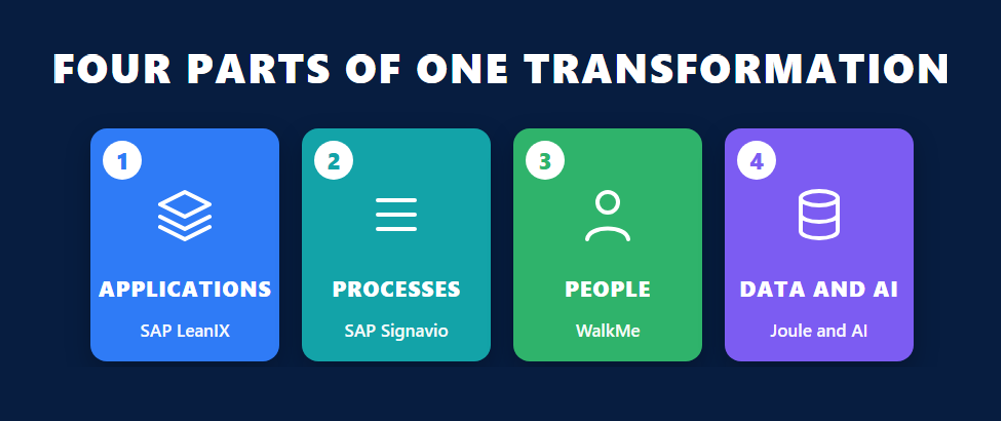
Each product in the portfolio answers a different question a customer asks during change. SAP LeanIX answers what applications and architecture the company runs. SAP Signavio answers how its processes really work and where they break. WalkMe answers whether people actually use the new systems. C_BCBTM checks that you can join those answers into one story.
SAP’s own Business Transformation Management page frames the portfolio in three verbs: see the current state, align business, IT and operations around connected insight, and govern what changes. That framing is useful in the exam because it gives you an order for the conversation rather than a product list.
SAP LeanIX: what is running
SAP LeanIX is the enterprise architecture management tool. It gives a company accurate data on the applications it runs, how complex the landscape is, and what a future state should look like. SAP’s product page notes that the AI Agent Hub in SAP LeanIX is generally available, giving one place to manage AI agents across their lifecycle. Enterprise architecture has its own established method, and frameworks such as The Open Group TOGAF explain the architectural principles the blueprint expects you to talk about.
SAP Signavio: how work actually flows
SAP Signavio shows how processes run, helps spot inefficiencies, compares performance with benchmarks and supports continuous improvement. Much of that rests on process mining techniques, which rebuild the real process from system event logs rather than from workshop diagrams. SAP says Signavio now includes Joule Agents for tasks such as onboarding, value-case creation and dashboard analysis.
WalkMe: whether people adopt the change
WalkMe finds where employees struggle with software and closes the gap with in-context guidance and automation. When SAP agreed to buy WalkMe in June 2024, it said the deal complemented the Business Transformation Management portfolio around SAP Signavio and SAP LeanIX. SAP’s CEO put the logic in one line:
“Applications, processes, data and people are the four key elements of a successful business transformation.”
Read that sentence as an exam map. LeanIX covers applications, Signavio covers processes, WalkMe covers people, and data and AI form the fourth blueprint area. A recommendation that leaves one of them out is usually the weaker answer.
How Do You Shape the Pitch for Each Buying Center?
A buying center is the group of people who influence a purchase, and C_BCBTM expects the same portfolio to be framed differently for each of them. ERPPrep’s last blueprint area asks you to match features to distinct buying centers and decision-makers. The skill being tested is choosing which value to lead with, not knowing more features.
The exam does not publish a list of personas, so the safest preparation is to practise with the stakeholders that the product scopes naturally point to. Three cover most scenarios.
The business or process owner
Someone responsible for order to cash, procure to pay or another end-to-end chain usually cares about cycle times, rework and compliance. Lead with Signavio’s view of how the process really runs, then show how adoption guidance in WalkMe keeps an improved process from slipping back.
The CIO or enterprise architect
IT leaders worry about landscape complexity, technical debt and the risk of a migration. Lead with LeanIX’s application transparency and future-state planning, and connect it to Signavio so that architecture decisions follow real process needs. SAP’s own customer stories use this pairing: Tetra Pak used SAP Signavio and SAP LeanIX to reduce technical debt and standardise change globally, and adidas used SAP LeanIX to optimise its application portfolio.
The HR, change or line-of-business lead
Leaders who own a rollout care about whether people adopt it. Lead with WalkMe’s guidance and its insight into where users struggle. SAP cites STADA, which used WalkMe to speed up adoption of SAP SuccessFactors HCM, as an example.
In the activity, read the scenario for who is speaking and what they are measured on before you decide which product to lead with. The same three tools appear in every answer; the order and the value statement change.
Where Do Joule and SAP Business AI Enter the Story?
AI enters C_BCBTM as an amplifier of the portfolio rather than a separate product to sell. ERPPrep’s blueprint asks how the solutions do more when paired with SAP’s cloud data foundation and AI services, and SAP’s learning journey asks you to describe their role within the Autonomous Enterprise and their integration with Joule, SAP’s AI copilot.
The prerequisites SAP lists for the learning journey tell you how much AI background it expects: Discovering the Autonomous Enterprise and Introducing SAP Business AI Platform. Take those two first if the terms are new to you, because the Positioning course builds on them.
On the product side, SAP describes AI agents across the portfolio for architecture guidance, process modelling and contextual help for users. A good answer in a scenario uses AI to strengthen a value statement you have already made, for example faster value-case creation in Signavio or governance of AI agents in LeanIX, rather than leading with AI for its own sake.
The learning journey also says the portfolio delivers value across SAP and non-SAP environments. Keep that in mind when a scenario describes a mixed landscape: the portfolio does not require a customer to run SAP everywhere, and assuming it does is a weak recommendation.
How Should You Prepare for C_BCBTM?
Prepare for C_BCBTM by following SAP’s learning journey in order and then rehearsing positioning decisions on realistic scenarios. The journey covers the why, what and how of the portfolio across three courses. Because the activity scores judgment, most of your time should go into turning customer problems into recommendations, not into memorising product features.
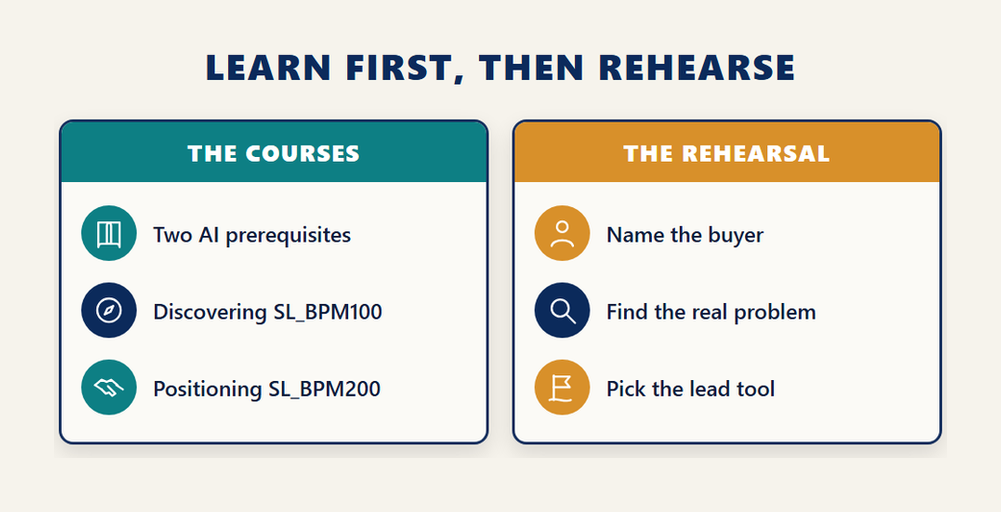
- Cover the prerequisites first. Work through Discovering the Autonomous Enterprise and Introducing SAP Business AI Platform, which SAP lists before the journey.
- Take the Discovering course, SL_BPM100. It runs 1 hour 9 minutes across three units on the portfolio, its business value and SAP customer references.
- Take the Positioning course, SL_BPM200. It runs 1 hour 3 minutes across two units on end-to-end processes, integration with the SAP portfolio and SAP Business AI Platform, and industry value.
- Finish with the Selling course, SL_BPM290. Its details sit behind sign-in, so check the current content on SAP’s site.
- Write a one-line value statement for each product and each buying center. Keep them short enough to say aloud in a meeting.
- Rehearse full scenarios. Read a customer situation, name the buyer and the problem, choose the lead product, then add the other two.
- Try SAP’s scenario-based assessment tool and complete the readiness checks. Confirm your format and language before booking.
The SAP learning journey page lists the outcomes it targets, including using customer reference stories in sales conversations. Those stories are worth collecting as you go, because a scenario answer backed by a real example reads as more credible.
An older erpqna page, the earlier positioning preparation guide, describes a previous version of this credential. Use it for background on how the exam has evolved, and take current facts from SAP’s certification page.
C_BCBTM or a Product Consultant Exam: Which One Fits You?
Choose C_BCBTM if your job is to sell or position the portfolio, and a product consultant exam if your job is to implement one of the tools. SAP runs separate consultant credentials for Signavio process management, LeanIX enterprise architecture and WalkMe digital adoption, and each goes deep on one product. C_BCBTM goes wide across all three.
| Question | C_BCBTM positioning | Product consultant credentials |
|---|---|---|
| Who sits it | Presales, sales, marketing, customer engagement | Consultants who implement the product |
| Product scope | Signavio, LeanIX and WalkMe together | One product each |
| What is judged | The recommendation and its value story | Applying the product in a project |
| Hands-on configuration | Not needed | Central |
Some people hold both. A consultant who often supports sales calls may find C_BCBTM a quick way to show breadth, and a presales specialist who wants to move into delivery will eventually need the consultant exam for their main product.
C_BCBTM also sits in SAP’s wider family of positioning credentials, which test the same kind of reasoning for other parts of the portfolio, such as finance or business AI. If you have passed one of those, the format will feel familiar; the product knowledge will not. For a short checklist written for an earlier release, the C_BCBTM_2509 exam checklist is still a useful starting point, provided you check every fact against SAP’s current page.
Frequently Asked Questions
What is the C_BCBTM certification?
C_BCBTM is SAP Certified – Positioning Business Transformation Management Solutions, an associate-level credential for presales and sales people who position SAP Signavio, SAP LeanIX and WalkMe as one portfolio.
How long is the C_BCBTM exam?
SAP’s certification page shows a duration of 2 hours for the single Scenario-Based Assessment activity.
What score do you need to pass C_BCBTM?
The pass score is 60 percent, shown on both SAP’s certification page and the ERPPrep study guide.
Does C_BCBTM have a bank of questions?
No. It is one scenario activity in which you reason through a customer situation and make positioning decisions, so there is no fixed set of questions to memorise.
Which languages is C_BCBTM available in?
SAP says languages vary by format. The roleplay with AI guidance is offered in English, Spanish, Italian, French, Japanese and 25 more languages, while the recorded video format is English only.
Do I need hands-on experience with Signavio, LeanIX or WalkMe?
No configuration skill is tested. You need a clear understanding of what each product does and the value it brings, plus practice turning customer problems into recommendations.
Which courses prepare you for C_BCBTM?
SAP’s learning journey uses three courses: Discovering (SL_BPM100), Positioning (SL_BPM200) and Selling (SL_BPM290), with two prerequisite courses on the Autonomous Enterprise and SAP Business AI Platform.
Are the seven blueprint areas weighted?
No weightings are published. ERPPrep lists seven areas without percentages and SAP’s certification page shows no topic list, so prepare for all seven evenly.
What do I need before booking C_BCBTM?
SAP asks for a Learning Hub subscription with certification attempts, a valid SAP Universal ID with a secondary email, and a system that passes its Technical Readiness Checklist.
Conclusion
The SAP Business Transformation Management certification asks one thing of you: to sell three tools that SAP bought separately as a single answer to a customer’s change problem. C_BCBTM does it in one Scenario-Based Assessment activity of 2 hours with a 60 percent pass score, across seven blueprint areas that move from product knowledge to buying-center alignment. Learn what LeanIX, Signavio and WalkMe each answer, practise leading with the right one for each buyer, and use AI to strengthen a value statement rather than replace it. Follow SAP’s learning journey in order, rehearse full scenarios, confirm your format and language, and then book the exam with confidence.


