On 19 October 2026 SAP retired its SAP BTP solution architect exam, P_BTPA, and pointed every candidate who had been preparing for it at a new code: C_BAIPA. The credential behind that code is SAP Certified – Solution Architect – SAP Business AI Platform, and it is not a renamed copy of the old exam. The platform it describes has been reorganised around three pillars and an AI agent layer, and the exam follows that new shape.
For a SAP Business AI Platform architect, the change matters in practical ways. The study plan you built for P_BTPA covered services one by one. C_BAIPA asks you to design across Build, Contextualize and Reason, and Govern, apply SAP’s advisory methodologies, and defend a blueprint in a single scenario. This article sets out why the replacement happened, what SAP and ERPPrep each publish about the format, the seven blueprint areas, how the pillars and methodologies connect, what carries over from P_BTPA, how C_BAIPA differs from the positioning credentials that share its vocabulary, and how to prepare.
Why Did SAP Replace P_BTPA With C_BAIPA?
SAP replaced P_BTPA because the platform it certified changed. SAP Business Technology Platform has been repositioned as SAP Business AI Platform, organised around Build, Contextualize and Reason, and Govern pillars with AI agents at the centre. P_BTPA retired on 19 October 2026, and SAP’s own certification page named C_BAIPA as its recommended successor.
The old exam was built around service families. Its blueprint on ERPPrep listed areas such as application development and automation services, data and analytics services, integration services, AI services and foundation services. That structure made sense when AI was one capability among several. It no longer matches how SAP describes the platform, where agents and applications are created in Joule Studio, grounded in business data, and governed from the start.
The successor keeps the architect’s job the same: turn business requirements into a defensible solution design. What moves is the frame around that job. C_BAIPA asks you to reason about where an agent gets its context, how it is observed once it runs, and how a design stays clean-core while it extends SAP applications.
What the code change means for search and study
Many candidates still search for the SAP BTP solution architect certification, and older study material still describes P_BTPA. Treat anything written for P_BTPA as background only. The current exam is C_BAIPA, its blueprint is the one described below, and its preparation journey is SAP’s Becoming an SAP Business AI Platform Solution Architect learning journey.
What Does the C_BAIPA Exam Look Like?
C_BAIPA is one Scenario-Based Assessment activity with a 60 percent passing score. SAP’s certification page displays a 2 hour duration for it, and both SAP and ERPPrep list the same single-activity format and pass mark. You are given a realistic business situation and scored on the architectural decisions and reasoning you produce, not on recalled facts.
The format is SAP’s performance-based model. In a Scenario-Based Assessment you read a business situation and reason through the right decisions and the right sequence of steps, which suits an architecture credential well: there is rarely one correct service, but there is usually a design that fits the constraints better than the alternatives. ERPPrep builds its C_BAIPA scenario simulations around that idea, with multi-phase scenarios ordered from foundation to advanced and skill drills grouped into eight practice domains.
| Field | ERPPrep study guide | SAP certification page |
|---|---|---|
| Exam code | C_BAIPA | C_BAIPA |
| Format | Scenario-Based Assessment, 1 activity | 1 activity, Scenario Based Assessment |
| Passing score | 60% | 60% |
| Duration | Not published | 2 hours |
| Languages | English | Vary by format: roleplay with AI guidance in English, Spanish, Italian, French, Japanese and more; recorded video in English only |
| Product listed | SAP Integration Suite | SAP Integration Suite, on the learning journey |
Two rows need a word of explanation. On languages, this article follows the official SAP certification page, which shows a list that depends on how you complete the activity rather than a single language. On duration, ERPPrep publishes nothing and SAP displays 2 hours, so 2 hours is the figure to plan around. Neither source publishes a fee or an item count for this exam, so none is given here.
What SAP asks you to check before exam day
SAP’s page lists three readiness steps: run its technical readiness checklist for hardware, software and connectivity; confirm a Learning Hub subscription that includes certification exam attempts, together with an SAP Universal ID that has a secondary email set up; and try SAP’s AI-powered scenario-based assessment tool so the format is familiar before the attempt counts.
Which Seven Blueprint Areas Does C_BAIPA Cover?
ERPPrep’s study guide lists seven blueprint areas for C_BAIPA: enterprise architecture foundations and architect roles, platform fundamentals and Joule, the Build pillar, the Contextualize and Reason pillar, the Govern pillar with the platform foundation, the three architectural advisory methodologies, and solution blueprinting across business, applications and security architecture. No weightings are published.
| Blueprint area | What it asks of you |
|---|---|
| Enterprise Architecture Foundations and Architect Roles | Explain what enterprise architecture contributes, distinguish architect types, and use SAP’s framework tooling with reference business and solution architectures |
| SAP Business AI Platform Fundamentals and Joule | The autonomous enterprise vision, the role of Joule, the account model, commercial models, consumption estimates and available resources |
| Build Pillar: Development, Runtimes and Integration | Choose tools, runtimes and programming models, create agents and applications in Joule Studio, and apply SAP’s integration strategy and SAP Integration Suite |
| Contextualize and Reason Pillar: Data and Analytics | Core data and analytics concepts and the part SAP Business Data Cloud plays in giving agents harmonised, semantically rich data |
| Govern Pillar and Platform Foundation | Plan governance for agents and applications, monitor them through SAP AI Agent Hub observability, and confirm outcomes with SAP Signavio Process Intelligence |
| Architectural Advisory Methodologies | Apply the advisory frameworks for application extensions, data and analytics, and integration as decision tools aligned with a clean-core strategy |
| Solution Blueprinting: Business, Applications and Security Architecture | Combine business, applications and cloud security architecture into one blueprint and justify the trade-offs to stakeholders |
Because nothing is weighted, plan by area rather than by percentage. A sensible reading is that the first two areas give you vocabulary, the three pillar areas give you the platform, and the last two are where the scenario is decided: a methodology narrows the options, and the blueprint is what you defend.
Why enterprise architecture comes first
The first area is the one P_BTPA candidates are most likely to skim, and it is the one that frames every later answer. SAP expects you to tell an enterprise architect’s concerns apart from a solution architect’s, and to structure a design with reference architectures rather than from scratch. If you have not worked with a formal framework before, the TOGAF Standard overview from The Open Group is a useful neutral grounding in why architecture is organised into business, data, application and technology views.
How ERPPrep’s eight drill domains relate to the seven areas
ERPPrep’s product page groups its drills into eight practice domains, such as AI agent and Joule solution design, integration architecture, and platform commercial models and cost estimation. That is a practice grouping that splits some areas more finely. The seven areas above are the blueprint to plan against.
How Do Build, Contextualize and Reason, and Govern Fit Together?
The three pillars form one system on C_BAIPA. Build creates agents and applications, Contextualize and Reason supplies the business data they depend on, and Govern oversees them once they run. A scenario rarely tests one pillar alone; it asks how a decision in one changes the others, so learn them as a connected chain rather than three lists.
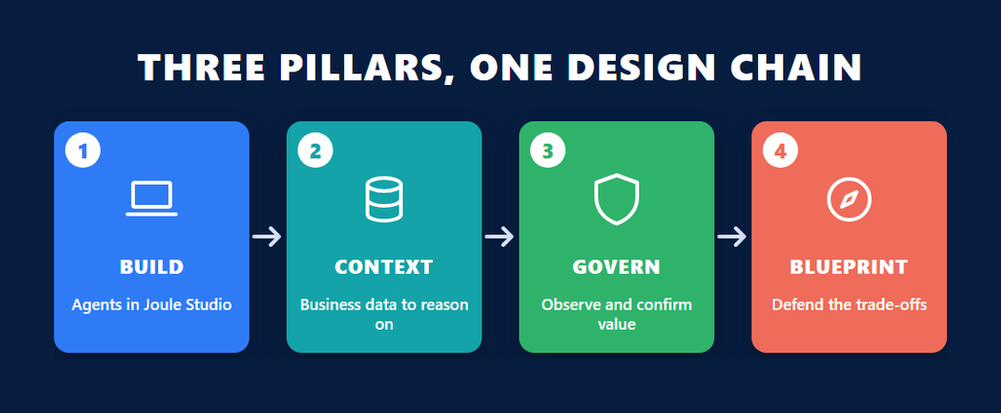
SAP describes Joule Studio as the place where that chain starts. In its announcement of the new Joule Studio, the president of SAP Business Technology Platform put it plainly:
“Joule Studio brings SAP Business AI Platform to life, empowering organizations to build agents that are natively grounded in live business data, end-to-end processes, and rich business semantics that already exist across your SAP landscape.”
That sentence names all three pillars in one breath. The agent is built in Joule Studio, it is grounded in business data and semantics, and the phrase “already exist across your SAP landscape” is the clean-core argument: use what the landscape holds instead of copying it. The Joule Studio announcement is worth reading in full for the Build pillar, because it describes the development options an architect has to choose between.
Build: tools, runtimes and integration
The Build area covers selecting development tools, runtime environments and programming models, creating agents and applications with Joule Studio, and applying SAP’s integration strategy with SAP Integration Suite to connect SAP and non-SAP systems. In a scenario, the question is usually which option fits the volume, latency and ownership constraints described, not which service exists.
Contextualize and Reason: the data an agent relies on
An agent is only as trustworthy as the data it reasons over. This pillar asks for core data and analytics concepts and the role SAP Business Data Cloud plays in giving agents and applications harmonised, semantically rich data. Expect to justify where context comes from and why it is reliable.
Govern: planning oversight before the first agent runs
Govern is the pillar P_BTPA had no direct equivalent for. ERPPrep’s blueprint asks you to plan governance for agents and applications from the outset, monitor them through the observability features of SAP AI Agent Hub, and confirm business outcomes with SAP Signavio Process Intelligence. For a vendor-neutral view of what AI governance should cover, the NIST AI Risk Management Framework sets out the govern, map, measure and manage functions that most enterprise AI policies borrow from.
How Do SAP’s Three Advisory Methodologies Shape a Design?
SAP’s three advisory methodologies cover application extensions, data and analytics, and integration. On C_BAIPA they work as decision tools: you pick the right one for the problem in the scenario and use it to narrow the design options toward a scalable, maintainable answer that respects a clean-core strategy. Memorising their steps is less useful than practising when each applies.
ERPPrep’s study guide describes the methodologies as structured decision tools that move an architect past tool-by-tool thinking. The learning journey has a dedicated course for them, Introducing the Architectural Methodologies, alongside the platform deep dive, Exploring SAP Business AI Platform Architecture.
- The application extension methodology helps decide where and how to extend business functionality without modifying the core.
- The data and analytics methodology shapes how information is collected, unified and made available to people and agents.
- The integration methodology classifies integration scenarios so you can choose fitting patterns and technologies.
The reference material behind these frameworks lives in the SAP Architecture Center, which publishes SAP’s reference architectures by technology domain, including AI, application development, data and analytics, and integration. Browsing a few reference architectures in each domain is a practical way to see what a finished, defensible design looks like before you are asked to produce one.
Turning a methodology into an answer
In a scenario, the methodology is the reasoning you show. State the business goal and constraint, name the methodology that fits, explain which options it rules out, and land on the design. That sequence is also how SAP describes the target candidate: someone who translates complex business requirements into a holistic solution blueprint.
What Changes for Someone Who Prepared for P_BTPA?
Much of a P_BTPA candidate’s knowledge carries over: architect roles, the enterprise architecture framework, integration strategy, SAP Integration Suite, SAP Business Data Cloud and the advisory methodologies all appear in both blueprints. What changes is the organising frame. C_BAIPA arranges content by pillar, puts Joule Studio agents at the centre, and adds explicit governance and observability.
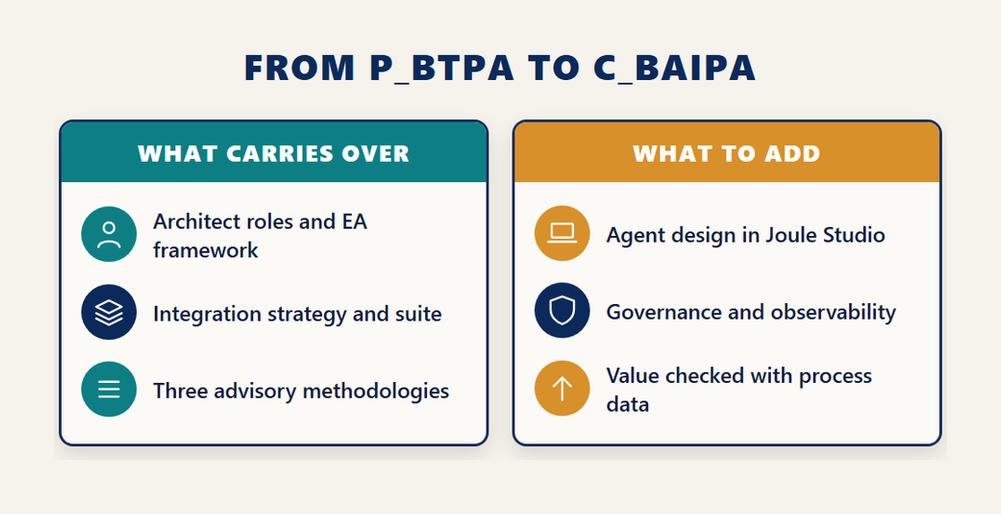
Comparing ERPPrep’s blueprint for the retired exam with the current one shows the shift clearly. P_BTPA treated AI services as one area next to application development, data and analytics, integration and foundation services. C_BAIPA folds those topics into Build, Contextualize and Reason, and Govern, and adds material that had no home before: creating agents in Joule Studio, observing them through SAP AI Agent Hub, and confirming business value with SAP Signavio Process Intelligence.
What to keep, and what to add
- Keep your enterprise architecture foundations, account model knowledge and cost estimation practice; platform fundamentals and consumption estimates remain in scope.
- Keep your integration preparation; SAP Integration Suite is the product SAP lists against the learning journey.
- Add agent design in Joule Studio, and the reasoning about where an agent gets its context.
- Add governance planning and observability, which P_BTPA did not cover as a pillar.
- Add the habit of defending a blueprint across business, applications and security architecture in one answer.
If you were close to sitting P_BTPA, the gap is real but bounded. Plan for new material in the Build and Govern pillars rather than starting again from the beginning.
Is C_BAIPA the Same Exam as the Other SAP Business AI Credentials?
No. C_BAIPA is SAP’s solution architect credential for SAP Business AI Platform. Two other codes share its vocabulary: C_BCBTP certifies positioning SAP Business AI Platform to customers, and C_BCBAI covers positioning SAP Business AI solutions as part of SAP Business Suite. Both are positioning credentials about explaining value, while C_BAIPA is about designing the solution.
The confusion is understandable, because search results for “SAP Business AI certification” mix all three. The difference is the role. A positioning credential asks you to match a customer’s problem to the right platform capability and explain why. The architect credential asks you to design the solution that delivers it, across integration, extension, data and governance, and to defend the trade-offs.
Which one to choose
If you advise customers before a project starts, a positioning credential fits your work. ERPQnA’s guide to the Positioning SAP Business AI Platform exam explains how that scenario is scored. If you design and defend the target architecture once a project is under way, C_BAIPA is the credential that matches the job.
How Should You Prepare for a Scenario-Based Architecture Exam?
Prepare for C_BAIPA by learning the platform as a connected system, practising the advisory methodologies as decision tools, and rehearsing complete scenarios from business goal to defended design. SAP’s learning journey, Becoming an SAP Business AI Platform Solution Architect, lists no prerequisites and supplies the two courses the blueprint draws on.
The SAP solution architect learning journey pairs Exploring SAP Business AI Platform Architecture with Introducing the Architectural Methodologies. Work through them in that order, then follow this sequence:
- Learn the three platform pillars as one connected system, so you can trace how a Build decision affects the data and governance choices that follow.
- Practise picking the right advisory methodology for an extension, data and analytics, or integration problem, and walk through how it narrows the design options.
- Build a clear picture of SAP’s integration strategy and SAP Integration Suite, because choosing a pattern that fits volume, latency and ownership is a recurring decision.
- Revisit the enterprise architecture foundations, architect roles and reference architectures, since they give you the vocabulary to structure and justify a blueprint.
- Rehearse full scenarios end to end, listing goals and constraints first, sketching the solution, then explaining why each alternative was rejected.
Practising out loud
SAP’s displayed format list includes a roleplay with AI guidance and a recorded video. Both reward an answer you can say clearly, so practise explaining a design out loud, in order, with the rejected options named. Writing a blueprint silently is not the same skill as defending one.
Who Is the C_BAIPA Certification Built For?
C_BAIPA is built for experienced solution and enterprise architects, senior developers and IT strategists who design how an organisation adopts AI on SAP’s platform. SAP describes the target candidate as a seasoned professional who bridges business strategy and technology execution, and lists cloud security, business and applications architecture as the skills involved.
SAP’s page says that passing signals command of integration strategies, technical architecture, application design and solution governance, the knowledge needed to lead a digital transformation initiative. That is a senior profile. If most of your experience is configuring one module, the exam will feel broad, because it expects you to weigh integration, extension, data and governance together.
Related paths for data-focused architects
Architects whose work centres on the Contextualize and Reason pillar may also look at SAP’s data architecture credential. ERPQnA’s guide to the SAP Business Data Cloud architect exam covers that route in depth, and the two credentials complement each other well for anyone designing agents that depend on governed business data.
Frequently Asked Questions
What is C_BAIPA?
C_BAIPA is the exam code for SAP Certified – Solution Architect – SAP Business AI Platform. It certifies that you can translate business requirements into a solution blueprint on SAP Business AI Platform, covering integration, application extensions, data and governance.
Did C_BAIPA replace P_BTPA?
Yes. P_BTPA, the SAP BTP solution architect exam, retired on 19 October 2026, and SAP’s certification page for it named C_BAIPA as the recommended successor.
How is the C_BAIPA exam delivered?
As one Scenario-Based Assessment activity with a 60 percent passing score. SAP’s certification page displays a 2 hour duration. You reason through a business situation and are scored on your decisions and their sequence.
Which languages is C_BAIPA available in?
SAP displays that languages vary by format. The roleplay with AI guidance is offered in English, Spanish, Italian, French, Japanese and further languages, while the recorded video format is in English only.
Are there prerequisites for C_BAIPA?
SAP’s learning journey for the credential lists no prerequisites. The exam still assumes senior architecture experience, so the absence of a formal prerequisite does not mean it is an entry-level exam.
How many blueprint areas does C_BAIPA have?
ERPPrep’s study guide lists seven blueprint areas, from enterprise architecture foundations to solution blueprinting, with no published weightings. ERPPrep’s practice drills are grouped into eight domains, which is a finer practice grouping of the same content.
Is C_BAIPA the same as C_BCBAI or C_BCBTP?
No. C_BCBTP and C_BCBAI are positioning credentials about explaining the value of SAP Business AI Platform and SAP Business AI to customers. C_BAIPA is the architect credential about designing and defending the solution.
Which SAP product is listed for C_BAIPA?
SAP lists SAP Integration Suite against the learning journey, and the blueprint also covers Joule Studio, SAP Business Data Cloud, SAP AI Agent Hub and SAP Signavio Process Intelligence.
What should I study first for C_BAIPA?
Start with the three pillars as one connected system, then the advisory methodologies. The enterprise architecture foundations give you the vocabulary, but the pillars and methodologies are where most scenario decisions are made.
Conclusion
C_BAIPA is the architect exam SAP now offers in place of P_BTPA, and it reflects a platform that has moved from service families to pillars and agents. The format is one Scenario-Based Assessment activity at 60 percent, with a 2 hour duration displayed by SAP and languages that depend on the format you choose. Plan by ERPPrep’s seven blueprint areas, learn Build, Contextualize and Reason, and Govern as one chain, and treat the advisory methodologies as the reasoning you show. If you prepared for P_BTPA, keep your architecture and integration foundations and add agent design, governance and observability. Then rehearse whole scenarios out loud until your blueprint, and the alternatives you rejected, come out in a clear order every time.


