Put the revision cards away. This one is marked on what you build.
C_LCNC, the exam behind the SAP Build Developer certification, is a System-Based Assessment. There is no list of items to work through and nothing to recognise. Instead you are given a single guided activity inside a working SAP Build environment and asked to carry out the building and configuration tasks it describes: connect to a back end system, model the data an app consumes, build a process with forms and decision logic, wire an Action to a remote API, configure a Work Zone site. The credential awarded is SAP Certified, SAP Build Developer, at associate level, and the cut score is 83 percent, well above the 60 percent many SAP associate certifications use. That combination, a task you complete rather than answers you choose, and a bar set high, is what makes this exam different from almost anything else on an SAP learning path.
What Does the SAP Build Developer Certification Prove?
That you can build applications and automate business processes on SAP Build using a low code and no code approach, rather than describe the tools. C_LCNC confirms you can connect to SAP back end systems, model the business data an app consumes, and design and run process automations, at an associate depth suited to a mentored project role.
The word doing the work there is build. An associate credential on a conventional exam usually proves familiarity, and an employer reads it that way. This one proves execution, because the assessment has you produce something inside the product. That changes what it signals on a CV: not that you recognise SAP Build terminology, but that you have stood up a process project and made it run.
The scope reaches wider than the name suggests. Alongside app building and automation it covers the SAP Business Technology Platform foundation the tools sit on, user access and site configuration through SAP Build Work Zone, and the AI agent capabilities delivered through Joule Studio. Anyone weighing whether that breadth is realistic at associate level will get a clearer picture from the C_LCNC sample tasks than from any description of it.
Who the credential targets
- Low code and no code developers already building on SAP Build
- Business technologists and citizen developers formalising what they do
- Consultants moving into an SAP Build delivery role
- Business users whose app building has outgrown the informal stage
What Is a System-Based Assessment, and Why Does It Matter Here?
A System-Based Assessment, or SyBA, puts you inside a live style SAP environment and scores you on whether you completed the tasks correctly. C_LCNC is delivered as one such activity rather than as a series of separate items, which reflects SAP’s move to performance based certification and changes how preparation has to work. The contrast is the Scenario-Based format used by the C_BCBTP positioning exam, where you reason through a business situation instead of configuring one.
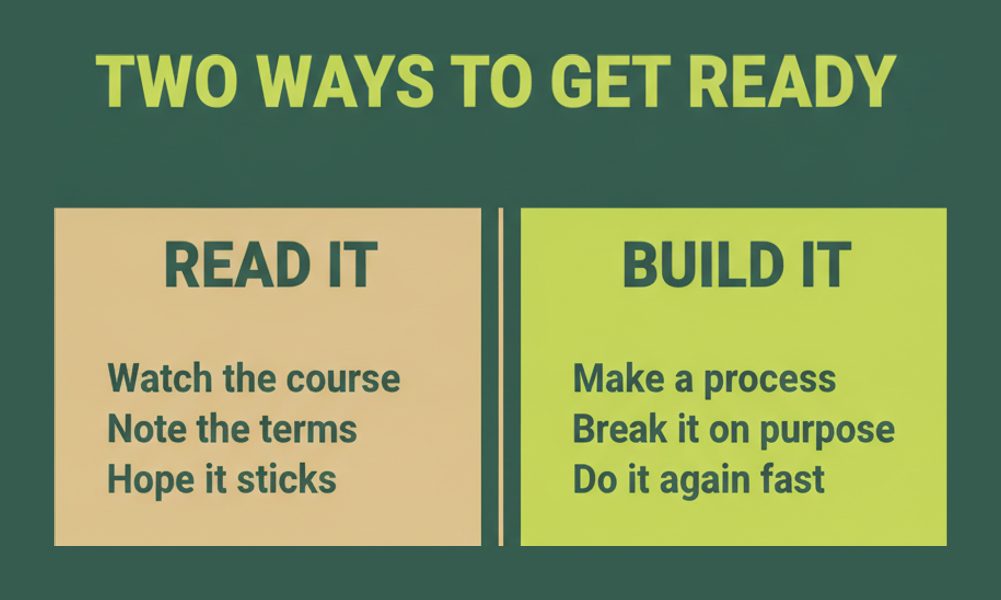
The practical difference is that recognition does not help you. On a conventional paper, a candidate who half remembers a concept can often still identify the right statement among several. Inside a working environment there is nothing to identify. Either you know where the setting lives and what it does, or the task does not complete. Partial familiarity earns very little.
It also means the exam is sequential in a way a list of items never is. Tasks build on one another inside the same environment, so a wrong turn early can leave later steps impossible rather than merely wrong. That is the argument for rehearsing whole workflows end to end rather than drilling isolated features.
No duration is published for C_LCNC on any of the money site’s pages, and the single activity design means there is no item count either. Plan around fluency rather than pace: the goal is that each sequence runs without hesitation, because hesitation is what a timed hands on assessment punishes.
Why Is the C_LCNC Cut Score 83 Percent?
Because SAP sets each exam’s threshold to the competency it wants certified, and for an SAP Build developer that means reliable capability across the whole toolset rather than familiarity with part of it. At 83 percent, C_LCNC sits well above the 60 percent used by many SAP associate certifications, which tells you something about the expected standard.
| Field | Value |
|---|---|
| Credential | SAP Certified, SAP Build Developer |
| Exam code | C_LCNC |
| Level | Associate |
| Format | System-Based Assessment, one guided activity |
| Cut score | 83 percent |
| Language | English |
| Product scope | SAP Build, on SAP Business Technology Platform |
| Blueprint areas | 6, with no weighting published |
The high bar and the format reinforce each other. On an exam where answers are selected, a threshold has to absorb a certain amount of successful guessing. On one where tasks are completed, it does not, so the score maps far more directly onto ability and can sit higher without becoming unfair.
What this changes for you is the definition of ready. Being able to complete each task once, slowly, with a reference open, is not ready at 83 percent. Being able to complete each of them without looking anything up is. That is a different amount of rehearsal from what most associate exams need, and it is the single most useful thing to know before planning a study schedule.
Confirm the version before you book
SAP revises product scope between exam versions, and SAP’s own Learning page is the authoritative place to check what the current C_LCNC covers before you pay for anything. That is worth two minutes given how quickly the SAP Build toolset has been adding capability.
What Does the SAP Build Blueprint Actually Cover?
Six areas, running from the platform underneath to the AI agents on top. They are SAP Business Technology Platform foundations, connecting to SAP systems and modelling business data, process automation with SAP Build Process Automation, automations and Actions and API integration, user access and sites with SAP Build Work Zone, and AI agents with Joule Studio. No weighting is published against any of them.
| Blueprint area | What it asks you to do |
|---|---|
| SAP BTP Foundations | Understand BTP architecture, services, connectivity, and the security and identity model that every app sits on |
| Connecting to SAP Systems and Modeling Business Data | Establish connections to back end systems and model the data an application reads and writes |
| Process Automation with SAP Build Process Automation | Reuse content, build process projects with forms and conditions, then release, deploy, run and monitor them with custom KPIs |
| Automations, Actions and API Integration | Identify automation use cases, use the desktop agent, apply decision logic, and call remote system APIs through Actions |
| User Access and Sites with SAP Build Work Zone | Structure the site menu, workpages, workspaces, application integration and header bar settings |
| AI Agents and Joule Studio | Use Joule Skills for deterministic tasks and build custom Joule agents for multi step scenarios |
The absence of weightings is probably correct rather than missing. A single activity cannot allocate a fixed share of marks to each area the way a paper of separate items can, because the task set decides which areas it touches. What it means for you is that no area can be safely under prepared on the assumption that it is small.
Read in order, the six areas describe a delivery sequence rather than six subjects. The platform underneath, then the data, then the process, then the integration, then the access, then the intelligence. Studying them in that order is also the order in which each one makes the next comprehensible.
Why Are Actions and API Integration the Hardest Part?
Because a choice made in one step changes what is possible several steps later. Candidates most often struggle with API integration through Actions, decision logic inside processes, and connecting apps to the correct SAP data, and all three share that property: the consequence of a decision shows up downstream rather than immediately.
An Action encapsulates the API of a remote system so a process can call it. How you define that Action, which parameters it exposes and what it returns, determines what a later process step can do with the result. Get it wrong and nothing fails at the point of the mistake; a step three stages later simply has nothing useful to work with.
Decision logic behaves the same way. A condition that evaluates the wrong field routes a process down a branch that then behaves correctly for the wrong case, which is far harder to spot than an outright error. On a performance based assessment where tasks connect, that is exactly the kind of failure that costs.
The practical answer is to build the mental model rather than memorise screens. SAP’s own documentation for SAP Build Process Automation sets out how Actions, conditions and process steps relate, and reading it as a system rather than as a feature list is what makes the downstream effects predictable.
What Do Work Zone and Joule Studio Add to the Scope?
Work Zone adds the delivery surface and Joule Studio adds the AI layer. Together they extend C_LCNC beyond building an app into publishing it to the people who need it, and into having an agent carry out multi step work on top of what you have built. Both are named blueprint areas rather than optional extras.
SAP Build Work Zone is where the apps and processes you have built become something a business user can actually reach. The blueprint names the site menu, workpages, workspaces, application integration and header bar settings, which is the information architecture of the site rather than its styling. SAP’s Work Zone documentation covers the same structures in the order the tasks tend to use them.
Joule Studio is the newer half and the one most candidates have least exposure to. The scope covers Joule Skills, which deliver a result for a deterministic task, and custom Joule agents, which plan and execute a multi step business scenario. It also names tools and the Model Context Protocol as the mechanisms for extending agent behaviour, so the vocabulary matters as much as the capability.
How the two relate
Work Zone answers where a user meets your work. Joule Studio answers what happens when the work is handed to an agent instead of a person. A task set that touches both is asking whether you can complete a delivery rather than only build a component, which is the associate project-participation depth the credential describes. The wider toolset context sits on SAP’s developer tools page.
Who Should Take C_LCNC, and What Should They Study First?
People who already build on SAP Build and want the credential to say so, and consultants or business users moving into that role. Study SAP BTP foundations first regardless of background, because every app and automation in the other five areas sits on the platform and the tasks assume you understand its connectivity and identity model.
The strongest fit is someone who has built a process project, even a rough one. For them the preparation is mostly about closing gaps and raising speed, and the format works in their favour because it rewards exactly what they already do. The credential then converts informal capability into something an employer can read.
A reader coming from traditional code first development should expect a genuine adjustment. Low code is a different discipline rather than a simplified version of the same one, with its own idea of what a component is and where logic belongs. The independent explainer of low code platforms is a useful ten minutes for anyone meeting the category through SAP rather than the other way round.
The weaker fit is a candidate with no hands on access to SAP Build at all. A performance based assessment cannot be prepared for by reading, and without an environment to practise in there is no realistic route to 83 percent. If you are in that position, our earlier notes on the low code certification path cover how candidates have approached getting that access.
How Should You Prepare for the C_LCNC Assessment?
By rehearsing the tasks rather than reading about them, and by following SAP’s four named learning path courses in order. The cut score of 83 percent means the target is not understanding but fluency, so the measure of readiness is whether a sequence runs without you stopping to think about where something lives.
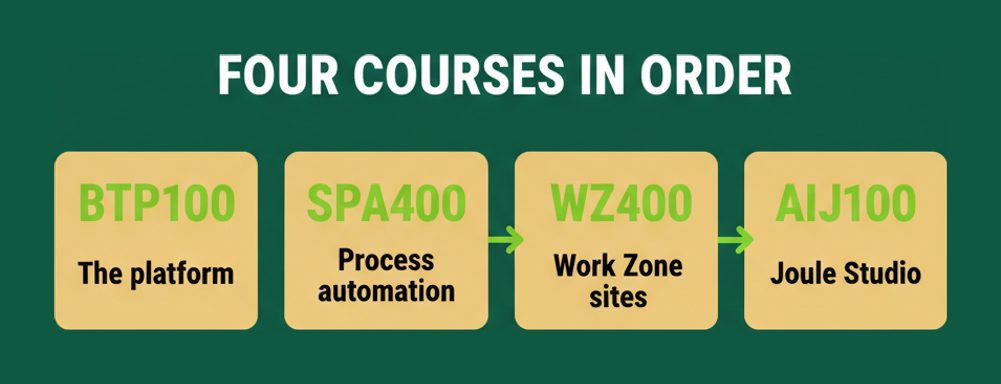
| Course | What it covers |
|---|---|
| BTP100 | Exploring SAP Business Technology Platform, its architecture, services, connectivity and security fundamentals |
| SPA400 | Developing with SAP Build Process Automation, from reusing content to Actions and the automation APIs |
| WZ400 | Designing SAP Build Work Zone, covering information architecture, the site menu, workpages and workspaces |
| AIJ100 | Introducing Joule Studio in SAP Build, covering Joule Skills and building custom Joule agents |
- Work through the platform foundation first so that BTP architecture, services, connectivity and security are familiar before you build anything, since every later task sits on top of them.
- Create one complete process project end to end, adding a form for a user interaction, a condition to control flow, then releasing, deploying, running and monitoring it so the full lifecycle feels routine.
- Rebuild that same project from an empty start without notes, because the difference between having done it once and being able to do it reliably is the difference between 60 percent and 83.
- Drill API integration through Actions specifically, encapsulating a remote system API and calling it inside a process, since that is where an upstream setup choice shapes what later steps can do.
- Add decision logic and a desktop agent automation to the project you already have, so the harder chains are practised in context rather than in isolation.
- Configure a Work Zone site around your finished process, working through the site menu, workpages and workspaces until the information architecture is second nature.
- Finish with Joule Studio, building one Joule Skill for a deterministic task and one custom agent for a multi step scenario, which is the newest material and the least likely to be familiar.
Keep returning to the platform underneath as you go. The connectivity and identity model that BTP provides is what makes half the later tasks work, and candidates who treat it as an introductory chapter to be got past tend to meet it again as a blocker. Our overview of the SAP BTP platform covers the same ground from the platform side rather than the exam side.
Frequently Asked Questions
What credential does C_LCNC award?
SAP Certified, SAP Build Developer, at associate level. It recognises that you can build apps and automate business processes on SAP Build as a contributing member of a delivery project.
What is the C_LCNC passing score?
Eighty three percent, which is considerably higher than the 60 percent used by many SAP associate certifications. The higher bar reflects a format where tasks are completed rather than answers chosen.
What format is the C_LCNC exam?
A System-Based Assessment built around one guided hands on activity inside a working SAP Build environment. You carry out building and configuration tasks, and the assessment scores whether each was completed correctly.
How long is the C_LCNC exam?
No duration is published on the money site’s pages for this exam. SAP’s own Learning page is the authoritative source for current timing details, which can change between exam versions.
What does the C_LCNC blueprint cover?
Six areas: SAP BTP foundations, connecting to SAP systems and modelling business data, process automation, Actions and API integration, user access and sites in Work Zone, and AI agents in Joule Studio.
Which topics do candidates find hardest?
API integration through Actions, decision logic inside processes, connecting apps to the correct SAP data, and configuring Work Zone. All four share the property that an early choice changes system behaviour several steps later.
Is C_LCNC available in languages other than English?
English is the published language. Because the assessment requires reading task instructions and acting on them under time pressure, language comfort matters more here than on a conventional exam.
Do I need coding experience for the SAP Build Developer certification?
No. The credential covers a low code and no code approach, aimed at business technologists and citizen developers as well as developers. Some prior exposure to app building or process automation makes preparation noticeably smoother.
Which courses does the learning path use?
Four: BTP100 for the platform foundation, SPA400 for SAP Build Process Automation, WZ400 for SAP Build Work Zone, and AIJ100 for Joule Studio. Working them in that order matches how the blueprint is layered.
Conclusion
The SAP Build Developer certification is an associate credential that behaves like a senior one, because of how it is assessed rather than what it covers. C_LCNC gives you a single guided activity inside a working SAP Build environment and asks you to complete it, with a cut score of 83 percent and a blueprint spanning six areas from SAP BTP foundations through process automation and Actions to Work Zone and Joule Studio. No area carries a published weighting, which means none can be safely skipped.
Preparation follows from the format. Build a process project end to end, then rebuild it from nothing without notes, then extend it with Actions, decision logic, a Work Zone site and a Joule agent until each sequence runs without hesitation. Working through a set of realistic task scenarios is the most reliable way to find out which part of that chain still slows you down.


