There is no partial credit on C_ADBTP. The SAP BTP administrator certification is decided by one hands-on activity in a live SAP Business Technology Platform system, and SAP’s certification card sets the pass score at 100 percent. A subaccount built correctly earns nothing if the role assignment after it is wrong, and a perfect Cloud Connector setup counts for little if the destination that uses it points at the wrong host. The exam measures whether a chain of administration tasks holds together from the first step to the last.
This guide explains what the SAP BTP administrator certification covers, how the 100 percent pass score plays out in a System-Based Assessment, the seven blueprint areas on the money-site study guide, where candidates usually lose the chain (account model, runtimes, identity, connectivity, tooling), and a preparation order built around doing the work rather than reading about it.
Table of Contents
- What is the SAP BTP administrator certification?
- How does a 100 percent pass score work on C_ADBTP?
- Which seven blueprint areas does C_ADBTP cover?
- Why does the account model come first?
- What changes across Cloud Foundry, Kyma and the ABAP environment?
- Where do identity and authorization usually break?
- How do destinations and the Cloud Connector reach on-premise systems?
- Which tools automate a BTP landscape?
- How do observability, resilience, DevOps and cost fit the role?
- How should you prepare for a System-Based Assessment on SAP BTP?
- Who should take C_ADBTP, and what sits next to it?
- Frequently Asked Questions
- Conclusion
What is the SAP BTP administrator certification?
The SAP BTP administrator certification is C_ADBTP, SAP Certified – SAP BTP Administrator, an Associate level credential that verifies you can set up, operate and govern SAP Business Technology Platform environments. It covers the account model, three runtime environments, identity, connectivity, automation, monitoring and cost, and it is assessed by carrying out the work in a live system.
SAP Business Technology Platform is SAP’s cloud platform for building extensions, integrating systems, managing data and running applications next to SAP and non-SAP software. Somebody has to own that platform: create the accounts, decide who can do what, connect it safely to systems that still run on premise, and keep an eye on usage and cost. C_ADBTP is the credential for that person.
What SAP’s card shows
SAP’s certification page tags the credential for three roles, Administrator, Consultant and Developer, and lists five skills: Cloud Services, Cloud Strategy, Cloud Security, Identity and Access Management, and Cloud Architecture. The product is SAP Business Technology Platform, and the recommended learning journey is Administrating SAP Business Technology Platform. To sit the exam you need a Learning Hub subscription that includes certification attempts and an SAP Universal ID with a secondary email address set up.
The code you will see in searches
Search results and older study notes sometimes carry a release suffix, such as C_ADBTP_2511. SAP’s certification page lists the code as plain C_ADBTP, and that is the exam you book today. The full title on the card is SAP Certified – SAP BTP Administrator, which is worth using exactly when you register so that you land on the right activity.
How does a 100 percent pass score work on C_ADBTP?
C_ADBTP is one System-Based Assessment activity with a 100 percent pass score, so every required task in the activity has to be completed correctly. SAP’s card displays a 2 hour duration and English as the language. You are not answering recall items: you carry out a connected sequence of administration tasks in a working BTP system and are scored on whether each task was done.
| Field | Value |
|---|---|
| Exam code | C_ADBTP |
| Credential | SAP Certified – SAP BTP Administrator |
| Level | Associate |
| Format | System-Based Assessment (SyBA), 1 activity |
| Passing score | 100 percent |
| Duration | 2 hours, as displayed by SAP; the money-site pages publish no duration |
| Language | English |
| Product | SAP Business Technology Platform |
| Blueprint areas | 7, with no published weightings |
Why the bar is set at 100 percent
A practical administration task either works or it does not. A destination that points at the wrong virtual host fails, whether the rest of the configuration is perfect or not. The money-site FAQ makes the same point: a single practical activity is completed correctly or it is not, so the cut score signals that a certified administrator can carry out core platform tasks without gaps. Most SAP associate exams that use a percentage threshold forgive a few slips. This one does not.
What that means for how you work on the day
Two habits matter more than speed. The first is reading the whole task before touching the cockpit, because later steps often depend on an early choice such as which subaccount or which identity provider. The second is checking each step before moving on: open the subaccount and confirm the entitlement is there, confirm the role collection really carries the role, test the destination. Working through ERPPrep’s free BTP administration drills builds that habit, because each one describes a landscape, a symptom and a requirement, and asks which action actually fixes it.
Which seven blueprint areas does C_ADBTP cover?
The money-site study guide lists seven blueprint areas for C_ADBTP, with no weightings published: account structure and governance, runtime environments, identity and access management, connectivity and the Cloud Connector, configuration tools and infrastructure as code, observability with high availability and disaster recovery, and DevOps with cost and usage management. Each one is something you do in the cockpit or a command line, not something you describe.
| Blueprint area | What you do in a live system |
|---|---|
| SAP BTP Account Structure & Governance | Arrange subaccounts and directories, assign entitlements, create service subscriptions, set up a governance model |
| Runtime Environments Administration | Provision and run Cloud Foundry, administer Kyma runtimes on Kubernetes, manage SAP BTP ABAP environments |
| Identity & Access Management and Cloud Identity Services | Manage users, identity providers, authorization models and role assignment; operate authentication and identity provisioning |
| Platform Connectivity & Cloud Connector | Configure destinations; install, configure and operate the Cloud Connector, including access control, backups, monitoring and high availability |
| Configuration Tools, CLI & Infrastructure as Code | Use boosters, command line interfaces, kubectl for Kyma and SAP Automation Pilot; provision resources with Terraform |
| Observability, High Availability & Disaster Recovery | Use central and local monitoring tools and apply resilience concepts to BTP workloads |
| DevOps Enablement & Cost and Usage Management | Support CI/CD, transport management and SAP Cloud ALM integration; analyse cost, consumption and entitlements |
The order matters less than the links between areas. A Cloud Connector is configured against a subaccount, a destination relies on that connector, and an application can only use the destination if the right people and services have been authorized. The sections below follow that chain.
Why does the account model come first?
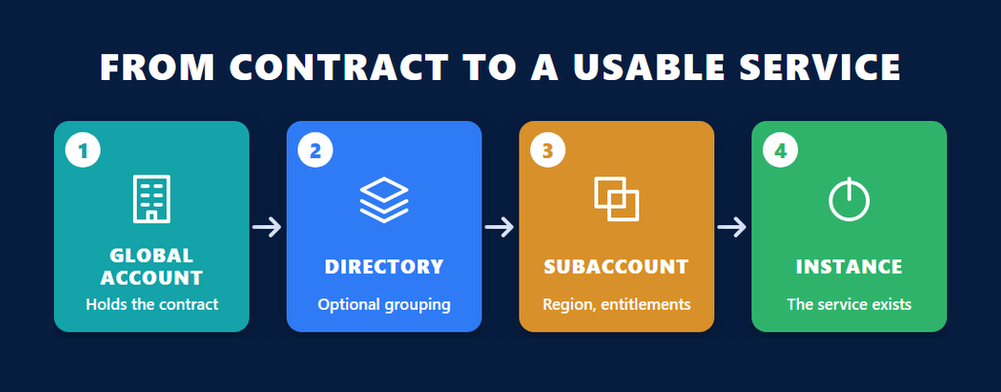
Nearly every administration task on SAP BTP happens inside a subaccount, so the account model is the foundation the C_ADBTP activity builds on. A global account holds the commercial contract, optional directories group subaccounts, and each subaccount sits in a region and carries the entitlements, environments and service instances that applications actually use.
Global account, directories, subaccounts
The SAP BTP cockpit is where the structure becomes visible. The global account is the top level that the contract attaches to. Directories are an optional grouping layer, useful for keeping development, test and production apart or for separating business units, and they can carry their own administrators. Subaccounts are where work happens: each one is created in a specific region, and its environments and services run there. A sensible structure decided early saves a great deal of rework, which is why the study guide puts governance in the same area as the account model.
An entitlement is permission, not a service
The most common trap in this area is treating an entitlement as if it were the service itself. Assigning a service plan from the global account to a subaccount, with a quota where the plan needs one, only gives that subaccount the right to use the plan. Nothing exists yet. Someone still has to create a service instance, or a subscription for a SaaS application, inside the subaccount before an application can bind to it or a user can open it. In a scored activity, stopping after the entitlement leaves the later steps with nothing to use.
What changes across Cloud Foundry, Kyma and the ABAP environment?
C_ADBTP expects you to administer all three runtime environments on SAP BTP, and each one has its own structure and its own access model. Cloud Foundry uses orgs and spaces, the Kyma runtime is managed Kubernetes with namespaces, and the ABAP environment is a full ABAP system with business users and business roles. Skills from one do not transfer automatically to the others.
Cloud Foundry: orgs, spaces and space roles
Enabling the Cloud Foundry environment in a subaccount creates an org. Inside the org you create spaces, typically one per stage or team, and you grant people org and space roles such as Space Developer or Space Manager. Those roles live inside Cloud Foundry, which is why a person can hold a perfectly good role collection at subaccount level and still be refused when they try to deploy into a space.
Kyma: Kubernetes underneath
The Kyma runtime is SAP’s managed Kubernetes environment. Administration means working with namespaces, access through a kubeconfig file and kubectl, and Kubernetes role-based access control. If you have never worked with Kubernetes, the Kubernetes overview documentation explains the objects and control plane that Kyma builds on, and it is worth reading before you open a Kyma cluster for the first time.
ABAP environment: an ABAP system in the cloud
The SAP BTP ABAP environment gives you an ABAP system managed by SAP. Its users and authorizations are maintained inside that system through business users and business roles, not only at the subaccount. A candidate who knows only the cockpit can create the environment and then be stuck at the first request to give a developer access to it.
Where do identity and authorization usually break?
Identity and authorization break when an administrator assumes one assignment covers every layer. On SAP BTP, authentication is handled by an identity provider, platform and application access come from role collections, and each runtime keeps its own authorization on top. The money-site FAQ names identity and access management as one of the areas candidates find hardest, and this is why.
Trust first, then roles
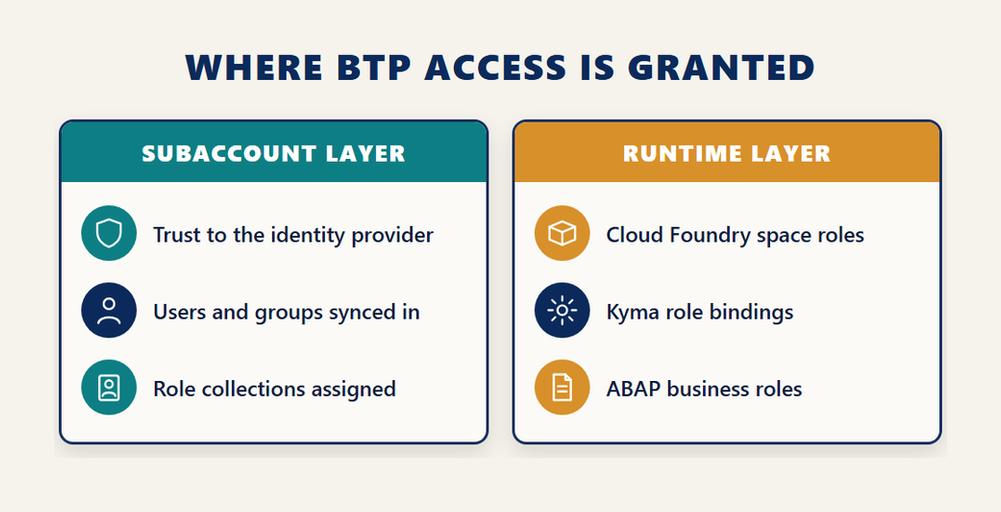
Out of the box, users sign in with the default SAP identity provider. Most companies want their own users and groups, so the administrator sets up a trust relationship between the subaccount and SAP Cloud Identity Services, using the Identity Authentication service as the custom identity provider and the Identity Provisioning service to synchronise users and groups from the corporate source. Only after trust works does role assignment make sense: role collections bundle roles, and they can be assigned to individual users or mapped to groups coming from the identity provider, which scales far better.
The runtime layer on top
After the subaccount layer, each runtime asks its own question. Cloud Foundry checks org and space roles, Kyma checks Kubernetes role bindings, and the ABAP environment checks business roles. In a System-Based Assessment, a refusal at the runtime is a sign that the runtime layer was skipped, not that trust is broken. The same layered thinking appears in other SAP administrator credentials: the SAP security administrator exam examines it on the ABAP and S/4HANA side.
How do destinations and the Cloud Connector reach on-premise systems?
Destinations tell SAP BTP applications where a system is and how to authenticate to it, and the Cloud Connector is the on-premise agent that makes systems inside a corporate network reachable without opening inbound firewall ports. On C_ADBTP the two are configured as one flow: connector, then exposed resources, then the destination that uses them.
The Cloud Connector in practice
The Cloud Connector is installed inside the customer network and opens an encrypted tunnel outward to a BTP subaccount, so nothing on the internet initiates a connection into the company. The administrator maps a virtual host name, which is what BTP sees, to the real internal host, and then lists exactly which resources, such as URL paths, may be reached through that mapping. Everything not listed stays closed. Where several connectors serve one subaccount, a location ID tells them apart, and for high availability a master instance is paired with a shadow instance that takes over if the master fails. SAP’s Cloud Connector documentation covers installation, the administration UI, backups and monitoring in detail.
Why order matters here
The money-site FAQ uses this exact chain to explain cross-service dependencies: connectivity through the Cloud Connector depends on the subaccount and destination setup being right. A destination of proxy type OnPremise that names a virtual host the connector does not expose fails, and so does a connector connected to a different subaccount from the one the application runs in. Configure in order, then test the destination from the cockpit before moving on.
Which tools automate a BTP landscape?
C_ADBTP covers the setup and automation tools an administrator uses beyond clicking in the cockpit: boosters for guided setup, command line interfaces including the btp CLI and the Cloud Foundry CLI, kubectl for Kyma, SAP Automation Pilot for operations tasks, and Terraform for infrastructure as code. The point is repeatable configuration rather than one careful manual build.
Boosters, CLIs and Automation Pilot
Boosters are guided wizards in the cockpit that create a subaccount, entitlements, subscriptions and role assignments for a common scenario in one run. The btp CLI manages global accounts, directories and subaccounts from a terminal, the cf CLI does the same for Cloud Foundry orgs, spaces and applications, and kubectl does it for Kyma. SAP Automation Pilot turns recurring operations tasks into commands that can be run on demand or on a schedule.
Terraform on SAP BTP
With Terraform, the landscape is written as configuration files and applied, so the same subaccount layout, entitlements and role collections can be created again in another region or stage without drift. The TERRA1 course in the learning path covers preparing the setup, applying a first configuration, inspecting state, using variables and locals, provisioning a Cloud Foundry environment and extracting reusable modules. SAP maintains the Terraform provider for SAP BTP as an open repository, and its examples are a quick way to see which resources can be managed as code. The money-site FAQ notes that infrastructure as code feels unfamiliar to many administrators, so it deserves real practice rather than a read-through.
How do observability, resilience, DevOps and cost fit the role?
The last two blueprint areas cover running the platform after it is built: monitoring services centrally and locally, keeping workloads available through high availability and disaster recovery planning, supporting DevOps through CI/CD and transport management, and understanding cost and consumption. They turn a configured landscape into one that can be operated and paid for.
Observability and resilience
The study guide describes an observability strategy built on central and local monitoring tools. In practice, SAP Cloud ALM provides the central view across services, while service-level tools give detail for a single application or runtime. Resilience means knowing which parts of the landscape need a second instance, a second availability zone or a second region, and the Cloud Connector shadow instance from the connectivity area is one concrete example.
DevOps and cost
DevOps on SAP BTP, as the DOP100 course frames it, means continuous integration and delivery, the services that support it, transports between stages and integration with SAP Cloud ALM. Cost and usage management means reading the consumption and cost views of the global account, understanding what each entitlement commits the company to, and spotting where usage is growing. SAP’s own direction makes governance a bigger part of the job, not a smaller one. SAP describes its new SAP Business AI Platform as unifying SAP Business Technology Platform, SAP Business Data Cloud and SAP Business AI into a single governed environment, and its technology chief put the purpose plainly:
“It’s the place where you build, contextualize, reason, and govern AI.”
Whatever runs on the platform next, an administrator still decides who may use which service, in which subaccount, at what cost.
How should you prepare for a System-Based Assessment on SAP BTP?
Prepare for C_ADBTP by doing administration tasks end to end in a real BTP account, following SAP’s learning journey and working from the account model outward. The money-site FAQ puts the learning journey at about 26 hours across five courses, and suggests roughly a couple of months in total so that hands-on rehearsal gets the time it needs.
- Learn the account model before anything else: subaccounts, directories, entitlements and subscriptions, because almost every other task depends on a correct account structure.
- Work hands-on in all three runtime environments, creating and managing Cloud Foundry, Kyma and ABAP environments until multi-runtime tasks feel familiar.
- Rehearse identity and access management from end to end, from trust and identity providers to users, role collections and runtime authorizations, since an access mistake blocks every later step.
- Practise connectivity as one complete flow: set up the Cloud Connector, expose the resources, then configure and test the destination that uses them.
- Automate parts of your own setup with the CLI and Terraform, and check the current course list on SAP’s learning journey page before the exam.
Where to practise
SAP’s certification page says the learning journey includes a practice system, and SAP’s Administrating SAP BTP journey lists the five courses: BTP200 Operating SAP Business Technology Platform, ADM002 Connecting SAP BTP with On-Premise via Cloud Connector, DOP100 Exploring DevOps with SAP BTP, SECCL1 Introducing SAP Cloud Identity Services, and TERRA1 Getting Started with Terraform on SAP BTP. A personal SAP BTP trial account is also useful for repeating account and Cloud Foundry tasks, although some enterprise features are not available there.
Rehearse the chain, not the parts
Because the pass score is 100 percent, rehearse complete flows: create a subaccount, entitle and subscribe, set up trust, assign roles, connect an on-premise system, create the destination and test it. Then break one thing on purpose and find it. That is the closest preparation to an activity where a single missed step decides the result. Before you book, read SAP’s C_ADBTP certification page again to confirm the format, the pass score and your available attempts.
Who should take C_ADBTP, and what sits next to it?
C_ADBTP suits people who run SAP BTP rather than build on it: platform administrators, basis and cloud operations staff, and consultants or developers moving into a BTP operations role who already know the cockpit. SAP’s card names Administrator, Consultant and Developer as the target roles, and the money-site study guide pitches it at project participation depth.
Good fit, weaker fit
It is a strong fit if your week involves creating subaccounts, assigning role collections, connecting on-premise systems or chasing consumption reports. It is a weaker fit for someone who writes extension applications all day; a developer credential matches that work better. Someone designing the landscape at enterprise level rather than operating it will find an architect track closer to their role, although running a landscape first is good grounding for designing one.
Related reading on ERPQnA
For the other SAP credentials built on the same platform, including integration, extension development and positioning exams, browse the SAP BTP certification hub. It is a quick way to see which credential follows naturally once the administration side is in place.
Frequently Asked Questions
What is the exam code for the SAP BTP administrator certification?
The exam code is C_ADBTP, for SAP Certified – SAP BTP Administrator. SAP’s certification page lists the code without a release suffix, so book C_ADBTP even if older notes mention a suffixed code such as C_ADBTP_2511.
What is the passing score for C_ADBTP?
The passing score is 100 percent. The exam is a single hands-on activity, so every required task must be completed correctly to pass.
How long is the C_ADBTP exam?
SAP’s certification page displays a duration of 2 hours. The money-site pages do not publish a duration, so SAP’s page is the source for that figure.
Is C_ADBTP a System-Based or Scenario-Based Assessment?
C_ADBTP is a System-Based Assessment. You carry out administration tasks in a working SAP BTP system and are scored on whether each task was completed, rather than reasoning through a written business situation.
Which language is the C_ADBTP exam available in?
English. Both SAP’s certification page and the money-site study guide list English as the language for this exam.
Which blueprint areas are hardest on C_ADBTP?
The money-site FAQ names identity and access management, connectivity through the Cloud Connector, and administration across the Cloud Foundry, Kyma and ABAP runtimes as the areas candidates find most challenging, with Terraform also unfamiliar to many administrators.
Does an entitlement make a service available in a subaccount?
No. An entitlement only gives the subaccount the right to use a service plan. You still have to create a service instance or a subscription inside the subaccount before anything can use it.
What do I need before I can book C_ADBTP?
SAP’s certification page asks for a Learning Hub subscription that includes certification attempts and an SAP Universal ID with a secondary email address set up.
Which learning journey prepares you for C_ADBTP?
The SAP learning journey Administrating SAP Business Technology Platform maps to C_ADBTP. It covers five courses: BTP200, ADM002, DOP100, SECCL1 and TERRA1, which together span administration, the Cloud Connector, DevOps, identity services and Terraform.
Conclusion
The SAP BTP administrator certification asks one thing above all: can you carry a chain of platform tasks through without a gap? C_ADBTP is a single System-Based Assessment activity, 2 hours by SAP’s display, passed only at 100 percent, across seven blueprint areas from the account model to cost and usage. The candidates who pass are the ones who have built subaccounts, set up trust and role collections, connected an on-premise system through the Cloud Connector and automated parts of it, more than once and in the right order. Start with the account model, follow SAP’s Administrating SAP BTP learning journey, rehearse full flows in a real account, and book the exam when a deliberately broken step no longer takes you long to find.


