Nothing in Subscription Order Management ever produces an invoice. The component that the SAP BRIM certification C_BRSOM is built around captures the subscription order, turns it into a contract, holds the product and bundle model behind it, and then hands the result to two other parts of SAP Billing and Revenue Innovation Management: SAP Convergent Charging, which rates the usage, and SAP Convergent Invoicing, which bills it. Contract accounting and revenue accounting pick up from there. A candidate who learns Subscription Order Management as a set of screens will configure each one correctly and still fail a task, because the task is scored on what arrives at the other end of the handoff.
That is the frame this guide uses. It walks through what has to exist before an order can be captured, how the product model decides what gets charged, where the subscription leaves Subscription Order Management for charging and for invoicing, what agreements and counters change along the way, and how the single three hour System-Based Assessment activity runs. It then puts C_BRSOM beside its sibling, the Usage to Cash credential, so you book the SAP BRIM certification that matches your job.
What Does the SAP BRIM Certification C_BRSOM Certify?
C_BRSOM is the SAP BRIM certification for Subscription Order Management, formally SAP Certified – SAP Billing and Revenue Innovation Mgmt. – Subscription Order Management. It is an associate credential delivered as one System-Based Assessment activity in a working SAP system, with a 64 percent pass score, a 3 hour duration displayed by SAP, and English as the exam language. It certifies configuration and process execution, not recall.
SAP describes the holder as someone with the core business-process and high-level configuration skills of a Subscription Order Management associate consultant, able to work on a BRIM project team under a mentor. SAP recommends it as an entry-level qualification and tags the role as Consultant, with Billing, Order Fulfillment, Convergent Charging, Payment Processing, Order Management and Order To Cash Process as the skills it covers. ERPPrep aims its study guide at the same profile: billing and subscription-management consultants, and order-to-cash or finance people moving into a BRIM role.
| Exam detail | Value | Published by |
|---|---|---|
| Exam code | C_BRSOM | ERPPrep and SAP |
| Credential | SAP Certified – SAP Billing and Revenue Innovation Mgmt. – Subscription Order Management | ERPPrep and SAP |
| Level | Associate, recommended by SAP as an entry-level qualification | ERPPrep and SAP |
| Format | System-Based Assessment (SyBA), 1 activity | ERPPrep and SAP |
| Passing score | 64 percent | ERPPrep and SAP |
| Duration | 3 hours | SAP only; ERPPrep publishes no duration |
| Language | English | ERPPrep and SAP |
| Product | SAP Billing and Revenue Innovation Management (BRIM) | ERPPrep and SAP |
| Fee, validity period, question count | Not published on either page | Neither |
Two things on that table deserve a second look. There is no question count because there are no questions in the old sense: the activity is a set of configuration and process tasks, and ERPPrep’s own FAQ is explicit that it does not involve a fixed bank of items. And there is no fee or validity figure because neither SAP’s page nor ERPPrep’s displays one, so none is given here. What ERPPrep does provide for the format is twelve C_BRSOM scenario simulations and 120 skill drills grouped under eight skill domains, each simulation built as a multi-phase business situation rather than a list of items.
How Does SAP Weight the C_BRSOM Exam Topics?
SAP’s certification page displays four weighted exam topics for C_BRSOM: Overview at 31 to 40 percent, Order Management at 21 to 30 percent, Contract Management at 21 to 30 percent, and Master Data at 11 to 20 percent. ERPPrep’s study guide lists seven unweighted blueprint areas that spell out what sits inside those four groups, so the two documents describe the same exam at different resolutions.
The weighting is worth reading carefully. Overview is the largest group, and on a BRIM exam that word does not mean introductory material. It is the BRIM and quote-to-cash landscape itself: how quoting, subscription capture, rating, charging, invoicing, contract accounting and revenue accounting connect, which is exactly the handoff knowledge this guide is organised around. Master Data is the smallest group, but every order and contract task defaults from it, so a thin master data setup shows up as failures in the two bigger groups.
| Exam topic displayed by SAP | Weight | ERPPrep blueprint areas that sit inside it |
|---|---|---|
| Overview | 31 to 40 percent | BRIM & Quote-to-Cash Landscape; Convergent Charging & Convergent Invoicing Integration; SOM Configuration, Fiori, Mass Runs & APIs |
| Order Management | 21 to 30 percent | Subscription Order & Contract Management (order capture and distribution); Product & Bundle Modelling |
| Contract Management | 21 to 30 percent | Subscription Order & Contract Management (contracts, phases, changes); Agreements & Counter Concepts |
| Master Data | 11 to 20 percent | Subscription Master Data: Business Partner, Contract Account & Products |
The mapping in the right-hand column is editorial: SAP does not say which blueprint area belongs to which topic, and ERPPrep does not publish weights. The seven area names are ERPPrep’s own wording, and the four topic names and their ranges are SAP’s. Use the ranges to decide where your hours go and the areas to decide what you practise inside each range.
What Has to Exist Before a Subscription Order Can Be Captured?
A C_BRSOM task that begins with a subscription order assumes three kinds of master data are already in place: a business partner inside the right organizational structure, a contract account for that partner, and subscription product data that includes cross-catalog mapping and, where the offering needs it, advanced variant configuration. The order defaults from all three, so a wrong account or product setting surfaces later as a wrong invoice.
The business partner is the customer as Subscription Order Management sees it, placed in the sales and service organization that the scenario names. The contract account is the object that financial contract accounting will later post against, so it is created in Subscription Order Management but consumed downstream. If the activity asks you to maintain one, the fields that matter are the ones contract accounting and invoicing read, not the ones that only describe the customer.
Why cross-catalog mapping is on an associate exam
Subscription products can originate outside Subscription Order Management and be mapped into it, which is why ERPPrep’s master data area names cross-catalog mapping explicitly. The point of testing it at associate level is simple: a product that is not mapped cannot be ordered, and a product that is mapped wrongly carries the wrong attributes into charging. Variant configuration belongs to the same area for the same reason; it decides which characteristics of a product the order can set, and those characteristics travel with the contract.
How Does Product and Bundle Modelling Decide What Gets Billed?
Product and bundle modelling is the C_BRSOM area where the commercial structure of an offering is written down: single subscription products, subscription product bundles with a bundle overview, calculation scheme pricing, and discounts and charges. Everything Convergent Charging rates and Convergent Invoicing bills is derived from this model, so a modelling mistake cannot be corrected at the invoice.
ERPPrep’s study guide makes the dependency the second of its five preparation steps: single products, bundles, the calculation scheme, and discounts and charges each behave differently, and how you model an offering directly shapes what the two downstream components later produce. That sentence is the whole reason this area carries its own blueprint entry rather than being folded into order capture.
Single product, bundle, calculation scheme
A single subscription product is the simplest case: one item with a recurring or usage-based price. A bundle groups several products under one commercial offer, and the bundle overview is where you check that the grouping and its components are what the scenario asked for. The calculation scheme is the pricing logic that applies to the product or bundle, and discounts and charges modify the result. SAP’s own product overview describes the range the platform supports, from one-time and usage-based to tiered pricing, and bundles of products, services and subscriptions that may come from partners as well as from you; the exam checks that you can model a given offering inside that range.
When you practise this area, model the offering, then follow it: capture an order for it, create the contract, and look at what reaches charging and invoicing. Modelling in isolation teaches the screens; modelling and following teaches the exam.
Where Does Subscription Order Management Hand Off to Convergent Charging?
The first handoff in the C_BRSOM scope is from the subscription contract to SAP Convergent Charging, the BRIM component that rates consumption. ERPPrep’s integration area names the configuration of that integration, including account splitting, and its order and contract area names the order distribution infrastructure that carries contract data out of Subscription Order Management. Both are tested as configuration tasks, not as diagrams.
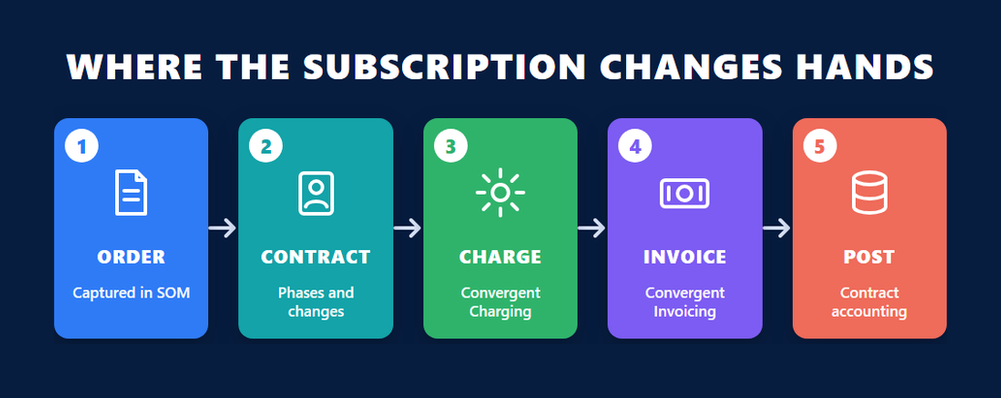
Three pieces of the syllabus meet at this handoff. The order distribution infrastructure is the mechanism by which a captured subscription order and its contract are distributed to the connected systems; if it is not set up for the scenario’s contract, nothing leaves Subscription Order Management. Phased contracts describe a subscription whose terms change over defined phases, and each phase has to be represented correctly on the charging side. Account splitting, named by ERPPrep inside the Convergent Charging integration, governs how charges for one subscription are divided across accounts, which matters whenever a scenario has more than one party paying.
Contract changes travel through the same door
ERPPrep’s order and contract area also lists processing subscription contract changes and configuring the change behaviour the business scenario requires. A change made in Subscription Order Management is only complete when its effect has reached charging, so a task that reads as a contract change in the system is scored on the downstream result. This is the integration pattern ERPPrep’s FAQ calls out as the most common place candidates struggle: a setting configured in one step changes system behaviour several steps later.
Where Does the Subscription Hand Off to Convergent Invoicing and Contract Accounting?
The second C_BRSOM handoff is into SAP Convergent Invoicing, the BRIM component that bills the subscription. ERPPrep’s integration area names the BRIM invoicing process, discounts and charges, and the billing plan as the configuration points, and the quote-to-cash landscape area carries the flow on into financial contract accounting and revenue accounting. The exam scores whether consumption and subscription revenue reach billing correctly.
The billing plan is the object that tells invoicing when and what to bill for a subscription, so it is the first thing to check when an invoicing task produces nothing or the wrong amount. Discounts and charges appear a second time here, at invoice level rather than product level, and SAP’s product overview separately describes invoice-level discounting by amount, percentage or rule. A candidate who has only seen discounts in the product model will look in the wrong place during the activity.
Convergent Invoicing works on billable items, and in a usage-based business those items can arrive from outside the SAP landscape through mediation. The erpqna post on the Convergent Invoicing connector for SAP Convergent Mediation explains how external sales and usage data is validated and prepared before it reaches invoicing as billable items; it is useful background for the landscape topic even though mediation itself is not a C_BRSOM blueprint area.
Where contract accounting and revenue accounting come in
Once an invoice exists, financial contract accounting posts and collects it, and revenue accounting recognises the revenue. ERPPrep’s product page runs a dedicated drill set on financial contract accounting, and SAP’s product overview describes receivables and payment automation, dunning, collections and dispute handling as the end of the flow. The accounting outcome is governed by the revenue standard the business reports under; the IFRS 15 revenue standard is the one most subscription businesses outside the United States apply, and knowing that a subscription contract is recognised over its term, not at order capture, explains why revenue accounting sits at the far end of the C_BRSOM landscape rather than inside order management.
What Do Agreements and Counters Change?
Agreements and counter concepts form a separate C_BRSOM blueprint area because they change how a subscription is priced and tracked without changing the product model. ERPPrep lists master agreements with customer hierarchies, solution quotations spanning sales, subscription and service, partner agreements, and four counter types: persistent, shared and allowance counters plus shared allowances. All of them govern entitlement and usage tracking.
A master agreement sits above individual subscriptions for a customer hierarchy, so that terms negotiated once apply to every contract underneath. A solution quotation is the document that can carry a sales item, a subscription item and a service item together, which is why it belongs to the quote-to-cash picture as much as to Subscription Order Management. A partner agreement does the same job for a partner whose products appear in your bundles.
Counters are the entitlement engine
A counter records how much of an entitlement has been used. A persistent counter keeps its value across periods; a shared counter is used by more than one contract or item; an allowance counter measures usage against a granted allowance; and a shared allowance lets several contracts draw on one allowance. ERPPrep’s study guide treats counters as their own study block for a reason it states plainly: small setup differences change how usage is measured and billed. Because the measurement is what Convergent Charging rates, a counter is a third handoff point in miniature, configured in Subscription Order Management and scored by what charging produces.
What Does the C_BRSOM System-Based Assessment Activity Look Like?
The C_BRSOM exam is one System-Based Assessment activity: a set of certification tasks carried out in a configured SAP system, scored on whether each task was completed correctly, with a 3 hour duration displayed by SAP and a 64 percent pass score. There is no question bank. ERPPrep’s seventh blueprint area, SOM Configuration, Fiori, Mass Runs and APIs, describes the tools the activity is performed with.
SAP’s help center describes how the assessment runs: the exam overview shows the time limit and the attempts remaining, the assessment dashboard holds a setup guide and the certification tasks, and the system opens in a separate browser tab. The timer runs from the moment you start and does not pause for breaks, and the activity has to be finished in one session before you confirm completion. Results are usually reviewed within about fifteen minutes, and a score report is available for system-based certifications.
“You should keep the main assessment page open to reference your tasks while you work.”
That advice matters more on a BRIM exam than on most, because a task here is rarely one screen. It may begin as a customizing object in Subscription Order Management, continue in an SAP Fiori app where the order or contract is captured, and end in a mass run or an API call that processes the result at volume. The system-based assessment FAQs page is the place to read the mechanics before exam day.
Why the C_BRSOM_2020 figures no longer apply
Search demand for “c brsom 2020 questions” still outruns demand for the current code, and that older code was a different exam. The erpqna earlier C_BRSOM preparation guide describes C_BRSOM_2020 with its own question count, time and 67 percent cut. SAP’s page displays C_BRSOM only, with 64 percent and one activity, and no retirement date. Book and prepare for what SAP displays, and treat any material built around the 2020 paper as an outline of topics rather than a description of the exam.
C_BRSOM or C_BRU2C: Which SAP BRIM Certification Fits Your Role?
ERPPrep lists two associate SAP BRIM certifications, and SAP’s pages display both as System-Based Assessments of one activity and 3 hours. C_BRSOM covers Subscription Order Management, the front of the flow, at 64 percent. C_BRU2C, SAP Certified – SAP Billing and Revenue Innovation Management – Usage to Cash, covers the back of the flow, with master data maintenance, documents and postings, and FI-CA and CI customizing, at 61 percent.
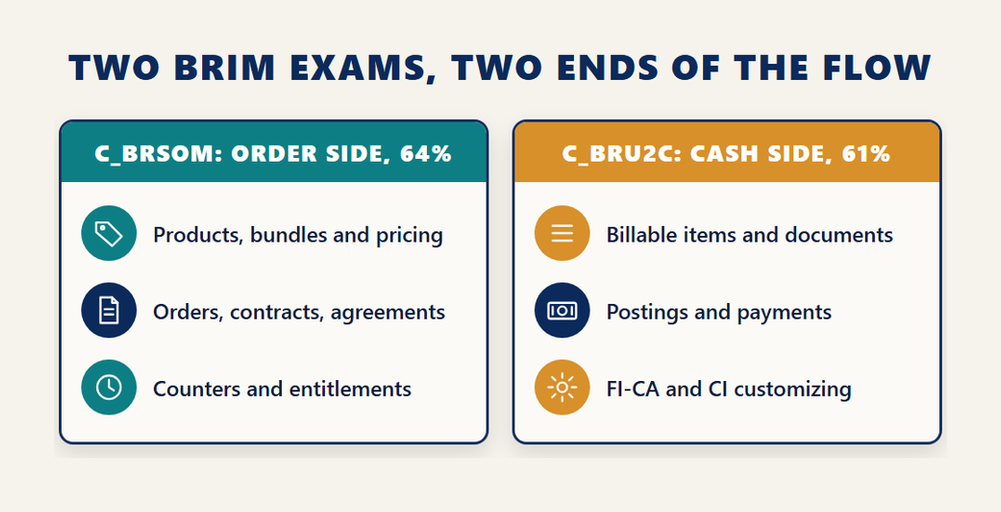
The two credentials meet at exactly the handoffs this guide describes. C_BRSOM owns everything up to the point where a contract is distributed to charging and a billing plan exists for invoicing; C_BRU2C owns what happens after billable items and invoices exist, in Convergent Invoicing and financial contract accounting. Both share the BR232 quote-to-cash course at the start of their learning journeys, and both are sold by ERPPrep in the same scenario format.
| Point of comparison | C_BRSOM, Subscription Order Management | C_BRU2C, Usage to Cash |
|---|---|---|
| Pass score displayed by SAP | 64 percent | 61 percent |
| Format and duration | 1 activity, System Based Assessment, 3 hours | 1 activity, System Based Assessment, 3 hours |
| Exam topics displayed by SAP | Overview 31 to 40, Order Management 21 to 30, Contract Management 21 to 30, Master Data 11 to 20 percent | Documents and postings 31 to 40, FI-CA/CI customizing 31 to 40, Master Data maintenance 21 to 30 percent |
| Core course after BR232 | BR234, Implementing SAP Subscription Order Management | BR235, BR240 and BR245 |
| Daily work it matches | Products, bundles, orders, contracts, agreements, counters and their distribution to charging and invoicing | Billable items, invoicing documents, contract accounting postings, payments and the customizing behind them |
If your project role is the order and contract side, or you come from sales operations and subscription management, C_BRSOM is the one. If you come from receivables, billing operations or contract accounting, C_BRU2C describes your day. Consultants who implement the whole BRIM landscape usually end up holding both, in that order, because the Subscription Order Management model is what the usage to cash side consumes.
How Should You Prepare for the C_BRSOM Exam?
Prepare for C_BRSOM by taking SAP’s learning journey in order and pairing every topic with hands-on work in a system, because the activity scores executed tasks. ERPPrep’s FAQ suggests two to three months alongside a job and says system access is strongly recommended. The order below follows ERPPrep’s five preparation steps and SAP’s three-course journey, and it ends at the handoffs.
- Start with BR232, the quote-to-cash overview, so that you can place Subscription Order Management between SAP CPQ on one side and charging, invoicing, contract accounting and revenue accounting on the other before you configure anything.
- Work through BR234, Implementing SAP Subscription Order Management, in a system, building the master data first: business partner and organizational structure, the contract account, and subscription products with cross-catalog mapping and variant configuration.
- Model single products, bundles, a calculation scheme and discounts and charges, then capture an order and a contract for each model and trace what reaches charging and invoicing.
- Configure the Convergent Charging and Convergent Invoicing integration as one block, covering order distribution, account splitting, phased contracts, the BRIM invoicing process and the billing plan, and deliberately break one setting to see where the error surfaces.
- Rehearse master and partner agreements, solution quotations, subscription contract changes and the four counter types end to end, because these govern how a subscription evolves and are easy to misconfigure when only read about.
- Finish with SL_RISE419 for the RISE with SAP methodology context, then run timed, multi-phase scenario rehearsals under the 3 hour limit, confirming each outcome before moving to the next task.
SAP’s Implementing Subscription Order Management journey states its outcome as understanding the customizing objects in Subscription Order Management and its integration in a BRIM landscape, which is the same two-part shape as the exam. It lists a business-user quote-to-cash journey as its prerequisite, so if BRIM is new to you, that is where to begin. The official C_BRSOM certification page is where the current pass score, duration and topic weights are displayed, and it shows no retirement date for the credential. For the platform itself, SAP’s BRIM product overview describes the subscription, usage and bundle models the exam expects you to configure.
Frequently Asked Questions
What is the SAP BRIM certification for Subscription Order Management called?
The exam code is C_BRSOM and the credential is SAP Certified – SAP Billing and Revenue Innovation Mgmt. – Subscription Order Management. It is an associate-level SAP BRIM certification delivered as a System-Based Assessment, and SAP recommends it as an entry-level qualification for a mentored project role.
What is the C_BRSOM passing score?
The passing score is 64 percent, displayed on SAP’s certification page and published on ERPPrep’s study guide and FAQ. Because the assessment scores completed tasks rather than recognised answers, ERPPrep’s advice is to prepare for reliable execution rather than aiming at the threshold.
How long is the C_BRSOM exam?
SAP displays a 3 hour duration for the single System-Based Assessment activity. The timer does not pause for breaks and the activity must be completed in one session. ERPPrep does not publish a duration for C_BRSOM.
Does C_BRSOM still have 80 questions like C_BRSOM_2020?
No. C_BRSOM_2020 was an earlier paper with its own question count and a 67 percent cut, and erpqna’s older preparation guide still describes it. The current C_BRSOM is one hands-on activity with no question bank, scored at 64 percent on tasks completed in a working system.
How are the C_BRSOM exam topics weighted?
SAP displays four weighted topics: Overview at 31 to 40 percent, Order Management and Contract Management at 21 to 30 percent each, and Master Data at 11 to 20 percent. ERPPrep’s study guide breaks the same ground into seven unweighted blueprint areas, from the BRIM landscape to SOM configuration, Fiori, mass runs and APIs.
Which parts of BRIM does C_BRSOM actually cover?
Subscription Order Management itself, plus its integration points: master data, subscription orders and contracts, product and bundle modelling, agreements and counters, and the configuration of the handoffs into SAP Convergent Charging and SAP Convergent Invoicing. Contract accounting and revenue accounting appear as the end of the landscape, not as configuration areas.
Is C_BRSOM available in languages other than English?
SAP’s page displays the exam as available in English, and ERPPrep lists English as the language. Since the activity involves reading task instructions and acting on them in the system, comfort with English BRIM terms such as contract account, billing plan and allowance counter matters.
Should I take C_BRSOM or C_BRU2C?
Take C_BRSOM if your work is products, orders, contracts, agreements and counters, the front of the subscription flow. Take C_BRU2C, the Usage to Cash credential, if your work is billable items, invoicing documents, contract accounting postings and FI-CA and CI customizing. Both are one 3 hour activity; C_BRU2C passes at 61 percent.
Which SAP courses does the C_BRSOM learning journey include?
Three: BR232, the quote-to-cash overview for solution architects; BR234, Implementing SAP Subscription Order Management, which is the core course; and SL_RISE419, which introduces the RISE with SAP methodology. ERPPrep’s study guide lists the same three against its blueprint areas.
Conclusion
The SAP BRIM certification C_BRSOM is scored where Subscription Order Management stops: at the contract that reaches Convergent Charging, the billing plan that reaches Convergent Invoicing, and the counters that decide what either of them measures. Everything upstream of those points, the business partner and contract account, the product and bundle model, the agreements and the contract changes, is tested through what it produces downstream. Prepare in that direction: BR232 first, then the master data and product model in BR234, the two integrations as one block, the agreements and counters, and timed scenario work against SAP’s 3 hour limit and 64 percent pass score. If your role is the back of the flow instead, C_BRU2C is the SAP BRIM certification to book. Either way, start by opening SAP’s certification page and reading the four weighted topics it displays; that is the list the activity is built from.


