If you last looked at C_BCSBS when SAP called it Positioning SAP Business Suite, the exam you would book today has a new title, a new subject and a new format. The code is the same. The credential is now SAP Certified – Positioning the Autonomous Enterprise, an Associate level certification for sales and presales people, and it asks whether you can explain SAP’s Autonomous Enterprise strategy to a customer well enough to recommend a direction. SAP’s certification card displays a 60 percent pass score, one Scenario-Based Assessment activity and a 2 hour duration. There is no list of separate items to work through: you read a customer situation and position the answer.
This article covers what the SAP Autonomous Enterprise certification actually tests, how the scenario format is scored, the six blueprint areas on the money-site study guide, the ideas behind each one (the operating model, the foundations that make autonomous operations dependable, the five Autonomous Domains, Joule agents and Joule assistants, and the Business AI platform), and how a seller can prepare for a conversation rather than a recall exercise.
Table of Contents
- What is the SAP Autonomous Enterprise certification?
- How is C_BCSBS delivered and scored?
- Which six blueprint areas does C_BCSBS cover?
- What does SAP mean by the Autonomous Enterprise as an operating model?
- How do the five Autonomous Domains work as one system?
- What separates Joule agents from Joule assistants?
- Where does the SAP Business AI Platform fit in the story?
- How should a seller prepare for a Scenario-Based Assessment?
- Who should take C_BCSBS, and who should choose another exam?
- Frequently Asked Questions
- Conclusion
What is the SAP Autonomous Enterprise certification?
The SAP Autonomous Enterprise certification is C_BCSBS, SAP Certified – Positioning the Autonomous Enterprise. It is an Associate level credential that verifies you can position, articulate and recommend SAP’s Autonomous Enterprise strategy to customers. SAP tags it for the Sales and Presales roles, with Artificial Intelligence and Customer Value Proposition as the skills and the SAP Cloud Suite Portfolio as the product.
Same code, new name
The code C_BCSBS has been in use for a while. Earlier releases carried suffixed codes such as C_BCSBS_2502 and the title Positioning SAP Business Suite, and SAP’s own certification address still reads sap-certified-associate-positioning-sap-business-suite. The page at that address now shows the new title, Positioning the Autonomous Enterprise, with no release suffix on the code. If a job advert, a colleague or an older study note names the Business Suite version, the exam you book today is this one, and its content has moved on from describing a suite of applications to describing an operating model run by AI agents. The same positioning track continues with the Business AI Platform certification, C_BCBTP, which is the natural follow-on once the Autonomous Enterprise pitch is in place.
Searchers also use slightly different wordings for the same credential, including “SAP certified positioning the autonomous enterprise” and “positioning AI in the autonomous enterprise”. The title SAP displays against C_BCSBS is SAP Certified – Positioning the Autonomous Enterprise, and that is the name to use when you register.
What the Associate level means here
This is not a configuration exam. The money-site study guide describes the audience as sales and presales professionals, plus marketing and customer-engagement people moving into an advisory SAP role, who want proof that they can explain the Autonomous Enterprise vision, its architecture and its business value to a customer with confidence. You are assessed on how you advise, not on what you can set up in a system.
How is C_BCSBS delivered and scored?
C_BCSBS is delivered as one Scenario-Based Assessment activity and passed at 60 percent, a figure both the money-site study guide and SAP’s certification card publish. SAP’s card also displays a duration of 2 hours. Instead of answering isolated recall items, you work through a realistic customer situation and show how you would position and recommend SAP’s Autonomous Enterprise approach.
| Field | Value |
|---|---|
| Exam code | C_BCSBS |
| Credential | SAP Certified – Positioning the Autonomous Enterprise |
| Level | Associate |
| Format | Scenario-Based Assessment (SBA), 1 activity |
| Duration | 2 hours, as displayed by SAP; the money-site pages publish no duration |
| Passing score | 60 percent |
| Languages | Vary by format, as SAP displays them: Roleplay with AI guidance in English, Spanish, Italian, French, Japanese and 25 more; Record a video in English only |
| Product | SAP Cloud Suite Portfolio |
| Roles | Sales and Presales |
| Blueprint areas | 6, with no published weightings |
What a Scenario-Based Assessment asks of you
SAP’s 2026 certification formats split into two families. A System-Based Assessment, or SyBA, puts you in a working system to carry out tasks. A Scenario-Based Assessment, or SBA, gives you a business situation and asks you to reason through the right decisions. C_BCSBS is the second kind, which suits a role whose real work is a customer conversation. The money-site FAQ describes the activity as a single guided scenario in which you position and recommend.
The worked examples show the reasoning the activity rewards. In one, a retailer’s board paper presents the Autonomous Enterprise as a list of AI features to switch on branch by branch, while its trading, service and supplier data each describe the same product differently. The stronger framing treats the move as a change in how the business runs, with one agreed product meaning and joined-up processes, so the first year’s work carries into later years. Working through ERPPrep’s worked customer scenarios builds exactly that habit: each one describes a customer, a constraint and a deadline, and asks which framing a presales advisor should put forward.
Languages, and the two ways to take it
The language field is the one place where the two sources differ. The money-site study guide lists English. SAP’s certification card does not show a single language; it shows that available languages vary by format, with the Roleplay with AI guidance option offered in English, Spanish, Italian, French, Japanese and 25 more, and the Record a video option in English only. The C_BCSBS certification card is the one to trust here, and it is worth checking which format you will take before you book.
SAP also asks for two things before exam day: a Learning Hub subscription that includes certification exam attempts, and a valid SAP Universal ID with a secondary email. Its card points candidates to an introduction to scenario-based assessments and an AI-powered tool for trying the format out first.
Which six blueprint areas does C_BCSBS cover?
C_BCSBS covers six blueprint areas on the money-site study guide: The Autonomous Enterprise as an Operating Model; Foundations for Reliable Autonomous Operations; The Five Autonomous Domains as a Connected System; Joule Agents versus Joule Assistants; The SAP Business AI Platform and Its Pillars; and SAP’s AI Strategy and Enterprise Value Shift. No weightings are published, so plan by theme.
| Blueprint area | What it asks you to do |
|---|---|
| The Autonomous Enterprise as an Operating Model | Explain what the Autonomous Enterprise means as a way of running a business, its architectural principles and its strategic value, and connect it to a customer’s outcomes |
| Foundations for Reliable Autonomous Operations | Identify the building blocks that keep autonomous operations dependable at enterprise scale, and explain why they matter to a customer weighing adoption |
| The Five Autonomous Domains as a Connected System | Describe how the five domains operate as one integrated whole rather than separate features, and use that as a differentiator |
| Joule Agents versus Joule Assistants | Tell the two apart, explain how each behaves and how users interact with it, and frame human and AI collaboration correctly |
| The SAP Business AI Platform and Its Pillars | Explain the three foundational layers of the platform and the part each plays in running an autonomous enterprise |
| SAP’s AI Strategy and Enterprise Value Shift | Articulate how AI is reshaping enterprise software, why governed data, connected processes and business context are essential, and how value is moving toward the agentic AI layer |
Five abilities on SAP’s card, six areas on the study guide
SAP’s certification card lists five abilities the credential validates, and they match the first five blueprint areas closely. The sixth area, the AI strategy and value shift, is the context those five sit inside, and the money-site FAQ ties it to the learning journey’s coverage of how AI reshapes enterprise software and why value is moving toward the agentic layer. Treat it as the opening of every customer conversation the scenario simulates, not as a separate topic to memorise.
What does SAP mean by the Autonomous Enterprise as an operating model?
SAP uses the Autonomous Enterprise to describe a way of running a business in which decisions draw on real-time intelligence, workflows are automated end to end, and AI agents carry out work inside governed business processes. For C_BCSBS the key word is operating model: the exam expects you to present a change in how a company runs, not a catalogue of AI features to switch on.
SAP launched the vision at SAP Sapphire in May 2026, and its chief executive put the reliability argument at the centre of it.
“For the mission-critical processes of our customers, ‘almost right’ just isn’t good enough. By uniting SAP Business AI Platform with SAP Autonomous Suite, we anchor AI agents in the business processes, data and governance so they can deliver accurate, compliant and secure outcomes, unlocking new sources of revenue and meaningful cost savings.”
That quote is close to a summary of the exam. It names the platform, the suite, the agents, and the three things the agents are anchored in. SAP’s Autonomous Enterprise launch announcement sets out the full package: a unified AI platform for building, contextualising and governing agents, and an autonomous suite that runs core business processes.
Foundations that keep autonomous operations dependable
The second blueprint area asks why autonomy can be trusted at scale. The study guide’s answer is governed data, connected processes and business context. In customer terms, an agent is only as reliable as the meaning of the data it acts on and the process it acts inside. If the same customer is identified three different ways in three systems, no amount of AI fixes that; it simply automates the confusion faster.
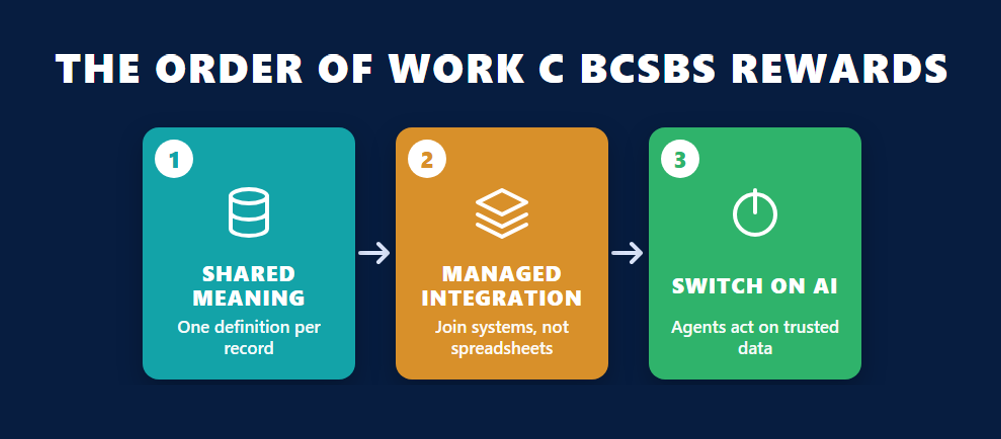
One of the worked examples makes the order of work explicit. A games publisher wants AI support for daily offer decisions in time for a launch, while player, billing and community data sit in three platforms joined by an unmaintained link. The recommended sequence is to settle one shared meaning for a player, a refund and an event, then join the platforms through managed integration, then switch on the AI capability, because each step feeds the next.
“Our SAP S/4HANA transformation across 140 countries is creating a connected digital core with consistent processes, trusted data and greater visibility across markets and functions. With that foundation, Joule and the Accounts Receivable Assistant can automatically prioritize collections work based on risk and business context, recommend the next best action and help our finance teams respond faster to change.”
Customers in regulated industries will often frame the same question as risk rather than reliability. The NIST AI Risk Management Framework, a voluntary framework NIST released in January 2023 for building trustworthiness into the design and use of AI systems, is a common reference point in those conversations, and knowing that vocabulary helps a seller answer a risk officer in their own terms.
How do the five Autonomous Domains work as one system?
The five Autonomous Domains are finance, spend, supply chain, human capital management and customer experience, the business functions SAP Autonomous Suite spans. SAP’s position is that they operate as a single system, so workflows and agents run across functions without splitting into separate tools, separate data or separate decisions. C_BCSBS expects you to sell that connection, not five products.
SAP’s Autonomous Enterprise vision article makes the argument directly: running the domains as one system lets AI recommendations reflect a company’s full operating reality. The launch announcement adds scale, with more than 50 domain-specific Joule assistants across finance, supply chain, procurement, human capital management and customer experience, orchestrating a subset of more than 200 specialised agents.
Why the connection is the selling point
The money-site worked example shows the trap. A maintenance company bought one automation tool for spare-part reordering and another for engineer rostering; each succeeded inside its own department. Then a delayed part shipment, recorded by one tool and invisible to the other, sent an engineer to the wrong plant and cost a contract penalty. When the chief operating officer proposes running the five domains the same way, as five independent workstreams with five sets of data rules, the advisor’s answer is shared data definitions with owned hand-offs between domains, because an event in one function has to reach another the same day.
The money-site FAQ lists presenting the domains as disconnected features among the most common mistakes on this exam. If your answer to a scenario could be given one domain at a time, it is probably missing the point the scenario was built to test.
What separates Joule agents from Joule assistants?
In SAP’s description, Joule assistants carry role and process context and coordinate teams of Joule agents, while Joule agents execute the specific tasks. An assistant works with a person toward an outcome; agents do the precise work underneath it. The money-site FAQ names this distinction as one of the areas candidates find hardest, because it is easy to blur under scenario pressure.
| Aspect | Joule assistant | Joule agent |
|---|---|---|
| What it carries | Role and process context | A specialised task |
| What it does | Coordinates a team of agents toward an outcome | Executes precise steps within a process |
| Who it works with | The person directing the work | The assistant that orchestrates it |
| Scale SAP announced | More than 50 domain-specific assistants | More than 200 specialised agents |
Positioning the two for a real customer
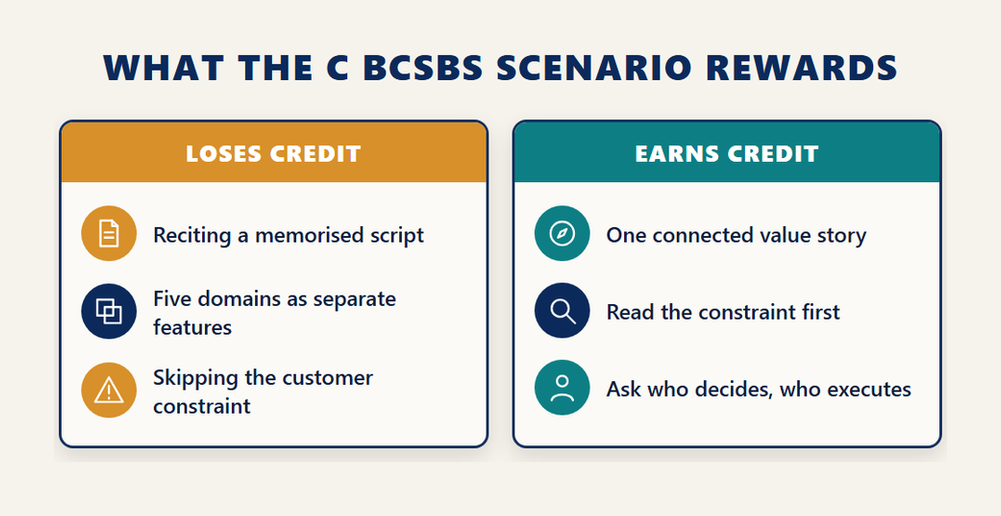
The distinction matters most where a customer has a governance constraint. In one money-site example, a department store wants markdown decisions handled without anyone in the loop, while its privacy officer has ruled that no system may act on a customer’s purchase history unless a named employee makes the decision. The two uses need different framing: one is about agents executing a sequence of steps, the other about an assistant supporting a person who keeps the decision. A single description that covers both clears neither concern well.
The useful habit is to ask, for every use in a scenario, who decides and who executes. If a named person must decide, position the assistant working alongside them. If the work is a defined sequence that can run inside governed rules, position agents doing it, coordinated by an assistant.
Where does the SAP Business AI Platform fit in the story?
The SAP Business AI Platform is the foundation under the Autonomous Enterprise. SAP describes it as unifying SAP Business Technology Platform, SAP Business Data Cloud and SAP Business AI into a single governed environment, with SAP Knowledge Graph at its core giving agents a structured map of business entities, processes and relationships. C_BCSBS asks you to describe its three pillars and what each contributes.
SAP’s certification card refers to the three pillars of the platform without naming them on the card, so learn their names exactly as the Positioning the Autonomous Enterprise learning journey presents them rather than reconstructing them from press coverage. What SAP’s launch material does make clear is the shape of the story. The Knowledge Graph supplies business context. Joule Studio is where enterprise agents, applications and agentic workflows are built, using no-code, pro-code or AI frameworks on SAP-managed infrastructure. SAP AI Agent Hub is described as a vendor-agnostic command centre to discover, inventory and govern SAP and non-SAP agents.
How to use the platform in a scenario
The platform is rarely the opening of a customer conversation, and the money-site FAQ warns that its role is easy to skip. It is the answer to the question a technical buyer or a chief financial officer will eventually ask: what makes these agents trustworthy, and what stops each department building its own? Positioning the platform well means linking it back to the earlier parts of the story: the governed data and business context that make operations reliable, and the connected domains that need one environment rather than five.
SAP has kept building the story since the launch. At SAP Connect in October 2026 it presented customers using Joule assistants in procurement, supply chain and finance, and positioned Joule, SAP Autonomous Suite and SAP Business AI Platform together as the way to deliver trusted business outcomes.
How should a seller prepare for a Scenario-Based Assessment?
Prepare for C_BCSBS by rehearsing the Autonomous Enterprise as one connected story you can explain aloud, then testing it against full customer scenarios. The money-site FAQ suggests several weeks of focused preparation alongside a job, with extra time for Joule agents versus assistants and the platform layers. Sellers already in a presales role can usually compress that.
The study guide sets out a preparation order that builds the story in the same sequence a customer conversation follows.
- Learn the Autonomous Enterprise as one connected story, covering the operating model, the architectural principles and the value proposition, so you can explain why it matters to a customer.
- Rehearse the difference between Joule agents and Joule assistants until you can describe how each behaves and how users interact with them.
- Practise presenting the five Autonomous Domains as a single integrated system rather than as disconnected capabilities.
- Study the layers of SAP’s Business AI platform as a group, focusing on the part each plays in running an autonomous enterprise.
- Work through full customer scenarios end to end and check each recommendation against the need the scenario describes.
SAP’s own preparation material is the Positioning the Autonomous Enterprise learning journey, linked from the certification card. The money-site FAQ recommends reviewing SAP’s introductory Discovering SAP material first if the concepts are new. For a wider view of how SAP’s performance-based formats changed, the site’s SAP certification new format guide explains the move from recall to applied capability across the whole programme.
Practise articulation, not recognition
The most common mistake the money-site FAQ identifies is preparing by memorising rather than practising positioning. Saying the story aloud exposes the gaps that silent reading hides. A useful drill is to take any one blueprint area and explain it to an imagined chief financial officer in two minutes, then again to an imagined privacy officer. If the second explanation is not different from the first, you have learned a script rather than a positioning skill.
ERPPrep’s practice set runs to 24 scenario simulations and 240 skill drills, ordered from foundation to advanced. Whatever material you use, read the customer’s constraint before you choose a framing; the FAQ notes that misreading the customer’s need produces weak recommendations even when each concept is known in isolation.
Managing time in one activity
Because the assessment is a single scenario, hesitation on the core themes adds up. Rehearse the operating model, the domains and the Joule roles until they come out automatically, so the time goes on the judgement each scenario actually varies: what this customer needs, in what order, and with what constraint.
Who should take C_BCSBS, and who should choose another exam?
C_BCSBS suits account executives, presales consultants, solution advisors and customer-engagement staff who present SAP to customers and need proof they can position the Autonomous Enterprise accurately. No deep technical background is required, according to the money-site FAQ, because the exam assesses positioning rather than hands-on configuration.
Candidates who fit well
Sellers early in an SAP advisory path benefit most, because the credential gives them a structured version of a message they are already expected to deliver. Experienced sellers formalising their command of the new message fit too, particularly those who sold SAP Business Suite under the earlier positioning and now need the agent-based version of the story.
Candidates who should look elsewhere
If your work is configuring or building SAP solutions rather than advising on them, a System-Based Assessment in your product area will reflect your job better. C_BCSBS will not test whether you can set anything up, and an employer looking for implementation skill will read it as a sales credential. Newcomers to SAP can still take it, but the FAQ advises budgeting extra weeks and prioritising repeated scenario rehearsal over reading. Consultants whose job is getting users to adopt new SAP processes, rather than selling them, have their own route in the WalkMe consultant credential.
Readers who prepared for the earlier version will find that the positioning habits carry over even though the subject has changed. The site’s Business Suite positioning overview covers the suite capabilities that the earlier exam centred on, which remain useful background for a seller explaining where the Autonomous Enterprise builds on existing SAP applications.
Frequently Asked Questions
What is the exam code for the SAP Autonomous Enterprise certification?
The exam code is C_BCSBS, for SAP Certified – Positioning the Autonomous Enterprise. It is an Associate level credential for sales and presales roles. SAP’s certification page lists the code without a release suffix, so book C_BCSBS rather than an older suffixed code such as C_BCSBS_2502.
Is C_BCSBS the same exam as Positioning SAP Business Suite?
It uses the same code, but the credential has a new title and new content. Earlier releases were titled Positioning SAP Business Suite; the current certification is Positioning the Autonomous Enterprise and covers the operating model, the five Autonomous Domains, Joule agents and assistants, and the SAP Business AI Platform. Prepare from the current study guide and learning journey.
What is the passing score for C_BCSBS?
The passing score is 60 percent, published by both the money-site study guide and SAP’s certification card. Because the exam is a Scenario-Based Assessment, reaching it depends on interpreting a customer situation and recommending sound positioning, so prepare for confident articulation rather than recognition of terms.
How long is the C_BCSBS exam?
SAP’s certification card displays a duration of 2 hours. The money-site study guide, FAQ and product pages publish no duration, so SAP’s page is the source for it. The 2 hours cover one Scenario-Based Assessment activity rather than a series of separate items.
What format does C_BCSBS use?
C_BCSBS is a Scenario-Based Assessment, or SBA, delivered as one activity. You are given a realistic customer situation and reason through how to position and recommend SAP’s Autonomous Enterprise approach. It is not a System-Based Assessment, so there are no configuration or transaction tasks to perform in a working system.
Which languages is C_BCSBS available in?
SAP shows that available languages vary by format. The Roleplay with AI guidance option is offered in English, Spanish, Italian, French, Japanese and 25 more languages, while the Record a video option is English only. Check SAP’s certification card for the current list before you book.
Are domain weightings published for C_BCSBS?
No. Neither the money-site study guide nor SAP’s certification card publishes a percentage for any of the six blueprint areas. Plan preparation by theme instead, and give extra time to the areas candidates find hardest: Joule agents versus assistants, the connected domains, and the Business AI platform layers.
Do I need a technical background for C_BCSBS?
No deep technical background is required, because the exam targets a sales and presales positioning role rather than configuration. You need a solid grasp of SAP’s Autonomous Enterprise strategy and the ability to translate it into customer value. Newcomers to SAP may find SAP’s introductory Discovering SAP material a helpful starting point.
How long should I prepare for C_BCSBS?
The money-site FAQ suggests several weeks of focused preparation alongside a job. The scope is conceptual, so the time goes into internalising the Autonomous Enterprise story and rehearsing how to position it. People already in a presales role can often compress that; those new to SAP’s AI strategy should budget more.
Conclusion
C_BCSBS kept its code and changed almost everything else. The SAP Autonomous Enterprise certification is one Scenario-Based Assessment activity, 2 hours by SAP’s display, passed at 60 percent, built on six blueprint areas that trace a single customer story: an operating model, the foundations that make it dependable, five domains working as one system, assistants that coordinate and agents that execute, and the platform underneath.
Prepare the way the exam scores. Learn the story as one connected chain, say it aloud to different imagined buyers, and then test it against full customer scenarios where the constraint decides the framing. The worked scenarios linked above are a quick way to find out which parts of the story you can already defend.


