Nothing in C_S43 asks you to explain what a maintenance plan is. The SAP Certified – Implementation Consultant for SAP S/4HANA Cloud Private Edition, Asset Management credential from SAP is earned inside a working S/4HANA system, where you build the plan, schedule it and prove that the order it generates can be confirmed. SAP delivers it as one System-Based Assessment activity, displays a 3 hour duration for it, and sets the pass score at 70 percent.
That changes what preparation means for an SAP asset management implementation consultant. A technical object you structure early decides what a maintenance plan can reference. An order type you configure decides which costs the order collects and where settlement sends them. A notification type with no catalog profile gives the field crew no damage codes to pick. The assessment rewards the person who can see those links before the system shows them. This article sets out the facts SAP and the money site actually publish, walks the six blueprint areas, follows one maintenance order from master data to settlement, and ends with the eight courses in the order they build on each other.
Table of Contents
- What does the SAP asset management implementation consultant credential test?
- Which six blueprint areas does C_S43 cover?
- How does one maintenance order carry a setting from master data to settlement?
- Where do preventive maintenance plans go wrong in C_S43?
- Does Private Edition versus on-premise change what C_S43 asks?
- How should you prepare for the C_S43 System-Based Assessment?
- Frequently Asked Questions
- Conclusion
What does the SAP asset management implementation consultant credential test?
C_S43 tests whether you can implement and operate the Asset Management line of business in SAP S/4HANA at an associate level, as a mentored member of a project team. It is a single System-Based Assessment activity with a 70 percent pass score, delivered in English, and SAP displays a 3 hour duration for it. The content applies to SAP S/4HANA Cloud Private Edition and to on-premise systems.
| Field | Value |
|---|---|
| Exam code | C_S43 |
| Credential | SAP Certified – Implementation Consultant for SAP S/4HANA Cloud Private Edition, Asset Management |
| Level | Associate, written for an entry-level, mentored project role |
| Format | System-Based Assessment (SyBA), 1 activity |
| Duration | 3 hours, as displayed by SAP |
| Passing score | 70 percent |
| Language | English |
| Product | SAP S/4HANA Cloud Private Edition, with content that also applies to on-premise |
| Blueprint areas | 6, with no published weightings |
The 3 hours only SAP displays
The money site publishes the format, the pass score, the language and the product for C_S43 but no duration. SAP’s certification page shows 3 hours in its header and again in its overview block, so that is the figure to plan around. Three hours for one activity is a long time to hold a single scenario in your head, and it is also enough time to go back and fix an early setting once a later step reveals it was wrong.
SAP tags the credential with four labels on the same page: Consultant, Preventive Maintenance, SAP Business Suite and Logistics. Read those as the shape of the role being certified. It is a logistics consultant whose specialism is keeping plant and equipment running, not a controller and not a developer.
What 70 percent means when there is one activity
A 70 percent bar on a long list of separate items lets you drop three in ten and pass. There is no such list here. The activity is scored across the tasks it contains, and a task that depends on an earlier setting fails with it. A functional location without its reference data, a plan that was never scheduled, an order that was never released: each one takes the steps built on it down too. Prepare for the chain, not for a percentage.
Two dated versions of this code, C_S43_2022 and C_S43_2023, still dominate search results and still quote item counts and timings from a format that no longer exists. Search demand has not caught up: the dated codes draw several hundred impressions a quarter on the money site while the undated code is the only one SAP lists. If a page you are reading gives you an item count for C_S43, it is describing the old exam.
Which six blueprint areas does C_S43 cover?
The C_S43 blueprint on the money site lists six areas: Asset Management Business Processes & Deployment, Technical Objects & Master Data, Preventive Maintenance & Maintenance Planning, Maintenance Customizing (Notifications, Orders, Controlling), Advanced Maintenance & Spare-Parts Refurbishment, and S/4HANA Cloud Private Edition Implementation & RISE Method. None carries a weighting, and SAP displays none either, so there is no percentage to plan around.
| Blueprint area | What it expects you to do in the system |
|---|---|
| Asset Management Business Processes & Deployment | Place deployment options and organizational levels; run corrective, emergency and preventive maintenance end to end; know where mobile maintenance and maintenance analytics sit |
| Technical Objects & Master Data | Build and customize functional locations, linear assets, equipment with categories and classification, bills of material, serial numbers, and measuring points and counters, with the related Fiori apps and settings |
| Preventive Maintenance & Maintenance Planning | Create task lists and inspection rounds, single-cycle plans and regular service procurement; configure time-based, performance-based and multiple-counter strategies so calls are generated and scheduled correctly |
| Maintenance Customizing (Notifications, Orders, Controlling) | Configure the user interface, plants and work centers, notification types with catalogs and priorities, order types with scheduling, printing and confirmation, and the costing and settlement behind orders |
| Advanced Maintenance & Spare-Parts Refurbishment | Run the phase-based maintenance model through initiation, planning and completion; manage inspection checklists; refurbish spare parts internally and externally with the related controlling |
| S/4HANA Cloud Private Edition Implementation & RISE Method | Apply landscapes, fit-to-standard workshops, users and authorizations, configuration, data migration, testing and extensibility inside the RISE with SAP methodology and clean-core framing |
Read the six as two layers. Areas one to three and five are the maintenance work itself: the objects, the processes, the plans, the advanced variants. Area four is the configuration that decides how that work behaves, and area six is the project in which it is delivered. The full objective list under each heading, with the course that teaches it, sits on the C_S43 study guide, and it is the page to keep open while you plan.
The money site’s own FAQ names the three places candidates stall: maintenance-plan scheduling and strategy configuration, the customizing chain behind notification and order types, and the phase-based maintenance model. All three share one property. A value set early changes what the system does several steps later, which is why the next two sections follow a maintenance order and a maintenance plan rather than listing features.
How does one maintenance order carry a setting from master data to settlement?
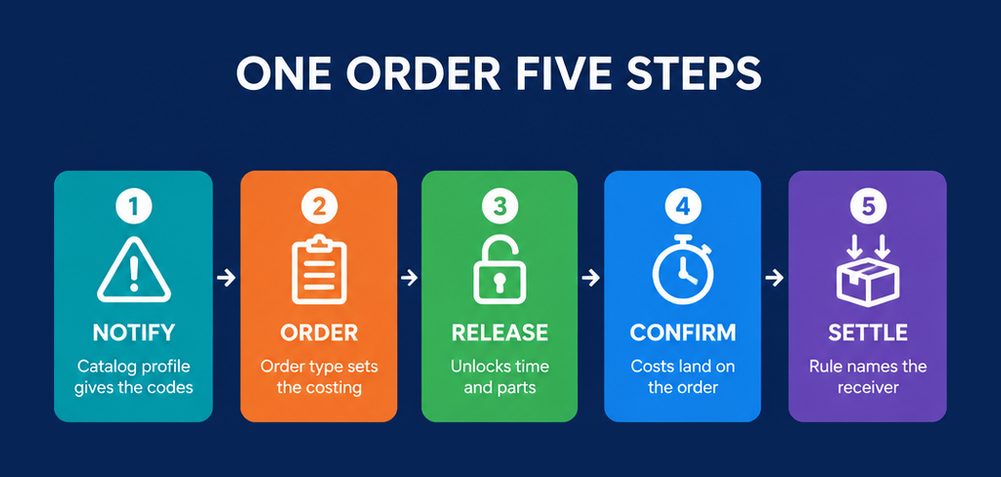
In SAP S/4HANA Asset Management a maintenance order runs from notification to order, release, execution, confirmation, technical completion and settlement, and C_S43 examines each step through the setting that enables it. The technical object supplies the cost center and planner group, the order type supplies the costing rules, and the settlement rule decides where actual costs finally land.
The chain in order
- A notification records the fault against a technical object, using the damage and cause codes that the notification type’s catalog profile makes available.
- An order is created from the notification. Its order type decides scheduling behaviour, costing and which confirmation and printing options apply.
- The order is released. Until that status is reached, the technician can neither confirm time nor withdraw the reserved components, however correct the operations look.
- Execution and confirmation post hours and goods issues, so the actual costs accumulate on the order.
- Technical completion closes the work. It does not move the costs anywhere.
- Settlement, run against a settlement rule naming the receiver, posts the actual costs to the responsible cost center or another cost object.
Where the sample scenarios put the decision
The money site’s free drills and scenario make the pattern visible. A replacement unit installed at a functional location arrives with blank cost center and planner group fields, and the fix is the reference-data transfer on installation, not retyping the values on every unit. A breakdown order that will not accept confirmations needs releasing, not rebuilding. Finished orders still holding their costs at period end need a settlement rule and a settlement run; technically completing more of them changes nothing.
A refurbishment case follows the same logic one layer further back. If a reparable spare is to be held and valued by condition, defective against serviceable, the material has to be set up for that in Materials Management before any refurbishment order can show meaningful controlling. The S43410 course on the path exists for exactly that prerequisite chain.
“We realized that if we could gain more insight into the total cost of maintaining each of our production line machines, we could make better decisions.”
That is the business reason the controlling half of area four exists. Jowat, an adhesives manufacturer, moved its maintenance onto SAP S/4HANA and reported that it could at last allocate spare-parts costs to specific lines and even specific machines, with its maintenance backlog falling from three months to three weeks; the SAP News account of Jowat gives the figures. Cost per machine is only visible if settlement sends each order’s costs to the right receiver, which is the setting the assessment checks.
Where do preventive maintenance plans go wrong in C_S43?
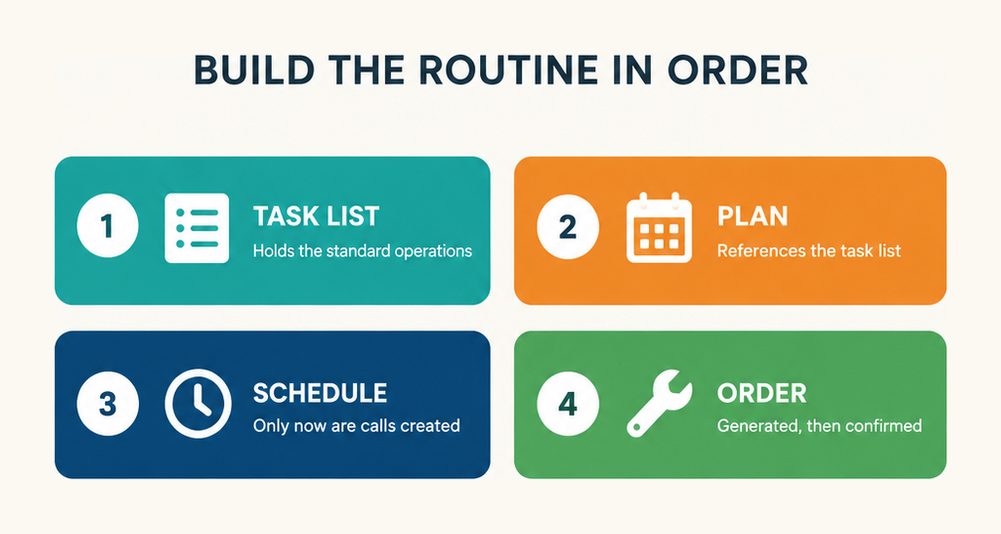
Preventive maintenance in C_S43 goes wrong at the sequence, not at the screens. A task list must exist before a maintenance plan can reference it, the plan generates nothing until it is scheduled, and the resulting order can only be confirmed once it has been generated. Reverse any two of those and the routine either cannot be saved or never produces work.
The strategy you attach decides when the next call falls due. The blueprint names three kinds: time-based, performance-based and multiple-counter. A time-based strategy counts calendar time, a performance-based one counts readings from a measuring point or counter, and a multiple-counter plan combines several conditions. The money site’s FAQ is specific that a strategy or counter setting silently shapes the next call date, and that this is one of the three places candidates most often lose the thread.
The objects a plan depends on
- Task lists and inspection rounds hold the standard operations the plan will copy into each order.
- Single-cycle plans suit one recurring interval; strategy plans suit packages that fall due at different intervals.
- Regular service procurement covers externally performed service on the same planning basis.
- Measuring points and counters on the technical object feed performance-based and multiple-counter scheduling, so they belong to area two but decide area three.
The single most useful habit is to build every preventive routine in the same order each time: technical object with its counters, task list, plan referencing the task list, scheduling, then the generated order. Repeat it until the order of steps is automatic, because the assessment leaves no time to reason it out from scratch.
Does Private Edition versus on-premise change what C_S43 asks?
No. C_S43 is written for SAP S/4HANA Cloud Private Edition, and both SAP and the money site state that its content applies to on-premise deployments as well. The maintenance processes, technical objects and customizing are the same in both; what Private Edition adds is the sixth blueprint area, which covers how such a system is implemented under the RISE with SAP methodology.
That sixth area is the one most maintenance specialists have never been examined on. It expects you to place system landscapes, fit-to-standard workshops, users and authorizations, configuration, data migration, testing and extensibility inside a RISE engagement, and to respect the clean-core framing that keeps the system upgradeable. The two courses that teach it, SL_RISE419 and S4C03, are implementation courses rather than maintenance courses. If RISE is new to you, the article on this site about the RISE with SAP methodology credential explains the phases and the tooling the methodology expects, which is the vocabulary area six uses.
The terminology shift matters for older practitioners too. What SAP calls Asset Management here is the function that earlier releases called Plant Maintenance, and the wider industry calls enterprise asset management; the enterprise asset management overview on Wikipedia is a fair definition of the discipline the credential sits in. A PM business user moving into project work already knows the processes; the credential asks that person to configure them, and to do so inside a methodology with its own phases and deliverables.
How should you prepare for the C_S43 System-Based Assessment?
Prepare for C_S43 by working the eight courses of the Asset Management learning path in process order, from S43000 to S4C03, and then rehearsing full maintenance chains in a system until each sequence is automatic. The money site puts the path at well over fifty hours and suggests two to three months of study alongside a job, with hands-on system access strongly recommended.
- Start with S43000, Exploring Business Processes in SAP S/4HANA Asset Management, so the whole maintenance picture is in place before any single object.
- Take S43100, Managing Technical Objects in SAP S/4HANA Asset Management, and build functional locations, equipment, bills of material, serial numbers and measuring points yourself.
- Move to S43200, Exploring Preventive Maintenance in SAP S/4HANA Asset Management, and practise the task list, plan, scheduling and order sequence until it needs no thought.
- Work S43300, Customizing in SAP S/4HANA Asset Management, as one chain: notification types and catalogs, order types with scheduling and confirmation, then costing and settlement.
- Add S43400, Exploring Advanced Functions in Maintenance Processing, for the phase-based model and inspection checklists.
- Finish the maintenance content with S43410, Exploring Refurbishment of Spare Parts, including the Materials Management prerequisites.
- Take SL_RISE419, Introducing RISE with SAP Methodology for SAP Partners and Customers, and S4C03, Implementing SAP S/4HANA Cloud Private Edition, for the sixth blueprint area.
- Rehearse complete scenario simulations against a 3 hour clock, then use skill drills on the steps that still slow you down.
SAP packages the same material as the Implementing Asset Management journey, which lists its objectives as the core processes, technical objects, preventive maintenance and operations, phase-based maintenance and checklists, refurbishment, and all the customizing behind them. SAP shows one prerequisite for the journey, its support accreditation course, and places a practice system inside the journey so you can rehearse in a live environment before you book.
Before exam day, read the official C_S43 certification page. It carries SAP’s technical readiness checklist for a system-based assessment, the requirement for a Learning Hub subscription that includes exam attempts, and the SAP Universal ID with a secondary email that the booking needs. It also links an introduction to system-based assessments, which is worth watching once so the format holds no surprises.
Passing is not the end of the path. SAP lists a Stay Certified course for this credential, a 32 minute unit of six lessons with a recorded session labelled from October, so expect to keep up with release content after you pass. If you studied for the earlier dated release, the guide on this site to the C_S43_2023 preparation approach shows how the topic areas were weighted before the move to a single live-system activity. The topics overlap heavily; the way they are examined does not.
Frequently Asked Questions
What is the passing score for the C_S43 exam?
The passing score for C_S43 is 70 percent. Both the ERPPrep study guide and SAP’s certification page state it, and because the assessment is one activity rather than a list of separate items, the bar applies to connected tasks rather than to a count of right answers.
How long is the C_S43 System-Based Assessment?
SAP displays a duration of 3 hours for C_S43, in the header of the certification page and again in its overview block. The money site publishes no duration for this exam, so SAP’s figure is the one to plan around.
How many activities does C_S43 contain?
One. C_S43 is a single System-Based Assessment in which you carry out configuration and process tasks inside a working SAP S/4HANA system. There is no bank of separate items and no item count, whatever pages written for the retired dated codes still claim.
Is C_S43 available in languages other than English?
No. Both the money site and SAP’s page give English as the only language. SAP’s page is the place to recheck before booking, since availability can change between releases.
Does C_S43 apply to SAP S/4HANA on-premise as well as Cloud Private Edition?
Yes. SAP states the certification is relevant for SAP S/4HANA Cloud Private Edition and SAP S/4HANA on-premise, and the money site says the same. Only the sixth blueprint area, implementation under RISE with SAP, is specific to the Private Edition context.
Do the six C_S43 blueprint areas have weightings?
No. ERPPrep lists the six areas without percentages and SAP displays none, so plan by objective and assume any area can anchor the activity. Give extra time to maintenance planning and strategies, notification and order customizing, and the phase-based model.
Is C_S43_2601 a real SAP exam code?
Not on SAP’s site. SAP lists the credential under the undated code C_S43 with no retirement date. The dated codes C_S43_2022 and C_S43_2023 belonged to the earlier format, and a dated 2601 code appears only on third-party pages.
How long does it take to prepare for C_S43?
The money site suggests two to three months alongside a job. Its learning path runs well over fifty hours across eight courses, and the live-system format needs additional time for repeating each maintenance sequence until it is automatic.
Is SAP Plant Maintenance the same as SAP S/4HANA Asset Management?
Asset Management is the current name in SAP S/4HANA for the function earlier releases called Plant Maintenance. The technical objects, notifications, orders and maintenance plans are the same concepts, so PM experience transfers directly; the credential adds the Private Edition implementation and RISE methodology context.
Does the C_S43 credential need to be kept current?
SAP lists a Stay Certified course for SAP S/4HANA Cloud Private Edition, Asset Management, a 32 minute unit with a recorded session labelled from October. SAP’s page does not display a validity period for this credential, so check your own certification record for the renewal date that applies to you.
Conclusion
The single live-system activity is the fact that organises everything about C_S43. Because one 3 hour task carries the whole maintenance flow, the SAP asset management implementation consultant credential rewards the person who can hold a technical object, a plan, an order and a settlement rule in mind at once and see how an early setting reaches every later step.
The published numbers are few: one activity, 3 hours, 70 percent, English, six unweighted areas, eight courses of well over fifty hours. Nothing else is stated by SAP or the money site, so nothing else should shape your plan.
Work the courses in order, learn the customizing chain as cause and effect rather than as screens, and rehearse complete scenarios until no step needs reasoning out. When the sequences run without pauses, 70 percent is a formality.


