If your preparation plan for the SAP Ariba Sourcing certification starts with a list of questions to memorise, it is preparing you for an exam SAP no longer runs. C_ARSOR, formally SAP Certified – Implementation Consultant – SAP Ariba Sourcing, is delivered as a single Scenario-Based Assessment activity: you are given a realistic sourcing situation and marked on the decisions and configuration steps you take inside it, against a 60 percent pass score, in the two hours SAP displays for it. There is no question count because there are no questions in the old sense.
That changes what preparation looks like. This article sets out what the credential actually tests, why the format has no item count, how the seven blueprint areas follow the guided sourcing lifecycle from project setup to award, where C_ARSOR stops and the procurement exam C_ARP2P begins, which twelve SAP courses the learning journey contains, and how to rehearse for a scenario rather than a paper.
What Does the SAP Ariba Sourcing Certification Actually Test?
The SAP Ariba Sourcing certification, exam code C_ARSOR, tests whether you can run strategic sourcing work inside SAP Ariba Sourcing as a mentored member of an implementation team. SAP positions it as an entry-level qualification for the SAP Ariba Sourcing Consultant profile: enough command of guided sourcing projects, events, pricing, grading and awarding to contribute to design and implementation projects from the first week.
The scope is the guided sourcing lifecycle rather than the whole SAP Ariba suite. Contracts, supplier lifecycle and buying appear only where they touch a sourcing event. The roles SAP lists against the credential are Consultant, Strategic Sourcing, Strategic Procurement and Purchasing, which is a fair description of who sits it: implementation consultants, and sourcing or procurement specialists who want proof that they can configure and run competitive events rather than only describe them.
The published facts are few, and the gaps are deliberate. SAP displays a duration, a pass score and a format on its C_ARSOR certification page, and nothing about question counts or topic weightings, because a single scenario activity has neither.
| Exam detail | C_ARSOR |
|---|---|
| Credential | SAP Certified – Implementation Consultant – SAP Ariba Sourcing |
| Level | Associate, entry-level qualification |
| Format | Scenario-Based Assessment, 1 activity |
| Passing score | 60 percent |
| Duration | 2 hours, as displayed by SAP |
| Blueprint areas | 7, no weightings published |
| Languages | Vary by format: roleplay with AI guidance in English, Spanish, Italian, French, Japanese and more than 25 others; recorded video in English only |
| Learning journey | Implementing SAP Ariba Sourcing, 12 courses |
| Product | SAP Ariba Sourcing |
Two things SAP does not display are worth saying plainly so you do not go looking for them: there is no published fee on the certification page, because attempts come from a Learning Hub subscription, and there is no published validity period on the page either. Treat any figure you find for those on a third-party site as that site’s claim, not SAP’s.
Why Does C_ARSOR Have No Question Count?
C_ARSOR has no question count because SAP completed its move to performance-based certification in early 2026, and C_ARSOR is delivered as a Scenario-Based Assessment: one guided activity in which you reason through a realistic sourcing situation and are scored on the judgement you show, not a bank of discrete items. The pass score of 60 percent applies to that activity as a whole.
SAP now runs two performance-based formats. A System-Based Assessment, or SyBA, puts you in a live-style system and scores whether you completed configuration tasks correctly. A Scenario-Based Assessment, or SBA, gives you a business situation and scores the decisions and the sequence of steps you defend. C_ARSOR is the second kind. That is why the certification page can show two delivery options, roleplay with AI guidance or a recorded video, with different language lists for each: both are ways of presenting your reasoning about the scenario, not two different papers.
For a candidate the practical consequence is that recall stops being enough. The scenario does not ask what a lot is; it puts you in front of a category that needs sourcing and expects you to decide the event type, set the rules and pricing, invite the right participants, grade what comes back and award it, explaining why each choice fits the situation described. Every one of those decisions sits somewhere in the seven blueprint areas below.
Which Seven Blueprint Areas Does C_ARSOR Cover?
The C_ARSOR blueprint has seven areas, and SAP publishes no weighting for any of them, so the sensible assumption is that the scenario can draw on all seven. Five of the seven are stages of one guided sourcing flow; the remaining two, reporting and administration, sit around that flow and are the areas candidates most often leave until last.
| Blueprint area | What it asks you to handle | Courses |
|---|---|---|
| SAP Ariba Sourcing Fundamentals & Solution Landscape | Terminology, benefits, the indirect versus direct spend distinction, how sourcing projects fit the strategic sourcing suite | ARS010 |
| Guided Sourcing Navigation & Full Project Setup | Dashboards, tabs, searches and preferences; full projects with teams, access controls, reusable content, tasks and the message board | ARS109, ARS110 |
| Sourcing Event Creation & Configuration | Requests for information, requests for proposals and auctions; rules, timing, currency, participants, sections, questions, line items and lots | ARS111 |
| Pricing Tactics, Bidding & Response Options | Lots, line items, terms and formulas, total cost, alternative and supplier-added responses, bid transformation, offline response sheets, sealed envelopes | ARS112 |
| Event Administration, Grading & Awarding | Monitoring live bids, surrogate bidding, editing published events, audit logs, weighted graders and scorecards, award by optimization, manual or bid analysis | ARS113 |
| Sourcing Reporting & Analytics | Reporting methods, downloadable event reports, prepackaged guided sourcing reports, analytical reports on projects | ARS114 |
| Direct Materials, Realm & Template Administration | Bills of materials and the product sourcing dashboard, enabling direct materials, realms, users, groups, project and event templates | ARS222, ARS345, ARX280, ARX290, ARS280 |
Read the table as a map of dependencies rather than a list of topics. A rule chosen while creating an event decides which bids can be compared at award time; a template edited in administration decides which rules the event creator can see at all. The parts candidates find hardest, pricing tactics and bid transformation, bidding configuration and the awarding stage, are hard precisely because they are where those chains surface. ERPPrep builds its C_ARSOR scenario simulations around that connected flow rather than around isolated screens, which is the right shape for an exam that is itself one connected scenario.
How Does a Guided Sourcing Scenario Run From Project to Award?
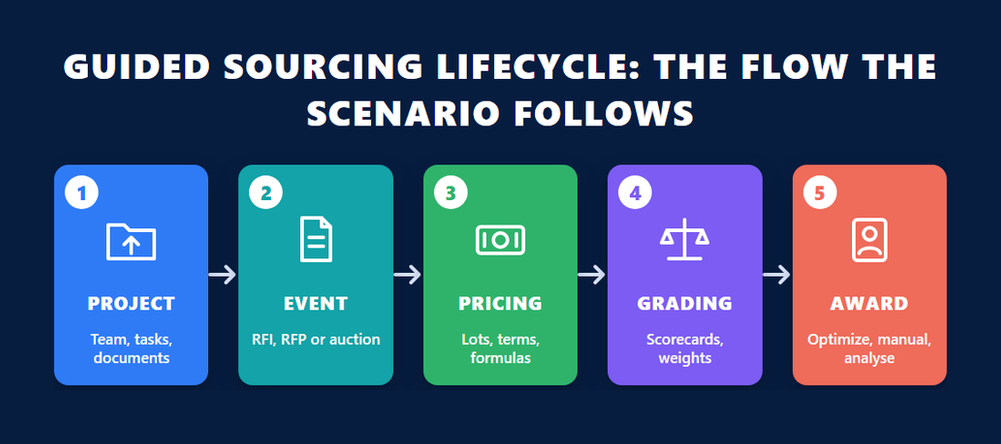
A guided sourcing scenario in C_ARSOR runs the way a real sourcing project runs in SAP Ariba Sourcing: a full project is created with its team and tasks, an event is built inside it, pricing and bidding rules are set, suppliers respond, their responses are graded, and the business is awarded. Each stage is a blueprint area, and the exam can test any decision along the chain.
Stage one: the full project and its team
Everything starts with a full guided sourcing project. The project holds the team, the access controls that decide who can see and edit what, the reusable content and documents, the tasks that sequence the work and the message board the team collaborates on. Projects can also be created from a sourcing request, which is how a demand raised elsewhere in the business becomes a sourcing exercise. The scenario tends to test whether you set the project up so that the later stages have what they need, rather than whether you can find the button.
Stage two: choosing and building the event
The central decision in most sourcing scenarios is the event type. A request for information gathers supplier capabilities and market intelligence before any price is asked for; a request for proposal collects priced, structured responses against requirements; an auction applies competitive pricing pressure to a specification that is already settled. Choosing an auction for a category whose requirements are still loose is the classic wrong answer, and it is wrong for reasons that exist outside SAP as well. The CIPS category management cycle places a market enquiry step before specification and competitive pricing for exactly that reason. Once the type is chosen, the event carries its rules, timing, currency and bidding factors, its participants, and its content: sections, requirements, questions, line items and lots.
Stage three: pricing tactics and response options
Pricing is where a scenario gets technical. Lots group line items so they can be bid together; terms and formulas turn individual entries into a total cost the buyer can compare; alternative responses and supplier-added items let a supplier propose something other than what was asked for; bid transformation adjusts a bid for factors the raw price does not show, such as freight or switching cost; sealed envelopes keep commercial and technical responses apart until the right moment. SAP’s own documentation on guided sourcing event features describes how these options attach to an event, and the ARS112 course is built around them.
Stage four: administration, grading and award
While the event is live, the consultant watches bids and responses, places surrogate bids on behalf of a supplier who cannot, edits a published event where the rules allow it, and reads the audit log when something looks wrong. After close, graders score responses against weighted criteria and scorecards. The award can then be built three ways: an optimization scenario lets the system propose the best allocation under constraints you define, a manual award lets you allocate by hand, and bid analysis lets you compare responses in detail before deciding. Which route a scenario expects depends on what was configured earlier, which is why this stage is where upstream mistakes become visible.
SAP’s direction for the product reinforces the point that the consultant’s value is in the decisions, not the clicks. Describing a pilot of SAP’s Joule Sourcing Assistant at SAP Connect in October 2026, the head of procurement at Novartis put it this way:
“Our vision is for AI agents to handle the manual heavy lifting, enabling sourcing professionals to focus on strategy, supplier engagement and value creation.”
An exam that scores judgement across a scenario is measuring the part of the job that remains.
C_ARSOR or C_ARP2P: Which SAP Ariba Exam Matches Your Role?
C_ARSOR is the SAP Ariba exam for people who find, compare and select suppliers; C_ARP2P is the exam for people who buy from the suppliers already selected. Both are associate-level implementation consultant credentials, both are Scenario-Based Assessments with a 60 percent pass score, and they test different halves of spend management. Pick by the work you do or want to do, not by which name sounds more senior.
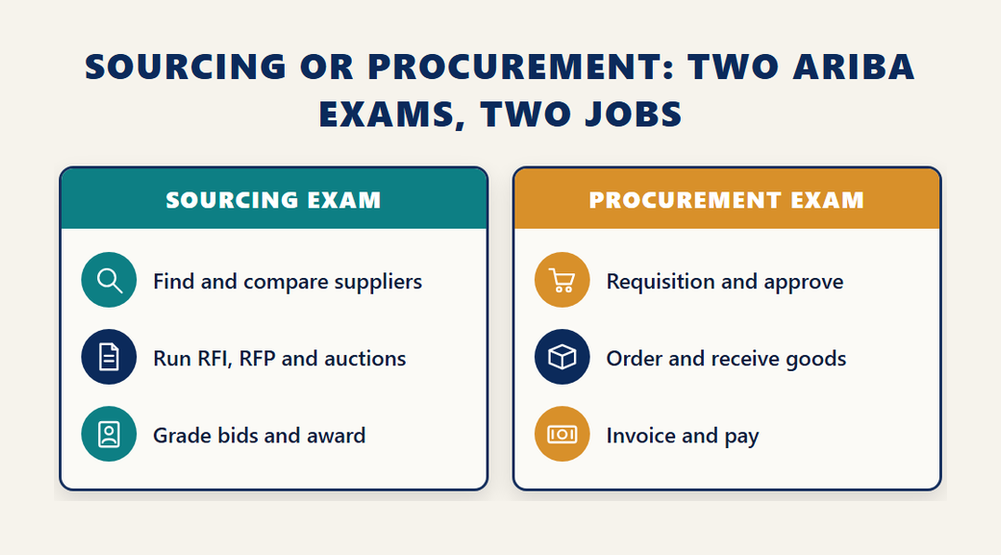
The two credentials are often confused because the search cluster around them is confused. On ERPPrep, the broad query for SAP Ariba certification draws several times the impressions of either exam name, which suggests many candidates arrive without knowing the family has separate sourcing, procurement, contracts, supplier management and integration exams. The table separates the two that overlap most.
| Question | C_ARSOR, SAP Ariba Sourcing | C_ARP2P, SAP Ariba Procurement |
|---|---|---|
| Part of the flow | Upstream: identify demand, run events, select and award suppliers | Downstream: requisition, approval, order, receipt, invoice |
| Core objects | Sourcing projects, RFIs, RFPs, auctions, lots, scorecards, award scenarios | Requisitions, catalogs, purchase orders, receipts, invoices |
| Typical reader | Sourcing manager, category manager, sourcing consultant | Procurement operations lead, buying and invoicing consultant |
| Format and pass score | Scenario-Based Assessment, 1 activity, 60 percent | Scenario-Based Assessment, 1 activity, 60 percent |
| Where it sits after passing | Strategic sourcing suite, direct materials, templates and realms | Buying and invoicing, guided buying, supplier collaboration |
If your week is spent deciding which suppliers get asked, on what terms, and who wins, C_ARSOR is the credential that describes you. If it is spent making sure requisitions become orders and invoices get paid, this blog has already walked the SAP Ariba Procurement certification through its seven areas, and that is the one to read next. Consultants who implement both ends usually sit sourcing first, because the award it produces is the input the procurement flow consumes.
Which Courses Make Up the Implementing SAP Ariba Sourcing Learning Journey?
The learning journey SAP attaches to C_ARSOR is Implementing SAP Ariba Sourcing, and it contains twelve courses: an overview, six guided sourcing courses that follow the lifecycle in order, two on direct materials and three on template and realm administration. ERPPrep’s FAQ puts the journey at about 25-plus hours, which is why most candidates studying alongside a job plan one to two months.
| Course | Title | Blueprint area it feeds |
|---|---|---|
| ARS010 | SAP Ariba Sourcing Overview | Fundamentals and solution landscape |
| ARS109 | Navigating SAP Ariba Guided Sourcing Dashboards, Preferences and Documentation | Navigation and full project setup |
| ARS110 | Creating a Full Project within SAP Ariba Guided Sourcing | Navigation and full project setup |
| ARS111 | Creating Sourcing Events within SAP Ariba Guided Sourcing | Event creation and configuration |
| ARS112 | Working with Pricing Tactics and Response Options within SAP Ariba Guided Sourcing | Pricing tactics, bidding and response options |
| ARS113 | Project Monitoring and Event Administration within SAP Ariba Guided Sourcing | Event administration, grading and awarding |
| ARS114 | Creating Sourcing Reports within SAP Ariba Guided Sourcing | Reporting and analytics |
| ARS222 | Exploring Functionality for Direct Materials in SAP Ariba Sourcing | Direct materials, realm and template administration |
| ARS345 | Administering Functionality for Direct Materials in the SAP Ariba Strategic Sourcing Suite | Direct materials, realm and template administration |
| ARX280 | Managing Project Templates | Direct materials, realm and template administration |
| ARX290 | Configuring a New Strategic Sourcing Realm | Direct materials, realm and template administration |
| ARS280 | Managing Sourcing and Event Templates | Direct materials, realm and template administration |
The order matters more than it looks. ARS109 through ARS114 are the lifecycle in sequence, so a decision made in ARS111 reappears as a consequence in ARS113. The five administration courses explain where the rules the event creator sees actually come from, which is the knowledge that turns a puzzling scenario into an obvious one. The journey itself is on SAP Learning, and it is the only official preparation SAP names.
One note on exam codes, because searches still carry suffixes. SAP’s page shows the code as C_ARSOR with no release suffix, and the ERPPrep page does the same. Older releases carried one: this blog covered the C_ARSOR_2404 release when it was still a timed paper, and C_ARSOR_2308 and C_ARSOR_2302 before it. Material written for those releases describes a format and a question count that the current exam does not have.
How Should You Prepare for a Scenario-Based Assessment?
Prepare for C_ARSOR by rehearsing the guided sourcing lifecycle as one connected flow until each decision is automatic, rather than by reading the twelve courses once and hoping to recognise answers. A Scenario-Based Assessment rewards reasoning you can defend across a whole sourcing situation, so practice has to be hands-on, sequenced the way the exam is sequenced, and timed to the two hours SAP displays.
- Work through the Implementing SAP Ariba Sourcing journey in course order, from ARS010 to ARS280, so that each lifecycle stage is learned after the stage that feeds it.
- Rehearse event creation and pricing tactics together in a system, choosing the event type, rules, lots, terms and bid transformation for a stated requirement and checking what the choices do to the responses you can compare later.
- Practise the award stage three ways on the same event, building an optimization scenario, a manual award and a bid analysis, and note which configuration each one depended on.
- Spend one session on reporting and one on template and realm administration, tracing a rule from the template where it is set to the event where it appears.
- Run full scenario simulations against the clock, reading the requirement first, deciding the event type before touching configuration, and writing down the reason for each decision as you would have to in the roleplay or recorded format.
Hands-on access matters more for this exam than for a recall-based one. If a live realm is not available, scenario simulations and skill drills that follow the same task sequence are the next best rehearsal, and reviewing why a step produced a given result is where the transferable understanding comes from. Candidates with no prior SAP Ariba exposure should plan the longer end of the one to two month window and start with ARS010 rather than with event configuration.
Frequently Asked Questions
What is the passing score for the SAP Ariba Sourcing certification?
The passing score for C_ARSOR is 60 percent, published by both SAP and ERPPrep. It applies to the single Scenario-Based Assessment activity as a whole rather than to a count of correct items.
How many questions are on the C_ARSOR exam?
None in the traditional sense. C_ARSOR is one Scenario-Based Assessment activity in which you work through a realistic sourcing situation and are scored on the decisions and steps you take. SAP publishes no question count for it.
How long is the C_ARSOR exam?
SAP displays a duration of 2 hours on the certification page. ERPPrep does not publish a duration, so the SAP figure is the one to plan around.
Is C_ARSOR_2601 or C_ARSOR_2404 the current exam code?
SAP’s certification page and the ERPPrep page both show the code as C_ARSOR with no release suffix. Suffixed codes such as C_ARSOR_2404 belong to earlier releases of the same credential, and material written for them describes a format the current exam does not use.
Which languages is the SAP Ariba Sourcing certification available in?
SAP states that available languages vary by format. The roleplay with AI guidance option lists English, Spanish, Italian, French, Japanese and more than 25 others; the recorded video option is English only.
What is the difference between C_ARSOR and C_ARP2P?
C_ARSOR covers SAP Ariba Sourcing, the upstream work of running events and awarding suppliers. C_ARP2P covers SAP Ariba Procurement, the downstream flow from requisition to invoice. Both are associate-level Scenario-Based Assessments with a 60 percent pass score.
Do I need hands-on SAP Ariba Sourcing access to pass?
It is strongly recommended. The exam scores whether you can carry a sourcing scenario through to an award, and that fluency comes from configuring events, pricing and awards in a system or in scenario simulations that follow the same sequence, not from reading alone.
How long does it take to prepare for C_ARSOR?
Most candidates studying alongside a job plan one to two months. The twelve-course learning journey runs about 25-plus hours, and the performance-based format needs additional time for hands-on repetition.
Who should take the SAP Ariba Sourcing certification?
Sourcing and procurement consultants, and business users moving into an SAP Ariba delivery role, who want an associate credential proving they can design, configure and run sourcing events. SAP lists Consultant, Strategic Sourcing, Strategic Procurement and Purchasing as the roles it serves.
Conclusion
The SAP Ariba Sourcing certification is one scenario, seven blueprint areas, a 60 percent pass score and a displayed two hours, and that shape tells you how to prepare for it. The scenario follows the guided sourcing lifecycle from a full project through event creation, pricing, grading and award, so the decisions that score are the ones that connect those stages: the event type that fits a loosely specified category, the pricing format that makes bids comparable, the award route the configuration allows. Learn the twelve courses in order, rehearse the flow in a system, and choose C_ARSOR over C_ARP2P only if selecting suppliers, rather than buying from them, is the work you do. Then book the two hours and treat them as one connected sourcing project rather than a list of things to remember.


