Record a partial receipt in the third step of an SAP Ariba scenario and the right answer to the invoice decision two steps later moves with it. That is the constraint built into C_ARP2P, the SAP Certified – Implementation Consultant – SAP Ariba Procurement exam from SAP. SAP delivers it as a single Scenario-Based Assessment: one connected activity, 2 hours long, with a 60 percent pass score.
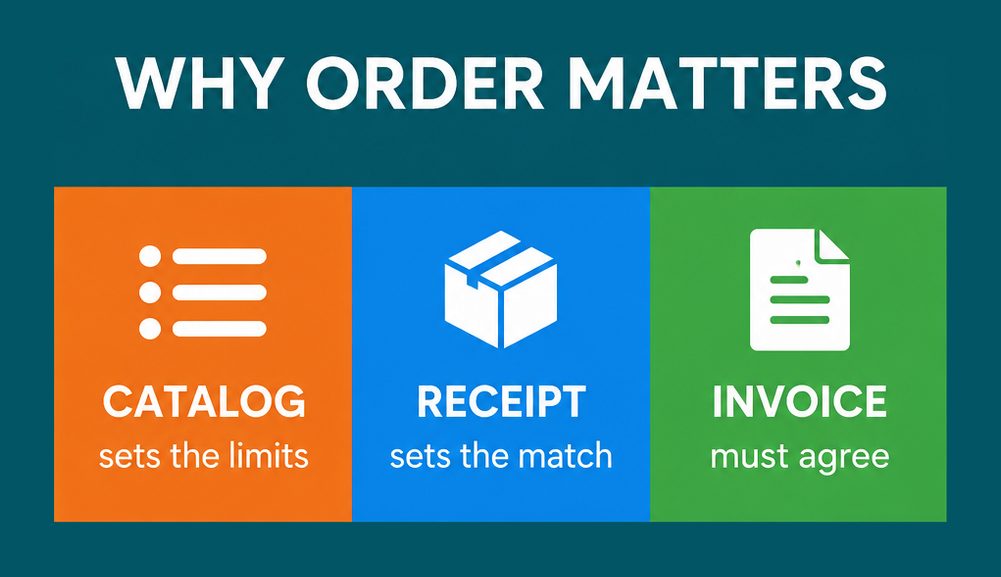
The knock-on effect is on preparation. In a fixed bank of separate items you could learn catalogs one week and invoicing the next and never connect them. In one scenario, a catalog rule you set early decides what a requisition can contain, the requisition decides what the purchase order dispatches, the receipt decides what the invoice will match, and the match decides whether reconciliation raises an exception. This article follows that chain through the seven blueprint areas the SAP Ariba procurement certification lists, shows where a single setting changes the outcome, and ends with a study order that respects the flow.
Table of Contents
- Why does one scenario change how you prepare for C_ARP2P?
- What do the seven blueprint areas of the SAP Ariba procurement certification cover?
- How does the procure-to-pay flow run in SAP Ariba Buying and Invoicing?
- Where do catalogs, guided buying and contract compliance decide the outcome?
- How does C_ARP2P sit among the SAP Ariba certifications?
- How should you prepare for the SAP Ariba procurement certification?
- Frequently Asked Questions
- Conclusion
Why does one scenario change how you prepare for C_ARP2P?
C_ARP2P is delivered as one Scenario-Based Assessment activity rather than a run of unrelated items. SAP allows 2 hours for it and sets the pass score at 60 percent. Because every decision feeds the next one, the exam measures whether you can carry a procurement situation from requirement to reconciled invoice, not whether you recognise a feature name in isolation. The same single-activity format applies across SAP spend management, including the Concur Invoice configuration consultant exam for Concur Invoice.
| Field | Value |
|---|---|
| Exam code | C_ARP2P |
| Credential | SAP Certified – Implementation Consultant – SAP Ariba Procurement |
| Level | Associate, positioned by SAP as an entry-level qualification |
| Format | Scenario-Based Assessment (SBA), 1 activity |
| Duration | 2 hours |
| Passing score | 60 percent |
| Product | SAP Ariba Buying and Invoicing |
| Blueprint areas | 7, with no published weightings |
| Languages | Vary by response format (see below) |
Two response formats, two language lists
SAP publishes the languages for this exam by response format rather than as a single list. Roleplay with AI guidance is offered in English, Spanish, Italian, French and Japanese, with 25 more listed. The Record a video format is English only. If you plan to answer in a language other than English, that decision also decides which format you will be using.
The roleplay format matters for another reason. In it you explain and defend your reasoning to an AI-guided stakeholder, so the skill being scored is the argument for a configuration choice, not only the choice itself. ERPPrep’s Scenario Roleplay drills exactly that skill, with an AI client stakeholder pressing on each decision. Teams that also buy external services and contract labour may pair this credential with the C_TFG61 administrator exam for SAP Fieldglass.
What 60 percent means when there is one activity
A 60 percent bar sounds forgiving until you remember there is no long list of independent chances behind it. The activity is scored across the objectives it touches, and a wrong early decision can make several later steps wrong at once. Treat the bar as a reason to prepare the whole chain, not as room to skip an area.
Earlier releases of this credential carried a suffixed code and a different format. Search results still quote those figures, so check the current SAP page before you rely on any number that is not on it.
What do the seven blueprint areas of the SAP Ariba procurement certification cover?
The SAP Ariba procurement certification lists seven blueprint areas: Procurement Fundamentals and Solution Overview, Requisitions and Purchase Order Management, Receiving and Goods Processing, Invoicing and Invoice Reconciliation, Catalogs and Guided Buying, Contract Compliance and Advanced Purchasing, and Realm Configuration, Approvals and Integration. None of them carries a weighting, so C_ARP2P gives you no percentage to plan around.
| Blueprint area | What it asks you to do |
|---|---|
| Procurement Fundamentals & Solution Overview | Place SAP Ariba Procurement in source-to-pay; connect requisitioning, ordering, receiving, invoicing and supplier collaboration; orient to guided buying and the Joule assistant |
| Requisitions & Purchase Order Management | Create material and service requisitions; dispatch, change, amend, cancel and close orders; route orders to SAP Business Network; split orders; force order and force cancel |
| Receiving & Goods Processing | Handle receipt types, manual receipts, tolerances, returns and rejections, service entry sheets and their approvals; configure receipt types, team receiving and over- and under-receiving |
| Invoicing & Invoice Reconciliation | Create PO-based, contract-based, service-order and non-PO invoices on SAP Business Network; handle credit memos and approvals; reconcile automatically and resolve exceptions |
| Catalogs & Guided Buying | Load, validate, replicate and syndicate catalogs; manage items, attributes, visibility and kits; configure tiles, landing pages, forms, policies and machine-learning features |
| Contract Compliance & Advanced Purchasing | Create release-order and no-release-order contracts with hierarchies and the request wizard; use spot buy, collaborative requisitioning, demand aggregation, the purchasing workbench and the procurement operations desk |
| Realm Configuration, Approvals & Integration | Configure a realm from core data, users, groups, dashboards, commodity codes and custom fields; build approval processes and rules; run the go-live methodology; connect to ERP and SAP Business Network |
Read the seven areas as one process with configuration wrapped around it. Areas two to four are the transaction chain. Areas five and six are the rules that shape what the chain is allowed to do. Area seven is the realm those rules live in. The full objective list for each area, with the courses that teach it, is on the C_ARP2P study guide, which is the page to keep open while you plan.
Without weightings, the honest planning assumption is that any area can anchor the scenario. The money site’s own FAQ names the areas candidates find hardest: invoice reconciliation exceptions, release against no-release contract logic, and catalog and guided-buying settings that quietly change later behaviour. Those three get their own section below.
How does the procure-to-pay flow run in SAP Ariba Buying and Invoicing?
In SAP Ariba Buying and Invoicing, procure-to-pay runs as requisition, purchase order, receipt, invoice and reconciliation, with the supplier side of the order and invoice handled on SAP Business Network. C_ARP2P tests each step and, more importantly, how the record created at one step constrains the next. Sourcing events and supplier discovery sit in separate Ariba solutions and are out of scope.
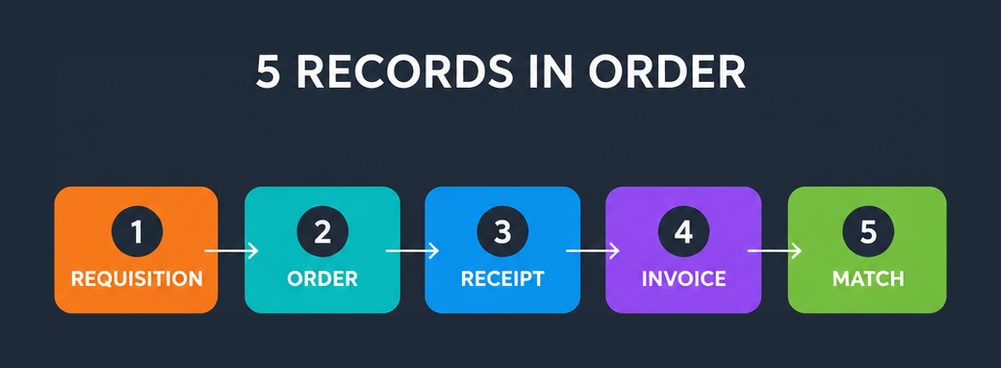
The five records in order
- A requisition captures the need. Material lines come from a catalog or free text; service lines describe effort and expected value rather than a fixed quantity.
- Approval turns the requisition into a purchase order, which is dispatched to the supplier on SAP Business Network or by an alternate method defined on the supplier record.
- A receipt or a service entry sheet records what actually arrived, in the quantity that arrived, within the tolerances configured for the receipt type.
- The supplier submits an invoice against the order, the contract, the service order or with no order at all, and can issue a credit memo to correct it.
- Reconciliation matches the invoice to the order and the receipt, clears what agrees and raises exceptions for what does not.
The general shape of this process is not unique to SAP. The Chartered Institute of Procurement and Supply describes the same requisition-to-payment sequence in its procure-to-pay process guide, and it is worth reading once so you can separate the procurement logic the exam assumes from the Ariba-specific configuration it tests.
Where the chain is tested
The sample material on the money site shows how the chain becomes a decision. A pallet arrives short and the receiving clerk must choose between recording what came and recording what was ordered; the correct receipt is the delivered quantity, because reconciliation two steps later depends on the receipt reflecting reality. A supplier bills ten rolls when eight were received; the correction is a credit memo against the same invoice, not a new order or an inflated receipt.
SAP describes SAP Ariba Buying and Invoicing as a set of procure-to-pay applications built around guided buying, supplier collaboration on the business network and automated invoicing. That is a fair one-line map of the product the exam covers, and the first blueprint area expects you to place it inside source-to-pay without claiming the sourcing and finance functions that belong elsewhere.
Where do catalogs, guided buying and contract compliance decide the outcome?
Three areas of C_ARP2P change the answer to later steps without appearing in them: catalog content and attributes, guided buying policies, and the choice between release-order and no-release-order contract compliance. Each is configured once and then shapes every requisition, order and invoice that follows, which is why the money site’s FAQ lists all three among the hardest topics.
Catalogs set what a buyer can choose
Catalog work in the syllabus runs from preparing files and subscriptions through validation, punchout, replication, syndication and deletion, then into item attributes, preferred and partial items, hierarchies, access control and kits. A visibility setting or a search parameter changes what appears when a buyer looks for an item, so an ordering scenario may turn on a catalog decision made earlier.
Guided buying steers the casual buyer
Guided buying is the simplified front door for people who buy occasionally and would abandon the full interface. The blueprint covers tiles, landing pages, forms, and validation, supplier, checkout and risk policies, plus parameters, integration end points and machine-learning features. In a scenario, the right move for off-contract stationery buying is usually a curated landing-page tile that routes the need to an approved catalog or form, not wider access or fewer approvals.
“By moving to SAP Ariba, we’re unlocking significant cost-savings, and laying the crucial groundwork for long-term financial stability.”
That quote comes from an NHS purchasing consortium whose rollout embedded guided buying so that requisition to order stayed compliant for everyday users. It is the outcome a guided-buying configuration is meant to produce, and the standard a scenario will judge your tile and policy choices against.
Release or no release
Contract compliance splits into release-order contracts and no-release-order contracts. Both use contract hierarchies, the request wizard, pricing terms and settings, and the syllabus lists blanket purchase orders under the release side. The two courses that teach them, ARP300 and ARP301, are deliberately parallel. Study them together, because a scenario often hinges on which compliance type fits the situation, and a wrong pick changes how later orders and invoices behave.
How does C_ARP2P sit among the SAP Ariba certifications?
C_ARP2P is the operational procurement credential in SAP’s Ariba family, covering Buying and Invoicing from requisition to reconciled invoice. Its neighbours cover the other parts of the suite: strategic sourcing, contracts, supplier management, supply chain collaboration and integration through the Cloud Integration Gateway. If your project role is buying and invoicing implementation, this is the one to take first.
The confusion is understandable, because searches for an SAP Ariba certification return every one of them. The sourcing side is examined separately, and the article on this site about the C_ACDET strategic sourcing credential shows how differently that blueprint reads: events, awards and supplier lifecycle rather than orders and invoices. The first C_ARP2P blueprint area even expects you to explain that competitive bidding belongs to a different solution.
Within procurement itself, SAP also certifies S/4HANA Sourcing and Procurement, which is an ERP credential rather than an Ariba one. A candidate who works in the SAP Business Network and Spend Management space should pick C_ARP2P; one who configures purchasing inside S/4HANA should look at the S/4HANA exams instead.
How should you prepare for the SAP Ariba procurement certification?
Prepare for the SAP Ariba procurement certification by working the Implementing SAP Ariba Procurement learning journey in process order, then rehearsing full scenario simulations until the chain from requisition to reconciliation feels automatic. The journey has 18 courses and takes about 44 hours; most candidates studying alongside a job plan one to three months for C_ARP2P.
- Start with ARP010, the SAP Ariba Procurement overview, so the whole source-to-pay picture is in place before any single step.
- Work the transaction courses in flow order: ARP100 requisitions, ARP102 purchase orders, ARP101 receiving, then ARP200 invoice creation and ARP201 invoice reconciliation.
- Give catalogs and guided buying their own block: ARP204 loading catalogs, ARP340 items and attributes, ARP341 guided buying configuration.
- Study ARP300 and ARP301 side by side so release and no-release contract compliance are learned as one decision.
- Finish the configuration layer with ARP342 receiving, ARP343 approval rules, ARP344 configuring a new realm, TAR73 implementation consulting and AR820 integration points.
- Rehearse complete scenario simulations under a 2 hour limit, then use skill drills on the areas where a step still slows you down.
SAP’s own Implementing SAP Ariba Procurement journey lists no prerequisites and is written for consultants, administrators and business users, so it is the right starting point even without project experience. The money site’s FAQ is blunt that reading alone is the most common way to fail this format; if you have no realm access, format-faithful scenario practice is the substitute.
Before booking, read the official C_ARP2P certification page. It carries the technical readiness checklist, the subscription and SAP Universal ID requirements, an introduction to scenario-based assessments and an AI-powered tool for trying the format. SAP also lists a Stay Certified course for SAP Ariba Procurement, updated from April 2026 onward, with this credential as its prerequisite, so plan to keep up with release changes after you pass.
If you sat or studied for an earlier release, the guide on this site to the C_ARP2P_2508 release shows how the credential was structured before the move to a single scenario. The topic areas overlap heavily; the way they are examined does not.
Frequently Asked Questions
What is the passing score for the SAP Ariba procurement certification?
The passing score for C_ARP2P is 60 percent. Both the ERPPrep study guide and SAP’s certification page state it, and SAP describes the credential as an entry-level qualification for consultants working under the guidance of an experienced colleague.
How long is the C_ARP2P exam?
SAP displays a duration of 2 hours for C_ARP2P. The whole time is spent on one Scenario-Based Assessment activity, so pacing means moving through connected steps rather than budgeting per item.
How many activities does the C_ARP2P exam contain?
One. C_ARP2P is a single Scenario-Based Assessment in which you work through a realistic procurement situation and make the configuration and process decisions it calls for. There is no bank of separate items behind it.
Is C_ARP2P available in languages other than English?
It depends on the response format. SAP lists Roleplay with AI guidance in English, Spanish, Italian, French and Japanese, with 25 more languages, while the Record a video format is English only. Confirm the current list on SAP’s page before you book.
Do the seven blueprint areas have weightings?
No. ERPPrep lists the seven areas without percentages and SAP publishes none. Plan by objective and assume any area can anchor the scenario, giving extra time to invoice reconciliation, contract compliance and catalog and guided-buying configuration.
Which SAP product does the C_ARP2P certification cover?
C_ARP2P covers SAP Ariba Buying and Invoicing, the operational procurement solution, running against SAP Business Network. Sourcing events, contracts authoring and supplier management are examined by other SAP Ariba certifications.
Do I need hands-on SAP Ariba experience before taking C_ARP2P?
The credential targets an entry-level, mentored project role, so it assumes foundational learning rather than years of experience. Hands-on work is strongly recommended because the format expects real decisions in context; without realm access, scenario simulations that mirror the flow are the closest substitute.
How long does it take to prepare for the SAP Ariba procurement certification?
Most candidates studying alongside a job plan one to three months. The Implementing SAP Ariba Procurement journey is 18 courses and about 44 hours, and the scenario format needs extra time for rehearsing decisions beyond reading.
What is the difference between C_ARP2P and C_ACDET?
C_ARP2P certifies operational procurement in SAP Ariba Buying and Invoicing, from requisition to reconciled invoice. C_ACDET certifies configuring the SAP Ariba Strategic Sourcing Suite, which covers sourcing events, contracts and the supplier lifecycle upstream of the purchase order.
Does the SAP Ariba Procurement credential need to be kept current?
SAP lists a Stay Certified course for SAP Ariba Procurement, updated from April 2026 onward, with this credential as its prerequisite. SAP does not display a validity period on the certification page, so check your own certification record for the exact renewal date.
Conclusion
The single scenario is the fact that organises everything else about C_ARP2P. Because one activity carries the whole flow, the SAP Certified – Implementation Consultant – SAP Ariba Procurement credential rewards people who can hold a requisition, an order, a receipt, an invoice and a reconciliation in their head at once and see how a catalog rule or a contract type reaches across all five.
The numbers are few and firm: 2 hours, 60 percent, seven unweighted areas, 18 courses of about 44 hours, and languages that depend on whether you answer by roleplay or by video. Nothing else is published, so nothing else should shape your plan.
Study the journey in process order, learn the three configuration areas as decisions rather than screens, and rehearse complete scenario simulations until the chain runs without pauses. When it does, the 60 percent bar is a formality.


