
One activity carries the whole blueprint. That single constraint shapes everything about how you prepare for C_SAC, the SAP Certified – Data Analyst – SAP Analytics Cloud credential, because a Scenario-Based Assessment made of one connected activity can reach across modelling, story design and planning inside the same task. Being strong in six of the seven areas and weak in one is not a safe position.
SAP holds the cut score at 60 percent and publishes no question count, no duration and no area weightings, because none of those apply to an assessment built this way. What it does publish is seven blueprint areas and a learning journey of roughly 25 hours. This guide sets out what each area contains, why the format changed, and how to prepare for a task where an early decision reshapes every later step.
What Does the C_SAC Assessment Actually Look Like?
C_SAC is a Scenario-Based Assessment consisting of one activity. You are given a realistic business situation and reason through the correct analytics and planning decisions in context, working toward an outcome rather than answering isolated items. The cut score is 60 percent, and SAP does not publish a language list for this credential.
| Specification | Value |
|---|---|
| Credential | SAP Certified – Data Analyst – SAP Analytics Cloud |
| Exam code | C_SAC |
| Level | Associate |
| Format | Scenario-Based Assessment, one activity |
| Cut score | 60% |
| Languages | Not published by SAP |
| Guided learning | Roughly 25 hours across four courses |
The absence of a question count is not an omission. A single activity has no item total to report, which is why the specification looks sparse next to older SAP credentials. What replaces it is a demand for applied fluency: you are scored on whether you reason through the situation correctly, not on whether you recognised a definition. Building that fluency is what C_SAC scenario simulations are for.
Why Does C_SAC No Longer Carry a Version Number?
Because SAP completed its move to performance-based certification in early 2026 and dropped the release suffixes along with the old format. The credential is now simply C_SAC. SAP’s own certification page carries the title SAP Certified – Data Analyst – SAP Analytics Cloud, with no version attached to it.
This matters more than a naming footnote, because search data shows candidates still looking for the suffixed codes. Anyone revising against material written for a release-numbered version is preparing for an assessment structure that has been retired, and the difference is not cosmetic. A performance-based activity rewards different preparation entirely.
How to tell whether your material is current
- If it quotes a question count and a time limit for C_SAC, it describes the retired structure
- If it names a percentage weighting per blueprint area, it predates the change
- If it describes one scenario-driven activity against a 60 percent cut, it is current
The broader transition across every SAP credential is covered in the SAP certification format guide, which explains how System-Based and Scenario-Based Assessments differ from each other.
What Are the Seven Blueprint Areas?
Navigating and getting started, data sources and connections and modelling, story design and visualisation, analysing and manipulating data in stories, manual planning, advanced planning features, and augmented analytics and collaboration. Seven areas, no published weightings, spanning the full analyst workflow from opening the platform to collaborating on the result.
| Area | What it covers |
|---|---|
| Navigating and Getting Started | Navigation, file management, working with metrics, and where SAP Analytics Cloud sits alongside SAP Business Data Cloud |
| Data Sources, Connections and Modeling | Establishing data sources and connections, the Data Analyzer, choosing between modelling options, building a basic model |
| Story Design and Data Visualization | Stories from scratch and from templates, tables, charts, geo maps and widgets, conditional formatting, scripting advanced stories |
| Analyzing and Manipulating Data in Stories | Sorting, filtering, calculating, blending across sources, data point comments, performance best practices |
| Manual Planning | Versions, dimensions and members, basic and advanced entry, mass and fluid entry, inverse formulas, hierarchies, validation and locking |
| Advanced Planning Features | Data actions, advanced formula actions, multi actions, allocations, currency conversion, rolling forecasts, predictive forecasting, value driver trees and Compass |
| Augmented Analytics and Collaboration | Built-in augmented analytics, discussions, comments and the SAP Analytics Cloud calendar |
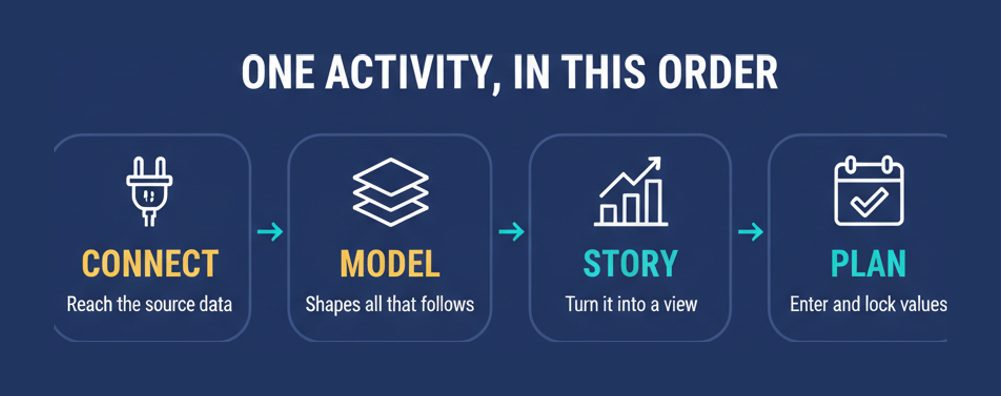
Read as a list, the seven look like separate subjects. Read as an activity, they are one sequence: you connect, you model, you build a story, you interrogate it, and you plan against it. That sequence is how the assessment presents them, which is why the missing weightings matter less than they would on a conventional paper.
Why Does the Modelling Area Decide Your Result?
Because everything downstream depends on it. The model determines what a story can show, what a calculation can reach, and whether a planning action behaves as intended. In a single connected activity, a modelling choice made in the first few minutes constrains every option available afterwards, and a wrong one is rarely recoverable later in the same task.
This is also where candidates report the most difficulty, alongside advanced planning. The two are related. A small modelling decision changes results downstream, and diagnosing that afterwards requires understanding the model rather than the symptom.
The modelling decisions worth rehearsing
- Choosing between the available modelling options for a given source, since the assessment expects you to justify the choice rather than default to one.
- Establishing the connection correctly, because a live connection and an imported model behave differently under exactly the same story design.
- Exploring model data sources before building anything, so you know what is actually available rather than what you assumed would be.
- Building a basic model end to end at least once unaided, because reading about dimensions is not the same as creating them.
Data modelling, blending and validation are established disciplines in their own right, documented in the body of knowledge maintained by DAMA International, and the vocabulary transfers cleanly into how SAP Analytics Cloud frames the same work.
Why Do Two of the Seven Areas Cover Planning?
Because SAP Analytics Cloud is a planning tool as much as a reporting one, and the data analyst role SAP certifies here is expected to do both. Manual Planning and Advanced Planning Features are separate blueprint areas, which makes planning roughly two sevenths of the credential by area count and easily the largest single theme.
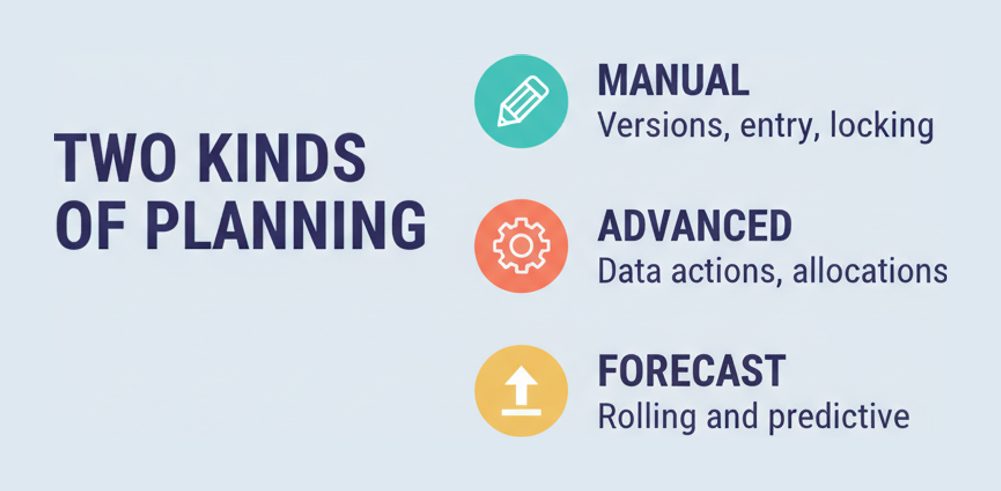
Manual planning is the mechanical half: versions, dimensions and members, basic and advanced entry, mass and fluid data entry, inverse formulas, multiple hierarchies, and the validation and locking controls that keep planning data trustworthy. It is procedural, and it rewards having actually entered data rather than read about entering it.
Where advanced planning gets difficult
The advanced area covers data actions, advanced formula actions, multi actions, allocations, currency conversion, rolling forecasts, predictive forecasting, and simulation through value driver trees and SAP Analytics Cloud Compass. Each of those involves several interacting settings, and candidates consistently name this area as the hardest.
The reason is the same one that makes modelling decisive: interactions. An allocation behaves differently depending on the version it writes to and the hierarchy it walks. If planning is your weakest area, the adjacent SAP Integrated Business Planning credential covers the discipline from a supply chain angle and builds the same intuitions.
Where Does SAP Analytics Cloud Sit Next to Business Data Cloud?
Blueprint area 1 asks you to differentiate them, so this is examinable rather than background. SAP Analytics Cloud is where an analyst models, visualises and plans. SAP Business Data Cloud is where business context and data products are governed centrally, so that the meaning of data is consistent wherever it is consumed.
“Compute can happen anywhere, data can stay at the source when needed, but business context is managed once, centrally, in SAP Business Data Cloud.”
That framing is the distinction the blueprint is after. One product manages meaning across the landscape; the other is where an analyst does the work. The two connect, and SAP Datasphere appears at the edges of the same picture, but the assessment centres on doing the analyst work inside SAP Analytics Cloud.
SAP’s own Analytics Cloud product page sets out the business intelligence, planning and predictive capabilities the seven blueprint areas map onto.
Who Is the Data Analyst Credential Written For?
Aspiring and practising data analysts, plus consultants and business users moving into an analytics role. SAP pitches it at project-participation depth: someone who can contribute as a mentored member of an analytics implementation team rather than lead one. No prior SAP Analytics Cloud experience is formally required.
That positioning is honest about what the credential is and is not. It proves four competencies – data visualisation, data modelling, data analysis and business planning – at a working level. It does not claim architectural authority, and the more senior SAP analytics credentials exist for that.
Why hands-on time still matters without a prerequisite
The absence of an experience requirement and the scenario-based format pull in opposite directions. Nothing stops a newcomer sitting it, but a performance-based activity rewards applied fluency, and candidates who have actually built models, stories and planning tasks find it considerably more manageable. The official SAP certification page is the authoritative record of the credential’s current name and status.
How Should You Prepare for a Single Connected Activity?
Practise the workflow, not the topics. Because one activity can touch modelling, visualisation and planning together, the skill being assessed is moving smoothly from one step to the next while keeping earlier decisions consistent with later ones. Even coverage beats deep specialisation, since a weak area anywhere can pull you under 60 percent.
- Work the learning journey first, starting with SACE11 for the platform foundations, because the roughly 25 hours of guided content is the fastest route to knowing what exists.
- Build a basic model unaided before touching stories, so that the area everything else depends on is genuinely yours rather than followed along.
- Design stories next, moving from templates to building from scratch, and add tables, charts and geo maps until the widget choices stop needing thought.
- Interrogate your own story by sorting, filtering, calculating and blending, since that area is about using what you built rather than building it.
- Enter planning data manually, including versions and validation, before going near data actions, because the advanced area assumes the manual one.
- Finish by running an end to end scenario in one sitting, connecting through to a planned result, because the assessment is one continuous task and that is the only thing that rehearses it.
Treat augmented analytics and collaboration as the lightest area. It is real and examinable, but it is also the most self-explanatory, and time spent there returns less than the same hour spent on advanced planning.
Frequently Asked Questions
What is the format of the C_SAC assessment?
A Scenario-Based Assessment made of one activity. You reason through a realistic business situation and complete analytics and planning tasks in context, rather than working through isolated items.
What is the passing score for C_SAC?
Sixty percent. Because a single activity can touch several blueprint areas at once, that cut score rewards even coverage across all seven rather than depth in one.
How many blueprint areas does C_SAC cover?
Seven, running from navigation and getting started through to augmented analytics and collaboration. SAP publishes no percentage weighting for any of them.
Why do older sources give a question count for C_SAC?
They describe the retired release-numbered format. SAP completed its move to performance-based certification in early 2026, and the current assessment has no item total to report.
Which areas do candidates find hardest?
Advanced planning features and the modelling foundations. Both involve several interacting settings, and a small modelling choice changes results downstream in ways that are hard to diagnose.
Is prior SAP Analytics Cloud experience required?
No formal requirement exists, and the beginner learning journey is built to bring you up from foundational knowledge. Hands-on time still helps substantially, because the assessment rewards applied fluency.
How long does preparation take?
The supporting learning journey runs roughly 25 hours across four courses. Reaching confident, scenario-ready fluency usually takes longer, with several weeks realistic alongside work.
How much planning content is on the assessment?
Two of the seven blueprint areas cover it: manual planning, and advanced planning features including data actions, allocations, currency conversion and rolling forecasts. Planning is the largest single theme.
What languages is C_SAC available in?
SAP does not publish a language list for this credential. English is the usual delivery language for SAP associate assessments, but confirm on SAP’s own certification page before booking.
Does C_SAC cover SAP Business Data Cloud?
At the edges. Blueprint area 1 asks you to differentiate SAP Analytics Cloud from SAP Business Data Cloud, but the assessment centres on doing analyst work inside SAP Analytics Cloud itself.
Conclusion
C_SAC certifies a working SAP Analytics Cloud data analyst through one connected scenario rather than a long list of items. Seven blueprint areas, a 60 percent cut, no weightings and no item count, and two of those seven areas devoted to planning. The modelling area is where the result is quietly decided, because every later step inherits the choices made there.
Work the learning journey for coverage, then build a model, a story and a planned result end to end in a single sitting until the sequence feels routine. When the workflow holds together without stopping to think, run a full scenario against the money site’s simulations before you book the assessment.


