Two SAP credentials carry the words Project Manager and SAP Activate in their titles, and candidates regularly ask whether they are one certificate or two. They are two. C_ACT is the Associate exam on the SAP Activate methodology. E_ACTAI, SAP Certified – Project Manager – SAP Activate for Agile Implementation Management, is the Specialist exam that sits beside it and asks a narrower, harder question: can you run that methodology the agile way, with a backlog, sprints and releases, on a real cloud project? If you searched for an SAP agile certification, E_ACTAI is the exam you were looking for.
SAP’s certification card displays a 60 percent pass score, one Scenario-Based Assessment activity and a 2 hour duration for E_ACTAI. This article sets the two exams side by side, explains how E_ACTAI is delivered and scored, walks through the seven blueprint areas on the ERPPrep study guide, and covers the ideas a scenario leans on most: the SAP Activate phases and transition paths, Scrum roles inside an SAP project, the definitions of ready and done, and release planning when several teams share one go-live.
Table of Contents
- What is the SAP agile certification?
- Are E_ACTAI and C_ACT two different certificates?
- How is E_ACTAI delivered and scored?
- Which seven blueprint areas does E_ACTAI cover?
- How do the SAP Activate phases and transition paths frame the scenario?
- How does Scrum work inside an SAP project?
- What do the definitions of ready and done decide?
- Release planning, sprints and testing: where do candidates slip?
- How should you prepare for E_ACTAI?
- Who should take E_ACTAI, and in what order?
- Frequently Asked Questions
- Conclusion
What is the SAP agile certification?
The SAP agile certification is E_ACTAI, SAP Certified – Project Manager – SAP Activate for Agile Implementation Management. It is a Specialist level credential that verifies a project manager can apply SAP Activate and agile methods to steer a cloud project from the sales phase through realization, manage internal and external stakeholders, and handle basic change management along the way.
SAP’s description is written for a project manager, not a configurer. The certification verifies knowledge of SAP Activate agile project management, validates cloud-focused advanced business skills and the ability to apply methodologies and tools, and confirms that the project manager can manage stakeholders, has basic knowledge of change management processes and can manage the end-to-end transition of the project from sales to realization. SAP tags it with one role, Project Manager, and three skills: Project Planning and Execution, Agile Project Management and Project Implementation.
A word on the search term
“SAP agile certification” is a loose phrase, and search engines sometimes read it as a request for general agile credentials from Scrum or project management bodies. Those are different things. E_ACTAI does not certify you in Scrum as a framework. It certifies that you can use agile delivery inside SAP’s own implementation methodology, which is a more specific claim and a more useful one on an SAP project.
Are E_ACTAI and C_ACT two different certificates?
Yes. C_ACT, SAP Certified – Project Manager – SAP Activate, is an Associate credential covering the SAP Activate methodology broadly. E_ACTAI is a separate Specialist credential focused on agile implementation management within that methodology. Both are single Scenario-Based Assessment activities with a 60 percent pass score and a 2 hour duration on SAP’s cards, but they are booked, sat and awarded separately.
| Aspect | C_ACT | E_ACTAI |
|---|---|---|
| Credential | SAP Certified – Project Manager – SAP Activate | SAP Certified – Project Manager – SAP Activate for Agile Implementation Management |
| Level on the ERPPrep study guide | Associate | Specialist |
| Format and pass score on SAP’s card | 1 Scenario-Based Assessment activity, 60 percent | 1 Scenario-Based Assessment activity, 60 percent |
| Duration on SAP’s card | 2 hours | 2 hours |
| Roles SAP tags | Project Manager, Consultant | Project Manager |
| Learning journey SAP recommends | Discovering SAP Activate – Implementation Tools and Methodology | Discovering SAP Activate – Agile Project Delivery |
| Centre of gravity | The methodology: pillars, phases, workstreams, transition paths, with agile delivery as one part | Agile delivery: project setup, backlog, sprints, release planning and testing, set inside the methodology |
Same two courses, different weight
The ERPPrep study guides list the same two SAP courses for both exams, ACT100 and ACT200. That overlap is why the two get confused. The difference is where the scenario spends its time. On the ERPPrep blueprint for E_ACTAI, four of the seven areas are agile delivery topics, two are methodology framing and one is stakeholder and change management. A candidate who knows the phases cold but has never refined a backlog or planned a release across teams will find E_ACTAI much harder than C_ACT, despite the shared reading list.
How is E_ACTAI delivered and scored?
E_ACTAI is delivered as one Scenario-Based Assessment activity and passed at 60 percent, a figure both the ERPPrep study guide and SAP’s certification card publish. SAP’s card also displays a duration of 2 hours. You work through a realistic project situation and make the calls a project manager would make, instead of answering separate recall items.
| Field | Value |
|---|---|
| Exam code | E_ACTAI |
| Credential | SAP Certified – Project Manager – SAP Activate for Agile Implementation Management |
| Level | Specialist |
| Format | Scenario-Based Assessment (SBA), 1 activity |
| Duration | 2 hours, as displayed by SAP; the ERPPrep pages publish no duration |
| Passing score | 60 percent |
| Languages | Vary by format, as SAP displays them: Roleplay with AI guidance in English, Spanish, Italian, French, Japanese and 25 more; Record a video in English only |
| Product | SAP Portfolio and Project Management (SAP Activate) |
| Role | Project Manager |
| Blueprint areas | 7, with no published weightings |
What the scenario format changes
SAP’s 2026 formats come in two families. A System-Based Assessment, or SyBA, has you carry out tasks in a working system. A Scenario-Based Assessment, or SBA, gives you a business situation and scores your reasoning. E_ACTAI is an SBA, which fits a role whose output is decisions. The ERPPrep FAQ notes that a choice made in project setup shapes the delivery decisions that follow, so partial knowledge of one topic rarely rescues an answer built on a wrong earlier call. The E_ACTAI scenario simulations on ERPPrep are built around that chained structure.
Older descriptions of this exam, usually under the suffixed code E_ACTAI_2403, still circulate with a fixed count of items and a different cut score. SAP’s card now shows the plain code E_ACTAI and a single scenario activity. Treat any page that quotes a number of items as describing the earlier format.
Languages and prerequisites to sit
The ERPPrep study guide says a language is not published by SAP. SAP’s card does display language information, as a list that depends on how you take the assessment: Roleplay with AI guidance in English, Spanish, Italian, French, Japanese and 25 more languages, and Record a video in English only. The SAP E_ACTAI certification page also lists what you need beforehand: a Learning Hub subscription that includes certification exam attempts and a valid SAP Universal ID with a secondary email.
Which seven blueprint areas does E_ACTAI cover?
E_ACTAI covers seven blueprint areas on the ERPPrep study guide: SAP Activate Methodology Foundation and Phases; Cloud Transition Paths, Workstreams and Clean Core; Agile and Scrum Foundations in SAP Projects; Setting Up and Organizing the Agile Project; Backlog Management; Iterative Build, Release Planning and Testing; and Stakeholder and Change Management Through Sales-to-Realization. No weightings are published.
| Blueprint area | What it asks you to do |
|---|---|
| SAP Activate Methodology Foundation & Phases | Explain what SAP Activate is, its three pillars and its structure, and know how the phases sequence an implementation from start to finish |
| Cloud Transition Paths, Workstreams & Clean Core | Tell new implementation, system conversion and selective data transition apart, with RISE with SAP, Clean Core, the integrated toolchain and how workstreams differ by project type |
| Agile & Scrum Foundations in SAP Projects | Apply agile and Scrum fundamentals inside an SAP delivery and judge when an agile approach fits a project |
| Setting Up & Organizing the Agile Project | Identify agile roles and responsibilities, design the project organization and prepare team, cadence and governance before build work begins |
| Backlog Management | Create and refine a product backlog through the explore phase and apply clear definitions of ready and done |
| Iterative Build, Release Planning & Testing | Plan releases, including in a scaled environment, design the sprint cycle and manage testing and deployment |
| Stakeholder & Change Management Through Sales-to-Realization | Manage internal and external stakeholders and apply basic change management while guiding the project from the sales phase into realization |
The areas ERPPrep flags as hardest
The ERPPrep FAQ names three: release planning in a scaled environment, backlog refinement using the definitions of ready and done, and matching the right transition path and workstreams to a project. Each gets its own section below. The last blueprint area, stakeholders and change, is easy to under-prepare because it has no diagram to memorise. It is also the only area that names the sales phase, which means the scenario can start before the project formally does, with expectations set in a contract that the project manager then inherits.
How do the SAP Activate phases and transition paths frame the scenario?
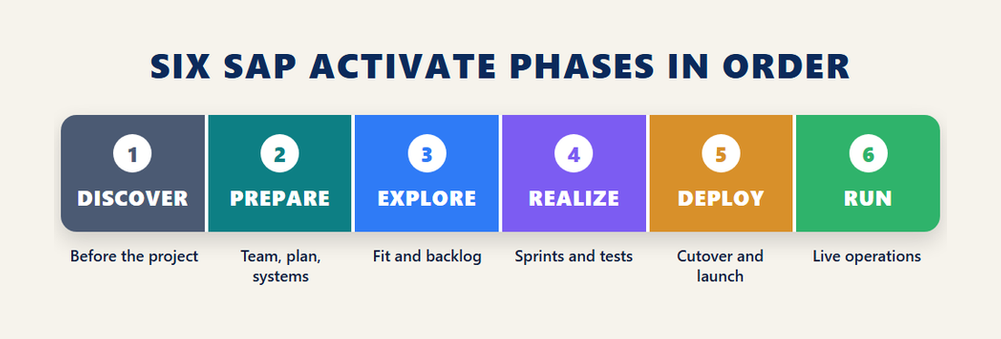
SAP Activate runs in six phases: Discover, Prepare, Explore, Realize, Deploy and Run. E_ACTAI expects you to place every agile decision in the right phase and to match the project to one of three transition paths, new implementation, system conversion or selective data transition. The path chosen changes which workstreams matter and what the backlog contains, so it frames everything that follows.
Six phases, and what the agile work does in each
The first worked example on ERPPrep is a tile maker whose team has started entering configuration before the project team, plans and environments exist. The correct sequence is Prepare, then Explore, then Realize, then Deploy, with Discover before and Run after go-live. For E_ACTAI the useful mapping is where the agile artefacts appear. The project organization and cadence are set in Prepare. The product backlog is created and refined in Explore, which is where the blueprint places backlog management. Sprints run in Realize. Skipping ahead, as the tile maker did, means building against a backlog nobody has agreed.
The ERPPrep study guide for the sibling exam names the three pillars of SAP Activate as a ready-to-run business solution, guided configuration and tools, and a proven methodology. E_ACTAI’s blueprint asks you to know them as context: the agile cycle works on top of a pre-configured starting point, which is why exploration is about confirming fit and capturing gaps as backlog items, not designing from a blank page.
Three transition paths
| Path | Starting point | What it tends to mean for the backlog |
|---|---|---|
| New implementation | A fresh system, often called greenfield | Items come from confirming standard processes and recording the gaps |
| System conversion | An existing SAP system moved to the new platform | Items lean toward technical conversion, custom code and regression testing |
| Selective data transition | Chosen data and processes carried into a new system | Items mix both, with data scope decisions arriving early |
The third column is a reading aid, not a published rule. What the blueprint requires is that you can distinguish the three paths, place RISE with SAP and Clean Core alongside them, and explain how workstreams differ across cloud, on-premise and upgrade projects. The ERPPrep preparation steps add the reason: you need to match the right approach to a scenario and anticipate how that choice shapes the delivery plan.
Clean Core is checked at the phase boundary
Clean Core appears in the same blueprint area as the transition paths, and SAP has tied it to the phase structure directly. Writing in 2024 about changes to the RISE with SAP Methodology, the head of SAP’s Cloud ERP services described how.
“We’re also adding new quality gate checks to validate that the actual implementation is in line with recommended clean core best practices before customers proceed to the next project phase.”
For an agile project manager that sentence has a practical consequence. A sprint can finish its stories and still leave the project unable to pass the gate, if what was built modifies the core. SAP’s article on the RISE with SAP Methodology update also notes that a clean core success plan was added to the SAP Activate road map viewer, so the standard sits in the same place as the phase guidance. In a scenario, a definition of done that ignores Clean Core is incomplete.
How does Scrum work inside an SAP project?
Inside an SAP project, Scrum supplies the roles, the sprint rhythm and the backlog, while SAP Activate supplies the phases, the starting solution and the quality gates. E_ACTAI examines the two together. The blueprint asks you to apply Scrum fundamentals in an SAP delivery, judge whether an agile approach fits a given project, and design the project organization before build work starts.
Three roles a scenario keeps apart
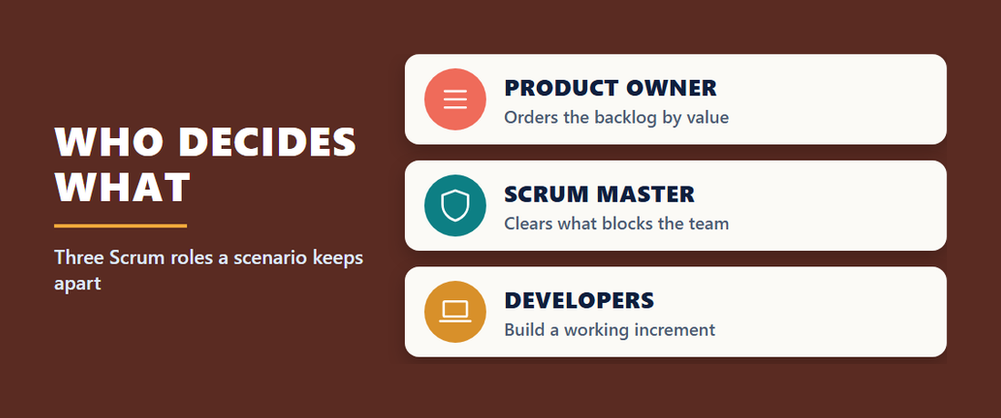
The ERPPrep worked examples return to role confusion several times. In one, business stakeholders at a brewery email individual developers with conflicting priorities and nobody can tell whose request comes first. The role that should own the order of the backlog is the product owner, who represents the business and orders items by value. In another, sprints stall on a failing test environment while a manager assigns daily tasks and tracks who is late. The role that is missing is a scrum master who facilitates the team and removes impediments.
These match the Scrum Guide, the definition of record for Scrum, which makes the product owner accountable for ordering the product backlog, the scrum master accountable for the team’s effectiveness, and the developers accountable for creating a usable increment each sprint. On an SAP project the trap is the traditional project plan. A project manager used to assigning work will be tempted to do the product owner’s ordering and the scrum master’s unblocking personally. The scenario rewards the candidate who sets up the roles and then lets them work.
Judging whether agile fits
The blueprint asks when an agile approach fits, which implies that sometimes it fits less well. The exam’s material frames agile as a way of delivering within SAP Activate, not as a replacement for it. A sprint should produce something demonstrable: in one worked example a robotics firm runs month-long sprints that yield only design documents, and the fix is that each sprint delivers a working, demonstrable increment. That expectation comes straight from the Agile Manifesto principles, which name working software as the primary measure of progress. If a project’s constraints make working increments impossible for long stretches, that is the signal to question the fit, and to say so in your answer.
What do the definitions of ready and done decide?
The definition of ready decides whether a backlog item may enter a sprint, and the definition of done decides whether it counts as complete. E_ACTAI’s Backlog Management area names both, and the ERPPrep FAQ lists backlog refinement with these two definitions among the hardest topics. They are easy to state and easy to swap under scenario pressure.
| Question | Definition of ready | Definition of done |
|---|---|---|
| When is it applied? | Before an item is pulled into a sprint | Before an item is accepted as complete |
| What does it protect? | The sprint, from work that is unclear or too large | The increment, from work that is unfinished or untested |
| A symptom that it is missing | Work stalls mid-sprint while the team chases clarifications | Items are reported complete and then reopened |
The ERPPrep example for the first column is a textile company that keeps pulling stories into sprints without acceptance criteria or agreed scope. The concept that fixes it is a definition of ready. A candidate who answers with a definition of done has named the right family and the wrong member, and in a scenario that is a wrong answer.
One of the two is SAP practice, not Scrum
Here is a detail worth knowing before the exam. The Scrum Guide formally defines a Definition of Done, as a commitment attached to the increment. It does not contain a definition of ready at all. Ready is a widely used working agreement, and SAP’s agile course and this blueprint adopt it explicitly. So when a scenario mentions both, it is using SAP Activate’s agile vocabulary, and you should answer in those terms instead of arguing from the Scrum Guide alone.
Release planning, sprints and testing: where do candidates slip?
Candidates slip most often on release planning in a scaled environment, where several teams build toward one release and their sprints have to line up. The blueprint area also covers designing the sprint cycle and managing testing and deployment. The common thread is that these are decisions about how work flows across sprints and teams, not about any single sprint.
Release planning when there is more than one team
A release plan groups backlog items into delivery waves. With one team that is a list and a few dates. With several teams, items depend on each other across teams, shared environments become a constraint, and an integration that one team needs may sit in another team’s later sprint. The ERPPrep FAQ makes the dependency explicit: how you scale sprints depends on how the project organization was designed. That sends you back to the setup area. If the scenario describes teams organised by module with no shared cadence, the release problem it then presents was created in Prepare, and the strongest answer says so.
Testing belongs inside the sprint
The last worked example on ERPPrep is a food company that plans to leave all testing to one phase after every sprint is built. Defects found then are costly and hard to trace to a sprint. The answer is to test within each sprint so every increment is validated as it is built. On an SAP project this does not remove the larger integration and acceptance test cycles that sit later in Realize. It means they should be confirming work that was already tested, not discovering it. A definition of done that includes testing is what connects the two.
How should you prepare for E_ACTAI?
Prepare for E_ACTAI by learning SAP Activate and Scrum as one way of working and rehearsing project decisions aloud. The ERPPrep FAQ suggests roughly one to two months alongside a job, and describes SAP’s learning journey as about seven hours across two courses, with the rest of the time spent rehearsing scenarios. The five steps below follow the study guide’s order.
- Learn the SAP Activate methodology as one connected lifecycle, covering the pillars, the phase structure and each phase’s purpose, so you can place any agile decision at the right point.
- Study agile and Scrum inside the SAP context, practising how roles, backlog, sprint cycle and release planning map onto SAP Activate.
- Drill backlog management end to end, including product backlog creation and the definitions of ready and done.
- Work through release planning in both standard and scaled environments, and connect it to the sprint cycle and to testing and deployment.
- Rehearse the transition paths and workstreams, covering new implementation, system conversion, selective data transition and RISE with SAP, so you can match the right approach to a scenario.
The ERPPrep FAQ recommends taking ACT100 first for the methodology foundation and then ACT200 for agile delivery, because the agile practices only make sense once the phases are in place. SAP hosts the second course in its agile project delivery journey, which covers applying Agile and Scrum in SAP projects, setting up an agile project, scaling to larger projects, backlog management and iterative build. This site’s earlier E_ACTAI study materials page lists further resources for the credential, although it was written for the suffixed release and its format details predate the scenario activity.
Seven hours of courses is not seven hours of preparation
The short learning journey misleads people. Two courses can be read in a week, and a candidate who stops there has prepared for a recall exam that no longer exists. The ERPPrep FAQ calls preparing by reading instead of reasoning the most common mistake, followed by treating agile and SAP Activate as separate topics. Use the remaining weeks on scenarios. Take a situation, such as two teams whose sprints do not align or a sponsor who wants scope added mid-sprint, and explain what you would decide, who should own the decision, and which phase the root cause sits in.
If you have little agile delivery experience
The ERPPrep FAQ is candid that hands-on delivery experience is strongly helpful here. If you have managed SAP projects in a traditional way and are new to agile delivery, spend extra time on the two definitions and on scaled release planning, and practise explaining Scrum roles to an imagined steering committee that expects a conventional plan. That conversation, in some form, is very likely to appear.
Who should take E_ACTAI, and in what order?
E_ACTAI suits project managers and delivery leads who run SAP implementations and want proof they can lead them the agile way, along with experienced consultants stepping into a project management role. Because it is a Specialist credential centred on leadership decisions, it fits less well for someone who has not yet worked through the SAP Activate methodology itself.
The ERPPrep study guide describes the audience as people running SAP implementations who want a recognised specialist credential showing they can apply SAP Activate and agile methods from sales through realization. The FAQ adds that the exam fits candidates comfortable with planning, stakeholders and team coordination, and that prior exposure to agile ways of working and to the implementation phases makes preparation much smoother.
Which exam first
Neither ERPPrep nor SAP’s card displays a rule that one credential must be held before the other, so this is advice and not a requirement. If the methodology is new to you, the Associate exam is the natural first step, because E_ACTAI assumes the phases, workstreams and transition paths as background and spends its time on the agile layer. If you already manage SAP projects and the gap is agile delivery, going straight to the Specialist exam is reasonable. For the Associate route, this site’s C_ACT study guide covers that exam in detail.
Frequently Asked Questions
Is E_ACTAI the same exam as C_ACT?
No. C_ACT is SAP Certified – Project Manager – SAP Activate, an Associate credential on the methodology. E_ACTAI is SAP Certified – Project Manager – SAP Activate for Agile Implementation Management, a separate Specialist credential focused on agile delivery. They are booked and awarded separately.
What is the passing score for E_ACTAI?
The passing score is 60 percent. Both the ERPPrep study guide and SAP’s certification card publish that figure. SAP can change a cut score between releases, so confirm it on SAP’s card before booking.
How long is the E_ACTAI exam?
SAP’s certification card displays a duration of 2 hours for E_ACTAI, in the card header and again in the certification overview. The ERPPrep pages do not publish a duration, so SAP’s card is the source for this figure.
What format does E_ACTAI use?
E_ACTAI is a single Scenario-Based Assessment activity. You reason through a realistic project situation as a project manager would. Neither the ERPPrep study guide nor SAP’s card publishes a count of separate items for it.
In which languages is E_ACTAI available?
SAP’s card shows that languages vary by format: Roleplay with AI guidance in English, Spanish, Italian, French, Japanese and 25 more languages, and Record a video in English only. Check SAP’s card for the current list before you book.
Which topics does E_ACTAI cover?
The ERPPrep study guide lists seven blueprint areas: the SAP Activate methodology foundation and phases, cloud transition paths with workstreams and Clean Core, agile and Scrum foundations, agile project setup, backlog management, iterative build with release planning and testing, and stakeholder and change management. No weightings are published.
Which SAP courses prepare you for E_ACTAI?
The ERPPrep study guide lists two: ACT100, Discovering SAP Activate – Implementation Tools and Methodology, and ACT200, Discovering SAP Activate – Agile Project Delivery. Its FAQ recommends taking ACT100 first and describes the learning journey as about seven hours.
Does the Scrum Guide define a definition of ready?
No. The Scrum Guide defines a Definition of Done as a commitment for the increment and does not mention a definition of ready. E_ACTAI’s blueprint uses both terms, following SAP Activate’s agile practice, so answer scenario decisions in those terms.
Do I need SAP project experience to pass E_ACTAI?
The ERPPrep FAQ describes hands-on delivery experience as strongly helpful, because the assessment asks for project manager decisions in context. Candidates with limited experience can prepare by rehearsing scenarios on backlog refinement, release planning and phase transitions, and should allow more time.
Conclusion
E_ACTAI answers one question: can you lead an SAP implementation the agile way? It is a Specialist credential, separate from the Associate C_ACT exam, delivered as one Scenario-Based Assessment activity with a 60 percent pass score and a 2 hour duration on SAP’s card. Its seven blueprint areas spend most of their attention on agile delivery, from setting up roles and a backlog to planning releases across teams and testing inside each sprint, all framed by the SAP Activate phases, the three transition paths and Clean Core. The reading list is short, so the preparation that counts is rehearsal. Work through whole project situations, name who should decide each point, and trace problems back to the phase that caused them. Start with ERPPrep’s free scenario, note where your reasoning stalls, and spend your weeks there.


