SAP’s module is called Controlling. The credential is called Management Accounting. They are the same subject, and that single naming gap is why candidates search for one term and find pages about the other, or conclude that two separate certifications exist when there is only one.
The S/4HANA management accounting certification, exam code C_TS4CO, is a three hour System-Based Assessment made up of one activity, scored against a 59 percent cut score. It spans seven blueprint areas from controlling master data through product costing and profitability analysis to the implementation methodology that frames the project.
Table of Contents
- Why is it called Management Accounting when SAP calls it Controlling?
- What does the C_TS4CO assessment actually involve?
- What do the seven blueprint areas cover?
- Why do costs cascade, and what does that mean for one activity?
- Product cost planning has the most moving parts
- What does profitability analysis add at the end of the flow?
- Why does an implementation methodology area sit on a controlling exam?
- How should you prepare for three hours in a live system?
- Frequently Asked Questions
- Conclusion
Why is it called Management Accounting when SAP calls it Controlling?
Management accounting is the discipline; Controlling is what SAP named its implementation of it. The module code is CO, practitioners call themselves CO consultants, and the credential SAP awards is titled Management Accounting. One subject, three names, and search traffic splits across all of them. Consultants who plan the transformation rather than the ledger should look at the RISE with SAP credential instead.
The distinction that matters is not the label but the boundary. Financial accounting produces the statements the outside world reads. Management accounting produces the numbers the business steers by: what a product actually costs to make, which cost centre absorbed which overhead, and which customer segment is genuinely profitable once everything is allocated.
That framing is how the global accountancy federation describes the professional accountant in business, and it explains why this credential looks so different from its sibling. The financial accounting credential examines the ledger that faces outward; this one examines the machinery underneath it.
A note on old exam codes
SAP now names the credential simply C_TS4CO. Search demand still arrives on the older suffixed forms, C_TS4CO_2023 and C_TS4CO_2601, and material written against those suffixes describes earlier versions of the same credential rather than a different exam. If you landed here from one of them, this is the current one.
What does the C_TS4CO assessment actually involve?
C_TS4CO is delivered as a System-Based Assessment, or SyBA, consisting of a single activity. You work inside a live-style SAP system and carry out configuration and transaction tasks, and you are scored on whether the tasks were completed correctly. The assessment runs three hours against a 59 percent cut score, in English.
| Field | Value |
|---|---|
| Credential | SAP Certified Associate, SAP S/4HANA Cloud Private Edition, Management Accounting |
| Exam code | C_TS4CO |
| Format | System-Based Assessment (SyBA) |
| Structure | One activity |
| Duration | 3 hours |
| Cut score | 59 percent |
| Language | English |
| Level | Associate |
| Role | Consultant |
| Blueprint areas | 7, with no published weightings |
SAP completed its move to performance-based certification in early 2026, and the consequence for this credential is total. There is no bank of recall items to work through and no partial credit for recognising a correct statement. You either carried out the configuration task or you did not.
Three hours is a long single activity, and it behaves differently from a timed item set. There is no next item to move on to when something stalls, which is exactly why rehearsing the shape matters as much as revising the content. ERPPrep’s C_TS4CO scenario simulations are built to the current format rather than to the older one, so the pacing of a sustained connected task stops being unfamiliar.
Where the duration comes from
One caveat on sourcing. The money site publishes the cut score, the format and the language but no duration at all. The three hour figure comes from SAP’s own certification page, which displays it twice, in the header line and again in the certification overview. Everything else on the two sources agrees exactly.
What do the seven blueprint areas cover?
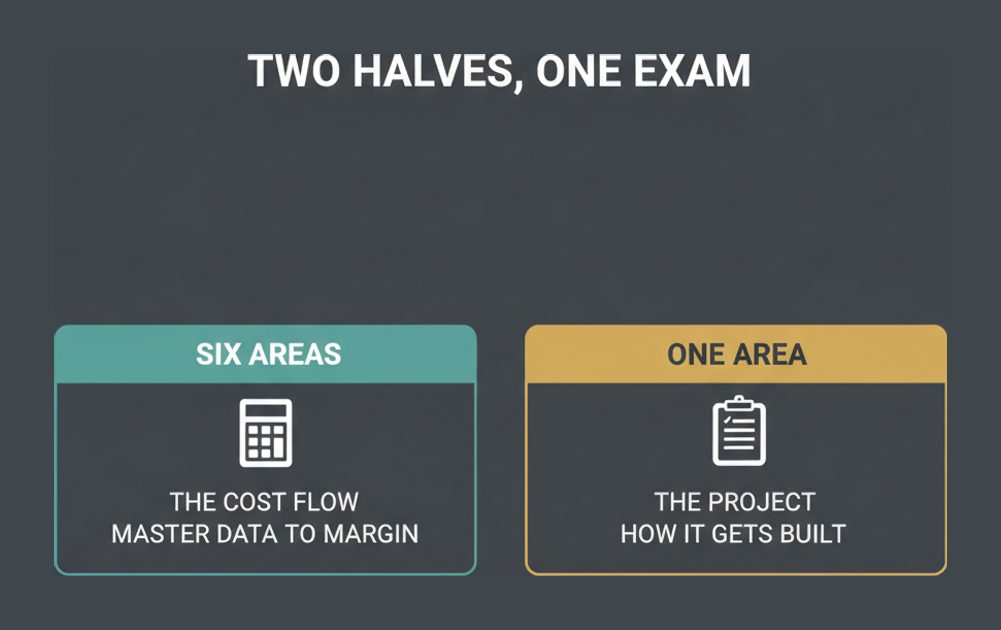
C_TS4CO has seven blueprint areas and no published percentage weightings. Six of them follow the controlling flow from master data to period-end reporting, and the seventh covers the implementation methodology that surrounds the project rather than the controlling content itself.
| Blueprint area | What it asks you to configure and run |
|---|---|
| Organizational Units and Controlling Master Data | The management accounting organisational structure, cost centers, cost elements, activity types, statistical key figures and internal orders, so that postings default correctly |
| Overhead Cost Accounting | Event-based primary and secondary postings, periodic debit and credit allocations, planning and budgeting, availability control, and the commitment management solution |
| Product Cost Planning | Material cost estimates with and without a quantity structure, costing items, costing variants, cost component splits, overhead and process cost allocation, costing runs, mixed costing, co-products and the material ledger |
| Cost Object Controlling | Product cost by period, by order and by sales order, preliminary and simultaneous costing, template allocation, work-in-process, variance analysis, results analysis and settlement, including make-to-order and service scenarios |
| Profit Center Accounting and Profitability Analysis | Profit center master data, actual value flows, planning and transfer pricing, operating concern structures, characteristic derivation and valuation, and reports across costing-based CO-PA and margin analysis |
| Periodic Activities and Management Reporting | Period-end closing across the controlling components, allocations, revaluations, WIP and variance postings, settlement, and the reports that surface the results |
| Implementation Approach and Cloud Private Edition Configuration | Transition paths, system landscapes, Fit-to-Standard workshops, business-process configuration, extensibility and data migration, framed by the RISE with SAP methodology |
Without weightings there is no marks-based way to prioritise, which sounds like a disadvantage and is actually a signal. The six controlling areas are sequential rather than parallel, so the order they appear in is the order the work happens in, and that is a better guide than a percentage would be.
Why do costs cascade, and what does that mean for one activity?
Management accounting in SAP is one long chain. A cost posts to a cost center, gets allocated to a cost object, accumulates as work in process, settles with a variance, and finally lands in a profitability segment. Every stage depends on the configuration of the stage before it, which is why the first blueprint area matters far more than its position suggests.
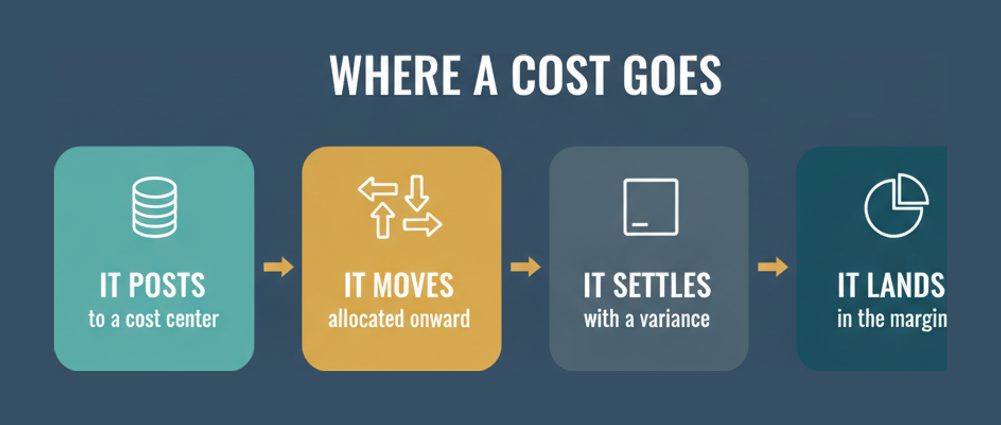
In a connected three hour activity that dependency becomes the defining risk. Assign a cost element to the wrong category early and the allocation you configure afterwards behaves correctly according to its own settings while producing a figure nobody can defend. The system does not object; the numbers simply come out wrong at the end.
Master data is a configuration decision, not an admin task
The first blueprint area names cost centers, cost elements, activity types, statistical key figures and internal orders, and the study guide says explicitly that they exist so postings default correctly and downstream allocations and reporting behave as intended. That phrasing is doing real work: the master data is judged by what happens three steps later.
Candidates who have only maintained master data in a running system, rather than designed it, are the ones most likely to be caught here. Knowing where the field is is not the same as knowing what setting it to the wrong value will do at period end.
Overhead is where the cascade starts moving
The second area covers event-based primary and secondary postings alongside periodic debit and credit allocations, which are two different mechanisms for getting cost where it belongs. Event-based postings happen as the transaction occurs; periodic allocations happen at the close. Understanding which one a scenario calls for is a judgement question rather than a configuration one.
Availability control and the commitment management solution sit in the same area and behave as a brake on the flow rather than part of it, stopping spend before it happens rather than accounting for it afterwards.
Product cost planning has the most moving parts
Product cost planning is the densest area in the blueprint. It covers material cost estimates both with and without a quantity structure, costing items, costing variants, cost component splits, overhead and process cost allocation, costing runs, and additional valuation methods including mixed costing, co-products and the material ledger.
The with-and-without distinction is the foundation. A cost estimate with a quantity structure reads the bill of material and the routing and builds the cost from them. Without one, you supply the components yourself. Those are different configurations for different situations, and the exam expects you to know which a scenario describes.
The costing variant is the control point
Almost everything in this area routes through the costing variant: which valuation applies, which overhead is picked up, which dates govern, which quantity structure is used. Learning it as the central object rather than as one of many settings makes the rest of the area considerably easier to hold in your head.
Cost object controlling is where the estimate meets reality
The fourth area runs product cost by period, by order and by sales order, and adds preliminary and simultaneous costing, template allocation, work in process, variance analysis, results analysis and settlement. Make-to-order and service scenarios are named explicitly, which is worth noting because service costing is often left out of study plans built around manufacturing.
Variance analysis is the point where the planned cost from area three meets the actual cost from area four, and explaining the difference is the whole purpose of the exercise. A candidate who can configure both sides but cannot say why they differ has missed what the area is for.
What does profitability analysis add at the end of the flow?
Profitability analysis is where the accumulated cost finally becomes a margin. The fifth blueprint area pairs it with profit center accounting, covering profit center master data, actual value flows, planning and transfer pricing on one side, and operating concern structures, characteristic derivation and valuation, actual data flows, planning and reporting on the other.
The two halves answer different questions. Profit center accounting asks how a part of the organisation performed. Profitability analysis asks how a product, a customer or a channel performed. They draw on the same postings and slice them differently, which is why they sit in one area.
Characteristic derivation decides what you can report on
Characteristics are the dimensions a margin can be analysed by, and derivation is how the system fills them in from the transaction. Get derivation wrong and a report that is technically correct becomes analytically useless, because the margin cannot be attributed to anything meaningful.
Two reporting models, named separately
The blueprint names both costing-based CO-PA and margin analysis. They coexist, they answer overlapping questions, and they do not always agree, which is precisely why the exam names both rather than one. SAP’s S/4HANA product documentation is the reference that sets out how each is populated.
The sixth area then closes the loop with period-end: allocations, revaluations, WIP and variance postings, settlement, and the management reporting that surfaces all of it. In a single connected activity, this is where an early mistake becomes visible.
Why does an implementation methodology area sit on a controlling exam?
The seventh blueprint area is not about controlling at all. It covers transition paths, system landscapes, Fit-to-Standard workshops, business-process configuration, extensibility and data migration, framed by the RISE with SAP methodology. It is there because the credential certifies a consultant on a project, not an accountant at a desk.
That is a meaningful signal about who the exam is for. A controlling expert who has never worked inside a structured implementation will find this area genuinely unfamiliar, while a consultant who has delivered a project will recognise most of it and need to learn the controlling depth instead.
Fit-to-Standard is the concept to understand properly
Fit-to-Standard inverts the old approach. Instead of gathering requirements and building to them, the workshop demonstrates the standard process and captures where the business genuinely cannot use it. For a controlling consultant that changes the default answer from “configure it” to “justify why standard will not do”, which is a habit as much as a technique.
The same shape appears across the current SAP credential range. Anyone who has worked through the S/4HANA service credential will recognise both the single-activity format and the presence of implementation content alongside the functional material.
How should you prepare for three hours in a live system?
Preparation for a System-Based Assessment has to be done in a system. Reading about a costing variant produces a memory of a screenshot; configuring one produces the fluency a three hour activity rewards. SAP names a learning journey for this credential, and it is built from six courses that map onto the blueprint areas almost one to one.
- Build the controlling organisational structure and its master data from scratch, covering cost centers, cost elements, activity types, statistical key figures and internal orders, because everything later depends on it.
- Run overhead controlling end to end, posting primary and secondary costs and then executing both an event-based posting and a periodic allocation, so the difference between them becomes concrete.
- Configure a costing variant deliberately and use it to build one cost estimate with a quantity structure and one without, since that pair is the foundation of product cost planning.
- Execute a costing run, then work through cost object controlling by period and by order until work in process and variance calculation stop being abstract.
- Settle an order and follow the settled cost into profitability analysis, which is the single exercise that makes the whole cascade visible in one pass.
- Configure characteristic derivation for an operating concern and produce a margin report, then check whether the report can actually attribute the margin to anything useful.
- Run a full period-end close across the controlling components, covering allocations, revaluations, WIP and variance postings and settlement, in one uninterrupted session.
- Read the RISE with SAP methodology material and connect each phase to the controlling work you have just done, so the seventh area is context rather than a separate subject.
- Rehearse one complete connected task under a three hour clock, because pacing a single sustained activity is a skill in its own right.
The learning journey is the shortest route
SAP’s management accounting learning journey draws on six courses covering cost center and internal order accounting, product cost planning, cost object controlling, profit center accounting, profitability analysis and the RISE methodology. Even if you do not take them, the course list is a reliable checklist for whether your own preparation has a gap.
Frequently Asked Questions
What format is the SAP C_TS4CO exam?
A System-Based Assessment made up of a single activity. You carry out configuration and transaction tasks inside a live-style SAP system and are scored on whether each task was completed correctly.
How long is the C_TS4CO assessment?
Three hours, as displayed twice on SAP’s own certification page. The money site publishes no duration, so this figure comes from the vendor.
What is the cut score for C_TS4CO?
Fifty-nine percent, confirmed on both the money site and SAP’s certification page. Because the format is performance based, that measures work completed rather than answers recognised.
Is C_TS4CO the same as SAP CO certification?
Yes. SAP’s module is Controlling and the credential is titled Management Accounting. They are one subject with two names, which is why searches for each return results about the other.
What are the C_TS4CO blueprint areas?
Seven: controlling master data, overhead cost accounting, product cost planning, cost object controlling, profit center accounting and profitability analysis, periodic activities and management reporting, and implementation approach with Cloud Private Edition configuration.
Are the blueprint areas weighted?
No percentages are published for any of them, so there is no marks-based way to prioritise. The six controlling areas are sequential, and that order is a better guide than a weighting would be.
Which language is C_TS4CO available in?
English. Both the money site and SAP state this, and unlike some scenario-based credentials the availability does not vary by assessment format here.
Does C_TS4CO apply to on-premise as well as Cloud Private Edition?
The credential is named for SAP S/4HANA Cloud Private Edition, and the controlling content applies to on-premise deployments as well, which is common in real implementation work.
Which area do candidates find hardest?
Product cost planning and cost object controlling together, because they hold the most configuration objects and because the planned and actual sides have to be reconciled through variance analysis.
How long does preparation usually take?
Two to three months alongside a job for somebody already working in controlling, with most of the time spent executing the flow in a system rather than reading about it.
Conclusion
C_TS4CO certifies that you can run the controlling line of business in S/4HANA rather than describe it. Three hours, one connected activity, a 59 percent cut score, seven blueprint areas and no weightings to prioritise by.
The thing to organise your preparation around is the cascade. Costs move from master data through overhead and cost objects into settlement and margin, each stage governed by configuration set earlier, and a single connected activity examines exactly that chain. Build the flow once end to end and most of the blueprint stops being a list.
Then rehearse a full task under a three hour clock. In a performance-based format, pacing is not a detail around the edge of the preparation; it is part of it.


