It is the last working day of the month in an SAP S/4HANA Cloud Public Edition tenant. Overhead is sitting on cost centers, an enterprise project has been collecting costs all month, a production order is showing a variance, and a make-to-order sales order is waiting for its margin to be read. Someone has to allocate, settle and explain all of it before the close.
That someone is the person C_S4CCO certifies. The credential, SAP Certified – Implementation Consultant – SAP S/4HANA Cloud Public Edition, Management Accounting, is tested as one three hour System-Based Assessment activity with a 63 percent pass score. This article covers how S/4HANA Cloud Public Edition management accounting is examined: how SAP weights the topics, the seven study areas ERPPrep maps out, why public cloud implementation work sits inside a controlling exam, how allocation, settlement and production accounting connect, how C_S4CCO differs from the private edition exam, and how to prepare.
What Does the C_S4CCO Exam Ask You to Do?
C_S4CCO asks you to carry out management accounting work inside a working SAP S/4HANA Cloud Public Edition system. It is a single System-Based Assessment activity, SAP displays a 3 hour duration, and the pass score is 63 percent. You are scored on whether the configuration and transaction tasks are completed correctly, not on recalled facts.
A System-Based Assessment is one of the two performance-based formats SAP now uses for certification. Instead of reading statements and choosing between them, you log on to a configured system and do the job: set up a posting control, run an allocation cycle, execute a settlement, analyse a production order. Preparation that feels like the task, rather than a reading exercise, is what this format rewards.
| Field | ERPPrep study guide | SAP certification page |
|---|---|---|
| Exam code | C_S4CCO | C_S4CCO |
| Level | Associate | Not displayed |
| Format | System-Based Assessment, 1 activity | 1 activity, System Based Assessment |
| Pass score | 63% | 63% |
| Duration | Not published | 3 hours |
| Languages | English | English |
| Product | SAP S/4HANA Cloud Public Edition | SAP S/4HANA Cloud Public Edition, on the learning journey |
The duration is the one field where the two sources differ. ERPPrep publishes none, while the official SAP certification page displays 3 hours, so 3 hours is the figure to plan around. Neither source publishes a fee or an item count, and none is given here.
What SAP asks you to check before exam day
SAP lists three readiness steps on the certification page. Run its technical readiness checklist for hardware, software and connectivity. Confirm a Learning Hub subscription that includes certification exam attempts, together with an SAP Universal ID that has a secondary email set up. Then watch SAP’s introduction to system-based assessments and use the practice system inside the learning journey, so the environment is familiar before an attempt counts.
How Does SAP Weight the C_S4CCO Exam Topics?
SAP’s certification page lists eight weighted exam topics for C_S4CCO. Overhead Accounting is the largest at 21 to 30 percent. Cost Center Accounting and Enterprise Projects each carry 11 to 20 percent, and five narrower topics, from direct activity allocation to margin analysis, are each weighted at up to 10 percent.
| Exam topic (SAP) | Weighting |
|---|---|
| Overhead Accounting | 21-30% |
| Cost Center Accounting | 11-20% |
| Enterprise Projects | 11-20% |
| Direct activity allocation | up to 10% |
| Overhead Costs Allocation Cycle | up to 10% |
| Production Accounting | up to 10% |
| Product Cost by Order | up to 10% |
| Sales Accounting / Margin Analysis | up to 10% |
Read the table as a shape rather than a formula. Overhead Accounting, Cost Center Accounting, direct activity allocation and the allocation cycle together describe how overhead is collected and moved, and they account for the largest share of the exam. If your experience is mostly product costing, that is where the extra study time belongs.
Why Enterprise Projects carries real weight
Enterprise Projects is weighted as heavily as Cost Center Accounting, which surprises candidates who think of controlling as cost centers and product costs. In a public cloud tenant, projects are a common cost collector, and ERPPrep’s blueprint gives project settlement methods, settlement profiles and source structures their own study area. Expect a project to appear somewhere in the activity, and expect to settle it.
How SAP’s topics and ERPPrep’s areas relate
ERPPrep’s study guide does not publish weightings. It organises the same content into seven areas that follow SAP’s learning journey course by course. The weighted list above tells you where the marks are; the seven areas below tell you what to study and in which order.
Which Seven Study Areas Does ERPPrep Map Out?
ERPPrep’s C_S4CCO study guide maps seven study areas: implementing SAP S/4HANA Cloud Public Edition; account assignment, posting control and cost center logic; universal allocation; settlement and project settlement methods; production accounting by order and by period; make-to-order production accounting; and profitability and margin analysis in make-to-order. Each follows one course in SAP’s learning journey.
| Study area | What it asks of you | Learning journey course |
|---|---|---|
| Implementing SAP S/4HANA Cloud Public Edition | Systems and authorizations, fit-to-standard, Central Business Configuration, Fiori launchpad, extensibility, integrations, migration cockpit, test automation | S4C01 |
| Account Assignment, Posting Control and Cost Center Logic | Default account assignments, validation and substitution rules, cost center categories | F2211 |
| Universal Allocation: Distribution and Overhead | Distribution versus overhead allocation, allocation tags and structures, cycle download and upload, run errors and warnings | F2211 |
| Settlement and Project Settlement Methods | Cost and revenue settlement, settlement profiles, source structures, ledger-specific allocation structures | F2211 |
| Production Accounting by Order and by Period | Production and process orders, goods issues, confirmations, goods receipts, product cost collectors, target costs, WIP, variances, backflushing | F2261, F2262 |
| Make-to-Order Sales-Order-Related Production Accounting | Quotation, sales order, MRP, production order as cost object, delivery and billing | F2271 |
| Profitability and Margin Analysis in Make-to-Order | SAP Analytics Cloud stories, margin terms, make-to-order with manufacturing and with services, event-based revenue recognition | F2241 |
ERPPrep groups its C_S4CCO skill drills into six skill domains and adds full scenario simulations, which is a practice grouping of the same content rather than a different blueprint. Plan against the seven areas and check your balance against SAP’s weightings.
The term most candidates misread
Universal allocation is SAP’s current allocation framework in the public cloud, and it covers both distribution and overhead allocation through cycles. The difference matters in a task: distribution moves primary costs and keeps their original cost elements, while overhead allocation moves costs onto a secondary allocation element. Choosing the wrong one gives a result that looks plausible and is still marked wrong.
Why Does Public Cloud Implementation Sit Inside a Controlling Exam?
C_S4CCO certifies a public cloud implementation consultant, not only a controlling expert. SAP’s learning journey says the credential covers core implementation tasks to deploy, adopt and extend SAP S/4HANA Cloud Public Edition alongside core management accounting knowledge, so system setup, fit-to-standard and Central Business Configuration are in scope.
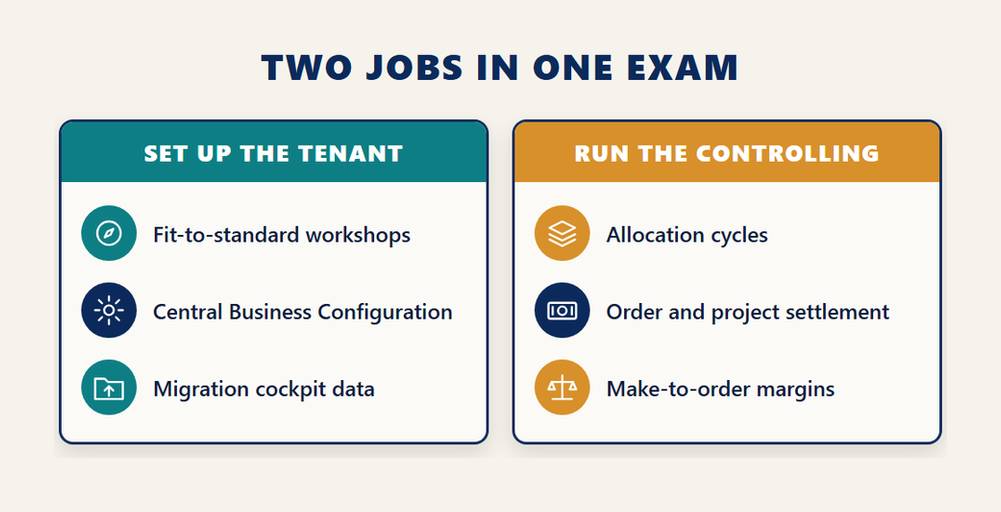
The public cloud edition is adopted rather than built from scratch. A project starts from SAP’s standard processes, runs fit-to-standard workshops to confirm how the business will use them, and configures the agreed scope through SAP Central Business Configuration. Data arrives through the migration cockpit, and test automation checks the configured processes. A management accounting consultant on that project has to work inside those constraints.
Customers describe the same trade in plain terms. When Bain and Company went live on the public cloud edition across 40 countries, its finance leader tied standard processes directly to management reporting:
“We standardized many processes to create real business value and execution efficiency. For example, we simplified and standardized our chart of accounts enabling us to utilize SAP S/4HANA Cloud Public Edition, group reporting to provide the management reporting our leaders need to make timely decisions.”
That is the mindset the first study area tests. The Bain public cloud story is a useful read for understanding why a controlling design in this edition starts from the standard and changes it only where the business genuinely needs it.
What this area asks in practice
- Know how systems, users and authorizations are provisioned for a public cloud project.
- Explain what a fit-to-standard workshop decides and what it hands to configuration.
- Find where a management accounting setting is configured in Central Business Configuration.
- Recognise where key user extensibility and integrations fit without modifying the core.
How Do Allocation, Settlement and Production Accounting Connect?
On C_S4CCO, allocation, settlement and production accounting form one chain. A default account assignment decides where a cost lands, an allocation cycle moves it to the objects that consume it, settlement clears collected costs to their final receivers, and production and margin results reflect every earlier choice. A small setting early on shows up as a wrong number much later.
ERPPrep’s study guide makes the same point in its first preparation step: trace how an account assignment or allocation structure set early shapes settlement and profitability results downstream. In a single three hour activity, that is the practical risk. A task late in the activity may only work if a task you did an hour earlier was set up correctly.
Production accounting by order and by period
The two production approaches post and settle differently, which is why ERPPrep treats them as separate study blocks. By order, the production or process order is the cost object, collecting goods issues and confirmations until goods receipt and settlement. By period, a product cost collector gathers costs, and target costs, work in process and variances are read period by period. Backflushing behaves differently in each.
Margin analysis at the end of the chain
The make-to-order topics finish where controlling meets revenue. Margin analysis reads the sales order cycle, and event-based revenue recognition posts revenue as the business events happen rather than waiting for a period-end run. The underlying accounting principle is the one set out in IFRS 15 revenue recognition, which is worth knowing at a conceptual level so the system’s postings make sense.
The discipline behind the configuration
None of this is SAP-specific in principle. Overhead allocation, cost objects, variances and contribution margins are core ideas of management accounting practice, and candidates from a finance background often find the exam easier once they map each SAP object to the concept it implements.
How Is C_S4CCO Different From the Private Edition Exam C_TS4CO?
C_S4CCO certifies management accounting in SAP S/4HANA Cloud Public Edition, while C_TS4CO certifies it in the Private Edition. Both are associate System-Based Assessments with one activity, but they use different learning journeys and different study areas, and ERPPrep lists a 63 percent pass score for C_S4CCO against 59 percent for C_TS4CO.
| Point of difference | C_S4CCO (Public Edition) | C_TS4CO (Private Edition) |
|---|---|---|
| Product | SAP S/4HANA Cloud Public Edition | SAP S/4HANA Cloud Private Edition |
| Pass score on ERPPrep | 63% | 59% |
| Implementation area | Public cloud setup, fit-to-standard, Central Business Configuration, migration cockpit | Private edition transition paths and landscapes, framed by RISE with SAP |
| Controlling emphasis | Universal allocation, project settlement, production accounting by order and period, make-to-order margin | Controlling master data, internal orders, product cost planning, profit center accounting, CO-PA |
| Learning journey courses | S4C01 and F-series courses (F2211 to F2271) | S4F-series courses (S4F22 to S4F29) and S4C03 |
The practical rule is simple: choose the exam that matches the edition your project runs. A consultant on a private edition project builds controlling from master data upward, while a public cloud consultant works within SAP’s standard scope and its configuration tools. ERPQnA’s article on the private edition management accounting exam covers the C_TS4CO route in depth.
Can one prepare you for the other?
Partly. The accounting concepts carry over, and anyone who has run cost center allocations and order settlement in either edition starts ahead. The configuration paths, the implementation area and the course list do not carry over, so treat a switch between editions as new study for at least the first area and the allocation topics.
How Should You Prepare for One Three Hour System Activity?
Prepare for C_S4CCO by learning the controlling flow as one connected chain, then rehearsing it hands on in a system until the routine steps are automatic. Work through SAP’s learning journey in order, give the heavily weighted overhead topics the most time, and practise complete scenarios under a three hour clock.
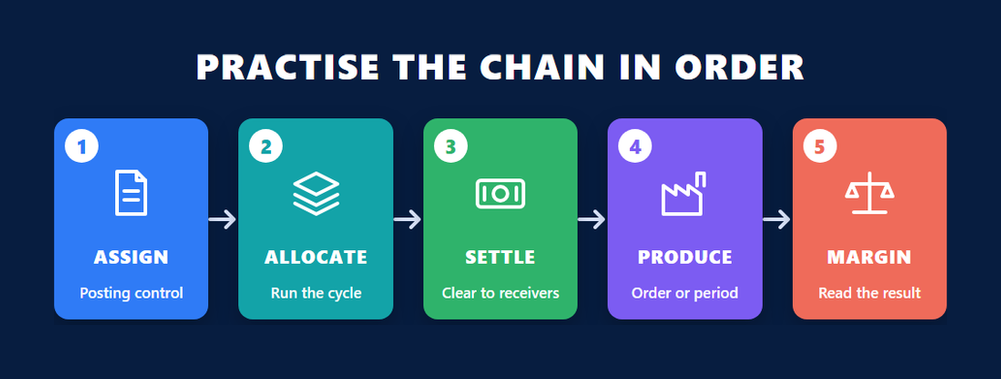
SAP’s management accounting learning journey lists three prerequisites: Performing Overhead Cost Controlling, Introducing Product Cost Planning and Production Accounting, and Getting Started with Support from SAP. ERPPrep puts the six journey courses at roughly 31 hours in total. Then follow this sequence:
- Start with S4C01 to build the public cloud implementation foundation before going deeper into controlling.
- Drill posting control, universal allocation and settlement together, because one setting often drives the final clearing.
- Treat production accounting by order and by period as separate study blocks, and practise target costs, WIP and variances in each.
- Work the make-to-order chain hands on, from sales quotation through MRP and the production order to delivery and billing.
- Finish with margin analysis and event-based revenue recognition, checking how upstream costing changes the result.
Practising against the clock
Three hours is long for one activity and short for a full controlling cycle. Time a complete run of allocation, settlement and a production order at least twice, note which steps slow you down, and confirm each result before moving on. A setting you never checked is the one that breaks a later task.
A free starting point on ERPQnA
For a second view of the public cloud scope before you begin the courses, the ERPQnA public edition preparation guide collects resources for this credential in one place. Use it alongside SAP’s learning journey rather than instead of it, since SAP’s pages hold the current exam topics.
Who Is the C_S4CCO Certification Built For?
C_S4CCO is built for management accounting and controlling consultants, and for finance business users moving into an SAP S/4HANA Cloud Public Edition role. SAP lists the role as Consultant and the skills as management accounting, system configuration, cost management, cost accounting and data migration, at the depth of a mentored member of an implementation project team.
That makes it a good first SAP credential for a cost accountant who already understands allocations and variances and now needs to show they can configure them in the public cloud. It also suits an experienced private edition consultant moving to public cloud projects, provided they budget time for the implementation area and the universal allocation framework.
What it does not cover
Financial accounting in the public cloud has its own credential, C_S4CFI, and sourcing and procurement has C_S4CPR. C_S4CCO stays on the controlling side, so pair it with financial accounting if your role spans both ledgers.
Frequently Asked Questions
What is C_S4CCO?
C_S4CCO is the exam code for SAP Certified – Implementation Consultant – SAP S/4HANA Cloud Public Edition, Management Accounting. It certifies that you can configure and run management accounting processes in the public cloud edition as a member of an implementation team.
How is the C_S4CCO exam delivered?
As one System-Based Assessment activity. You complete configuration and transaction tasks in a working SAP system, and SAP’s certification page displays a 3 hour duration.
What is the pass score for C_S4CCO?
The pass score is 63 percent. Both SAP’s certification page and ERPPrep’s study guide show the same figure.
Does C_S4CCO have a set of questions to answer?
No. It is a single hands-on activity in a system, not a list of separate items, so preparation should focus on doing the tasks rather than memorising answers.
Which C_S4CCO topic carries the most weight?
Overhead Accounting, at 21 to 30 percent on SAP’s certification page. Cost Center Accounting and Enterprise Projects follow at 11 to 20 percent each.
What is the difference between C_S4CCO and C_TS4CO?
C_S4CCO covers management accounting in SAP S/4HANA Cloud Public Edition and C_TS4CO covers the Private Edition. They use different learning journeys and study areas, and ERPPrep lists 63 percent for C_S4CCO against 59 percent for C_TS4CO.
What do codes like C_S4CCO_2506 or C_S4CCO_2602 mean?
A suffix identifies a release of the same credential. SAP’s certification page lists the credential as C_S4CCO, so check that page before booking to see which exam version you are scheduled for.
Which languages is C_S4CCO offered in?
SAP’s certification page shows the exam as available in English, and ERPPrep lists English as well.
Are there prerequisites for C_S4CCO?
SAP’s learning journey lists Performing Overhead Cost Controlling, Introducing Product Cost Planning and Production Accounting, and Getting Started with Support from SAP as prerequisites for the journey.
Conclusion
C_S4CCO tests S/4HANA Cloud Public Edition management accounting the way a consultant meets it at month end: one three hour activity in a working system, scored against a 63 percent pass mark. SAP’s weightings put overhead accounting first and give enterprise projects as much weight as cost centers, while ERPPrep’s seven study areas turn the learning journey into a study order. Build the public cloud groundwork first, learn allocation, settlement and production accounting as one chain, and choose C_S4CCO over C_TS4CO only if your project runs the public edition. Then rehearse complete scenarios against the clock until every result is checked before you move to the next task.


