
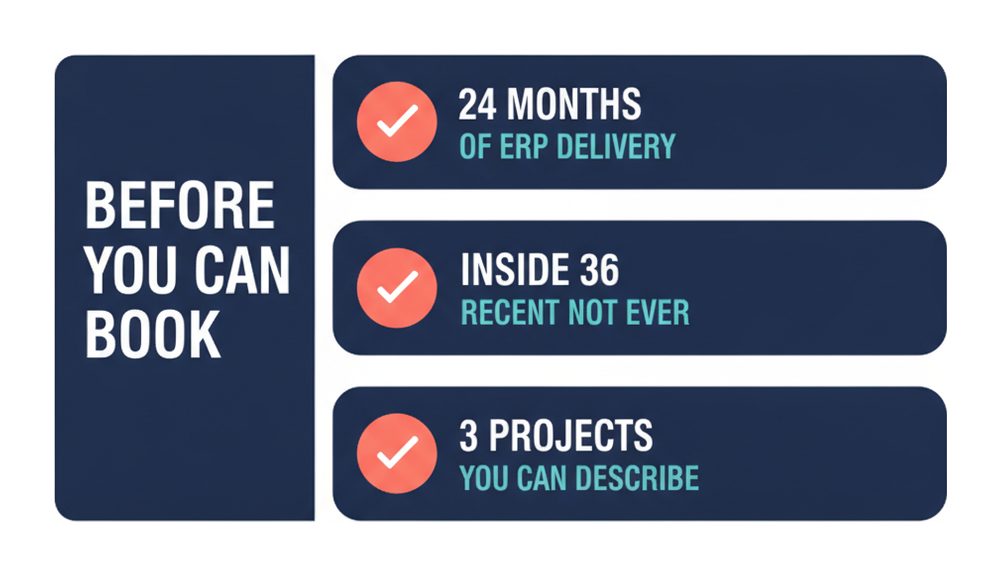
Most certifications let you decide you are ready. This one does not. Before C_RISME is available to you, SAP expects 24 months of active ERP project involvement inside the last 36, across three implementation projects you can describe. Study time will not substitute for it, and no amount of reading closes that gap.
The RISE with SAP methodology certification sits at associate level and is delivered as a Scenario-Based Assessment built around a single activity, scored against a 67 percent cut mark. Six blueprint areas run from the methodology’s phases through Clean Core to the dashboard that shows whether the transformation is working.
Table of Contents
- Why does this exam start with an experience rule?
- What are the C_RISME exam facts?
- What does a single scenario activity involve?
- What do the six blueprint areas cover?
- Why does Clean Core get its own area?
- The toolchain, Joule and the dashboard
- Who is this credential for?
- How should you prepare?
- Frequently Asked Questions
- Conclusion
Why does this exam start with an experience rule?
Because the credential certifies applied delivery judgment rather than knowledge of a framework. SAP states the requirement plainly: a minimum of 24 months of active ERP project involvement within the past 36 months, and candidates are asked to describe three SAP implementation projects they have worked on, with at least those 24 months falling inside the recent window.
The second half of the credential’s name is doing real work. It is called RISE with SAP Methodology and Experience, and the experience half is a gate rather than a recommendation. That is unusual in the SAP catalogue, where most associate credentials are open to anyone who can pay and prepare.
The projects are described anonymously. You are not asked to name customers or disclose anything commercially sensitive, which matters for consultants working under client confidentiality, and it means the requirement is about the shape of your involvement rather than about producing references.
What are the C_RISME exam facts?
C_RISME is an associate-level Scenario-Based Assessment consisting of one activity, with a 67 percent cut score, set in the product context of SAP Preferred Success for S/4HANA Cloud private edition. The passing mark is confirmed by both SAP and the exam catalogue, and the format is performance based rather than recall based.
| Field | Value |
|---|---|
| Credential | SAP Certified, RISE with SAP Methodology and Experience |
| Exam code | C_RISME, versioned as C_RISME_2511 |
| Level | Associate |
| Format | Scenario-Based Assessment, one activity |
| Cut score | 67 percent |
| Experience required | 24 months of active ERP project involvement within 36 months |
| Blueprint areas | Six, with no published weightings |
| Product context | SAP Preferred Success for SAP S/4HANA Cloud, private edition |
Three fields are deliberately missing from that table. No duration is stated, because neither the exam catalogue nor SAP’s rendered certification page publishes one for this assessment. No language list is stated, because SAP shows a format-dependent availability note for scenario assessments rather than a plain language field. No validity period is stated for the same reason: nothing published says one.
Check the current position yourself on SAP’s certification page before booking, since a new credential gains published detail over time. That is not evasion, it is the honest position. A figure repeated from a third-party summary and then quoted back by a reader as fact does more damage than a gap, and the gap itself tells you something: this is a newer credential whose published record is still thin.
What does a single scenario activity involve?
You work through one realistic transformation situation and make the decisions it calls for, rather than answering many small separate items. SAP completed its move to performance-based certification in early 2026, and this credential was built inside that format from the start, so the whole assessment is a connected piece of reasoning.
In practice that means reading a situation, identifying the underlying requirement, and choosing the methodology step, the tool or the framework that fits. The scoring rewards whether the decision was right for the situation described, which is why candidates with delivery background find the format natural and candidates relying on definitions find it uncomfortable.
It also changes what preparation looks like. Rehearsing full transformation journeys end to end, and defending the reasoning behind each choice, is closer to what the assessment asks than memorising the phase names, and a C_RISME scenario simulation puts you in that shape of thinking rather than in a recall drill.
What do the six blueprint areas cover?
The six areas are RISE with SAP Methodology Phases, Clean Core Fundamentals, Standardized Framework and Transformation Preparation, Integrated Toolchain and SAP Activate, Joule and Expert Guidance, and Methodology Dashboard and Outcome Visualization. No weightings are published, so plan by objective rather than by percentage.
| Blueprint area | What it examines |
|---|---|
| Methodology Phases | How the phases sequence a transformation and how each sets up the next |
| Clean Core Fundamentals | Keeping the landscape standard, extensible and upgrade stable |
| Standardized Framework and Transformation Preparation | Starting an engagement from a consistent baseline |
| Integrated Toolchain and SAP Activate | Choosing the right tool for a given step |
| Joule and Expert Guidance | Using the built-in guidance to de-risk decisions |
| Methodology Dashboard and Outcome Visualization | Tracking progress and value against expected results |
The absence of weightings is worth planning around rather than complaining about. With one connected activity, the assessment is unlikely to visit all six areas evenly, and a scenario that begins in preparation will pull in the framework, the toolchain and Clean Core as it develops. Studying the areas as one journey beats studying them as six lists.
Why does Clean Core get its own area?
Because it is the constraint that shapes every other decision in a RISE transformation. Clean Core means keeping the S/4HANA core standard and extending it through approved means, so the system stays upgrade stable, and once you accept it, whole categories of customisation stop being options.
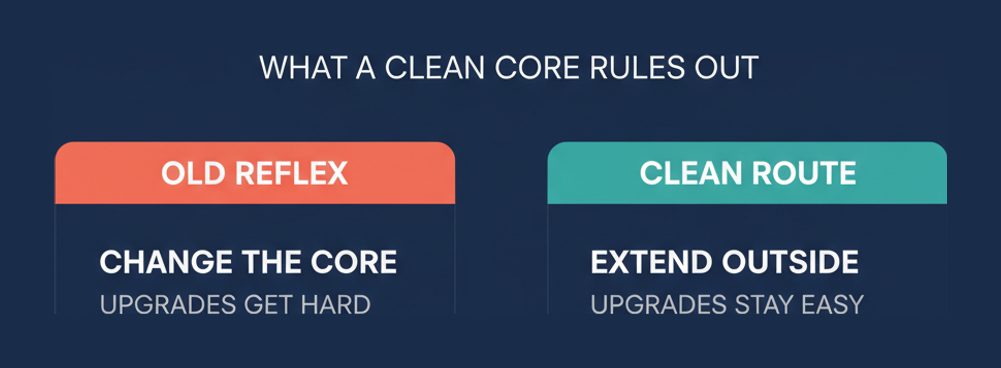
That is why the blueprint treats it as a principle rather than a technique. A scenario may describe a requirement that would traditionally be met by modifying the core, and the examinable judgment is recognising that the methodology forbids it and knowing which extensibility route replaces it. Candidates who learned SAP before this constraint existed are the ones most likely to answer from habit.
It also explains the shape of the credential. A methodology exists to make delivery repeatable, and a clean core is what makes the next upgrade cheap, so the two ideas are joined: the discipline protects the outcome that the dashboard later measures.
The toolchain, Joule and the dashboard
Three of the six areas are about instrumentation rather than theory: the integrated toolchain that works alongside SAP Activate, Joule and the expert guidance built into the approach, and the methodology dashboard that visualises outcomes. Together they describe how a transformation is run and watched rather than how it is designed.
Toolchain questions are the most concrete in the blueprint. You are given a step in the journey and asked which recommended tool supports it, which is a genuine recall of the methodology’s own mapping rather than a judgment call. This is the area where a candidate who has only read about RISE loses marks quickly.
The dashboard area is about evidence. Outcome visualisation and customer success stories are the methodology’s way of showing whether the promised value arrived, which is the same question any structured delivery approach asks at the end of a phase. Professional bodies frame it the same way, and the Association for Project Management defines project management around achieving a defined outcome rather than completing a task list.
Who is this credential for?
It is aimed at consultants, project managers and architects who guide customers through a RISE with SAP transformation, and the experience gate makes that audience explicit. If you are already two years into delivery work across several implementations, you are the candidate SAP has in mind.
It is a poor fit for two groups. Newcomers cannot meet the eligibility rule however well they study, and should target a product or module credential first. Technical specialists who configure rather than plan will find the material sits above the layer they work at, and a functional credential will serve them better.
For architects, the methodology sits alongside rather than instead of the general architecture frameworks, and anyone holding or pursuing the TOGAF standard will recognise the phase-and-gate thinking immediately, with the difference that this methodology is specific to one vendor’s cloud transformation.
If project delivery rather than methodology is your day-to-day, the adjacent credential is the more natural target, and the SAP project management certification examines the delivery role itself rather than the transformation framework around it.
How should you prepare?
Learn the methodology as a connected sequence, pair each phase with its tools, and rehearse reasoning through a full journey. With one activity and no published weightings, breadth across the six areas matters more than depth in any one, and the assessment rewards sustained reasoning rather than quick recall.
- Work through SAP’s recommended learning path, SL_RISE419, which sits inside the official learning journey and introduces the methodology, its components, the tools and the dashboard.
- Trace the phases end to end until you can explain how each one sets up the decisions of the next.
- Pair every phase with the tools that support it alongside SAP Activate, because the scenario will ask you to choose one.
- Study Clean Core as its own theme and work out which of your habits it rules out.
- Practise extracting the underlying requirement from a described situation before choosing any step.
- Rehearse a complete journey, from preparation through execution to outcome visualisation, so cross-phase dependencies feel familiar.
One practical note on the eligibility rule: prepare your three project descriptions before you sit down to study. Writing them anonymously takes longer than people expect, and discovering a gap in the 24-month window after you have paid for preparation is an expensive way to learn the rule.
If the single-activity format is new to you, the same shape appears across SAP’s current catalogue, and the single activity assessment shows how one connected task can cover a wide functional span.
Frequently Asked Questions
What is the passing score for C_RISME?
Sixty-seven percent. SAP and the exam catalogue agree on that figure.
How long is the C_RISME assessment?
No duration is published. Neither SAP’s certification page nor the exam catalogue states one, so plan around the single-activity format rather than around a clock.
What experience do I need before taking C_RISME?
SAP requires a minimum of 24 months of active ERP project involvement within the past 36 months, and asks you to describe three SAP implementation projects you have worked on.
Do I have to name the customers in those projects?
No. The descriptions are anonymised, without customer names or confidential details.
What format is the exam?
A Scenario-Based Assessment made up of one activity. You work through a realistic transformation situation and make the decisions it requires.
How many areas does the blueprint cover?
Six, and SAP publishes no weightings for them, so prepare by objective rather than by percentage.
What is Clean Core and why does it matter here?
Keeping the S/4HANA core standard and extending it through approved routes so the landscape stays upgrade stable. It is one of the six areas and it constrains decisions across all the others.
Which learning path does SAP recommend?
SL_RISE419, Introducing RISE with SAP Methodology for SAP Partners and Customers.
What product context does the exam assume?
SAP Preferred Success for SAP S/4HANA Cloud, private edition.
Is C_RISME the same as an SAP Activate credential?
No. SAP Activate appears inside one blueprint area as part of the integrated toolchain, but this credential examines the RISE with SAP Methodology around it.
Conclusion
C_RISME is an associate credential with a professional’s entry condition. One scenario activity, a 67 percent cut score, six blueprint areas without weightings, and a requirement for 24 months of recent ERP delivery across three projects you can describe.
Treat the eligibility rule as the first piece of preparation rather than a formality, then study the methodology as one connected journey with Clean Core running underneath it. The toolchain mapping is the most concrete material on the blueprint and the cheapest marks to secure.
Where SAP publishes nothing, this guide says so: no duration, no language list, no validity period. Check the certification page yourself before booking, because a credential this new tends to gain published detail over time.


