Most consultants expect an SAP S/4HANA Cloud Private Edition implementation exam to be about configuring business processes. SAP’s own topic list for E_S4CPE says something else. Two of its three exam topics, migrating data and creating users and defining authorizations, carry 31 to 40 percent each, while enterprise structure configuration carries 11 to 20 percent. The credential rewards the private edition implementation consultant who can get the right people into the system with the right access, and the right records into it, before anyone runs a single sales order.
This article explains what the credential proves, how SAP’s three weighted topics line up with the seven blueprint areas ERPPrep teaches from, what happens inside the three hour System-Based Assessment, how the conversion and new implementation paths differ, how to choose between the three extension routes, a preparation order built on SAP’s learning journey, which code to study for, and where the credential leads.
What Does the Private Edition Implementation Consultant Certification Prove?
The private edition implementation consultant certification, E_S4CPE, proves that you can carry out the core implementation work behind SAP S/4HANA Cloud Private Edition. SAP describes it as validating the core implementation skills required to support the product, and the scope runs across the whole delivery: systems, users and authorizations, configuration, extensibility, integration, data migration and testing.
The full credential name is SAP Certified – Implementation Consultant – SAP S/4HANA Cloud Private Edition. ERPPrep places it at the Specialist level, and SAP attaches the Consultant role to it. The skills SAP lists for the exam are Extension Methods, Data Migration, System Configuration, Software Testing Life Cycle and System Implementation. None of them names a single functional module, and that is the point: this exam is about running the project, not about knowing finance or logistics in depth.
The E_S4CPE certification page on SAP Learning displays a short set of facts. It shows the pass score, the assessment type, the duration, the language and the three exam topics. It shows no question count, because a single system activity has none, and no fee.
| Exam detail | E_S4CPE |
|---|---|
| Credential | SAP Certified – Implementation Consultant – SAP S/4HANA Cloud Private Edition |
| Level | Specialist |
| Product | SAP S/4HANA Cloud Private Edition |
| Format | System-Based Assessment (SyBA), 1 activity |
| Passing score | 82 percent |
| Duration | 3 hours, as displayed by SAP |
| Language | English |
| Role | Consultant |
| Learning journey | Implementing SAP S/4HANA Cloud Private Edition |
Why Do Data Migration and Authorizations Carry So Much of E_S4CPE?
Data migration and authorizations carry so much of E_S4CPE because SAP weights its exam topics around them. SAP lists three topics: Migrating Data at 31 to 40 percent, Creating Users and Defining Authorizations at 31 to 40 percent, and Enterprise Structure Configuration at 11 to 20 percent. Together the first two account for at least 62 percent of the topic weighting.
| SAP exam topic | Weighting | What it means on a project |
|---|---|---|
| Migrating Data | 31 to 40 percent | Moving legacy business records into the private edition system so the configured processes have data to run on |
| Creating Users and Defining Authorizations | 31 to 40 percent | Setting up identities, assigning the permissions each role needs and managing what each user sees in the SAP Fiori launchpad |
| Enterprise Structure Configuration | 11 to 20 percent | Defining the organisational units the business processes hang on |
The weighting makes sense once you think about where private edition projects actually stall. A configured process with no master data cannot be tested, and a project team that cannot log in with the right roles cannot run a fit-to-standard workshop in the system. Both jobs sit early in the delivery and everything later depends on them.
Authorizations are a design problem, not a checkbox
Creating a user takes seconds. Deciding what that user is allowed to do is the harder part, and it is what the exam spends a third or more of its weight on. The idea underneath is role based access: permissions belong to business roles, and users receive roles rather than individual rights. The NIST role based access project is the standard reference for that model, and it is worth reading once if you have only ever assigned roles from a list.
Migration is about records the processes can use
Migration on this exam is not a technical copy. It is getting legacy business records into a shape the configured processes accept, then checking that they do. The discipline of data quality and data governance behind that work is set out in the DAMA DMBOK framework, which is useful background for anyone who has not owned a migration before.
How Do ERPPrep’s Seven Blueprint Areas Fit SAP’s Three Topics?
ERPPrep’s seven blueprint areas fit SAP’s three topics as a wider study map around a narrower scoring list. SAP weights only migration, users and authorizations, and enterprise structure, while ERPPrep’s study guide follows the full delivery lifecycle in seven areas. The seven areas are what you need to learn; the three topics show where the E_S4CPE scoring weight sits.
ERPPrep publishes the seven areas without weightings, and SAP publishes the three topics with them. Neither contradicts the other. The learning journey teaches the whole lifecycle because a consultant cannot migrate data or assign authorizations in a system that was never provisioned, and because the activity can draw on any of it.
| ERPPrep blueprint area | Closest SAP exam topic or listed skill |
|---|---|
| Cloud ERP Foundations and Deployment Options | Background for all three topics |
| Implementation Team, Landscapes and System Setup | Background for all three topics (system preparation) |
| Users, Authorizations and Launchpad Content | Creating Users and Defining Authorizations |
| Fit-to-Standard and Business Process Configuration | Enterprise Structure Configuration |
| Fiori Launchpad, Extensibility and Custom Applications | Supporting skill (Extension Methods) |
| Integration and Data Migration | Migrating Data |
| Testing Configured Processes | Supporting skill (Software Testing Life Cycle) |
The practical reading is simple. Study all seven areas, because the activity is one connected project. Then spend your hands-on repetition where the weight is: user and role setup, launchpad content, and the migration of legacy records.
What Happens Inside the E_S4CPE System-Based Assessment?
Inside the E_S4CPE System-Based Assessment you work in a configured SAP system and carry out implementation tasks, and you are scored on whether each task was completed correctly. It is one activity, SAP displays its duration as three hours, and the pass score is 82 percent. There is no question bank to work through.
SAP completed its move to performance-based certification in early 2026, and this exam is one of the System-Based Assessments that came out of it. That changes how you should rehearse. Reading about a launchpad role tells you what it is; building one, assigning it and checking what the user can now see is what the activity asks of you. ERPPrep builds its E_S4CPE scenario simulations around that idea, with full multi-phase scenarios and skill drills across seven domains.
Why the 82 percent pass score changes your plan
ERPPrep points out that 82 percent is well above the 60 percent many SAP certifications use. In a task-based exam that is a demanding bar, because a half-finished task rarely earns half the credit. A shaky step early in the activity, such as a role assigned to the wrong user, can also make later tasks fail. Plan to rehearse until each task is dependable, not merely familiar.
What to check before booking
SAP lists three checks before exam day: your system set-up against its Technical Readiness Checklist, a Learning Hub subscription that includes certification exam attempts, and a valid SAP Universal ID with a secondary email. SAP also offers an introduction to system-based assessments and a practice system inside the learning journey. The certification page carried a beta of SAP Joule for Consultants as an open-book resource during the exam, with the beta period finishing on 29 October 2026, so check the page for the resources available when you sit it.
Conversion or New Implementation: Which Path Does the Exam Expect?
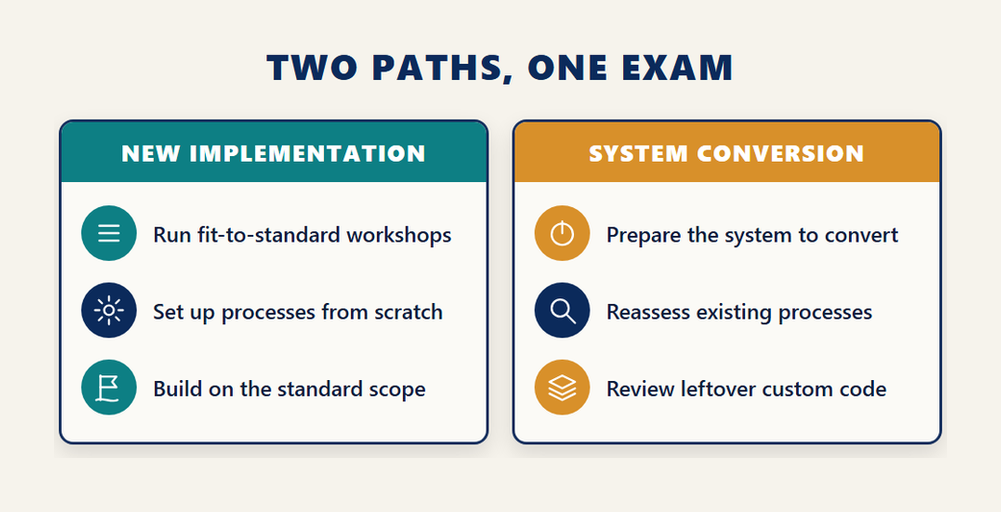
The exam expects both paths. E_S4CPE covers system conversion, where an existing SAP system moves to SAP S/4HANA Cloud Private Edition, and new implementation, where the system is built fresh. The tasks differ: a new implementation configures processes from scratch, while a conversion reassesses existing processes and leftover customisations after the move.
ERPPrep’s study guide singles this split out as something to practise deliberately, and its FAQ lists the conversion versus new implementation differences among the areas candidates find hardest. The reason is that the right action depends on the scenario. Knowing both procedures is not enough if you apply the greenfield steps to a converted system.
What changes between the two paths
- New implementation: run fit-to-standard workshops, then set up processes against the standard scope.
- Conversion: prepare the system for conversion, then reassess how existing processes behave and review the customisations carried over.
- Both: provision systems, set up the project in SAP Cloud ALM, create users, migrate data and test.
Conversion is the route an existing SAP customer takes when it keeps its current system rather than starting again, so this half of the scope reflects real project work. One customer quoted by SAP described the result of that move:
“Thanks to this successful transformation and the move to the RISE with SAP S/4HANA Cloud Private Edition solution, we have become an innovation leader.”
The remark appears in SAP’s private package announcement, which also describes the cloud optimisation and extensibility services that support a path to a clean core. That clean core idea is what links the conversion path to the next decision the exam tests.
Key User, Developer or Side by Side: How Do You Choose an Extension Route?
You choose an extension route by matching the requirement to the lightest tool that meets it. E_S4CPE covers three routes: key-user in-app extensibility for business-led changes, developer in-app extensibility for coded changes inside the system, and side-by-side extensions on SAP BTP for applications that should live outside the core. Picking the wrong one is a common, costly mistake.
The three routes in one view
| Route | Where it runs | Typical fit |
|---|---|---|
| Key-user in-app | Inside SAP S/4HANA Cloud Private Edition, using in-app tools | A field, a layout change or a simple rule a business expert can own |
| Developer in-app | Inside the system, built by a developer | Logic that must run close to the core data and transactions |
| Side-by-side on SAP BTP | On SAP Business Technology Platform, beside the core | A separate application or process that should not touch the core directly |
ERPPrep’s study guide advises comparing the three side by side and rehearsing the choice under a scenario, and it ties extensibility to reviewing the customisations left behind after a conversion. That second point is easy to miss. On a conversion project, the extension question is often not “what should we build” but “what should this old custom code become”.
The other launchpad tools in the same area
The same blueprint area covers the SAP Fiori launchpad itself, its embedded support and the Joule assistant, situation handling, flexible workflows and embedded analytics. These are often the answer before any extension is needed: a flexible workflow can replace a custom approval, and situation handling can replace a custom alert.
How Should You Prepare for E_S4CPE?
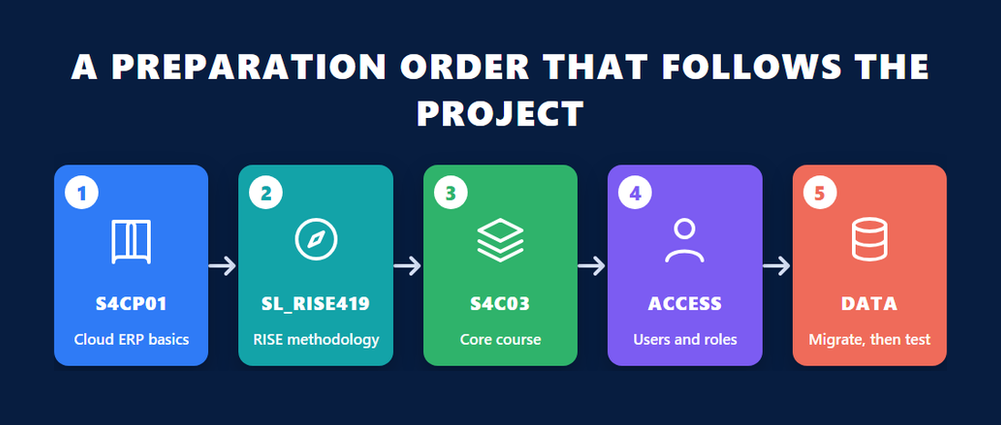
Prepare for E_S4CPE by following SAP’s learning journey in order and pairing every course with hands-on work in a system. The journey has three courses, S4CP01, SL_RISE419 and S4C03, and ERPPrep suggests two to three months of preparation alongside a job, with extra time for the hands-on repetition a System-Based Assessment needs.
SAP’s private edition learning journey, Implementing SAP S/4HANA Cloud Private Edition, lists one prerequisite, Getting Started with Support from SAP, the support accreditation. It also names the related products it touches: S/4HANA SCM Cloud edition and SAP Preferred Success for SAP S/4HANA Cloud, private edition.
A preparation order that follows the project
- Start with S4CP01, Exploring SAP Cloud ERP, to build the picture of deployment options, the cloud mindset, clean core and SAP Activate.
- Take SL_RISE419 for the RISE with SAP methodology, its phases and its toolchain.
- Work through S4C03, Implementing SAP S/4HANA Cloud Private Edition, as the core course on setup, users, configuration, extensibility, integration, migration and testing.
- Rehearse user creation, role assignment and launchpad content in the practice system until each step is automatic.
- Run a data migration end to end, then build and run a test plan in SAP Cloud ALM against the migrated data.
- Finish with full timed scenarios that chain setup, configuration, migration and testing together.
Steps four and five carry the weight. They match the two SAP topics that each count for 31 to 40 percent, so time spent there pays back directly. Steps one to three give you the context that keeps those tasks from going wrong.
If you want an earlier view of the same credential, ERPQnA’s private edition preparation guide covers the exam as it stood in 2024. Read it for background on SAP Activate, and take the current format and pass score from SAP’s certification page.
Is E_S4CPE_2405 Still the Exam to Study For?
No. E_S4CPE_2405 is the older, release-stamped code, and SAP’s certification page now lists the exam simply as E_S4CPE, delivered as one System-Based Assessment. Material written for the 2405 code can still help with concepts, but its format, structure and any numbers it gives should not be trusted for the current exam.
Searches for the 2405 code are still common, which suggests many candidates are working from older material. The safe rule is to treat anything that describes a set of separate items, a question count or a different pass mark as out of date, and to check every fact against SAP’s page. ERPQnA’s earlier E_S4CPE_2405 article is useful as a record of how the exam used to work, not as a guide to how it works now.
Who Should Sit E_S4CPE, and Where Does It Lead?
E_S4CPE suits implementation consultants and project team members who deploy or support SAP S/4HANA Cloud Private Edition and want proof that they can execute delivery tasks in a live system. It fits people moving into a private edition delivery role as well as experienced consultants who want to formalise skills they already use on RISE with SAP projects.
Because the credential certifies the project rather than a module, it pairs naturally with a functional credential. ERPPrep lists four related exams next to it:
- C_TS4FI, financial accounting in the private edition, for consultants who configure finance after the system is set up.
- C_TS452, sourcing and procurement in the private edition, for the purchasing side.
- E_S4CON, the conversion and upgrade credential, for the technical side of the conversion path.
- C_S4CPR, sourcing and procurement in the public edition, for consultants who work across both editions.
A sensible route is E_S4CPE first, to prove you can run the implementation, then one functional credential in the area you configure most.
Frequently Asked Questions
What is the passing score for E_S4CPE?
The passing score for E_S4CPE is 82 percent. SAP displays it on the certification page and ERPPrep gives the same figure, noting that it is well above the 60 percent many SAP certifications use.
How long is the E_S4CPE exam?
SAP displays the duration of the E_S4CPE System-Based Assessment as three hours for its single activity.
How many questions are on E_S4CPE?
E_S4CPE has no question count. It is one System-Based Assessment activity in which you complete implementation tasks in a configured SAP system.
Which topics carry the most weight on E_S4CPE?
Migrating Data and Creating Users and Defining Authorizations carry 31 to 40 percent each. Enterprise Structure Configuration carries 11 to 20 percent.
Is E_S4CPE available in languages other than English?
No. SAP’s certification page shows the exam as available in English, and ERPPrep lists English as the only language.
Does E_S4CPE cover system conversion as well as new implementation?
Yes. The scope covers both paths: building a new system from fit-to-standard workshops, and preparing a system for conversion and then reassessing existing processes and customisations.
Is there a prerequisite for the E_S4CPE learning journey?
The learning journey lists Getting Started with Support from SAP, the support accreditation, as its prerequisite. SAP displays no prerequisite certification for the exam itself.
How long should I prepare for E_S4CPE?
ERPPrep suggests two to three months alongside a job. Candidates with private edition project experience can often move faster, while newcomers should allow more time for hands-on repetition.
Should I study E_S4CPE_2405 material?
Use it for concepts only. The current exam is listed as E_S4CPE and runs as one System-Based Assessment, so take the format and pass score from SAP’s certification page.
Conclusion
E_S4CPE certifies the private edition implementation consultant who can run a delivery, not the specialist in one module. Its three hour System-Based Assessment asks you to work in a real system, and its 82 percent pass score leaves little room for half-finished tasks. SAP’s own weighting tells you where to practise: data migration and users with authorizations count for 31 to 40 percent each, with enterprise structure behind them. Learn the whole lifecycle from the three-course journey, rehearse both the conversion and the new implementation path, and spend most of your hands-on time getting people and records into the system correctly. Then take the format and the numbers from SAP’s certification page on the day you book, and book when the tasks feel routine.


